
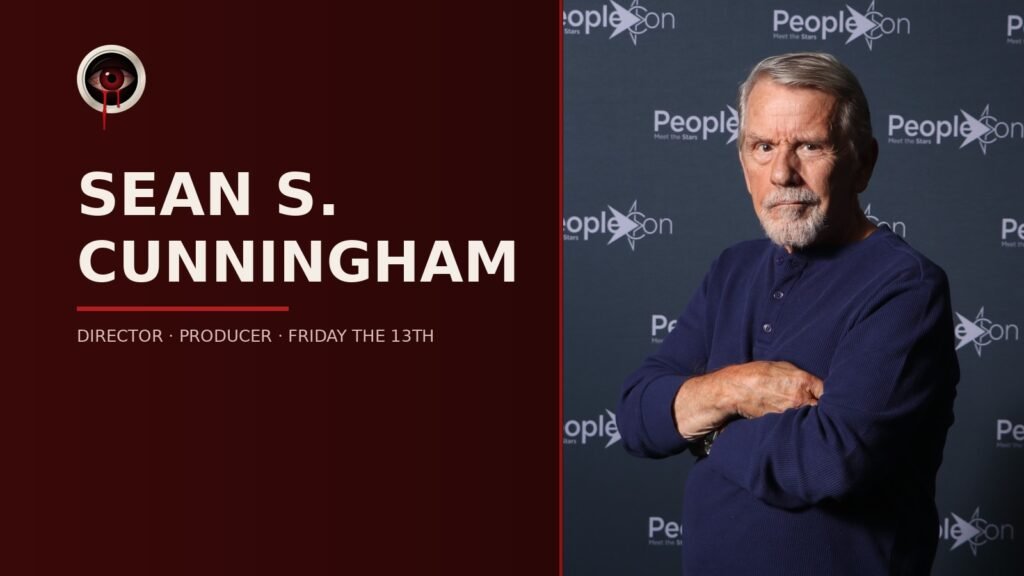
Sean S. Cunningham (born 1941) is an American director-producer: he directed Friday the 13th (1980) and produced Craven’s The Last House on the Left.
Here is the strange shape of Sean S. Cunningham’s career: he built one of horror’s most durable franchises, and its most famous figure is mostly not his work. The title was his. The camp was his. The company that kept the whole thing alive for four decades was his. But the killer in his film is a grieving mother, the hockey mask arrived two sequels after he walked away, and the grown-up Jason belongs to other men’s movies. Cunningham is a producer first and a director second — a showman who treated horror as a business of saleable titles, trusted crews and finished films sold up the chain — and the record, told precisely, is more interesting than the myth.
Quick Specs
Born: December 31, 1941, New York City (full name Sean Sexton Cunningham)
Education: B.A., Franklin & Marshall College; M.F.A. in film and drama, Stanford University
Known for: directing and producing Friday the 13th (1980); producing The Last House on the Left (1972) and House (1985)
Companies: Sean S. Cunningham Films, Ltd. (founded 1971); Crystal Lake Entertainment
Guild: Directors Guild of America
Honour: Time Machine Award, Sitges Film Festival, 2025
A Theatre Man First
Cunningham was born in New York City on the last day of 1941 and raised in Connecticut. He did not come up through film sets; he came up through the theatre. After a B.A. from Franklin & Marshall College and an M.F.A. in film and drama from Stanford, he worked in theatre management — including New York’s Lincoln Center, the Mineola Theater on Long Island, and the Oregon Shakespeare Festival — and worked as a stage manager and actor along the way. The training matters to everything after: the man who would later run the Friday the 13th franchise learned his trade putting on shows with other people’s money, on deadline, for paying audiences.
The Exploitation School
Film came through a New York documentary company in the late 1960s, where Cunningham also produced documentary and industrial work and commercials. His directorial debut, The Art of Marriage (1970), was a “white-coater” — a sex-education picture fronted by a medical authority, the era’s legal route to sexploitation material — and he followed it with Together (1971), a better-funded pass at the same formula. The films are footnotes; what they taught him is the career. A saleable subject, made cheap and fast, sold on its title and its taboo: that method never left his work, it just changed genres.
Together also gave him his most important collaborator. Hallmark Releasing had bought the film, and on a reshoot Cunningham put a broke young post-production hand named Wes Craven to work synchronising dailies, then editing alongside him. The two became close friends. When Hallmark offered the pair a bigger budget for a horror film, the split of labour set the pattern for both men’s legends: Craven would write and direct; Cunningham would produce.
The Last House on the Left
The result was The Last House on the Left (1972), Craven’s directorial debut and one of exploitation cinema’s founding shocks — a rape-revenge story Craven derived from Bergman’s The Virgin Spring. Cunningham’s name sits in the producer’s credit, and it belongs there: he was the money-and-logistics half of the partnership, the one who got a first-time director’s uncompromising script made and released. The rest of the decade ran on the same rails — the same Boston financiers, trading as Hallmark Releasing and then Georgetown Productions, the same lieutenant in Steve Miner, and Cunningham directing cheap, quick pictures of his own: Case of the Full Moon Murders (1973/74) and the youth films Here Come the Tigers and Manny’s Orphans, both 1978. It was an apparatus waiting for the right title.
Friday the 13th
The title was Cunningham’s, and the famous story of it needs telling the way the record supports. He had Friday the 13th — the date, the dread, the marquee value — before he had a finished film to hang on it, and he set out deliberately to build the kind of picture John Carpenter’s Halloween had just proven could work: visceral, shocking, a roller-coaster ride that made audiences jump out of their seats, the opposite of Last House‘s grimness. He hired Victor Miller to write it, and Miller was already drafting — under the working title Long Night at Camp Blood — when Cunningham and Miner took out a Variety advertisement on July 4, 1979, announcing the title to the industry, partly to test whether anyone else held a claim to it. Cunningham’s own later telling shrinks the timeline to nothing — no script, no idea, no money — but Miller’s account and the draft chronology are clear that the screenplay was well underway. The ad was a showman’s probe and a rights check, not a conjuring trick.
The production ran on the old Georgetown apparatus: shooting began September 10, 1979, in western New Jersey, with Camp No-Be-Bo-Sco, a working Boy Scout camp near Blairstown, standing in for Camp Crystal Lake. Tom Savini did the special makeup effects, assisted by Taso Stavrakis; the credits themselves show the shop’s shape — Miner as associate producer and unit production manager, Susan E. Cunningham as associate editor. Harry Manfredini wrote the score and built its deathless motif — “ki ki ki, ma ma ma,” in Manfredini’s own account distilled from Mrs. Voorhees’s line “Kill her, mommy!” and designed to announce a killer the film keeps unseen until the final reel. The cast was New York unknowns — an early Kevin Bacon among them — around one established name: Betsy Palmer as Pamela Voorhees. In Palmer’s own oft-told account she took the part because she needed a new car, at a thousand dollars a day for ten days’ work, having thought little of the script; the film only needs her to be unforgettable, and she is. And the point the whole franchise’s marketing works to blur: the killer of Friday the 13th (1980) is Pamela — a mother avenging her son Jason, who drowned in 1957 while counsellors neglected him. Jason himself appears only in the closing nightmare, a drowned child rising from the lake, after which Alice is told the boy was never found.
The money, honestly stated, comes in ranges, because the record does: the budget is reported between $550,000 and $650,000; Paramount’s purchase of the finished film is reported at both $1.2 million and $1.5 million; the domestic gross was roughly $40 million on contemporary reporting, with modern totals putting the worldwide figure near $59.8 million. What is not in dispute is the shape of it: a sub-$650,000 independent film, released by Paramount on May 9, 1980 — in the standard account, the first independent production of its kind to land U.S. distribution from a major studio — becoming one of the most profitable pictures of its era and proving the slasher was a repeatable business. The decade of slashers followed from that proof.
The Sequel He Walked Away From
Cunningham did not direct another Friday the 13th. His preference for the series was an anthology — new films trading on the date, unrelated stories — but producer Phil Scuderi and Paramount wanted the Crystal Lake story continued, and Friday the 13th Part 2 (1981), directed by Steve Miner, made Jason the killer; the hockey mask arrived a film later, in Part III. The franchise’s defining invention, in other words, was a sequel decision Cunningham opposed and had no hand in directing. His own 1980s directing run went elsewhere: A Stranger Is Watching (1982), from Mary Higgins Clark’s novel, the teen comedy Spring Break (1983), The New Kids (1985), and the underwater creature feature DeepStar Six (1989), one of that year’s three competing underwater films.
The Producer’s Second Act
Producing was always the deeper trade, and in 1985 it gave him a second franchise: House, directed by Miner from Ethan Wiley’s screenplay, with Cunningham producing and Manfredini scoring — the old repertory reassembled for a horror-comedy that became a financial success and a series, with Cunningham producing House II: The Second Story (1987) and House IV (1992) as well — while The Horror Show (1989), which he also produced, was marketed as a House sequel in some territories without being one in story. His directing thinned to a single later credit, XCU: Extreme Close Up (2001). Then the franchise he had left came back around. As the Friday rights passed from Paramount toward New Line, Cunningham returned as producer of Jason Goes to Hell: The Final Friday (1993), a film built to open the door to the Freddy Krueger crossover — its final shot, Freddy’s glove dragging Jason’s mask underground, says exactly that. He was executive producer of Jason X (2001), the hands-on producing passed to his son Noel — in the production accounts, a stand-alone Jason film set far in the future, authorised to keep the character in front of the public while the crossover stalled, without tangling its continuity — and then, at last, producer of Freddy vs. Jason (2003), the crossover he had pursued since the late 1980s, directed by Ronny Yu for New Line and his own Crystal Lake Entertainment — the franchise’s biggest hit of its era. He produced the 2009 Friday the 13th reboot as well. The full count, unpacked: of the twelve Friday the 13th films, Cunningham has a verified credit on five — one as director. Any filmography giving him more has absorbed fan-wiki inflation.
The Lawsuit
The franchise’s modern paralysis has a case name: Horror Inc. v. Miller. In 2016 Victor Miller moved to reclaim his rights in the 1980 screenplay under the Copyright Act’s termination provision, and Cunningham’s companies — Horror Inc. and the Manny Company; Cunningham personally was not the named plaintiff — sued. The question was employment: if Miller had written the screenplay as an employee, it was a work made for hire and there was nothing to terminate. The courts held otherwise — the District of Connecticut in 2018, affirmed by the Second Circuit on September 30, 2021: Miller had written as an independent contractor, the screenplay was not a work made for hire, and his termination was effective for the U.S. rights in the original screenplay. What the ruling did not do is just as often misstated: it did not hand Miller the franchise. The sequel-derived elements and the international rights remained on Cunningham’s side — including the adult, hockey-masked Jason, who was created in sequels Miller never wrote. The case is now a standard citation in copyright teaching, and no honest account of Cunningham’s career can skip it: the owner-operator habit that built the franchise also produced the lawsuit that froze it.
Why He Matters
Cunningham is one of modern horror’s founding producers in the literal sense: he put Wes Craven behind a camera for the first time, and he made the film that converted Halloween‘s breakthrough into an industry. But the precise record is the respectful one. He did not create the hockey-masked Jason, and he did not write Friday the 13th — Victor Miller did. What Cunningham created was the property: the title, the camp, the sale to Paramount, and the companies that carried it through sequels, a crossover, a reboot and a landmark lawsuit. In 2025, forty-five years after the film, the Sitges Film Festival gave him its Time Machine Award — an honour for the father of Friday the 13th. Father of the franchise is exactly right. It is the mask that has other parents.