
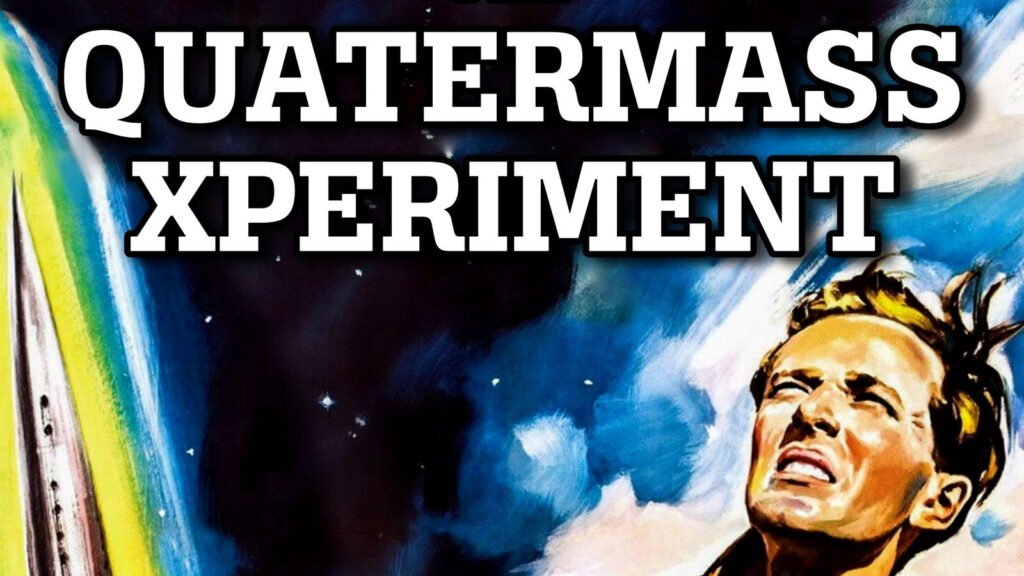
The Quatermass Xperiment is Hammer’s 1955 science-fiction horror film, adapted from Nigel Kneale’s BBC serial, in which a returned astronaut slowly becomes something else.
Three men rode the rocket up. One came back down — and the only words left in him were “Help me.” What rode back down with him is the reason we are still talking about this film seventy years later. Before the gowns, the castles and the colour, before Hammer was a byword for horror at all, there was a black-and-white rocket picture shot like a newsreel — and it changed the studio’s future.
Quick Specs
Director: Val Guest
Screenplay: Richard Landau and Val Guest, from the BBC Television serial by Nigel Kneale
Producer: Anthony Hinds
Starring: Brian Donlevy, Richard Wordsworth, Jack Warner, Margia Dean, David King-Wood, Thora Hird
Studio: Hammer Film Productions
Released: 26 August 1955 (UK première)
Runtime: 82 minutes (UK version)
Certificate: ‘X’ (BBFC)
US title: The Creeping Unknown
The night television emptied the pubs
It began as television — and not just any television. The Quatermass Experiment, six half-hour episodes written by Nigel Kneale and broadcast live by the BBC in July and August 1953, was the first adult science-fiction production on British television, and it landed like a thunderclap. Film historian Robert Simpson called it “event television, emptying the streets and pubs.” Only the first two episodes were telerecorded and survive; the rest went out live and are gone, which somehow suits a story about things that come back changed.
Hammer producer Anthony Hinds was watching. The studio inquired about the film rights on 24 August 1953 — two days after the final episode aired — and bought them from the BBC for a £500 advance. Because Kneale was a BBC staff writer, the Corporation owned his scripts outright, and he received nothing from the sale. Remember that. It is the first note in a grievance he would carry for decades.
The adaptation — and the missing E
Here is the first thing to get right, because everyone gets it wrong: the spelling is deliberate. The serial is The Quatermass Experiment, with the E. The film is The Quatermass Xperiment, without it — Hammer dropped the letter to wave the BBFC ‘X’ certificate in the audience’s face before they’d bought a ticket. That X, under the 1951 rules, simply barred under-16s. It was not an adults-only stamp and certainly nothing grubbier; it was forbidden-fruit marketing, and Hammer courted it from the outset while other studios were still nervous of it. Distributor Exclusive Films sold the certificate to exhibitors with the line “X is not an unknown quantity,” urging them to “Xploit the Xcitement.”
Kneale did not write this film. He was still under contract to the BBC and did not participate — much to his lasting chagrin. The screenplay is by Richard Landau and Val Guest. Landau’s first draft condensed roughly three hours of serial into an 82-minute feature and played up the horror; Guest then revised heavily, cutting some 30 pages, restoring Quatermass’s professorship, and tailoring the dialogue to his star’s brusque delivery. The television version’s first half hour is covered in about two minutes of film.
The rewrite reached into the details. Television’s British Experimental Rocket Group became the film’s British-American Rocket Group, a transatlantic name for a transatlantic production. Judith Carroon, a senior member of the Rocket Group in the serial, was reduced to the astronaut’s anxious wife. And most consequentially, the ending changed: on television, Quatermass appeals to the residual humanity of the absorbed astronauts and induces the creature to destroy itself. The film drops the absorbed-minds material entirely and simply electrocutes its monster. Kneale was, in the record’s own words, “particularly aggravated” by the loss of that material — and the ending was only one item on his list.
The rocket comes home wrong
The British-American Rocket Group, headed by Professor Bernard Quatermass, launches its first crewed rocket. Contact is lost. The rocket returns and crashes into an English field — and of the three-man crew, only Victor Carroon is found alive inside, in shock, able only to say “Help me.” The other two men’s fastened spacesuits are empty.
Under Dr Briscoe’s care, Carroon stays mute and immobile while his bone structure visibly changes. Inspector Lomax of Scotland Yard, investigating the disappearance, finds that Carroon’s fingerprints are no longer human. Film recovered from the rocket’s camera shows the crew reacting to something invisible entering the cabin and collapsing one by one. An alien life form got aboard, dissolved the other two men, and took over Carroon — and it is remaking him.
Judith, despairing of Briscoe’s care, hires a private investigator, Christie, to break her husband out of hospital. Carroon fuses a smashed cactus to his flesh, kills Christie in the lift and absorbs his life force, leaving a shrivelled husk; Judith sees what he is becoming and is left traumatised but unharmed. On the run, he kills a chemist for chemicals to speed the change, hides on a river barge, spares a little girl he encounters, and spends a night in the zoo absorbing the animals. Quatermass concludes that the organism, once fully transformed, will release reproduction spores and endanger the planet. The thing is tracked to Westminster Abbey, up a scaffolding tower — a mass of animal and plant tissue with tentacle-like fronds full of spores — and Quatermass has London’s power output combined and diverted into the scaffolding. The creature is electrocuted before it can spore. Quatermass walks out past the questions — “I’m going to start again” — and a second rocket roars into space.
The man with one line
The film belongs to Richard Wordsworth, and he barely speaks in it. As Victor Carroon he gives an essentially nonverbal performance — his only line is “Help me” — while Phil Leakey’s makeup and Walter J. Harvey’s lighting hollow out his face. Pitiful rather than ugly was the agreed aim, and it works: this is a man being evicted from his own body, and he knows it. John Brosnan wrote that “not since Boris Karloff as Frankenstein’s monster has an actor managed to create such a memorable, and sympathetic, monster out of mime alone.” Wordsworth was the poet William Wordsworth’s great-great-grandson — a real descent, not a stage name — and he was 40 years old at the première. Even Kneale, who praised almost nothing about this production, praised him.
Brian Donlevy, as Quatermass, is the film’s other argument. An American import supplied by co-producer Robert L. Lippert to interest US audiences, Donlevy was 54 at the première and carried an Academy Award nomination for Beau Geste (1939). He plays the professor as a blunt instrument — all forward motion, no bedside manner. Kneale hated it. He said Donlevy “played him as a mechanic,” against his conception of Bernard — named for astronomer Bernard Lovell — as “pioneer, ultimate questing man.” In a 1986 interview he went further: Donlevy “was then really on the skids and didn’t care what he was doing… It was a case of take the money and run. Or in the case of Mr Donlevy, waddle.” The role had been created on television by Reginald Tate; Donlevy remains the only actor ever to play Quatermass in two films.
Around them, a cast worth pausing on: Jack Warner as Inspector Lomax, who came straight off this film into the role he would play for two decades, the title constable of TV’s Dixon of Dock Green; Margia Dean as Judith; Thora Hird as Rosie Wrigley; Lionel Jeffries as a Ministry official; Gordon Jackson as a BBC TV producer; and, uncredited, a young Jane Asher as the little girl Carroon encounters — and spares — on the run.
Shot like science fact
Principal photography began on 12 October 1954 with a night shoot at Chessington Zoo, continuing from 18 October into December at Hammer’s Bray Studios. Guest shot the fantastic as if it were fact: a cinéma-vérité approach, hand-held camera, overlapping rapid-fire dialogue — as though a camera crew had simply been standing there when the impossible happened. It is why the film still feels modern when so many of its contemporaries feel embalmed.
The crash site was a cornfield at Water Oakley, near Bray, with emergency vehicles racing through Bray village itself; further location work took the production around Windsor and into the London docklands. Westminster Abbey refused permission to film, so the Abbey interiors were built on Bray’s New Stage, and Les Bowie’s effects team built the climactic creature from tripe and rubber, shot against a model Abbey. James Bernard, brought in after the original composer John Hotchkis fell ill, wrote about 20 minutes of score built on a rising-and-falling three-note semitone figure for strings and percussion. It was his first score for Hammer. It would not be his last — it began his run as the studio’s house composer.
Release, notices, and the money nobody can agree on
The BBFC classified the film ‘X’ on 3 June 1955, and it premièred on 26 August 1955 at the London Pavilion, Piccadilly Circus, with a UK general release following on 20 November. America had to wait until June 1956, and got it under a different name — The Creeping Unknown, after Lippert first tried to sell it as Shock! — in a version cut by four minutes, to 78. If you have ever seen the running time listed flatly as 78 minutes, you have seen the American cut mistaken for the whole film. In some areas, local Watch Committees demanded cuts of their own — mainly close-ups of Carroon’s victims — before allowing it to be shown at all.
How much did it cost? Honestly: nobody can hand you one clean figure, and any page that does is tidier than the record. Two numbers circulate from two distinct sources — £42,000, from a modern study of Hammer’s contracts and the film’s own production histories, and $140,000, reported by the trade press in 1957 — and at period exchange rates they do not reconcile. No verified box-office gross survives either. What is verified, and two-sourced, is the shape of it: a major success in the UK and a hit on both sides of the Atlantic.
The notices were the kind publicists dream about. Paul Dehn, in the News Chronicle: “This is the best and nastiest horror film I have seen since the War. How jolly that it is also British!” Dilys Powell called it “exciting but distinctly nauseating,” and William Whitebait ranked it “better than either War of the Worlds or Them!” The trade press at home praised Guest’s handling of the thrills, and in America, Variety found that “Val Guest’s direction brings out the maximum suspense factors.” There was dissent — Frank Jackson dismissed it as “82 minutes of sick-making twaddle,” and François Truffaut waved it away as “very, very bad” — but dissent at this volume is itself a sign a film has gotten under the skin.
Its modern standing has only hardened. BFI Screenonline calls it “one of the high points of British SF/horror cinema,” Stephen King placed it among his favourite horror films of 1950–1980 in Danse Macabre, and John Carpenter has said it “had an enormous, enormous impact on me.” On Rotten Tomatoes it currently stands at 91% from 22 reviews. Not bad for a film with a missing letter.
The film that turned Hammer toward the dark
Here is the claim, and it is verified from several directions at once: this is the film that put Hammer on the map. Michael Carreras, from inside the studio, said it plainly: “The film that must take all the credit for the whole Hammer series of horror films was really The Quatermass Xperiment.” Its success rescued Hammer from a run of lacklustre comedies and pivoted the studio toward the fantastic. What followed was the colour Gothic cycle, beginning with The Curse of Frankenstein in 1957 and Dracula the year after — but discipline matters: this film is not one of those. It is a black-and-white science-fiction horror picture, and it came first.
The lineage ran on. Quatermass 2 followed in 1957, Guest directing and Donlevy back, with Kneale himself this time writing the screenplay from his second serial. A decade later came Quatermass and the Pit (1967), directed by Roy Ward Baker with Andrew Keir as Quatermass. In between, Hammer made X the Unknown (1956) in the Xperiment mould after Kneale refused them the character — it has no Quatermass in it and is not a sequel, whatever the listings imply. The film itself has kept returning: a UK DVD in 2003, an American Blu-ray in 2014, and a deluxe 4K edition from Hammer for its 70th anniversary in 2025.
Seventy years on, the Xperiment still works for the simplest of reasons: it never winks. A rocket comes home wrong, a good man dissolves into something with spores, and the only man who understands it is too brusque to comfort anyone about it. Hammer would get louder, redder and grander. It started here — with a missing E, a courted X, and two words from a man who used to be Victor Carroon: help me.