
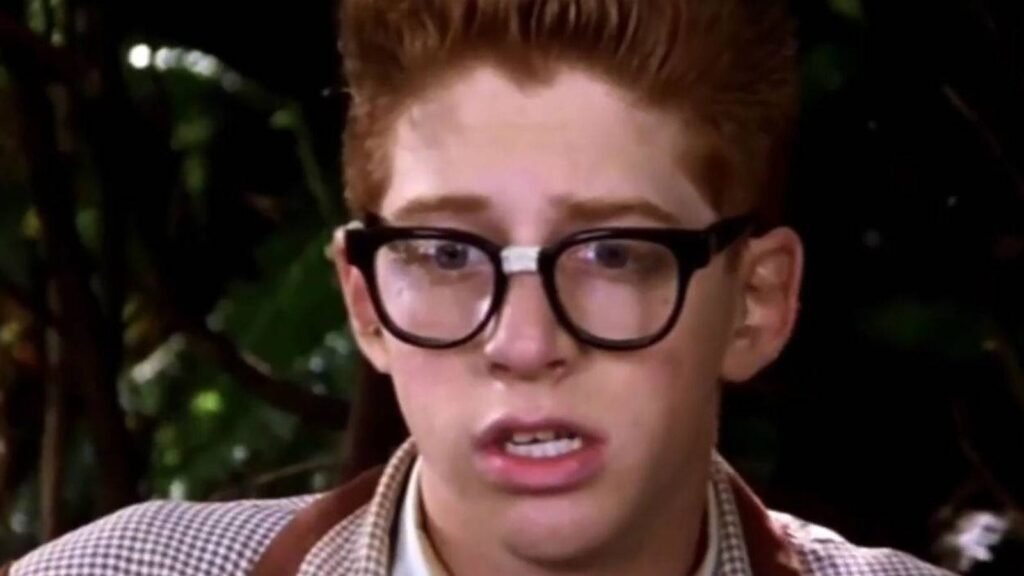
Seth Green is the former child actor who played young Richie Tozier in Stephen King’s It and grew up to co-create Robot Chicken. Sit with the shape of that career for a second. Most child actors who face down an iconic monster at sixteen either ride the one role forever or vanish. Green did neither. He became a werewolf on Buffy, a supervillain’s disappointed son, the voice of a cartoon teenager for a quarter-century and counting — and then, in his thirties, he built the stop-motion empire that let him play with the toys professionally. The kid who joked at the clown turned out to be playing the long game.
Quick Specs
- Born: February 8, 1974, Overbrook Park, Philadelphia, Pennsylvania
- Birth name: Seth Benjamin Gesshel-Green (later legally changed to Seth Benjamin Green)
- Occupations: Actor, screenwriter, director, producer
- Known for: Young Richie Tozier in Stephen King’s It (1990); Oz on Buffy the Vampire Slayer; Scott Evil in the Austin Powers films; the voice of Chris Griffin on Family Guy; co-creator of Robot Chicken
- Spouse: Clare Grant (married May 1, 2010)
The Kid from Overbrook Park
Seth Benjamin Gesshel-Green was born on February 8, 1974, in Overbrook Park, Philadelphia, and later legally shortened the name the industry would know him by. His father, Herbert “Herb” Green, taught mathematics; his mother, Barbara, was an artist; he grew up with an older sister, Kaela. A math teacher and an artist — you could do worse as an origin story for a man who would spend his adult life counting frames of stop-motion.
Ask the reference books when he started acting and they argue with each other: a summer-camp production of Hello, Dolly! is credited with catching him at six in some bios, his own site’s bio says he began in the business at seven, and the first film assignment lands at eight in the same telling. Nobody’s version is two-sourced against the others, so this page prints the work and skips the birthday. The work starts fast either way.
His film debut was The Hotel New Hampshire (1984), playing “Egg” Berry alongside Jodie Foster and Rob Lowe, with Billions for Boris the same year, as Benjamin “Ape-Face” Andrews. Two features in one year — he was nine, then ten, across 1984. Whatever age the business got him, it kept him.
Radio Days and the Working Kid
The credit that announced him properly was Woody Allen’s Radio Days (1987), where Green played Joe — the boy at the centre of Allen’s nostalgia film, the young alter ego of the narrator. Allen did not hand that part to amateurs. The same year he was Chuckie Miller, the little brother of Patrick Dempsey’s character, in Can’t Buy Me Love (1987).
Then the steady child-actor grind that separates the professionals from the dabblers: Big Business (1988) as Jason; My Stepmother Is an Alien (1988) as Fred Glass — a film that also featured Alyson Hannigan, who would matter to his career a decade later in a way neither of them could have known; and Pump Up the Volume (1990) as Joey. By 1990 he was a veteran of six years of sets. He was about to need every bit of that professionalism, because the next job involved a clown.
Beep Beep, Richie: Young Richie Tozier
Stephen King’s It was a two-part ABC miniseries directed by Tommy Lee Wallace, from King’s 1986 novel, aired November 18 and 20, 1990. Green plays young Richie Tozier — the Losers Club‘s comic relief, the kid in 1960s Derry doing impressions of real-life figures while a thing in the sewers wears a clown’s face. The adult Richie, a late-night talk show host, is Harry Anderson. Keep those two straight, because the whole performance depends on the split: Anderson is the man Richie became; Green is the boy who survived becoming him.
And here is the detail the trivia pages keep fumbling: Richie is twelve in the story. Green was not. Born in February 1974, he was sixteen when the miniseries filmed over three months in Vancouver in mid-1990, and sixteen when it aired that November — a sixteen-year-old playing twelve, which is simply how television casting works, however often the internet prints the character’s age as the actor’s. Green and Jonathan Brandis, the young Bill, were cast out of Los Angeles, while several of the other young Losers — Emily Perkins and Marlon Taylor among them — were cast out of Vancouver.
The production was television spending movie money: a $12 million budget, double the usual television budget of the day. It paid off in reach — the miniseries was ABC’s biggest success of 1990, drawing some 30 million viewers across its two parts. Its Emmy went to composer Richard Bellis for his score, and that credit belongs to Bellis and the production, not to any cast member. What Green took from it was different: Wikipedia’s biography counts Richie Tozier among his first lead roles on television, and he returned to the material three decades later, appearing as himself in Pennywise: The Story of It (2021), the documentary about the miniseries’ production.
One fence to build before we leave Derry: Green’s Richie exists only in the 1990 miniseries. He has no role in the 2017 film or its 2019 sequel — those Richies belong to other actors, in another adaptation entirely. When somebody tells you Seth Green was in the It movies, they are collapsing thirty years into one sentence. Don’t let them.
Cha-Ching: The Commercial That Ate New Orleans
Television kept him close. In the ABC sitcom Good & Evil (1991) he played David across six episodes — counted, like Richie, among his first television leads — and won a Young Artist Award for it, for Outstanding Young Comedian in a Television Series. Wikipedia’s awards table also lists a 1989 Young Artist nomination for The Facts of Life; at least one other reference work reverses the two results, so the win for Good & Evil is the sentence to lean on.
Then came the strangest line on the résumé. In 1991 — 1991, whatever the fan trivia pages tell you — Green starred in a Rally’s Hamburgers commercial as a drive-through operator for a fictional chain called “Pricey’s,” whose “CHA-CHING” catchphrase escaped the ad entirely and became a New Orleans phenomenon during the Saints’ 1991 season. The team flew the seventeen-year-old Green in to perform it at halftime of the December 16, 1991 game against the Los Angeles Raiders, and he received a key to the city of New Orleans. A horror wiki is recording this because it is true, and because it is magnificent: before he was a werewolf, before he was Chris Griffin, Seth Green was a catchphrase with a key to a city.
Oz, Scott Evil, and the Nineties Run
The horror work did not stop at Derry. In Ticks (1993) — also released as Infested — he played Tyler Burns in a killer-tick horror film, the kind of picture this wiki exists to remember. Then the mainstream arrived in a Nehru jacket: Scott Evil, Dr. Evil’s son, across the Austin Powers trilogy — International Man of Mystery (1997), The Spy Who Shagged Me (1999) and Goldmember (2002) — the sullen kid in the room stealing scenes from inside a franchise built for somebody else’s catchphrases.
The role that made him a fan favourite for life, though, was quiet. On Buffy the Vampire Slayer (1997–2000), Green played Daniel “Oz” Osbourne as a main role: the calm, mild-mannered guitarist in the band Dingoes Ate My Baby, boyfriend of Willow Rosenberg — Alyson Hannigan, his My Stepmother Is an Alien castmate from 1988, the loop closing — who is turned into a werewolf. Oz said little and meant all of it, and the character became beloved out of all proportion to his dialogue. Green played him once more in the spinoff Angel (1999). And a credit-discipline note, because the error is out there: Green acted on Buffy; he directed none of it. He is not related to Bruce Seth Green, the television director who did direct Buffy episodes — the shared name has produced bad credits for years.
Around the series work, the film roles kept stacking: an uncredited turn as Selby in Enemy of the State (1998); Kenny Fisher in Can’t Hardly Wait (1998); and a proper horror-comedy lead as Mick in Idle Hands (1999). The child actor from Derry was now, unmistakably, a working adult actor with range. What nobody had priced in yet was the voice.
The Voice: Chris Griffin and the Booth Years
On January 31, 1999, Family Guy premiered, and Green’s second career started inside a recording booth. He voices Chris Griffin, the Griffins’ teenage son — and has done since the series’ inception — along with Neil Goldman. Build the fence here, too, because the shared first name causes real confusion: Family Guy was created by Seth MacFarlane. Green is its cast member, never its creator. Two Seths, one show, entirely different jobs.
The booth became a second filmography. Green took over as the voice of Leonardo in Teenage Mutant Ninja Turtles for seasons three through five (2014–2017). Gamers know him as Jeff “Joker” Moreau, the Normandy’s pilot, across the Mass Effect trilogy (2007–2012) — a performance carried almost entirely in a chair, all nerve and timing. And Marvel keeps him in a drawer marked “break glass”: he is the uncredited cameo voice of Howard the Duck in Guardians of the Galaxy (2014), returning for Vol. 2 (2017) and Vol. 3 (2023), plus the animated What If…? (2021–2024).
The live-action work continued alongside: Duane Cody in Rat Race (2001); Lyle, the computer specialist nicknamed “Napster,” in The Italian Job (2003); a non-comedic dramatic turn as James St. James in Party Monster (2003); Patrick Wisely in Scooby-Doo 2: Monsters Unleashed (2004); Dan Mott in Without a Paddle (2004). He married actress Clare Grant on May 1, 2010, in Northern California, after a New Year’s Eve 2009 engagement — a working partnership as much as a marriage, with the two collaborating repeatedly across his productions.
Robot Chicken and Stoopid Buddy
All of it, though, was the runway. On February 20, 2005, Robot Chicken premiered on Adult Swim: an adult stop-motion sketch parody series, co-created by Seth Green and Matthew Senreich — co-created, both names, always. Green is its co-creator and co-executive producer, a writer and director on it, and its most frequent voice. It is the show where the kid who grew up inside pop culture got to take pop culture apart with his hands.
The awards ledger needs the same care as everything else on this page. The series has stacked up 23 Emmy nominations and six wins across its run — eleven seasons, eleven specials and 220 episodes at its twentieth anniversary in February 2025. Green’s personal record on the show is three Primetime Emmy Awards, each as a winning executive producer on the Outstanding Short Form Animated Program wins in 2010, 2016 and 2018 — plus five Annie Awards. Anyone who tells you “Seth Green won six Emmys” is handing him the whole team’s shelf. Three of his own, as a producer, is the true sentence, and it needs no inflation.
In 2011 the operation got a studio: Stoopid Buddy Stoodios, formed by four founders — Green, Senreich, John Harvatine IV and Eric Towner — joining Green and Senreich’s Stoopid Monkey (founded 1999) with Buddy Systems Studios, headquartered in Burbank. It produces Robot Chicken and other stop-motion and animated series, including SuperMansion, Buddy Thunderstruck and M.O.D.O.K. The child actor had become the man who signs off on the factory.
The Director’s Chair
In 2019 Green completed the set: Changeland, his feature directorial debut, which he wrote, directed and starred in as Brandon, released June 7, 2019. Actor, screenwriter, director, producer — the occupations line in the reference books is not padding; he has now done every job on the call sheet at feature level.
Why does a horror wiki keep a full page on him? Because the through-line starts in Derry and never really leaves it. Seth Green’s career is the rebuttal to every story about child actors being used up by the genre. The sixteen-year-old who did impressions at a killer clown grew into the werewolf, the voice, the studio head — and when the documentary crew came calling about the miniseries thirty years on, he showed up as himself, happily. Beep beep, Richie. The kid won.