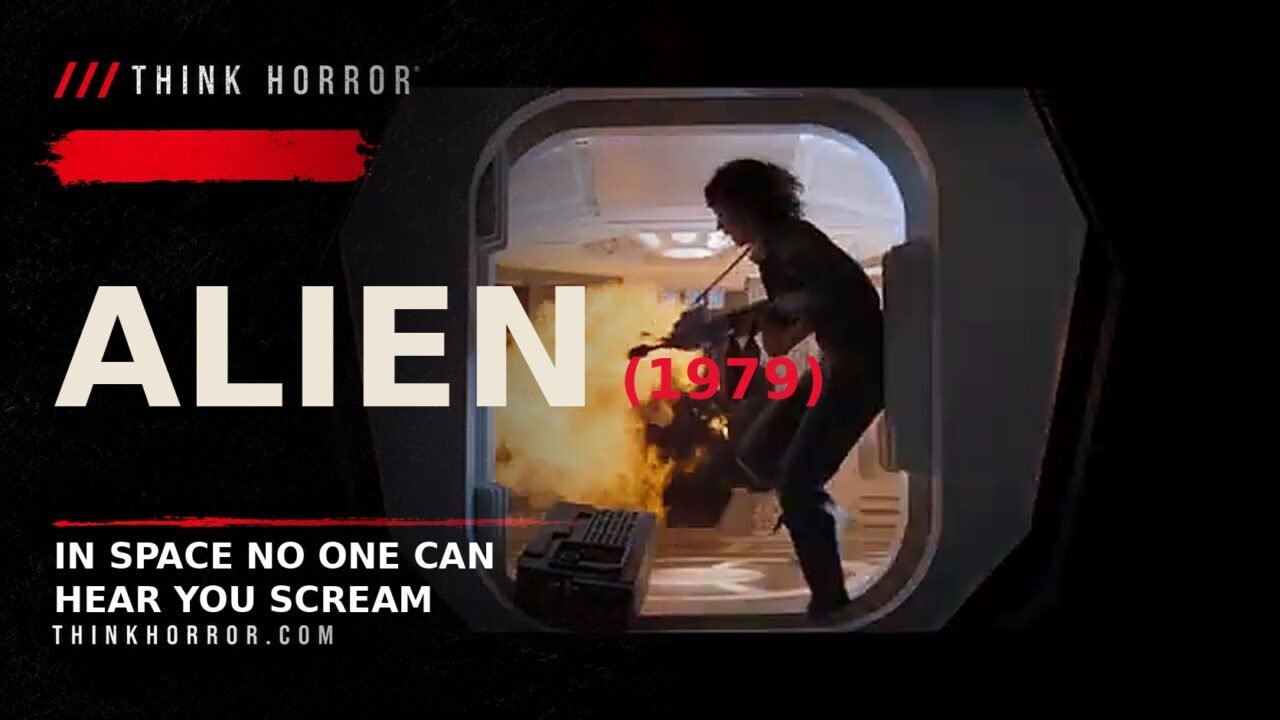
Alien is Ridley Scott’s haunted house in orbit: seven working stiffs, one stowaway, and nowhere to run.
Cold does it first. The Nostromo wakes her crew the way a freezer door opens — slowly. Seven people yawn, stretch, and complain about the pay, more than halfway home to Earth. Nothing in those first minutes frightens. Everything in them matters: within the hour, one of those people will be a doorway — and the thing that comes through him will spend the rest of the picture deciding which of the others is next.
Welcome back to the crypt. Tonight’s file is the picture that moved horror off the country road and into the machine shop, then locked the door. Our full file on Alien walks the whole case; the short version begins with a script that wouldn’t die. Dan O’Bannon’s unfinished draft was called Memory; rebuilt with Ronald Shusett, it worked under a title O’Bannon hated — Star Beast — until he renamed it for the word that kept surfacing in his own pages. 20th Century Fox bought it, Ridley Scott shot it, and H.R. Giger built its nightmares. Alien.
Watch the Trailer

Quick Specs
- Director: Ridley Scott
- Writer: Screenplay by Dan O’Bannon; story by Dan O’Bannon & Ronald Shusett
- Cast: Sigourney Weaver, Tom Skerritt, John Hurt, Ian Holm, Veronica Cartwright, Harry Dean Stanton, Yaphet Kotto
- Studio: Brandywine Productions
- Distributor: 20th Century Fox
- Release Date: May 25, 1979 (United States); premiered May 24, 1979 at the Seattle International Film Festival
- Runtime: 117 minutes
- Rating: R
- Budget: Roughly $11 million
- Box Office: $82.6 million (US gross, per Rotten Tomatoes)
The Review
The commercial towing vehicle Nostromo is hauling an ore refinery home when her computer — Mother — wakes the crew to answer a transmission from a dead moon. The crew are not explorers and nobody in this picture is a hero by job description: they are truckers, and their first conversation about the detour is about pay. Captain Dallas (Tom Skerritt, whose tribute file we keep here) leads them down to the surface, where executive officer Kane (John Hurt) finds a field of eggs in a derelict ship and leans over the wrong one. What happens on that moon has a long memory, and it is coming back up the ladder with them.
Scott shoots the Nostromo the way other directors shoot a gothic house: corridors that curve away into dark, rooms that hum and drip, ladders between floors of the same bad dream. But the house is also a workplace, greasy and lived-in, and that is the film’s deepest trick — it puts the genre’s oldest story inside the future’s dullest job. Warrant officer Ripley (Sigourney Weaver) refuses Kane entry under quarantine law and is overruled by science officer Ash (Ian Holm), a betrayal the film files away quietly and collects on later, with interest. Then Kane wakes up hungry. The crew sits down to one last meal together, laughing, eating, alive — and the picture performs the most famous act of violence in science fiction, at the dinner table, in the middle of a joke.
From there Alien becomes a siege with a shrinking map. The creature — designed by H.R. Giger, all bone and tubing and obscene elegance, worn by a 6-foot-10 Nigerian art student named Bolaji Badejo — is barely shown and therefore everywhere: in the ducts, in every hiss of steam the ship exhales. Engineer Brett (Harry Dean Stanton) goes looking for the ship’s cat and finds the adult thing waiting in the chains and rain of the landing-leg room. Lambert (Veronica Cartwright) and Parker (Yaphet Kotto) argue for abandoning ship and die gathering the supplies to do it. Ash comes apart — literally — and with him the film’s real revelation lands: the company knew. The crew was expendable. The monster aboard the Nostromo has a counterpart in a boardroom, and only one of them drools.
What Works
- The ship is the first monster. Before anything hatches, the Nostromo herself is doing horror’s work — a refinery the size of a cathedral towed behind a tug, corridors of pipe and condensation, a computer that answers questions like a priest. Scott’s grubby, secondhand future makes the impossible thing plausible: a world this worn-in can hide anything, and does.
- Giger’s creature rewired what a monster could be. No eyes. No expression to read. A silhouette like a pipe organ crossed with an insect, played by a man so tall and slender the shape never reads as a man in a suit. The film protects it the way Psycho protected its cellar — glimpses, tails, teeth inside teeth — so the audience’s imagination does the prosthetics. Our file on the Xenomorph traces the design from Giger’s paintings to this frame-by-frame withholding.
- The chestburster is the hinge of modern horror. A creature tearing out of a man’s chest at the dinner table, in one take, in front of a cast who knew something was coming but not what — only John Hurt knew the specifics, having spent the morning rigged with a false chest packed with butcher’s offal and high-pressure blood hoses, while four cameras waited to catch one unrehearsed take. Veronica Cartwright was told she’d catch “a little blood”; a jet caught her full in the face, and she passed out after the take. The scene would be unbearable played by actors who’d rehearsed it for a month. That they hadn’t makes it immortal.
- Ripley wins by procedure, and it rewired the genre. Weaver’s warrant officer is the film’s conscience from the start — the one who cites quarantine, who decodes the transmission as a warning, who reads Ash correctly before anyone. Her survival isn’t luck or destiny; it’s competence under terror, capped by a final confrontation in the shuttle Narcissus where she does everything right and it is still almost not enough. Horror had survivors before 1979. It hadn’t had this one.
What Doesn’t
- The middle hunt runs on rails for a stretch. Between the chestburster and the endgame, the crew’s search — motion trackers, nets, a plan to flush the thing through the air ducts — is more procedural than frightening, and the film briefly becomes a series of errands run in the dark. The duct sequence rescues the stretch, but the machinery shows: the one passage where the picture marks time before it’s allowed to be great again.
- Ash’s mechanics ask for a shrug. The reveal that Ash is an android is a career-best chill, and Ian Holm plays the aftermath superbly — but the scene that follows, with the crew interrogating his severed head on a tabletop, asks the audience to accept a great deal of wiring very quickly. It works on dread rather than logic. First-time viewers sometimes laugh at exactly the wrong moment; the film survives it, but the seam is there.
The ledger, this time, reads like a coronation delayed by one summer. Alien stands at 93% on Rotten Tomatoes with critics and 94% with audiences — the rare picture the two camps grade almost identically — and 89 out of 100 on Metacritic. It won the Academy Award for Best Visual Effects, three Saturn Awards (Best Science Fiction Film, Best Direction, and Best Supporting Actress for Cartwright), and the Hugo Award for Best Dramatic Presentation. Its American gross alone ran to $82.6 million on a budget of roughly $11 million — and its real gross is forty years of nightmares downstream, a franchise our franchise file tracks to Romulus.
Full disclosure, fiends, because Harper keeps an honest crypt: this is a desk verdict — built from the verified record, the awards shelf and the consensus, not a fresh team screening. Nobody on the Think Horror crew re-screened the film for this review, and we won’t pretend otherwise. Some pictures you re-judge. This one you check on, like a signal you already know is a warning.
Harper’s verdict: 5 ravens — Buried with honors.
Trivia & Facts
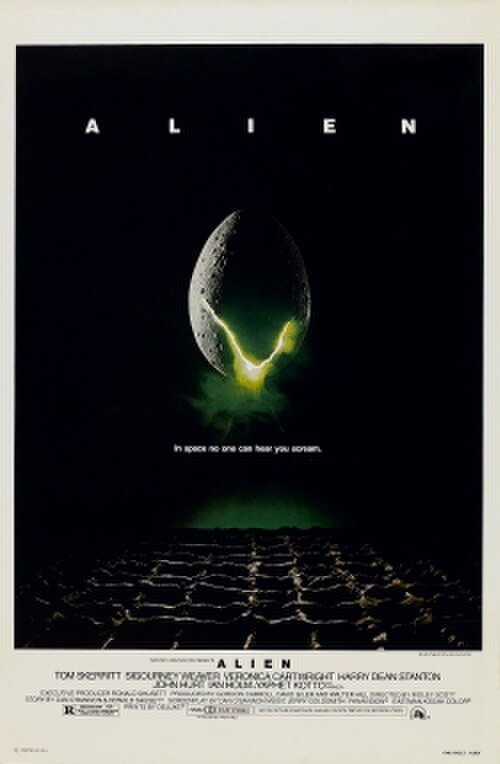
- The most famous sentence ever printed on a poster. “In space no one can hear you scream” was the film’s actual campaign line, written by copywriter Barbara Gips, whose husband Philip designed the poster — the cracked egg over the grid. The teaser campaign had run a colder line: “A word of warning…” The poster’s sentence outlived them both and became the genre’s epitaph.
- The monster was found in a pub. Bolaji Badejo was a Nigerian graphic-design student in London, 6 feet 10 inches tall, with no acting experience, when a member of Scott’s casting team spotted him in a Soho pub. Scott wanted a frame so long and slender it could never read as a man in a costume. Alien remains Badejo’s only film role.
- The cat had three understudies. Jones, the Nostromo’s ship cat — and, by any honest accounting, the crew member with the soundest survival instincts — was played by four identical ginger cats, each with its own specialty. The ship’s roster lists seven humans and one cat. Jones is the only other survivor. The cat negotiated better.
Harper’s Extras
- Alien — the full wiki file: the complete case file — production, release and legacy in crown-jewel depth.
- Xenomorph — the wiki file: the creature, from Giger’s sketchbook to the perfect organism.
- Aliens — the wiki file: Cameron takes the war back to LV-426, seven years later.
- Tom Skerritt — our tribute: Captain Dallas himself, first to the airlock of a bad decision.
- Crank it: Jerry Goldsmith’s score — that lonely, echoing main title, all distance and dread, before the orchestra starts to worry. Play it in a dark room with a machine humming somewhere. Mind the vents.
Where to Watch
As of November 6, 2026, it’s streaming on Netflix (including Netflix Standard with Ads) and fuboTV in the US; rent or buy it on Amazon Video, Apple TV Store or Fandango At Home.
Frequently Asked Questions
Is Alien a horror film or a science fiction film?
It’s a haunted-house picture that happens to be set on a spaceship. The science fiction supplies the house — the ship, the moon, the company — and the horror supplies everything that happens inside it: the locked doors, the shrinking cast, the thing in the walls. This desk counts it as horror, full stop. The genre argument has run nearly fifty years; the film keeps winning both sides of it.
Why is so little of the creature shown?
Because Ridley Scott trusted the arithmetic of dread: a monster fully seen is a monster measured, and a measured monster can be survived. Giger’s design is parceled out across the film — a tail, a jaw, a silhouette in the chains — so the finished creature exists mainly in the audience’s head. By the finale, when it is finally seen whole, we have been building it for two hours. It is exactly as big as we made it.
Who plays the alien?
Bolaji Badejo, a Nigerian graphic-design student discovered in a London pub, chosen for a 6-foot-10 frame so elongated the costume never reads as human. The performance is mostly stillness and slow, deliberate movement — and it is the reason the creature remains, nearly fifty years on, the standard every screen monster is measured against. It was his only film role.
Until next time, fiends — check the vents before you settle in, feed the cat, and if your employer ever marks you expendable on a bonus form, read the fine print twice. Harper will keep the airlock light on for you.
The weekly roundup
One letter a week, from the crypt.
- New reviews, with the ravens
- New wiki entries and news
- Cool stuff worth your night
Weekly. No spam, unsubscribe in one click.