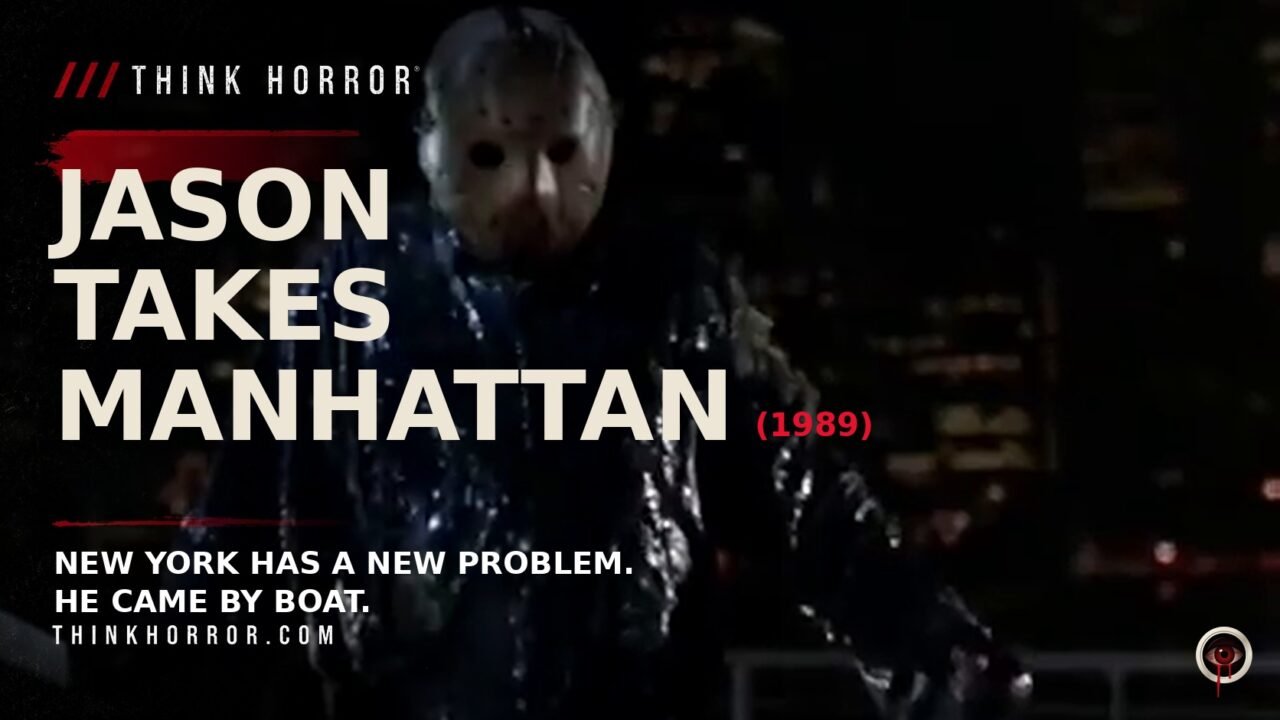
Friday the 13th Part VIII: Jason Takes Manhattan is the sequel that promised Jason in New York and delivered Jason on a boat.
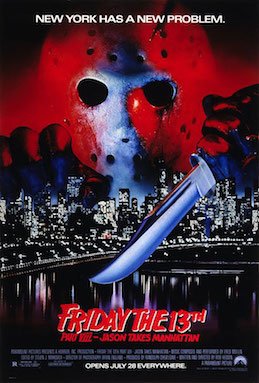
The promise came first, and it was magnificent. In the teaser, a lone figure stands at a railing above the Manhattan skyline while Sinatra croons the opening of “New York, New York” — and then the figure turns, and it’s Jason Voorhees, machete in hand, as the tagline lands: New York has a new problem. The poster did the same trick in one image: Jason slashing his knife straight through the “I Love New York” logo. It remains one of the great sales jobs in slasher history. Tonight’s file is about the film that sales job was attached to — a film in which Jason spends most of his running time on a graduation cruise, in alleys that are plainly Vancouver, and reaches the city of the title with roughly half an hour left on the clock.
Welcome back to the crypt. Friday the 13th Part VIII: Jason Takes Manhattan opened on July 28, 1989 — written and directed by Rob Hedden, in his feature debut, for Paramount Pictures. It was the eighth film in nine years, the most expensive the series had ever been, and the last one Paramount would release for twenty years. Everything about it says a franchise straining to reinvent itself. What it mostly proves is that a title is a promise, and promises, in this series, are made to be broken at sea.
Watch the Trailer

Quick Specs
- Director: Rob Hedden
- Writer: Rob Hedden; based on characters created by Victor Miller
- Cast: Jensen Daggett, Scott Reeves, Barbara Bingham, Peter Mark Richman, Kelly Hu, Kane Hodder
- Producer: Randolph Cheveldave
- Distributor: Paramount Pictures
- Release Date: July 28, 1989 (United States)
- Runtime: 100 minutes
- Rating: R
- Budget: Just over $5 million (the series’ most expensive to that point)
- Box Office: $14.3 million (US gross)
The Review
Jason is, as ever, at the bottom of Crystal Lake, where the last film’s heroine dragged him. A houseboat’s anchor snags an underwater cable, the cable shorts against him, and the current does what currents do in this series: it wakes him up. He takes a speargun and a fresh mask from the boat’s unlucky occupants, then stows away aboard the SS Lazarus, a cruise ship carrying the Lakeview High graduating class to New York. Among the passengers: Rennie Wickham (Jensen Daggett), a girl with a paralysing fear of water and recurring visions of a drowned child with Jason’s face, chaperoned by her uncle Charles (Peter Mark Richman), the biology teacher whose idea of curing her phobia, years earlier, was to push her into the lake.
What follows is a shipboard slasher of the standard pattern, executed at a strangely polished remove. Jason works the Lazarus deck by deck: the aspiring rocker J.J. meets her own electric guitar; a young boxer is finished in the sauna; Tamara, the class schemer, gets a shard of her own mirror; Eva is strangled on the disco floor. The kills are plentiful and oddly bloodless — this is the series at its most trimmed and television-slick — and the middle of the film settles into a holding pattern of corridors, cabins and visions while the audience waits for the destination on the poster. The Lazarus eventually sinks. A lifeboat rows into New York harbour. And with about a third of the film left, Jason Takes Manhattan finally, briefly, becomes the movie it advertised.
Let it be said plainly: those last thirty-odd minutes contain the film’s whole defence. Jason strides through a Times Square shot on location, past real crowds — during filming, Kane Hodder pointed at one watching fan between takes and she fainted on the spot. He ignores the street punks, kills two junkies who picked the wrong girl to rob, and then meets Julius, the young boxer, on a rooftop, in the single best scene Hedden ever shot: Julius gives Jason everything he has, punch after punch, until he is swinging on empty — and Jason takes his head off with one blow. It is funny, it is sad, and it is the only moment in the film where the premise — this unstoppable rural ghost loose in the biggest city on earth — is allowed to be itself. Then comes the subway, a third rail, and a finale in the sewers, where a flood of toxic waste washes over Jason and leaves behind the drowned child Rennie has been seeing all along: an ending so baffling it has been argued about, unresolved, for over thirty-five years.
The bones of a better film are visible throughout, because Hedden has described it himself. His original Manhattan was the full milk run: a scene on the Brooklyn Bridge, a boxing match in Madison Square Garden, Jason in the department stores, Jason in a Broadway play, Jason climbing the Statue of Liberty to dive off it. Paramount’s budget said no. The city shrank to a garnish, the ship — Hedden’s other concept, a claustrophobic Das Boot with a hockey mask — became the meal, and the title stayed behind like a tip the film couldn’t afford. As Adam Marcus, who directed the next film in the series, put it: “Jason is supposed to take Manhattan, and in fact, he spends most of his time on a boat.” Even Hedden, on his own commentary track, concedes that more of the film should have been set in New York, and cites the budget and the schedule. Critic Betsy Sherman said it in five words that have followed the film ever since: it should have been called Jason Takes a Cruise.
What Works
- The rooftop. Julius versus Jason is the finest scene in the series’ back half: a kid with real skill and real heart punching himself into exhaustion against a man-shaped wall, and the wall’s single answering punch. It earns its laugh and then, a beat later, earns something sadder. Whole sequels in this franchise have less in them than these two minutes.
- Hodder’s Jason, fully formed. This was Kane Hodder’s second outing in the mask, and the performance is all posture and patience — Jason soaked to the bone, streaming lake water in every scene, moving like weather. His Times Square walk, shot among genuine New York crowds, has a documentary charge no set could fake: the city looks at Jason, and the city shrugs. He fits right in. That’s the joke the film needed more of.
- The campaign is a masterpiece. The Sinatra teaser, the slashed “I Love New York” poster (pulled after the state’s tourism office complained, and replaced with Jason looming over the skyline), the title itself — the selling of this film is so much better than the film that it has become the film’s legacy. People who have never seen Part VIII know exactly what it promised. Marketing this good deserves its own raven.
- Mollin’s music is pure 1989, in a good way. Fred Mollin, the first composer to carry a series score without Harry Manfredini’s name beside his, fills the ship with synth dread, and the end-credit song — “The Darkest Side of the Night” by Metropolis — is a genuine period artefact: stadium-rock melancholy for a killer on a boat. The soundtrack remembers the tone the script keeps misplacing.
What Doesn’t
- The title is false advertising, and the film knows it. Jason reaches New York with roughly a third of the film left, and most of that third is spent in alleys shot in Vancouver and a sewer set. Hedden’s unmade Manhattan — the bridge, the Garden, the statue — is the movie on the poster. What Paramount could afford was a cruise with a finale. Audiences in 1989 felt the swap, and they were right to.
- The kills arrive pre-trimmed. Part VIII is the slickest-looking of the Paramount films and the tamest in the hand: cutaways where the series used to linger, a disco strangling in place of invention, a body count assembled from near-misses. For a franchise whose whole contract was the inventive kill, this one keeps apologising for its own premise.
- Rennie’s visions are a bridge to nowhere. The drowned-child apparitions are the film’s one reach for psychology — Jason as the face of a girl’s trauma — but they exist to set up the sewer ending, and the sewer ending explains nothing: toxic waste arrives at midnight, Jason melts back into a child, and the film simply stops, thirty-five years of fan argument notwithstanding. A reach is admirable. This one reaches a shrug.
- One hundred minutes is too long at sea. This is the longest film in the series, and the length lives in the wrong act: the Lazarus section repeats its corridor-and-cabin rhythm until the destination starts to feel theoretical. The last thing a film about anticipation should do is make the audience share the passengers’ boredom.
The ledger tells the whole sad story in two numbers. Part VIII was the most expensive Friday the 13th Paramount had made — just over $5 million — and it became the poorest-performing film in the franchise, opening in fifth place with $6.2 million and finishing with $14.3 million in the United States. Paramount, which had already cut the series back from its early-eighties heights, sold Jason to New Line Cinema, and the hockey mask stayed off screens for four years. The most expensive promise the series ever made was the one that ended its first era. There is a lesson in that, and every January since 1989 has re-taught it.
Full disclosure, because Harper keeps an honest crypt: this is a desk verdict — built from the verified record, the production history and the consensus — not a fresh team screening. The desk notes, for the record, that it would still rather watch this film’s failure than most films’ adequacy. A swing and a miss leaves a mark. This one left several, and a skyline.
Harper’s verdict: 2 ravens — on life support.
Trivia & Facts
- The Manhattan that got away. Hedden’s planned New York included a Brooklyn Bridge set piece, a boxing match at Madison Square Garden, department stores, a Broadway play, and Jason climbing the Statue of Liberty to dive off. Budget cuts reduced the city to the final act; to keep the production secret, the script circulated under the working title Ashes to Ashes.
- The poster New York made them pull. The original one-sheet showed Jason slashing through the “I Love New York” logo. After a complaint from the state’s economic development office over the unauthorised logo, Paramount replaced it with the now-familiar image of Jason looming over the Manhattan skyline — arguably the better poster, and unquestionably the more honest one about scale.
- Leonard Maltin liked it best. In the strangest critical footnote in the series’ history, film critic Leonard Maltin awarded Part VIII two out of four stars and called it the best film in the series, praising Hedden’s imaginative direction while faulting the running time. The desk respectfully reports this without endorsing it, and notes that Maltin remains, decades later, nearly alone on that rooftop.
- The cook became Jason. The Times Square diner cook who shoves Jason and gets thrown for his trouble is played, uncredited, by Ken Kirzinger — this film’s stunt coordinator, who doubled Jason in two stunts here, and who went on to play Jason himself in Freddy vs. Jason fourteen years later. Part VIII also marked the feature-film debut of Kelly Hu, as Eva, the disco’s unluckiest dancer.
Harper’s Extras
- Jason Voorhees — the wiki file: the full case history of the boy in the lake, across every film in the series.
- Kane Hodder — the wiki file: the man in the mask for the Paramount era’s final voyage.
- Friday the 13th — the franchise file: all twelve films, both studios, one lake.
- Crank it: “The Darkest Side of the Night” by Metropolis — play it loud, at the railing, looking at a skyline. Then check what’s standing behind you.
Where to Watch
As of November 7, 2026, it’s streaming on Paramount Plus and AMC Plus in the US, or free with ads on YouTube; rent or buy it on Amazon Video, Apple TV Store or Fandango At Home.
Frequently Asked Questions
How much of Jason Takes Manhattan is actually in Manhattan?
Roughly the final third. Jason is resurrected in Crystal Lake, spends the bulk of the film aboard the SS Lazarus, and reaches New York for the last act: Times Square, a rooftop, a diner, the subway and the sewers. Even then, most of the “New York” footage outside Times Square was filmed in Vancouver. The film’s own director has conceded the point on his commentary track.
Why was so little of it filmed in New York?
Money. Hedden’s script imagined a full New York showcase — the Brooklyn Bridge, Madison Square Garden, the Statue of Liberty — but Paramount’s budget, just over $5 million, couldn’t carry a New York shoot. The production combined Hedden’s two concepts, ship and city, and shot the ship and streets in British Columbia, reserving the real New York for the Times Square sequences.
Was this the last Friday the 13th film?
No — but it was the last of the Paramount era. The film’s poor returns ended the studio’s nine-year run with the series; the rights moved to New Line Cinema, which released Jason Goes to Hell in 1993. Paramount returned to the franchise only with the 2009 remake. Our franchise file walks the whole relay.
Why does Jason turn into a child at the end?
The film never explains it in so many words. The sewer floods with toxic waste at midnight; the adult Jason is washed away, and in his place Rennie finds the drowned child she has seen in visions all film — the reading the film seems to intend is that the water returns him to what he was when the lake first took him, and that Rennie, facing the child at last, is freed of her fear. It has been debated ever since, which is perhaps the most life this ending could have asked for.
Until next time, fiends — mind the anchor cables, never trust a title, and if a man in a hockey mask boards your cruise, get off at the next port. Harper will keep a candle lit for you. It has a tiny life jacket.
The weekly roundup
One letter a week, from the crypt.
- New reviews, with the ravens
- New wiki entries and news
- Cool stuff worth your night
Weekly. No spam, unsubscribe in one click.