
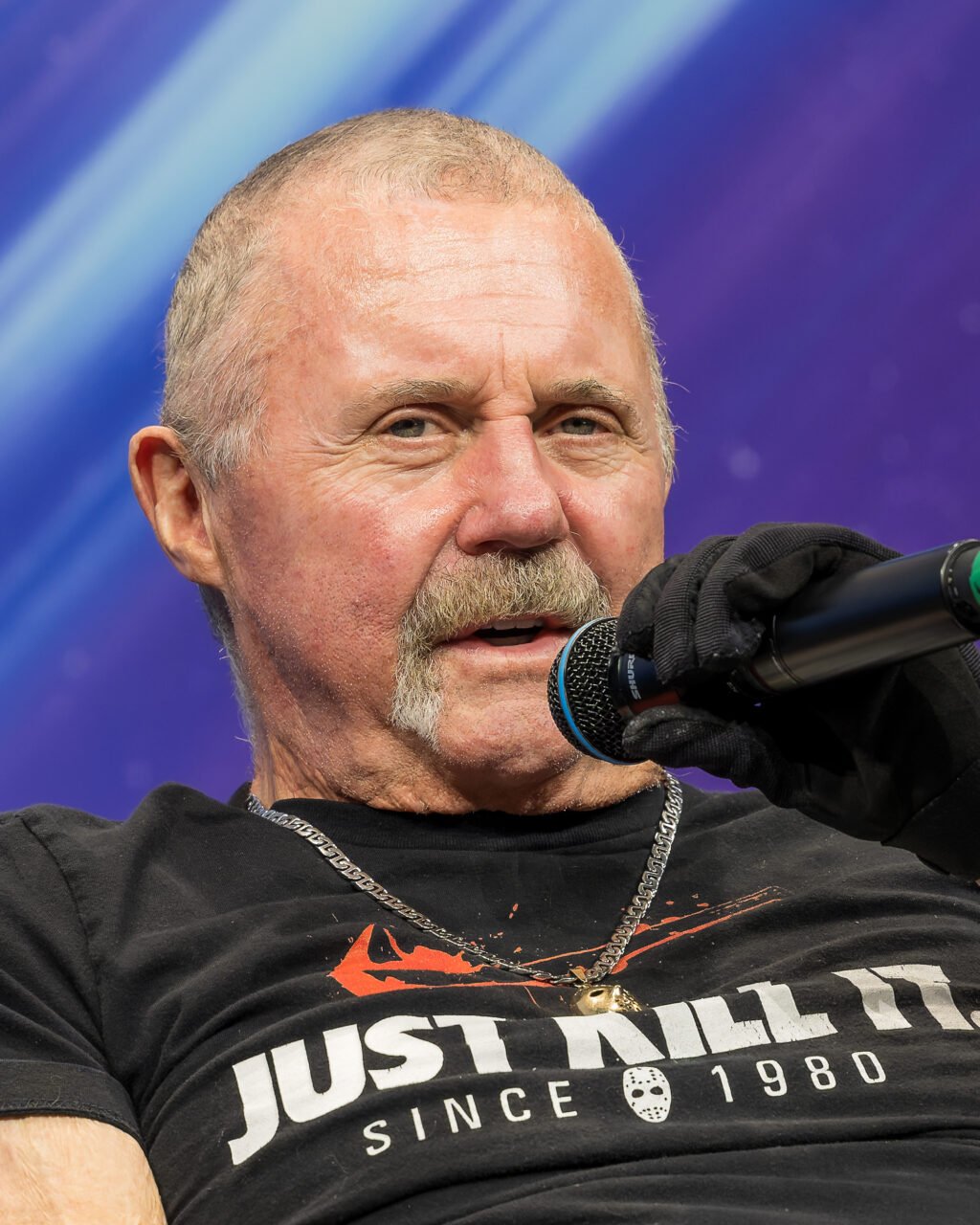
Kane Hodder (born 1955) is the stuntman-actor who played Jason Voorhees in four straight films — then invented Victor Crowley, horror’s second great mask.
Most horror icons are faces. Kane Hodder is a body. For four consecutive Friday the 13th films he was the breathing, heaving, coiled physical fact of Jason Voorhees — the first actor ever to play Jason twice, and still the only one to play him four times. Then, when the franchise handed his mask to another man, he went and built a second slasher from nothing and carried that one through four films too. Underneath the résumé is the real story: a stuntman who was nearly killed by fire at twenty-two, spent months in hospitals because the care went wrong, went back to work doing the very stunt that burned him — and became, by his colleagues’ account, one of the safest pair of hands in the business.
Jason. Leatherface, in the stunts. Freddy’s glove, literally, in one famous shot. And Crowley entire. No other performer has physically embodied all four of slasher horror’s Mount Rushmore killers in some verified form. This is how a stuntman did that.
Quick Specs
Full name: Kane Warren Hodder
Born: 8 April 1955, Auburn, California, USA
Family: Married since 1984; two children
Known for: Jason Voorhees in four Friday the 13th films (1988–2001), Victor Crowley in the four Hatchet films (2006–2017), stunt performance and coordination
The book: Unmasked: The True Story of the World’s Most Prolific Cinematic Killer (2011), his memoir with Michael Aloisi
The Burn: 1977
Before Jason, before the mask, there was the fire — and it did not happen on any film set, whatever the facts sites claim. In 1977, early in his stunt career, the 22-year-old Hodder was doing an interview and offered to demonstrate a fire stunt for the interviewer and her cameraman. It went horribly wrong. He suffered second- and third-degree burns over much of his upper body. Published accounts disagree on the percentage of his body burned, so this page states none — the injury’s shape is not in dispute: it nearly killed him, and then the treatment nearly finished the job.
In his own account, given decades later, he was not taken to a burn unit at first, and the burns worsened for months under inadequate care: “By four months I was almost dead, and then they said to get me to a burn unit… I got a staph infection throughout the whole burn area, and lost 60 pounds.” He was eventually transferred to a burn unit in San Francisco for roughly two further months of proper treatment. And then — this is the documentary record’s most telling detail — one of his first jobs back as a working stuntman involved a full-body burn: the exact stunt that had nearly killed him, performed by the man it nearly killed. That is the foundation everything else in this biography stands on. A college student who had dropped out to chase stunt work had been given every reason to quit. He went back to the fire instead.
Prison, the Maggots, and the Fight to Cast Him
The hinge credit is Prison (1987), Renny Harlin’s prison horror, where Hodder played Forsythe, an executed prisoner who returns from the grave. For the electric-chair resurrection scene, Hodder suggested — in his own telling — that live maggots should spill from his mouth to sell the decomposition, and performed it that way. The film’s effects man was John Carl Buechler. Buechler remembered exactly that level of commitment, and when he came to direct Friday the 13th Part VII: The New Blood, he knew who his Jason had to be.
It was a fight. The producers favoured the previous Jason, C.J. Graham. Buechler held his ground — “I know who should play Jason!” — and made the practical argument that defines Hodder’s whole career: this Jason had to do so many big stunts, including being set on fire, that an actor plus a stunt double would never look consistent from shot to shot. The man in the suit had to be both. To prove it, Buechler paid for Hodder’s screen test himself — renting the equipment, doing the makeup. The test won. What Buechler understood, and the next four films proved, is that Hodder wasn’t a stuntman who could act the part. He was the rare case where the stuntman was the performance.
Jason: Four Films, One Body
Part VII: The New Blood (1988) gave Jason Voorhees his most decayed, battle-damaged look yet — and Hodder played it head to toe: a body suit, seven prosthetic head pieces, dentures and lenses in his own account, his own stunts including the fire work, and a credit as the film’s stunt coordinator besides. What he brought to the role was physical, not vocal — Jason does not speak — and it reset the character permanently: the heavy, chest-heaving breathing under the mask; the head-tilt; the coiled, vibrating stillness between movements that reads not as a man waiting, but as a predator deciding. Before filming, he would study himself in the mirror in the prosthetics, testing movements to see what read as realistic and frightening. Jason stopped being a stuntman hitting marks. He became a performance.
He also policed the character’s soul. On Part VIII: Jason Takes Manhattan (1989) — Jason again, stunt coordinator again, and a famous in-costume, in-character promotional appearance on The Arsenio Hall Show — Hodder was asked to film a beat of Jason kicking a dog, and refused. His Jason kills people; he does not harm animals. It is the documented instance of a discipline the crew came to know: the man in the mask argued for what Jason would and wouldn’t do, and the films are better for it.
Jason Goes to Hell: The Final Friday (1993) carries the single best “what he actually did” credit block in slasher history — three performances in one film. He is Jason. He is also Security Guard #2, on screen and out of costume. And in the closing shot, when Freddy Krueger’s clawed glove bursts out of the ground and drags Jason’s mask down to hell, the hand inside Freddy’s glove is Kane Hodder’s. Add the stunt-coordinator credit and one film contains his whole career in miniature. Jason X (2001) closed the run: Jason in space, rebuilt mid-film as the cybernetic Uber Jason — the fourth consecutive film, a record for the role that still stands. The full saga is traced on our Friday the 13th franchise page, from the 1980 original forward.
The One That Got Away
Then the franchise did to Hodder what it had never done to Jason: it replaced him and moved on. For Freddy vs. Jason (2003), Hodder offered to reprise the role; director Ronny Yu and New Line cast 6′5″ Canadian stuntman Ken Kirzinger instead. Why is a genuinely unsettled record — Kirzinger’s Canadian location, his height opposite Robert Englund’s Freddy, and Yu’s statement that the choice was New Line’s idea all circulate, including in attributed remarks — so this page states the conflict and no single cause. Hodder has never hidden his resentment at losing the role, and he remains good friends with both Kirzinger and Englund. The 2009 remake’s Jason is a third man entirely, Derek Mears — aggregator pages credit Hodder with both films constantly, and both credits are wrong. His Jason films are four: VII, VIII, Goes to Hell and Jason X.
His fifth Jason performance isn’t a film at all, and it might be the most complete one: motion capture for Friday the 13th: The Game (2017), recruited by Gun Media when the project was still called Summer Camp, alongside effects legend Tom Savini and composer Harry Manfredini. Every Jason in that game moves the way Hodder moves — the breathing, the tilt, the stillness, digitised. He has said he never wanted to stop playing Jason, and that the game fills a void. Fourteen years after the mask was taken away in film, the performance came back through a gamepad.
Leatherface, Stated Precisely
Hodder’s Leatherface credit is the one the internet most often mangles, so here it is exactly. In Leatherface: The Texas Chainsaw Massacre III (1990), the credited Leatherface actor is R.A. Mihailoff. Hodder performed the stunts as Leatherface — he was Mihailoff’s Leatherface stunt double, uncredited — and carries a stunt-coordinator credit on the film in the wider record. “Kane Hodder played Leatherface in Texas Chainsaw Massacre III,” stated flat, is wrong; “the stunt Leatherface of the third film” is the truth, and it is impressive enough stated properly. His stunt-coordination work reached well beyond horror’s swamps, too — his coordinator credits include Seven. Then, thirty-three years after doubling the role, the circle closed: Hodder performed Leatherface in full via motion capture for The Texas Chain Saw Massacre video game (2023) — the stunt double of 1990 becoming the character entire, in a different medium. The franchise record is on our Texas Chainsaw Massacre franchise page.
Victor Crowley: The Second Icon
Most actors who lose an iconic mask spend their careers signing it at conventions. Hodder originated another one. Adam Green’s Hatchet (2006) built its swamp legend around a horror-trinity cast — Hodder, Robert Englund and Tony Todd — with effects man Buechler, the same director of effects who’d fought to cast him as Jason nearly twenty years before, on gore. As Victor Crowley, the deformed, long-dead child of Honey Island Swamp legend who returns with a hatchet, Hodder created a second franchise killer entirely from his own physical vocabulary — and served as the film’s stunt coordinator as well, per co-star Joel Moore’s on-set account. Moore also recorded the method: Hodder kept his distance from the younger cast so their fear on camera would be real. “He kept his distance from the other cast because he wanted… a genuine fear attached to it. So the girls never met him… He’d hide himself in a big hoodie, and then hide behind a tree to get into character — and literally the girls would cry.”
The Crowley run matched the Jason count exactly: Hatchet II (2010), in which he played both Victor and Victor’s father Thomas Crowley; Hatchet III (2013); and a fourth film released under the character’s own name, Victor Crowley (2017) — not “Hatchet IV,” whatever the listings say. Four Jasons, four Crowleys, one body. Hodder asserts he has “murdered more people on camera than any other actor in history,” and his memoir’s subtitle bills him “the World’s Most Prolific Cinematic Killer” — print it as what it is, his own claim, never independently audited, and all the stronger for coming from the man himself.
The Man Behind the Masks
The Hodder the conventions know is a study in contrasts the horror press reports consistently: the screen’s most prolific killer is, off it, a kind, generous fixture of the fan circuit — who has the word “Kill!” tattooed on the inside of his bottom lip, and will show you if you ask. When he is not filming, he spends time working with children in burn centres — the survivor of 1977 sitting with kids living his own worst year, a through-line his memoir Unmasked (2011, with Michael Aloisi; adapted in 2014 into the web series The Killer & I) and the documentary To Hell and Back: The Kane Hodder Story (2017) both treat as the centre of the man. The documentary’s other through-line, from the colleagues who trust him with their lives: the stuntman nearly killed by a stunt became one of the safest stunt coordinators in the business. The fire made the killer. It also made the guardian.
Why Kane Hodder Matters
Hodder did the rarest thing in slasher history twice. He took over an already-iconic masked killer six films into a series and made the role definitively his — four consecutive films, a record no other Jason approaches — through pure physical acting, in an era when the performance and the stunts had to be the same body or the illusion broke. Then, instead of living off the one mask, he originated a second franchise killer and carried him through four more films. His career is also the standing argument that stunt performers are actors: Buechler cast him precisely because a Jason who needed a double would never be consistent, and four films proved the point so completely that a video game later hired the man’s movement as the character. And underneath the masks sits the survival story the genre genuinely uses — the burn, the botched care, the return to fire, the burn centres — proof that horror’s most frightening body belongs to one of its most decent men. You’ll find him in our Horror Actors index, where the masked killers are measured against the standard he set.