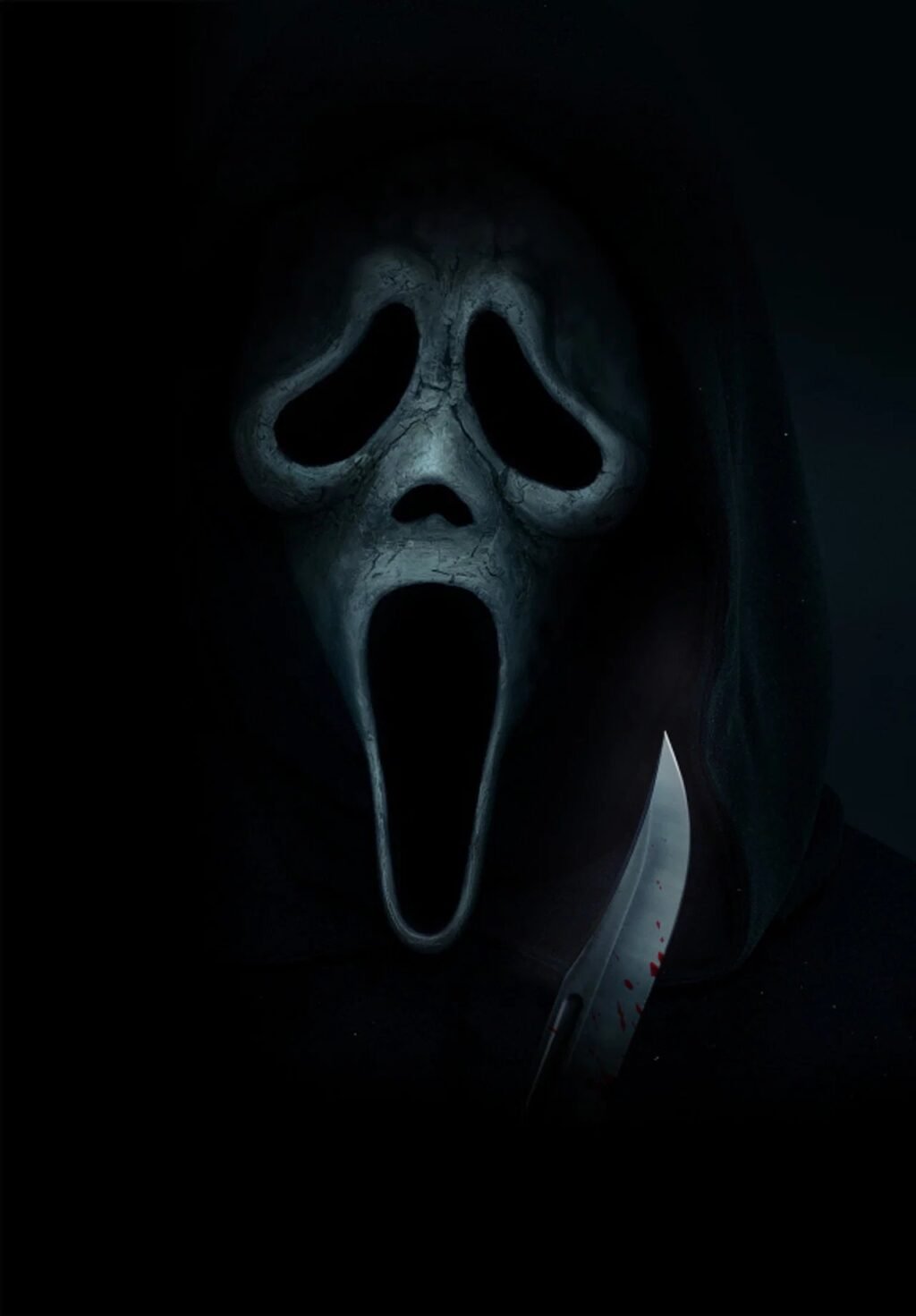
Ghostface is the masked killer of the Scream franchise. It isn’t one person but a disguise: a black hooded robe, a white mask frozen in a wail, a hunting knife, and a voice changer used to taunt victims over the phone. Created by screenwriter Kevin Williamson and brought to the screen by director Wes Craven in Scream (1996), Ghostface is a horror-movie fan who kills by the genre’s own rules. A different killer, or pair of killers, is under the mask in almost every film, so every Scream is also a whodunit.
At a glance
| Franchise | Scream |
| First appearance | Scream (1996) |
| Creators | Kevin Williamson (writer) and Wes Craven (director); the mask was designed for the costume company Fun World |
| Portrayed by | Roger L. Jackson (the voice, in every film and in Scream: Resurrection, 2019) Dane Farwell (main costume performer in Scream, Scream 2 and Scream 4) The unmasked killers are played by the cast of each film (see below). |
| Weapon of choice | A Buck 120-style hunting knife, plus taunting phone calls through a voice changer |
Origin story and backstory
In Scream, a killer in a Halloween costume terrorizes the small town of Woodsboro, California, a year after the rape and murder of Sidney Prescott‘s mother, Maureen. The killer calls victims first, quizzes them on horror movies and then attacks. In the finale, Ghostface turns out to be two people: Sidney’s boyfriend, Billy Loomis (Skeet Ulrich), and his friend Stu Macher (Matthew Lillard). Billy blamed Maureen’s affair with his father for breaking up his family. Stu cites “peer pressure” as his motive.
Because the costume is a store-bought outfit (labeled “Father Death” in the film), anyone can become Ghostface. Each sequel brings a new killer with a new motive, from revenge to fame to obsession with Stab, the in-universe movie series based on the Woodsboro murders. Whoever is under the mask, Ghostface has the same habits: the phone calls, wiping the knife clean after a kill, and the sense that the killer has seen every horror film and plans to use their rules against you.
The voice ties it all together. Ghostface always sounds the same on the phone, because the killers use a voice changer and the voice belongs to Roger L. Jackson. Craven described Jackson’s performance as having an “evil sophistication.” Williamson has said the idea for the script came partly from news reports about the Gainesville Ripper murders, and the result was a slasher that satirized the very clichés it used. The scares, though, are played completely straight.
Who was behind the mask (spoilers)
- Scream (1996): Billy Loomis and Stu Macher
- Scream 2 (1997): Mickey Altieri (Timothy Olyphant) and Billy’s mother, posing as reporter “Debbie Salt” (Laurie Metcalf)
- Scream 3 (2000): Roman Bridger (Scott Foley), Sidney’s half-brother
- Scream 4 (2011): Sidney’s cousin Jill Roberts (Emma Roberts) and Charlie Walker (Rory Culkin)
- Scream (2022): Richie Kirsch (Jack Quaid) and Amber Freeman (Mikey Madison)
- Scream VI (2023): Detective Wayne Bailey (Dermot Mulroney) and his children, Ethan (Jack Champion) and Quinn (Liana Liberato)
- Scream 7 (2026): left out here to avoid spoiling the newest film
Iconic moments
- The opening call (1996): Drew Barrymore’s Casey Becker, the film’s biggest star, answers the phone (“Do you like scary movies?”) and doesn’t survive the opening scene. Killing off the star early told audiences that anything could happen.
- The rules (1996): At a party, video-store clerk Randy lays out the rules for surviving a horror movie while Ghostface closes in.
- The garage door (1996): Tatum tries to escape through a pet door in a garage door, in one of the series’ most talked-about deaths, played mostly through tension rather than gore.
- The movie theater (1997): Scream 2 opens with a murder during a preview screening of Stab, while an audience in Ghostface masks cheers, unaware it’s real.
- The reveal (1996): Billy and Stu unmask and explain themselves in a kitchen finale that set the template for every sequel.
- The bodega (2023): Scream VI takes Ghostface to New York, where a killer with a shotgun stalks a convenience store.
Appearances
Films in release order
- Scream (1996), directed by Wes Craven
- Scream 2 (1997)
- Scream 3 (2000)
- Scream 4 (2011), Craven’s last film
- Scream (2022), directed by Matt Bettinelli-Olpin and Tyler Gillett
- Scream VI (2023)
- Scream 7 (2026), directed by Kevin Williamson
TV and parodies
MTV’s Scream series (2015–2016) replaced Ghostface with a different masked killer because of licensing issues. The original mask and Roger L. Jackson’s voice returned for the third season, Scream: Resurrection, on VH1 in 2019. Ghostface has been spoofed countless times, most famously in Scary Movie (2000), which used Scream‘s original working title.
Trivia and behind-the-scenes facts
- The mask predates the film. Fun World sold it around 1991–92 as part of its “Fantastic Faces” line, where it was known as “The Peanut-Eyed Ghost.” Fun World owns the Ghostface design and name.
- Producer Marianne Maddalena found the mask in a house while scouting locations. Craven later said he had misremembered finding it himself.
- Because the deal with Fun World wasn’t finished in time, KNB Effects made a lookalike mask that appears in some early scenes, including Casey Becker’s murder.
- The mask is often compared to Edvard Munch’s painting The Scream, but Fun World designer Brigitte Sleiertin has said it wasn’t inspired by the painting. She described its expression as “horrible,” “sorry” and “frantic” all at once.
- The robe was originally going to be white. Maddalena pushed for black, and each robe was handmade for an estimated $700.
- Craven himself wore the costume for part of the opening scene. Matthew Lillard, though he played one of the killers, never wore it.
- Craven had to trim some of the film’s violence after a dispute with the MPAA before it would give Scream an R rating.
- Williamson’s script was developed under the title Scary Movie. Scream opened on December 20, 1996, a risky date for a slasher, and grossed about $173 million worldwide.
- Scream 7 became the highest-grossing film in the series, with about $214 million worldwide.