
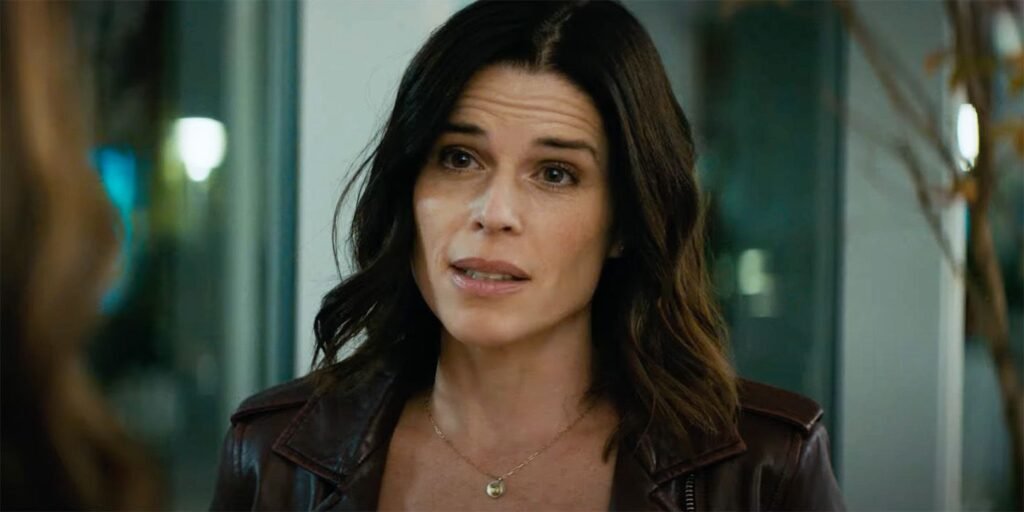
Sidney Prescott is the final girl of the Scream films, played by Neve Campbell in six of them across thirty years.
Every slasher franchise has a killer. Scream has a survivor. Sidney Prescott — created by Kevin Williamson, played by Neve Campbell — is the girl Ghostface could never finish: targeted at seventeen because of a lie about her mother, hunted through college, Hollywood, and her own hometown’s remake of her trauma, until the franchise’s seventh film finds her a mother in Indiana, watching a new Ghostface try to manufacture a replacement Sidney out of her teenage daughter. She headlines or co-headlines six films across thirty years, ageing in real time from target to protector — a longitudinal survivor arc with no equivalent in the genre.
This page keeps two layers separate, because Sidney’s record demands it: the canon — what is true of her inside the films — and the real world — casting, money and production history, including a pay dispute that removed her from one film entirely and a retooled seventh film that brought her back. Where the franchise contradicts itself — above all on her husband — the contradiction is stated, not smoothed over.
Quick Specs
Character: Sidney Prescott — in current canon, Sidney Evans
Created by: Kevin Williamson
Played by: Neve Campbell
First appearance: Scream (1996)
Home (canon): Woodsboro, California — the Prescott house at 34 Elm Street; later Pine Grove, Indiana
Family (canon): Mother Maureen Prescott (murdered before the first film), father Neil Prescott, half-brother Roman Bridger; married, three children, including eldest daughter Tatum
Who She Is: The Canon
Sidney grows up in Woodsboro, California, in the house at 34 Elm Street — an address the 2022 film speaks aloud, a nod to Craven’s Elm Street. A year before the first film, her mother Maureen is murdered; Sidney finds her, and testifies that she saw Cotton Weary leaving — testimony that convicts an innocent man. The truth the films assemble across three instalments: Maureen had affairs, including with Hank Loomis, and before her marriage spent a period in Hollywood during which she bore a first child, Roman Bridger, given up for adoption. Billy Loomis and Stu Macher killed Maureen; Cotton is exonerated and becomes an uneasy ally before his own murder in Scream 3. Her father Neil, a businessman often away, is framed by Billy and Stu in the first film and survives it; the later films give him no on-screen death, and this page states none. Her best friend is Tatum Riley (Rose McGowan), killed in the first film’s garage set-piece — Sidney later names her eldest daughter for her. Scream 4 adds her aunt Kate Roberts and cousin Jill. On the question every infobox answers and no film does — her birth date — this page follows the films: they give her age as seventeen in 1996, the reference works split between two March 1979 dates, and no film states one. Seventeen in 1996 is the film fact; anything more precise is invented canon.
Her in-universe path, film by film: a Woodsboro High senior (1996); a drama student at Windsor College, Ohio (Scream 2); a women’s crisis counsellor working under the alias “Laura,” living in guarded seclusion in Northern California (Scream 3); a self-help author whose memoir Out of Darkness brings her home on tour (Scream 4); a wife and mother living away from Woodsboro (Scream, 2022); in hiding with her family during the New York killings (Scream VI — Gale’s on-screen statement, and Sidney’s only absence); and settled in Pine Grove, Indiana, in Scream 7 (2026). The franchise hub is our Scream franchise page; the killer she keeps outliving is Ghostface.
Seven Films: What She Faces
Scream (1996). Ghostface taunts Sidney by phone and works through her circle — Casey Becker, Tatum, Principal Hembry among the dead. Attacked at home and at school, she survives the Macher-house finale by turning the killers’ own tools on them: she dons the Ghostface costume herself, stabs Billy with an umbrella, drops a television on Stu’s head, and shoots Billy as he lunges for one last scare. “Not in my movie.” The killers are her boyfriend Billy Loomis — avenging his family over Maureen’s affair with his father — and Stu Macher, along for the thrill. Scream 2 (1997). At Windsor College, a copycat spree grows around Stab, the film of her life; she loses Randy Meeks and her boyfriend Derek, and is confronted in the college theatre. The killers: Mickey Altieri, her film-student friend, seeking infamy — and Nancy Loomis, Billy’s mother, posing as reporter Debbie Salt, seeking revenge. Sidney shoots Mrs Loomis in the head afterwards, “just in case.” Scream 3 (2000). Living as “Laura,” she is drawn to Hollywood by the Stab 3 murders, where photos of young Maureen are left at the scenes. The killer, the franchise’s only solo Ghostface of the original run: Roman Bridger — her unknown half-brother, who filmed Maureen’s affairs and fed the footage to a young Billy, setting the original murders in motion. Note the layering: Roman orchestrated; Billy and Stu performed Maureen’s murder. Detective Mark Kincaid is wounded saving her. The film closes on Sidney leaving her gate and door open and her alarms off — choosing an unguarded life.
Scream 4 (2011). Author Sidney returns to Woodsboro on the Out of Darkness tour and is detained as a suspect while a remake-minded Ghostface kills. She tries to save her cousin Jill — and finds Jill is the killer, hungry for Sidney’s fame as the new generation’s sole survivor, with her secret boyfriend Charlie Walker as accomplice. Jill kills Charlie, stabs Sidney and mutilates herself to sell the act; in hospital, learning Sidney lived, she attacks again, and Sidney kills her. Scream (2022). Twenty-five years on, Sidney is married — husband named only as “Mark” — and a mother of three, living away from Woodsboro. She returns after Dewey’s murder, mentors Sam Carpenter through the finale at Stu’s old house, and is stabbed by killer Amber Freeman but survives; Amber’s partner is Sam’s boyfriend Richie Kirsch — toxic Stab fans staging a “requel” to give Hollywood better source material. Sidney ends the film as the protector, passing the centre to Sam and Tara. Scream VI (2023). Sidney does not appear — mentioned only, in hiding with her family while Richie Kirsch’s father and siblings (Wayne, Quinn and Ethan Bailey) avenge him in New York. Gale survives and asks that Sidney be told Ghostface “never got her.” Scream 7 (2026). Sidney — now Sidney Evans — lives in Pine Grove with her husband and daughter Tatum, when a video-call “Stu Macher” begins taunting her, targeting Tatum to manufacture a new Sidney by forcing the daughter through the mother’s trauma. The “Stu” is an AI deepfake — Stu Macher is dead, and stays dead — built by Marco Davis, a mental-institution supervisor; his partner is Jessica Bowden, Sidney’s neighbour, a reader of Out of Darkness who decided Sidney had gone soft. Their earlier Ghostface accomplice, escaped patient Karl Gibbs, is run down by Gale mid-film. Sidney shoots Marco; Sidney and Tatum kill Jessica together. She ends the current canon alive, her husband surviving his wounds, preparing to teach her daughter to defend herself — the torch visibly prepared, not yet passed.
The Husband Problem: A Retcon in Three Layers
No fact about Sidney is more often stated wrongly than her marriage, because the franchise itself has three layers that do not agree — and this page states the layer it means, every time. Layer one, on screen (2022): her husband is named only as “Mark.” No surname, never seen. Layer two, off screen (January 2022): directors Matt Bettinelli-Olpin and Tyler Gillett confirmed to the press that this Mark was Mark Kincaid, Patrick Dempsey’s Scream 3 detective — “Mark Kincaid is Sid’s husband… Officially on record!” Campbell herself said she hadn’t realised: she “just knew I was happily married and had children.” Layer three, on screen (2026): for the first time the husband appears — and he is Mark Evans, played by Joel McHale, Pine Grove’s police chief. Dempsey had explained in March 2025 that scheduling and the Los Angeles fires meant a return “didn’t work out”; McHale was cast in January 2025 and billed as Sidney’s husband, full stop. So: McHale is not a recast of Dempsey, Evans is not Kincaid renamed, and “Sidney married Mark Kincaid” is not settled on-screen canon — it is a 2022 directors’ statement that a 2026 film superseded in practice. Her current on-screen married name is Sidney Evans. Anything shorter than this paragraph is a distortion, in whichever direction it errs.
Signatures: The Phone, the Costume, the Confirming Shot
Ghostface’s taunting phone call is the franchise’s signature beat, and Sidney’s signature is refusing to play it straight: in 1996 she calls the bluff mid-call; by 2022 she is so unintimidated she hangs up on Ghostface mid-taunt. The arc — terrorised by the phone, then bored by it — is the character in miniature. Her thesis line comes in the 1996 finale: warned the killer always returns for one last scare, she shoots the lunging Billy in the head. “Not in my movie.” Fifteen years later comes its pole-pair, delivered to Jill in the Scream 4 hospital finale as she kills the would-be replacement final girl: “Don’t fuck with the original.” In between, the iconography: she is the only protagonist in the series to wear the Ghostface robe and mask herself and turn the voice-changer on the killers; her weapons are improvised and her finishes decisive — umbrella, television, defibrillator, and a repeated habit critics single out as her defining competence, the confirming shot, the refusal to assume the killer is dead (“just in case,” on Mrs Loomis). Against all of it stands Scream 3‘s closing image — alarms off, door open. Her arc runs target, repeat survivor, recluse who counsels other women, author who owns her story, protector; do not compress it into “she got tougher.” The counsellor and the author are the distinctive stages.
The Real World: Neve Campbell and the Role
Everything in this section is production history, not canon. The role of Sidney was first Drew Barrymore’s — she approached the production after reading Kevin Williamson’s script and was attached before a director was found. When her schedule couldn’t carry the lead, she volunteered for the smaller role of Casey Becker, killed in the famous opening — she was not fired from the part, and did not lose it. After the switch, the role was offered to Reese Witherspoon, who passed; Wes Craven cast Neve Campbell after seeing her in Party of Five, judging she could read as innocent yet handle the role’s physical and emotional demands. Campbell — born 3 October 1973 in Guelph, Ontario — was reluctant to do another horror film straight after The Craft, but took her first feature lead because she adored the character, playing her “reality-based” so the audience saw the films through Sidney’s eyes. She was 23 at the first film’s release and 52 at the seventh: thirty years in one role, rewarded early with a Saturn Award for Best Actress (1997) and an MTV Movie Award for Scream 2. Even her absences are production history: her Scream 3 role shrinks because Party of Five squeezed her availability to roughly twenty days; she initially refused Scream 4; and she hesitated over the 2022 film because Craven had died in 2015, persuaded in the end by the new directors’ letter about becoming filmmakers through his work.
The Scream VI pay dispute is documented in her own words, and this page uses them. On 6 June 2022 Campbell announced she would not return: “the offer that was presented to me did not equate to the value I have brought to the franchise.” She later expanded that she could not bear “walking on set and feeling undervalued,” and reaffirmed the decision in February 2026 — it was a pay and value dispute, not creative differences, and Scream VI became the first film in twenty-seven years with Courteney Cox’s Gale — not Sidney — as its only ever-present legacy lead. The seventh film’s upheaval followed: first built around Sam and Tara Carpenter under director Christopher Landon, it lost Melissa Barrera (fired by Spyglass in November 2023 over social-media posts) and Jenna Ortega (whose exit was reported as scheduling; she later said it “had nothing to do with pay or scheduling”), then Landon himself. The film was rebuilt around Sidney: Campbell announced her return on 12 March 2024, asked back “in the most respectful way,” with Williamson directing his first Scream film. Variety reported the rescue’s price — a rewrite around $500,000 and a fee for Campbell reported at $7 million, figures this page attributes to Variety rather than stating as ledger fact. Released 27 February 2026, Scream 7 became the franchise’s highest-grossing film unadjusted — $213.8 million worldwide, the first past $200 million — against the franchise’s worst reviews, with Rotten Tomatoes in the low thirties; inflation-adjusted, the original trilogy still leads. The film grosses, for the record: $173.0M (1996), $172.4M (1997), $161.8M (2000), roughly $97M (2011), $138.9M (2022), $169.1M (2023), $213.8M (2026) — about $1.13 billion across seven films, and none of it a salary figure. A Scream 8 is in development; no casting, Sidney’s included, is confirmed for it.
Why Sidney Prescott Matters
Carol Clover coined “final girl” in Men, Women, and Chain Saws (1992) for the slasher survivor who alone looks death in the face and kills the killer herself. Sidney arrived four years later as the trope’s self-aware revision — and the critical literature’s standard example, alongside Laurie Strode and Nancy Thompson, of its modern form. She breaks the classic rules and survives anyway: she has sex with her boyfriend, who proves to be the killer, and the film keeps its moral architecture while discarding the virginity requirement. Where earlier final girls survive the night, Sidney progressively takes over the telling — she out-quotes the killers, counsels other women, writes the memoir the later killers themselves read, and is targeted in 2026 precisely because her book made her the template: victim, viewer and author at once. Williamson has said Sidney’s distrust is partly his own — “Sidney trusted no one” — and that the final-girl struggle spoke to him as a gay kid; Campbell calls her a symbol of strength who refuses to be a victim. That Campbell’s own stand — walking away over the value of her work, then returning as its highest-grossing lead — now reads as part of the character’s off-screen meaning is criticism’s observation, offered here as exactly that. The door she leaves open at the end of Scream 3 is still the image: the final girl who stopped locking herself in. You’ll find her in our Horror Characters index and across the Horror Franchises.