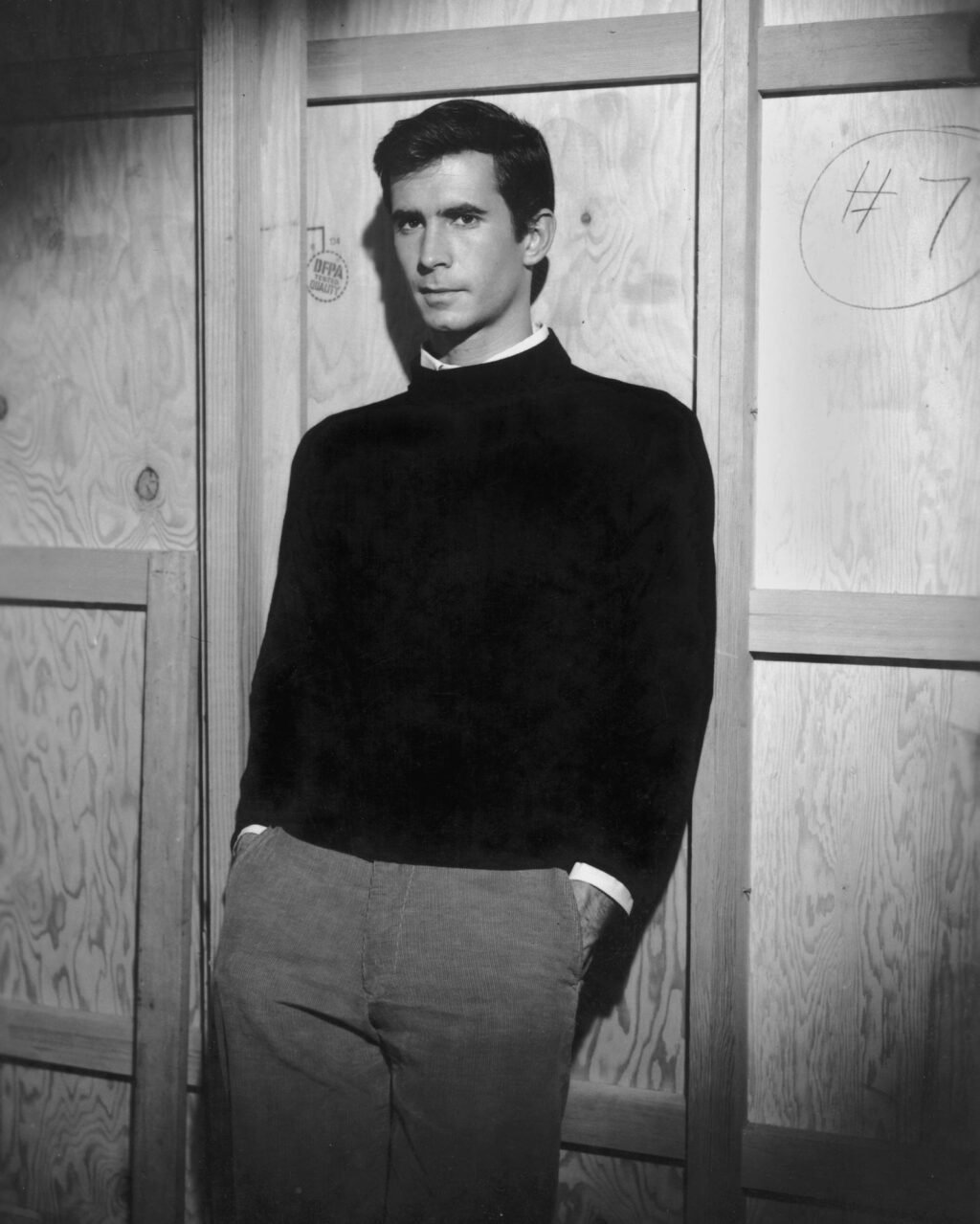
Norman Bates is the soft-spoken manager of the Bates Motel and the killer at the heart of Psycho. Created by Robert Bloch in his 1959 novel and made famous by Anthony Perkins in Alfred Hitchcock’s 1960 film, Norman lives in the old house on the hill with his domineering “Mother,” and therein lies the twist. Perkins played him in four films, Vince Vaughn in the 1998 remake and Freddie Highmore in A&E’s Bates Motel. The American Film Institute ranks Norman second on its list of the greatest screen villains, behind only Hannibal Lecter.
At a glance
| Franchise | Psycho |
| First appearance | Psycho (novel, 1959); first screen appearance in Psycho (1960) |
| Creator | Robert Bloch; brought to the screen by Alfred Hitchcock and screenwriter Joseph Stefano |
| Portrayed by | Anthony Perkins (Psycho, 1960; Psycho II, 1983; Psycho III, 1986; Psycho IV: The Beginning, 1990) Oz Perkins (young Norman, Psycho II) Kurt Paul (Bates Motel, 1987 TV film) Henry Thomas (teenage Norman, Psycho IV) Vince Vaughn (Psycho, 1998) Freddie Highmore (Bates Motel, 2013–2017) |
| Weapon of choice | A kitchen knife, used while dressed as “Mother”; in the backstory, he poisoned his mother and her lover with strychnine |
Origin story and backstory
Norman grew up alone with his mother, Norma, after his father died. She was possessive and cruel and taught him that sex was sinful and that other women were not to be trusted. When she took a lover, Joe Considine, and planned to remarry, Norman poisoned them both with strychnine and staged it as a murder-suicide. Unable to live with the guilt, he dug up her body, preserved it, and began to “become” her: he talks in her voice, wears her clothes and, as Mother, kills any woman who attracts him.
In Psycho, embezzler Marion Crane (Janet Leigh) checks into the motel on a rainy night. Norman makes her dinner and talks about his hobby, taxidermy, and his trapped life with Mother. That night, Marion is killed in the shower. Norman, believing his mother did it, cleans the room and sinks her car in a swamp. When Marion’s sister, Lila (Vera Miles), and boyfriend, Sam Loomis (John Gavin), come looking, the truth comes out in the fruit cellar. In the final scene, Mother’s personality has taken over Norman completely.
Bloch’s Norman vs. Hitchcock’s Norman, and the Ed Gein question
Bloch’s novel describes Norman as fortyish, overweight and balding, a heavy drinker who becomes Mother when he blacks out. Hitchcock and Stefano made him a slender, boyish young man the audience would like, and cast Perkins. The sequels then went their own ways. Bloch’s novel Psycho II (1982) kills Norman early, while the Universal films bring him home “cured” and then contradict each other: Psycho IV (1990) drops the backstory twists of Psycho II and III. Bates Motel (2013–2017) is a reboot set in the present day, in which Norma is alive and his illness develops in front of us. Norman is often called a portrait of Wisconsin murderer Ed Gein. Bloch said Gein’s 1957 arrest gave him the idea of a monster hiding in a small town, and that he was struck later by how closely his character resembled Gein.
Iconic moments
- The parlor talk (1960): Surrounded by his stuffed birds, Norman tells Marion that “we all go a little mad sometimes,” and the scene shifts from sweet to unsettling.
- The shower (1960): Marion’s murder, cut to Bernard Herrmann’s shrieking strings, is one of the most studied scenes in film. Almost everything is implied rather than shown.
- The staircase (1960): Private detective Milton Arbogast (Martin Balsam) climbs the stairs of the house, and Mother comes out of the bedroom to meet him.
- The fruit cellar (1960): Lila touches the shoulder of the woman in the chair, and the chair turns around.
- The final close-up (1960): In a cell, Norman sits wrapped in a blanket while Mother’s voice speaks his thoughts, and he smiles straight at the camera.
- The sandwich (1983): In Psycho II, a nervous, kindly Norman makes a grilled cheese sandwich for Mary, and the sequel makes you root for him.
Appearances
Novels
- Psycho (1959), by Robert Bloch
- Psycho II (1982), by Robert Bloch
- Psycho House (1990), by Robert Bloch, in which Norman appears only as an animatronic figure
- Psycho: Sanitarium (2016), an authorized novel by Chet Williamson set between the first two books
Films and TV in release order
- Psycho (1960), directed by Alfred Hitchcock
- Psycho II (1983)
- Psycho III (1986), directed by Anthony Perkins
- Bates Motel (1987), a TV film and unsold pilot
- Psycho IV: The Beginning (1990), a TV film
- Psycho (1998), Gus Van Sant’s color, near shot-for-shot remake
- Bates Motel (A&E, 2013–2017), with Vera Farmiga as Norma
Trivia and behind-the-scenes facts
- Hitchcock bought the rights to Bloch’s novel for $9,500 and reportedly had his assistant buy up copies to keep the ending a secret.
- Paramount didn’t want to make the film, so Hitchcock shot it cheaply, using crew from his TV show, for about $807,000. It became the most commercially successful film of his career.
- The shower scene took about a week of a roughly 30-day shoot. Counts of its shots vary: the documentary 78/52 takes its name from a commonly cited 78 camera setups and 52 cuts, while scholar Philip J. Skerry counted about 60 shots.
- The blood in the shower was chocolate syrup, which looked right in black-and-white, and the sound of the knife was made by stabbing a melon.
- Psycho is often called the first mainstream American film to show a toilet flushing, which worried the censors.
- Theaters were told not to let anyone in after the film had started, a policy Hitchcock used to protect the twist.
- Perkins poked fun at the role when he hosted Saturday Night Live in 1976, in sketches that included a mock training film called “The Norman Bates School of Motel Management.”
- Bloch’s Norman may have had a second inspiration. People who knew him, including Noel Carter and Chris Steinbrunner, have said the character was partly based on Calvin Beck, publisher of the magazine Castle of Frankenstein, though this has never been confirmed.
- Norman’s line “A boy’s best friend is his mother” is No. 56 on AFI’s list of the 100 greatest movie quotes.