
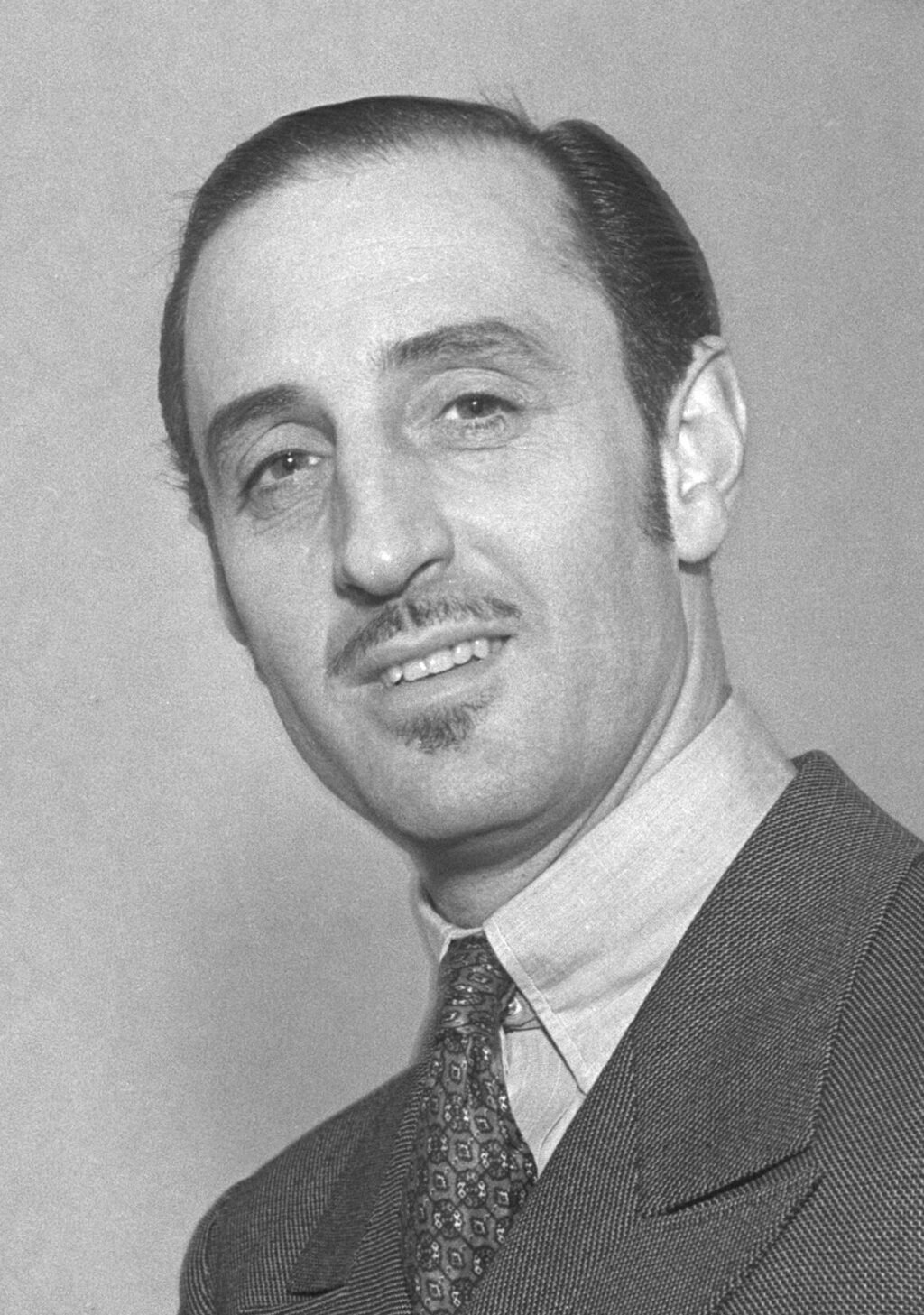
Basil Rathbone (1892 to 1967) was the English actor who played Sherlock Holmes in 14 films and Wolf von Frankenstein in Son of Frankenstein.
Quick Specs
| Born | Philip St. John Basil Rathbone, June 13, 1892, Johannesburg |
| Died | July 21, 1967, New York City, aged 75 |
| Trained in | Shakespeare, with his cousin Frank Benson’s touring company (stage debut 1911) |
| War service | London Scottish, then the Liverpool Scottish; intelligence officer; Military Cross, 1918 |
| Horror centerpiece | Baron Wolf von Frankenstein in Son of Frankenstein (1939) |
| Sherlock Holmes | 14 films (1939 to 1946), all with Nigel Bruce as Watson, plus more than 200 radio episodes |
| Other horror | Tower of London (1939), The Black Cat (1941), The Black Sleep (1956), Tales of Terror (1962), The Comedy of Terrors (1963) |
| Honors | two Oscar nominations (Romeo and Juliet, If I Were King); 1948 Tony Award for The Heiress; three stars on the Hollywood Walk of Fame |
| Last film | Autopsia de un fantasma (1968), released after his death |
Who He Is
Philip St. John Basil Rathbone was born in Johannesburg on June 13, 1892. His father, Edgar Philip Rathbone, was a mining engineer from the Liverpool Rathbone family; his mother, Anna Barbara, was a violinist. When Basil was three, the family fled to Britain after the Boers accused his father of being a spy in the wake of the Jameson Raid.
He went to Repton School in Derbyshire from 1906 to 1910, where he was good at sports and was known as “Ratters.” To keep his father happy he spent a year as a clerk with the Liverpool and Globe insurance companies, then turned to the stage. His cousin was the actor-manager Sir Frank Benson, and in 1911 he made his first stage appearance with Benson’s company as Hortensio in The Taming of the Shrew. He toured America with Benson in 1912 and made his London debut in The Sin of David in 1914.
At the end of 1915 he was called up as a private in the London Scottish, the same regiment that counted Claude Rains, Herbert Marshall and Ronald Colman in its ranks at various points of the war. In 1916 he was commissioned a lieutenant in the Liverpool Scottish, served as an intelligence officer and rose to captain. His younger brother John, a captain in the Dorsetshire Regiment, was killed near Arras on June 4, 1918. That September, Rathbone led the daylight patrols that won him the Military Cross, for “conspicuous daring and resource on patrol.”
He married Ethel Marion Foreman in 1914; their son Rodion later acted briefly in Hollywood as John Rodion. They divorced in 1926, and Rathbone married the writer Ouida Bergère. Their own baby died in 1928, and they later adopted a daughter, Cynthia.
The Work, and What He Did in It
The stage made him. After the war he played Romeo, Cassius and Florizel at Stratford in 1919, took the title role in Peter Ibbetson in London in 1920, and became a Broadway star opposite Eva Le Gallienne in The Swan in 1923. He always insisted he wanted to be remembered for his stage work, and he named Romeo as his favorite role. His film debut was Innocent (1921). His first talkie, The Last of Mrs. Cheyney (1929) with Norma Shearer, was also his last turn as a romantic lead, and in The Bishop Murder Case (1930) he played a detective, Philo Vance, years before Holmes.
Then came the villains. Playing the cruel stepfather Mr. Murdstone in David Copperfield (1935) got him bigger parts, but he believed it had typecast him as a movie villain. In one year he was Karenin in Anna Karenina, Pontius Pilate in The Last Days of Pompeii, the pirate Levasseur in Captain Blood and the Marquis St. Evremonde in A Tale of Two Cities. He was Oscar-nominated for Tybalt in Romeo and Juliet (1936) and again for King Louis XI in If I Were King (1938), and lost both times to Walter Brennan. His best-remembered villain is Sir Guy of Gisbourne in The Adventures of Robin Hood (1938). He wasn’t only a heavy, though: in The Dawn Patrol (1938) he plays Major Brand, a squadron commander breaking down under the guilt of sending pilots to their deaths.
His horror year was 1939. Son of Frankenstein, released by Universal on January 13, 1939, and directed by Rowland V. Lee, was the third film in the Frankenstein series. Universal announced it in August 1938, after a successful reissue of Dracula and Frankenstein, and Lee pushed the budget from $250,000 to $300,000. Rathbone plays Baron Wolf von Frankenstein, the son of the Monster’s creator, Henry. Wolf comes home with his wife and son, finds the Monster (Boris Karloff) in a coma and revives him to clear his father’s name, only to find that the creature now obeys Ygor (Bela Lugosi), the blacksmith who survived his own hanging and is using the Monster to kill the jurors who condemned him. Rathbone plays Wolf as a dedicated, respectable surgeon, not a cackling madman, and that respectable motive is what sets the horror going. It was Karloff’s last film as the Monster and Lugosi’s first as Ygor. The same year, again for Lee, he played Richard, Duke of Gloucester, killing his way to the throne in Tower of London, with Karloff as Mord the executioner and Vincent Price as the Duke of Clarence.
Sherlock Holmes began that year too. As Rathbone told it on the radio, the Fox producer Gene Markey proposed filming The Hound of the Baskervilles, and when asked who could play Holmes, he answered, “Who?! Basil Rathbone!” The Hound and The Adventures of Sherlock Holmes, both 1939 and both Victorian, were followed by twelve Universal films from 1942 to 1946, set in the present day, with Rathbone on loan from MGM. That’s 14 Holmes films, every one with Nigel Bruce as Watson. Several of the Universal entries are built like horror films: The Scarlet Claw has a marsh killer haunting a Canadian village, The Pearl of Death has Rondo Hatton as the back-breaking Creeper, and there are The House of Fear and The Spider Woman too. From October 1939 he and Bruce also played the parts on radio in The New Adventures of Sherlock Holmes, for more than 200 episodes. Alongside the series he made The Mad Doctor (1941), the Universal old-dark-house mystery The Black Cat (1941) as Montague Hartley, with Lugosi and Gale Sondergaard, and Fingers at the Window (1942).
In 1946 he walked away from Holmes on film and on radio, turning down a generous raise; his last Holmes broadcast went out on May 27, 1946, and Tom Conway took over the radio role. He went straight back to the stage and won the 1948 Tony Award for Best Actor in a Play for Dr. Austin Sloper in The Heiress, an award shared that year with Henry Fonda and Paul Kelly. In 1953 he tried Holmes again, in an episode of the TV anthology Suspense and in a stage play written by Ouida. Nigel Bruce fell too ill to play Watson and died on October 8, 1953, during rehearsals, and the play lasted three performances. He spoofed his old villains for Bob Hope in Casanova’s Big Night (1954) and for Danny Kaye as Sir Ravenhurst in The Court Jester, and did straight work in We’re No Angels (1955) and John Ford’s The Last Hurrah (1958).
The Black Sleep (1956), directed by Reginald LeBorg, gave him a late horror lead. He plays Sir Joel Cadman, a surgeon in 1872 England who drugs victims into a deathlike trance with an Indian potion and cuts into their brains, hoping to cure his comatose wife’s tumor, while the failures pile up in his cellar. The ensemble is the event: Lon Chaney Jr. as Mungo, John Carradine as a prisoner who thinks he’s a Crusader, Tor Johnson, Akim Tamiroff, and Bela Lugosi as Casimir, the mute servant, in his last completed film role.
The 1960s took him to the drive-ins. He was the evil sorcerer Lodac in The Magic Sword (1962). In Roger Corman’s Poe anthology Tales of Terror (1962) he appears only in the last segment, “The Facts in the Case of M. Valdemar,” as Carmichael, the mesmerist who hypnotizes the dying Valdemar (Vincent Price) at the moment of death, holds him between life and death for months, and pays for it when the rotting corpse rises. In Jacques Tourneur’s The Comedy of Terrors (1963, released 1964), written by Richard Matheson, he is the landlord John F. Black, whom Price’s undertaker sets out to murder for business; Black is cataleptic and keeps reviving in his coffin, quoting Macbeth. It is the only film with all of AIP’s “Big Four”: Price, Karloff, Peter Lorre and Rathbone. He headed the space institute in Voyage to the Prehistoric Planet (1965) and Queen of Blood (1966), both built by Curtis Harrington around Soviet science-fiction footage for Corman, played the crooked lawyer Reginald Ripper opposite Karloff in The Ghost in the Invisible Bikini (1966), and was Gregor, a spy-ring scientist hiding in the basement of a “haunted” mansion, in Hillbillys in a Haunted House (1967), the last film released in his lifetime. His final role was in the low-budget Mexican horror film Autopsia de un fantasma, released in 1968.
Cool Verified Facts
- His daylight patrol in 1918, in his own words: “Camouflage suits had been made for us to resemble trees. On our heads were wreaths of freshly plucked foliage, our faces and hands were blackened with burnt cork.” He had talked his superiors into letting him scout by day. The historian Richard Van Emden has speculated that guilt or vengeance after his brother’s death drove him.
- In a letter home after John’s death, published in 2012, he wrote: “I can’t think of him without being consumed with anger at him for being dead and beyond anything I can do to him.”
- He was the great-grandson of the Victorian philanthropist William Rathbone V.
- Ouida’s elaborate, expensive parties were famous enough that in The Ghost Breakers (1940), a film Rathbone isn’t in, Bob Hope hears a huge thunderstorm and says, “Basil Rathbone must be throwing a party.”
- Disney’s mouse hero Basil of Baker Street is named after him, and The Great Mouse Detective (1986) uses his voice as Sherlock Holmes, taken from his Caedmon recording of “The Adventure of the Red-Headed League.” He is credited among the additional voices.
- He has three stars on the Hollywood Walk of Fame, for film, radio and television.
Signatures, Habits and Behind the Scenes
He was a real swordsman, and fencing was one of his favorite recreations. His duels are the set pieces of Captain Blood, Robin Hood, The Mark of Zorro, Tower of London and The Court Jester. Sword historians still quote his verdict that “Tyrone could have fenced Errol Flynn into a cocked hat,” and on his touring show he went further: “I could have killed Errol Flynn any time I wanted to!”
He wrote frankly about being swallowed by Holmes. “My first picture was, as it were, a negative from which I merely continued to produce endless positives of the same photograph,” he said. In his 1962 autobiography, In and Out of Character, he wrote that he was “more completely ‘typed’ than any other classic actor has ever been or ever will be again.” When he quit, “My friends excoriated me for my dastardly behavior, and for a while my long-time friendship with Nigel Bruce suffered severe and recurring shocks.” It was the typecasting he resented, not the part: he called The Hound his favorite story and admitted it had made him famous.
He came back to the deerstalker on his own terms: a Milton Berle sketch in the early 1950s, Getz Exterminators commercials in the 1960s (“Getz gets ’em, since 1888!”), and Caedmon albums on which he voiced every character, Bruce’s Watson included. He also recorded Poe for Caedmon, including “The Tell-Tale Heart,” “The Pit and the Pendulum” and “The Raven,” readings now collected with Price’s. For years he toured a one-man show of poetry, Shakespeare and memories that closed with Vincent Starrett’s poem “221B.”
He kept Mrs. Patrick Campbell’s two put-downs of his looks in his autobiography: “two profiles pasted together” and “a folded umbrella taking elocution lessons.”
Late in life he took game-show panels, summer stock and cheap thrillers. The usual account of his career says this was to support Ouida’s lavish tastes; she was also his business manager.
He died suddenly of a heart attack in New York City on July 21, 1967, aged 75, and was entombed in the Shrine of Memories Mausoleum at Ferncliff Cemetery in Hartsdale, New York.
Why He Matters
For a generation, Basil Rathbone was Sherlock Holmes: 14 films in seven years, more than 200 radio episodes, the same Watson every time, and an aquiline, precise silhouette that every Holmes since has been measured against.
He also bookends classic horror. He opens Universal’s late cycle as the respectable heir who wakes the Monster in Son of Frankenstein, Karloff’s farewell and Lugosi’s first Ygor, and he was still headlining horror in 1956 in The Black Sleep, the film that gave Lugosi his last completed role. In The Comedy of Terrors he shared the screen with the rest of AIP’s Big Four. Few actors link Universal’s golden age to the Corman era in their own careers.
Before all that he was Hollywood’s most polished villain and a swordsman who didn’t need a double, and before that a decorated officer who crawled into No Man’s Land dressed as a tree. And he left one of the fullest first-hand accounts any classic actor gave of being eaten by one role, then making peace with it.