
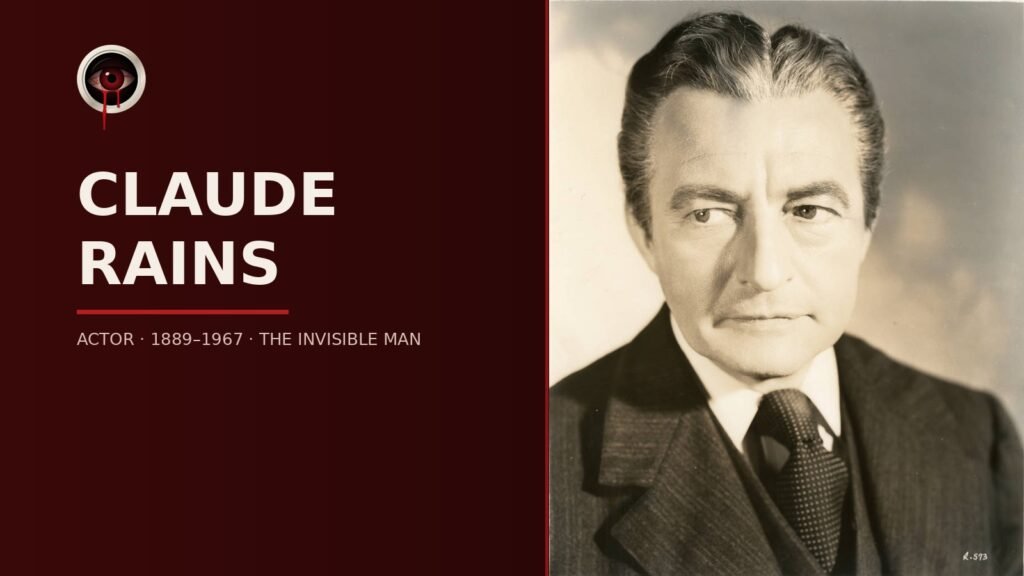
Claude Rains (1889–1967) was a British actor — the voice of The Invisible Man, Captain Renault, and Sir John Talbot of The Wolf Man.
Claude Rains became a movie star in a film where the audience cannot see him. Bandaged, then invisible, then a voice in empty rooms, he carried a Universal horror picture on diction alone — and then spent thirty years proving the voice was attached to one of the finest actors the screen ever had: four Academy Award nominations, the definitive Captain Renault, a Tony Award, and a trio of classic-monster roles no other actor matches for range. He was British-born, war-wounded, and a teacher before he was a star; John Gielgud and Charles Laughton were his pupils. This page is his record, with the famous claims printed only as firmly as the record allows.
Quick Specs
Born: 10 November 1889, Clapham, London (full name William Claude Rains)
Died: 30 May 1967, Laconia, New Hampshire, aged 77 — abdominal haemorrhage
Known for: The Invisible Man (1933), Casablanca (1942), The Wolf Man (1941), Notorious (1946)
Awards: four Academy Award nominations (no wins); Tony Award winner, 1951
Citizenship: British; naturalized American in 1939
The Voice, and What It Cost
Rains grew up poor in South London, in and around the theatre — his father, Fred Rains, was a stage actor — and he came up through the theatre’s trades: child extra in Sweet Nell of Old Drury at the Haymarket in 1900, then call boy, prompter, stage manager, understudy, and finally actor. The raw material was unlikely: a Cockney accent and a speech impediment. Sir Herbert Beerbohm Tree, the great actor-manager, recognized the talent and paid for the elocution books and lessons himself; Rains practised daily until both were gone. His daughter Jessica later described the result as a unique instrument, “half American, half English and a little Cockney thrown in.” At the outbreak of the First World War he returned from New York theatre work and was commissioned into the London Scottish, alongside fellow actors Basil Rathbone, Ronald Colman, Herbert Marshall and Cedric Hardwicke. In November 1916, at Vimy, a gas attack permanently cost him about 90 percent of the vision in his right eye and damaged his vocal cords; he served out the war in a transport battalion and finished a captain. Print both halves of the voice’s story — Tree’s training and the war damage — because neither half is the whole of it, and the legend that “the gas gave him his voice” is a gloss, not a fact.
Teacher, Stage Star, and One Silent Film
Between the wars Rains became a leading West End actor — the title role in John Drinkwater’s Ulysses S. Grant, Sheridan’s The Rivals — and, in his early London years, a teacher at the Royal Academy of Dramatic Art. He did not graduate from RADA; he taught there, and his students included John Gielgud and Charles Laughton, whose professional stage debut came in Rains’s 1926 production of The Government Inspector. (Laurence Olivier is sometimes listed among the pupils; his documented training was elsewhere, and this page does not print it.) His actual film debut came and went almost unnoticed: the British silent Build Thy House (1920), a single supporting role — his only silent film. By 1927 he was in New York, playing nearly twenty Broadway roles with and around the Theatre Guild. The road to horror runs through a failed screen test: his 1932 test for RKO’s A Bill of Divorcement failed as a test but, in the biographies’ standard account, was overheard playing in the next room — and the voice got him the role that made him.
The Invisible Man (1933)
State the debut precisely: The Invisible Man was Rains’s American film debut and his talking-picture debut — at 43, in a starring title role carried almost entirely by voice. Universal’s picture — directed by James Whale, from H. G. Wells’s 1897 novel — had been developed for Boris Karloff, who stayed attached through years of script trouble until the trade papers reported him definitively out in May–June 1933, with Variety citing salary issues; TCM’s account adds that Whale refused the studio’s preference and chose Rains because he wanted an actor with “a cultured voice.” Rains plays Dr. Jack Griffin, a chemist whose invisibility drug, monocaine, has also driven him mad — swathed in bandages and dark goggles at the village of Iping, then stripped bare and gone entirely, derailing trains and promising murders while the police hunt a voice. The invisibility method, as TCM describes it, was almost insultingly simple: the actor dressed head to toe in black against a black background. And the correction this page insists on: Rains is not absent from the screen. Shot and dying, Griffin tells Flora, “I meddled in things that man must leave alone” — and as he dies his body becomes visible again. That deathbed moment is the only time Claude Rains’s face is seen in the film, and it lands like a curtain call. The picture was a great financial success, counted by the New York Times among the best films of 1933, and was selected for the National Film Registry in 2008. Universal tried to steer its new star into a horror career; Rains resisted typecasting and took the varied road instead. Per his daughter, it was also the only one of his films he ever watched — he would not watch rushes, she said, because his huge face on the huge screen horrified him.
The Warner Years and the Four Nominations
Rains signed with Warner Bros. in 1935 and became one of the studio’s busiest character players, loaned out for some of his biggest roles; he credited Michael Curtiz with teaching him “what not to do in front of a camera,” the understatement that defines his screen style. Prince John in The Adventures of Robin Hood (1938) announced the mature Rains — smooth, amused, dangerous. Then the nominations, all four in Best Supporting Actor, and this page lists them exactly because the record is four and no more: the corrupt but honourable Senator Paine in Mr. Smith Goes to Washington (1939); Captain Louis Renault in Casablanca (1942) — the cynical, charming Vichy police chief who rounds up the usual suspects, the role the world knows him by; Job Skeffington in Mr. Skeffington (1944), one of his four films with Bette Davis, who named him her favourite co-star in her 1987 memoir; and Alexander Sebastian, the refugee Nazi in love with Ingrid Bergman’s character, in Alfred Hitchcock’s Notorious (1946). He never won. In between sit The Sea Hawk (1940), the heavenly Mr. Jordan of Here Comes Mr. Jordan (1941), the Devil himself in Angel on My Shoulder (1946), and Julius Caesar in Gabriel Pascal’s Caesar and Cleopatra (1945), a role George Bernard Shaw reportedly chose him for personally. Of that film’s famous salary claim, print only this: Rains is widely credited as the first actor to receive a million-dollar salary for a single picture — a claim repeated by biography after biography, whose primary documentation this page has not seen and therefore does not assert.
Sir John Talbot and the Phantom
His other classic-monster roles bookend the Invisible Man with two kinds of pathos. In The Wolf Man (1941) — Universal’s second werewolf picture, after Werewolf of London, and no sequel to it — Rains is Sir John Talbot, the father: not the monster, and not a doctor (the film’s doctor is Warren William’s Dr. Lloyd). Sir John is the story’s voice of reason in Llanwelly, Wales: werewolves are superstition, his son Larry’s belief is delusion, and to prove it he ties the distraught young man to a chair for the night. Larry transforms anyway, attacks Gwen — and Sir John beats the wolf to death with Larry’s own silver-headed cane, then watches Maleva’s spell turn the dead animal back into his son’s corpse. It is the film’s tragic hinge, and it is Rains’s scene as much as Lon Chaney Jr.‘s; the picture stands at 91% on Rotten Tomatoes from 43 reviews. Sir John exists in the 1941 film only — Rains never returned to the series, nor to any Invisible Man sequel. And in Phantom of the Opera (1943), Universal’s Technicolor remake, he took the title role himself: Erique Claudin, the disfigured music-lover haunting the Paris Opera. Heard but not seen; the father who must kill the monster; the monster played for pity — three corners of the classic Universal cycle, anchored by one actor.
Stage Triumph, Final Years, Death
In 1951 Rains returned to Broadway as Rubashov in Darkness at Noon and won the Tony Award for Best Actor in a Play — the major competitive win of his career, collected at 61. His own summary of the craft, given to interviewers: “I learn the lines and pray to God.” The later years held the Enoch Arden recording with Glenn Gould (Grammy-nominated, 1962), a Hollywood Walk of Fame star (1960), Mr. Dryden in Lawrence of Arabia (1962), and his final film, King Herod the Great in The Greatest Story Ever Told (1965). He had become an American citizen in 1939; he farmed seriously in Pennsylvania between films for fifteen years; he was married six times, five ending in divorce, and his only child — born Jennifer Rains in 1938, an actress under the name Jessica Rains — is the source of several of this page’s best-attributed family details. His final years were spent in Sandwich, New Hampshire. Claude Rains died of an abdominal haemorrhage in Laconia, New Hampshire, on 30 May 1967, aged 77, and was buried at Red Hill Cemetery, Moultonborough. Gielgud, his old pupil, delivered the profession’s verdict: the London stage’s loss was the cinema’s gain, and the virtuosity he had witnessed as a young actor was now “there for audiences everywhere to see for all time.”