
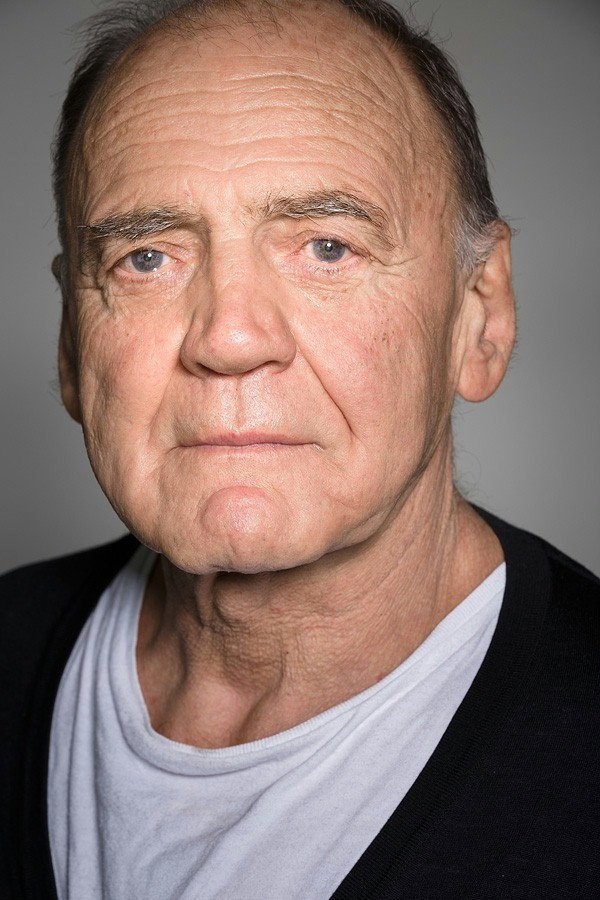
Bruno Ganz (1941 to 2019) was the Swiss actor who played Jonathan Harker in Nosferatu the Vampyre, the angel Damiel and Hitler in Downfall.
Quick Specs
| Born | March 22, 1941, Zurich, Switzerland |
| Died | overnight on February 15 to 16, 2019, at his home in Au, Wädenswil, near Zurich, aged 77 |
| Stage | co-founding member of Peter Stein’s Schaubühne ensemble in Berlin (1970); Faust in Stein’s complete, roughly 21-hour staging (2000) |
| Horror centerpiece | Jonathan Harker in Werner Herzog’s Nosferatu the Vampyre (1979) |
| Second horror role | Verge, the poet Virgil, in Lars von Trier’s The House That Jack Built (2018) |
| Other key films | The American Friend (1977), The Boys from Brazil (1978), Wings of Desire (1987), Downfall (2004), The Reader (2008) |
| Honors | holder of the Iffland Ring (1996 to 2019); David di Donatello Award for Bread and Tulips; European Film Award (2004); an asteroid, 199900 Brunoganz, named for him |
Who He Is
Bruno Ganz was born in Zurich on March 22, 1941, the son of a Swiss factory worker and a northern Italian mother. “As a boy I was morbidly shy,” he once said. He decided to act after a friendly lighting technician let him into a local theater, and his family opposed it. He left school to study acting in Zurich, supporting himself as a bookseller and a trainee paramedic, and got his first film role at 19, as a hotel bellboy in Der Herr mit der schwarzen Melone (1960). It went nowhere, and his film career proper waited another sixteen years.
He gave his life to the stage instead, and to Germany: the Junges Theater Göttingen in 1962, then Theater Bremen from 1964, where he worked with Peter Zadek, Kurt Hübner and Peter Stein. Stein’s Torquato Tasso, with Ganz in the title role, made him a star for a new generation of theatergoers.
He married Sabine in 1965. They separated but never divorced, and their son Daniel was born in 1972. In later life his partner was the theater photographer Ruth Walz.
The Work, and What He Did in It
In 1970 Ganz was a co-founding member of Peter Stein’s famously radical ensemble at Berlin’s Schaubühne am Halleschen Ufer, a theater that had existed since 1962. He stayed until 1975. In 1972 he played the Doctor in the Salzburg Festival world premiere of Thomas Bernhard’s Der Ignorant und der Wahnsinnige, directed by Claus Peymann, and Theater heute named him Actor of the Year in 1973. He played Hamlet at 24 and again in his early forties.
Film finally took in 1976, with Stein’s Summerfolk and Éric Rohmer’s The Marquise of O, in which he played the Russian Count. In Wim Wenders’s The American Friend (1977), from Patricia Highsmith’s Ripley’s Game, he is Jonathan Zimmermann, a terminally ill picture framer whom Dennis Hopper’s Tom Ripley draws into working as a hired killer. In The Boys from Brazil (1978) his role is small but holds up the plot: he is Professor Bruckner, the cloning expert Laurence Olivier’s Nazi hunter consults, who confirms that a person could in principle be grown from a scraping of skin. That’s the clue that reveals the identical boys as clones of Hitler.
Nosferatu the Vampyre (1979) is his horror landmark. Werner Herzog, who considered F. W. Murnau’s 1922 Nosferatu the greatest film ever made in Germany, remade it once Dracula had entered the public domain, restoring Bram Stoker’s names, and called it a bridge between Expressionist cinema and the New German Cinema. Ganz plays Jonathan Harker, an estate agent in Wismar sent by his employer Renfield to sell Count Dracula (Klaus Kinski) a house, leaving his wife Lucy (Isabelle Adjani) behind. Herzog swapped Stoker’s names, so Harker’s wife here is Lucy, not Mina.
Ganz’s Harker gets an arc no other Harker gets. Held prisoner in the castle, he cuts his thumb at Dracula’s table and is fed on. He escapes, sickens, and comes home unable to recognize Lucy, complaining that the sunlight hurts. After Lucy has sacrificed herself and Dracula is dead, Jonathan rises as a vampire himself. He has Van Helsing arrested for the Count’s “murder,” orders the consecrated Host swept away from around his chair, announces he has much to do, and rides off in Dracula’s black. For almost the whole film he is human; Ganz plays the spread of evil, not just a witness to it.
The production had its own legends. For distributor 20th Century Fox, most of the dialogue scenes were shot twice, once in German and once in English, so Ganz and Kinski played their parts in both languages; Herzog later called the German version the more authentic. The crew numbered just 16. Delft stood in for Wismar, and Czechoslovakia, with Pernštejn Castle, for Transylvania. When Delft refused to let Herzog release 11,000 rats, those scenes were shot in nearby Schiedam. The white laboratory rats came from Hungary and were dyed grey. The Dutch biologist Maarten ’t Hart, hired to handle them, quit over their treatment and said the dyeing killed about half of them; Herzog has said no rat was lost during the filming itself. Kinski spent about four hours a day in Reiko Kruk’s Orlok-inspired makeup and, by Herzog’s account, was remarkably patient about it. The film won a Silver Bear at Berlin for its production design, and Roger Ebert gave it four stars. It was Ganz’s only film with Herzog.
The 1980s and 1990s brought range: a war correspondent in Beirut in Volker Schlöndorff’s Circle of Deceit (1981), a sailor adrift in Lisbon in Alain Tanner’s In the White City (1983), and the career’s other pole, Damiel in Wenders’s Wings of Desire (1987). Damiel is one of the angels drifting unseen through divided Berlin, listening to people’s thoughts and comforting the dying, who falls in love with a trapeze artist and gives up immortality to become human. “I know now what no angel knows,” he says. Ganz played Damiel again in Faraway, So Close! (1993). He was a dying writer in Theo Angelopoulos’s Palme d’Or winner Eternity and a Day (1998) and won the David di Donatello Award as a quiet, poetic waiter in Bread and Tulips (2000). The summit of his stage career came in 2000: the title role in Peter Stein’s complete staging of Goethe’s Faust, both parts, about 21 hours long, at Expo 2000 in Hanover. He was injured in rehearsals, which delayed his start in the role.
In Oliver Hirschbiegel’s Downfall (2004) he played Adolf Hitler in his last days in the Berlin bunker. He was Hirschbiegel’s first choice and took about a month to say yes: “you will be identified with the one who played Hitler and that’s not easy.” What persuaded him was seeing Albin Skoda play Hitler in The Last Ten Days (1955), which convinced him it was possible. He spent four months preparing. He studied the secret 1942 recording of Hitler talking privately with Finland’s Marshal Mannerheim, the only known recording of Hitler’s ordinary speaking voice, which was “deeper, lower, than his screaming shouting voice,” and in which “he came from Austria.” An Austrian actor coached him on the dialect. From newsreels he decided Hitler had Parkinson’s disease, after noticing the hidden left hand trembling behind his back, and he sat in a hospital watching patients with the disease “for hours.” He did nothing to his face: “Nothing. Nothing.” One critic called it “the most convincing screen Hitler yet,” and Joachim Fest, whose book the film draws on, said simply, “That really is Hitler.” The film was nominated for the Oscar for Best Foreign Language Film. His bunker tirade later escaped the film to become the endlessly re-subtitled “Hitler Rant” parodies, starting in 2006.
In The Reader (2008) he played Professor Rohl, the law professor who takes his seminar to the war-crimes trial where Michael finds his former lover Hanna in the dock. The same year he was police chief Horst Herold in The Baader Meinhof Complex. He was a former Stasi man in Unknown (2011), the Diamond Dealer in Ridley Scott’s The Counselor (2013), the grandfather in Heidi (2015) and Sigmund Freud in The Tobacconist (2018).
His last horror role mirrors his first. In Lars von Trier’s The House That Jack Built (2018), Matt Dillon’s serial killer narrates his murders to an unseen listener who turns out to be Verge: Virgil, Dante’s guide through the Inferno. Ganz is a voice for almost the whole film, questioning and needling Jack, and appears on screen only in the closing “Katabasis,” leading him down into Hell. He played Judge Lueben in Terrence Malick’s A Hidden Life, one of his last films, which premiered at Cannes three months after his death.
Cool Verified Facts
- For 23 years he held the Iffland Ring, a diamond-studded ring owned by the Republic of Austria and passed down for life to the actor its holder judges the most significant and most worthy in German-language theater. Josef Meinrad left it to him in 1996, to the disappointment of many at Vienna’s Burgtheater.
- Each holder writes down his successor’s name in secret. Ganz first chose Gert Voss, who died in 2014. After Ganz’s death, officials in Vienna opened the safe and found his second choice: Jens Harzer. “Of course, I am not the most worthy actor of my generation or whatever. Never,” Harzer said, but the ring was “a subjective choice, by a great actor. That makes this strange ring almost likable.”
- He also performed as a narrator in classical music, including Luigi Nono’s Il canto sospeso with the Berlin Philharmonic in 1993.
- Asteroid 199900 Brunoganz, discovered in 2007, is named after him.
Signatures, Habits and Behind the Scenes
He kept Hitler at arm’s length on purpose. It was “useful to be able to put my Swiss passport between my heart and Mr Hitler, so that he couldn’t touch me,” he said. He described himself as the opposite of a Method actor: “You have to construct a wall or an iron curtain that when it’s a wrap it’s gone. I don’t want to spend my evenings at the hotel and dinner with Mr Hitler at my side… I’m not a method actor.” He drew a line on understanding the man, too: “I cannot claim to understand Hitler,” and, “We know how to judge Hitler. We don’t need another film that condemns him.”
The curtain slipped once. Shooting street scenes in St. Petersburg, a city that suffered terribly in the wartime blockade, he walked from his trailer to the set in full costume: “people stared at me. I was very ashamed and I felt terrible.” He’d seen the resemblance long before, in a rehearsal room, when he added a small moustache to a sailor’s costume: “Jesus Christ, you look like Hitler.”
Wings of Desire left him the opposite reputation. “People in planes said: ‘Ah, no need to be afraid because, with you here, nothing can happen,'” he recalled, and a mother told her child, “Look, there’s your guardian angel.” “They weren’t joking.” As he put it: “In some way, I became an angel, and who except me has experienced that in his lifetime?”
His friendship with Dennis Hopper began with a fistfight in the first week of The American Friend. Ganz admitted he had been “jealous because [Hopper] was a Hollywood star and I was nothing, really”; Wenders said the fight “cleared things up, and they got along fine in the end.”
In February 2018 doctors in Salzburg found he had intestinal cancer, and he began chemotherapy at once; that summer he pulled out of the Salzburg Festival. He died overnight on February 15 to 16, 2019, at his home near Zurich, with his son and Ruth Walz with him, a month short of his 78th birthday. He is buried in Zurich’s Rehalp cemetery.
Why He Matters
Bruno Ganz holds both poles: Damiel, who gives up eternity for a cup of coffee and a woman’s love, and Hitler, studied for four months down to a trembling left hand. For horror fans the span is wider still. He was Nosferatu’s victim, the ordinary, decent Harker whose corruption is the film’s real horror ending, and at the end of his life he was the guide who walks a murderer into Hell.
Herzog built his Nosferatu as a bridge back to Murnau, and Ganz is the human center of it. Downfall set the modern standard for playing a real monster without caricature, and its reach is measured in the parodies that made his performance the world’s default image of Hitler in a rage. And his own profession gave its verdict: 23 years holding the Iffland Ring, passed from one actor to the next and kept in a safe in Vienna.