
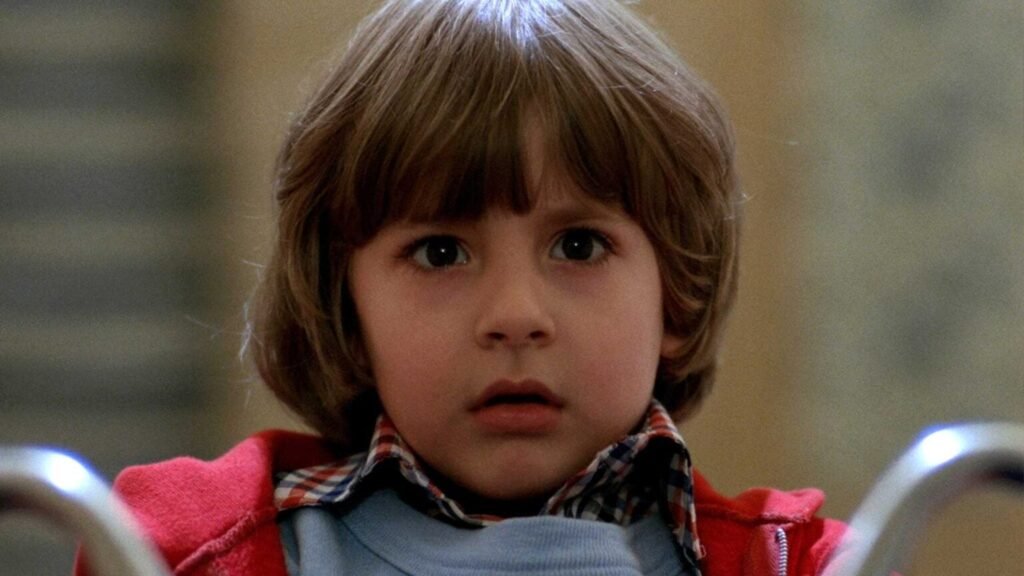
Danny Torrance is Stephen King’s psychic child from The Shining, who returns as the adult hospice worker Dan in Doctor Sleep.
Quick Specs
| Full name | Daniel Anthony Torrance; Dan as an adult |
| Created by | Stephen King, in The Shining (novel, 1977) |
| Parents | Jack and Wendy Torrance |
| Gift | The shining, named by the Overlook’s cook, Dick Hallorann |
| Age at the Overlook | Five in King’s novel; a young child, age unstated, in Kubrick’s film |
| The room | Room 217 (novel, 1997 miniseries); Room 237 (Kubrick’s film, Flanagan’s film) |
| Played by | Danny Lloyd (The Shining, 1980); Courtland Mead, with Wil Horneff as Tony and the older Danny (miniseries, 1997); Ewan McGregor, with Roger Dale Floyd as young Danny (Doctor Sleep, 2019) |
| Sequel | Doctor Sleep (novel, 2013; film, 2019) |
| Fate in Doctor Sleep | Survives in the novel; dies destroying the Overlook in the film |
| Signature | REDRUM |
Who He Is in Canon
Danny Torrance lives in more than one version, and the versions disagree. There are King’s novels, The Shining (1977) and Doctor Sleep (2013). There are the films, Stanley Kubrick’s The Shining (1980) and Mike Flanagan’s Doctor Sleep (2019), which sets out to reconcile King with Kubrick. And there is the 1997 television miniseries, written by King himself and faithful to his novel. On this page every claim about Danny carries its version, because a fact true in one is often false in another.
He is Daniel Anthony Torrance in every version, the son of Jack and Wendy Torrance, and as an adult he goes by Dan. He is five years old at the Overlook in King’s novel. Kubrick’s film never states his age: he is simply a small child.
His gift is the same everywhere. Dick Hallorann, the Overlook’s cook, who has a weaker version of it, calls it “the shining”: reading thoughts and feelings, talking mind to mind with others who shine, and seeing visions of what is coming and what has already happened, often terrifying ones. In the novel Hallorann tells him his is the strongest shine he has ever met. The hotel shines too, with the residue of its dead, and Danny’s power is why it wants him: in the novel’s terms, the Overlook means to absorb his gift and works through Jack to get it. In Doctor Sleep, in both versions, the same gift in children is what the True Knot feed on, and they call it “steam.”
Tony is the “imaginary friend” through whom many of the visions arrive, and he is a different thing in each version:
- The novel: an unseen presence who becomes a visible older boy, and is revealed near the end as Danny himself, ten years on, his name taken from Danny’s middle name, Anthony.
- Kubrick’s film: never shown and never explained. Danny speaks as Tony by wagging his crooked index finger in a croaking voice, and tells Hallorann that Tony is “a little boy that lives in my mouth.”
- The miniseries: shown on screen as a glowing, translucent teenager played by Wil Horneff, who then plays the older Danny, which makes the future-self identity explicit.
The family wound comes before the story starts. Jack, a writer and recovering alcoholic, hurt his small son in a drunken rage. In the novel he broke Danny’s arm. In Kubrick’s film Wendy tells a doctor he dislocated Danny’s shoulder: “it was an accident.” In both, the injury is why Wendy fears Jack, why Jack hates himself, and why Danny’s shine keeps picking up his parents’ thoughts about divorce.
Wendy is his protector in every version. She shields him through the climax and escapes the Overlook with him every time.
Hallorann is his first ally. The two recognise each other at once as shiners. Hallorann warns him about the hotel, tells him the things he sees are like pictures in a book that cannot hurt him, and tells him to call, mind to mind, if he is ever in trouble. Danny does call. What happens next depends on the version, and it is covered below.
The adult Dan, in both versions of Doctor Sleep, repeats his father before he escapes him: years of drifting, rage and drinking to dull the shine, then sobriety through AA in Frazier, New Hampshire, and work as a hospice orderly, where the gift comes back in the service of the dying. His friend and AA ally there is Billy Freeman. Hallorann taught him to build lockboxes in his mind, and he keeps the Overlook ghosts that followed him locked inside them.
Only the novel of Doctor Sleep gives him more family. There Dan learns that Jack fathered a daughter, Lucy, in an affair before the Overlook. That makes Lucy his half-sister, and her daughter, Abra Stone, whose shine is stronger than his own, his niece. Flanagan’s film drops the relationship entirely: Abra calls him “Uncle Dan” only as a cover story, so that a grown man talking to a young girl in public does not look suspicious.
Work by Work
The Shining, King’s novel (1977). Five-year-old Danny, already reading his parents’ unspoken thoughts through Tony, goes to the Overlook for the winter. He meets Hallorann, is warned about the hotel and about Room 217, and sees the hotel’s dead: the woman in the tub, the leftovers of old parties, the topiary animals that move. He goes into Room 217 with a passkey, and the dead woman strangles him, leaving bruises Wendy first believes Jack made. He understands before either parent that the hotel is taking his father. In the climax the possessed Jack hunts the family with a roque mallet and injures Wendy and Hallorann. Then Jack’s love breaks through long enough to tell Danny to run, Danny reminds the Jack-thing about the neglected boiler, and the hotel dies trying to save itself.
- Status at the end, novel: Danny is alive. He escapes with Wendy and Hallorann, who lives. The Overlook is destroyed, and Jack dies in the blast, redeemed in his last moment. The book closes on a summer in Maine, with Hallorann comforting Danny over his father’s death.
The Shining, Kubrick’s film (1980). Danny Lloyd’s Danny is quieter and less talkative than the novel’s child. He rides his tricycle through the empty hotel and receives Tony’s visions: the Grady girls, the elevator of blood, REDRUM. He goes into Room 237, and what happens inside is not shown; he comes out with torn clothes and bruises on his neck. He shines a desperate call to Hallorann, who arrives and is killed by Jack with an axe. Danny outwits his father in the hedge maze by backtracking through his own footprints in the snow, and escapes with Wendy in Hallorann’s snowcat.
- Status at the end, Kubrick’s film: Danny is alive and escapes with Wendy. Hallorann is dead. Jack freezes to death in the maze, and the Overlook is still standing.
Stephen King’s The Shining, the miniseries (1997). Courtland Mead plays the child Danny, and Wil Horneff plays Tony and the older Danny, in King’s fuller adaptation. Room 217 and the topiary animals are back, and Steven Weber’s Jack gets the novel’s slow, alcoholic decline. The climax follows the novel, boiler, explosion and a surviving Hallorann, and gives Jack an explicit, conscious act of self-sacrifice and a psychic goodbye to his son.
- Status at the end, miniseries: Danny is alive and escapes with Wendy and Hallorann, and the Overlook is destroyed. The miniseries adds an epilogue the novel does not have: ten years later Danny graduates from high school while Jack’s peaceful ghost watches.
Doctor Sleep, King’s novel (2013). Dan bottoms out as a drinking drifter, gets sober in Frazier and works in a hospice, where, helped by a cat that knows who is about to die, he uses the shine to sit with the dying and ease them out. The patients call him Doctor Sleep, which is where the title comes from. Abra Stone reaches him by telepathy, and the True Knot, psychic vampires led by Rose the Hat who torture shining children and breathe in their steam to live, are hunting her. Dan learns she is his niece and fights beside her family and Billy Freeman. The last battle is not in the Overlook, which is long gone, but on its old grounds, now a True Knot campsite. Rose is killed with help from Billy, Abra’s projected presence and the ghost of Jack Torrance, who waves goodbye, at peace.
- Status at the end, novel: Dan is alive, 15 years sober, at Abra’s 15th birthday party, her acknowledged uncle and mentor, and he goes back to the hospice to comfort a dying man.
Doctor Sleep, Flanagan’s film (2019). Ewan McGregor plays Dan, with Roger Dale Floyd as young Danny in flashbacks set in Kubrick’s continuity, where Hallorann is dead and the Overlook still stands. The film follows the novel’s recovery story, Frazier, AA, Billy, the hospice and the nickname, with the lockboxes taught by Hallorann’s spirit, until Abra (Kyliegh Curran) pulls him into the war with the True Knot and Rose the Hat (Rebecca Ferguson). Its departures pile up in the last act. There is no niece reveal. Billy dies, and so does Abra’s father. Dan and Abra lure Rose to the condemned, still-standing Overlook. Dan opens his lockboxes, and the released ghosts devour Rose. Then the hotel possesses him. He reaches the boiler room, stops the hotel from venting it, sees young Danny comforted by Wendy, and dies as the Overlook burns, King’s ending for the hotel delivered in Kubrick’s building. Afterwards his spirit talks with Abra, who takes up his work.
- Status at the end, Flanagan’s film: Dan is dead, sacrificed to destroy the Overlook, and lives on as a kind spirit in touch with Abra.
So the hotel’s fate runs in a circle. It explodes in the novel and the miniseries, stands frozen at the end of Kubrick’s film, and burns one film late, in Doctor Sleep, when Dan dies destroying it.
The Real-world Layer
Stephen King created Danny for The Shining, his third novel, and brought him back as the adult lead of Doctor Sleep. King has said the sequel began with people asking him what happened to Danny after the Overlook. The full name, Daniel Anthony Torrance, and the Tony and Anthony wordplay are his construction.
Danny Lloyd, from Illinois, was cast at about five or six after his father sent his photo to a casting call for a boy with no acting experience. Kubrick chose him for his ability to concentrate for long stretches. The Shining was effectively his only feature. His other screen credit is the young G. Gordon Liddy in the 1982 television film Will: The Autobiography of G. Gordon Liddy, and after that the auditions dried up and he left acting at about 13 or 14.
Kubrick shielded him from what the film was. Lloyd believed he was making a drama about a family living in a hotel. He was shown only heavily edited, unfrightening footage and kept off the set for the frightening scenes, and he remembers missing the whole of Scatman Crothers’ axing. A life-size dummy stood in for him when Wendy carries Danny while confronting Jack. He did not see the full film until years later. He remembers Kubrick warmly, from games of catch to an Easter egg hunt on set, and he was promised the tricycle as a wrap gift. By his own account it never arrived.
He went on to farm work to pay his way through university, studied biology, and in 2004 became a biology professor at Elizabethtown Community and Technical College in Kentucky. He is married with four children, keeps the role out of his classroom, and has always described the experience as a good one. In 2019 Flanagan contacted him directly, and he came back for a one-day cameo in Doctor Sleep, as a spectator at a baseball game.
The miniseries, Stephen King’s The Shining, aired on ABC from April 27 to May 1, 1997. Mick Garris directed from King’s own teleplay, with Steven Weber as Jack, Rebecca De Mornay as Wendy, Courtland Mead as Danny, Wil Horneff as Tony and the older Danny, and Melvin Van Peebles as Hallorann. It was shot at the Stanley Hotel in Colorado, the novel’s inspiration, and it exists because King was unhappy with Kubrick’s film.
The room number changed for a real-world reason. Timberline Lodge, the film’s exterior location, asked Kubrick not to use its real Room 217, so his film’s room is 237.
Ewan McGregor’s casting as the adult Dan was reported by Variety in June 2018, with Variety’s sources saying King had blessed it. In the same film Alex Essoe plays Wendy in the recreated scenes, Carl Lumbly plays Hallorann, and Henry Thomas plays the Bartender, an apparition with Jack Torrance’s face. Thomas plays Jack, not Danny.
King’s view of Kubrick’s film is his own, and it is famously low. He called it “a big, beautiful Cadillac with no engine in it.” Of Jack Nicholson’s Jack he told Deadline in 2016 that there is “no arc… when we first see Jack Nicholson… he’s crazy as a sh--house rat. All he does is get crazier.” He has complained of the film’s coldness toward the family and criticised its Wendy in the strongest terms. That is King’s stated opinion, not the critical consensus; the film’s standing with critics and audiences runs the other way, and the contrast is part of the story.
Mike Flanagan set out to end that argument. He has said his Doctor Sleep adapts King’s novel but “also exists very much in the same cinematic universe that Kubrick established,” and that “reconciling those three, at times very different, sources” was the most challenging and thrilling part of the job. King at first resisted bringing back Kubrick’s Overlook. By Flanagan’s account, after reading the script King told him: “Everything that I ever disliked about the Kubrick version of The Shining is redeemed for me here.”
Doctor Sleep grossed $72.4 million worldwide against a reported budget of $45 million to $55 million, and the trade reporting described it as a disappointment that ended plans for follow-up projects.
Signatures and Iconography
REDRUM is his word, in every version. It is Tony’s warning, croaked over and over, written in lipstick on the bathroom door and finally read in the mirror as MURDER. In the novel it is one of Tony’s earliest omens. In Kubrick’s film it is the centre of the sequence in which Wendy finds out the truth. It is the most reproduced Danny moment in popular culture, and one of the few that belongs to every version.
The tricycle belongs to Kubrick. The low, gliding shots of Danny pedalling his big-wheel trike through the Overlook’s corridors, the wheels hushed on carpet and loud on hardwood, are the film’s signature image of him. They are a film creation, not a scene from the novel.
Tony’s finger and voice are Kubrick’s too. The crooked, wagging finger and the croak are the film’s entire picture of the imaginary friend, and the gesture audiences imitate.
“Danny’s not here, Mrs. Torrance” is the line. In the REDRUM sequence Wendy tries to wake him and Tony answers through him: “Danny’s not here, Mrs. Torrance… Danny can’t wake up, Mrs. Torrance… Danny’s gone away, Mrs. Torrance.” The widely quoted “Danny isn’t here anymore” is a paraphrase.
The lockboxes are the adult Dan’s signature, in both versions of Doctor Sleep: the boxes he built in his mind, on Hallorann’s teaching, to imprison the Overlook’s ghosts. The film makes them literal when he opens them and lets the hungry dead loose on Rose. They are the adult answer to Tony: the childhood gift, turned into a weapon by discipline.
Doctor Sleep himself is the counter-image. The hospice scenes, the cat, the quiet room, Dan holding a dying stranger’s hand and shining them somewhere peaceful to go, reverse the child’s story. Everything the boy received was terror. Everything the man gives is comfort.
Why He Matters
He is the child who carries the novel. Danny is not The Shining’s victim but its perceiving centre: the book runs the Overlook’s horror, and both of his parents’ inner lives, through a five-year-old’s telepathy. The critic Heidi Strengell argues that King’s children “are able to deal with fantasy and terror on their own terms better than adults because of the size of their imaginative capacity and their unique position in life.” The standing complaint is on the record too: one reference work finds his maturity improbable for five.
Tony is the trope made literal. Dale Bailey reads the novel’s Tony as “a projection of Danny’s mind, giving voice to anxieties which otherwise transcend his understanding,” and the name chain backs him: Mark Anthony, John Daniel, Daniel Anthony. Danny is horror’s defining psychic child whose imaginary friend turns out to be himself, older, trying to save himself, and later children with a gift are measured against him.
He is the survivor who gets a sequel about surviving. Doctor Sleep brings him back in middle age not for another haunting but for a recovery story: alcoholism inherited and refused, and the gift turned into end-of-life care. The Guardian praised the novel’s Dan for capturing “the reality of a recovering alcoholic, a state with which King is intimately familiar,” and King has said he wanted to show Dan avoiding becoming his parents. The child the hotel tried to eat becomes the man who sits with the dying, an arc told across 36 years of King’s novels, from 1977 to 2013.
And there are two Dannys. Lloyd’s near-silent, finger-voiced child and the novel’s talkative prodigy are different creations, and scholarship on the film notes that his screen quietness, partly the practical limit of a child actor, increased the suspense. A page that describes only one Danny has covered half of his life in the culture, which is why this one keeps every version apart.