
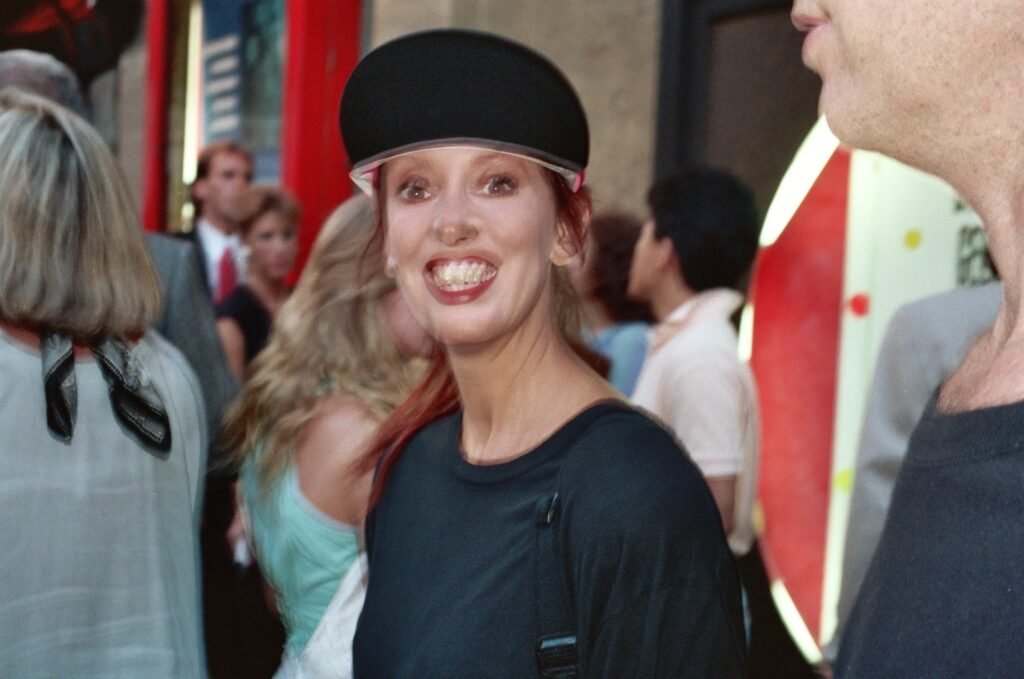
Shelley Duvall (1949 to 2024) was the American actress who played Wendy Torrance in The Shining and created the television series Faerie Tale Theatre.
Shelley Duvall had never acted a day in her life when members of Robert Altman’s crew walked into a Houston party posing as art buyers. Ten years later she was backing up the Overlook’s staircase with a baseball bat, facing down Jack Nicholson, and screaming at a bathroom door he was splitting with an axe, in a performance people are still arguing about. The argument has mostly settled in her favour, and it took far too long.
Quick Specs
| Born | July 7, 1949, Fort Worth, Texas (as Shelley Alexis Duvall) |
| Died | July 11, 2024, Blanco, Texas, aged 75, of complications of diabetes |
| Horror centrepiece | Wendy Torrance in The Shining (1980), directed by Stanley Kubrick |
| Discovered by | Robert Altman, who cast her in Brewster McCloud (1970); seven films together, ending with Popeye (1980) |
| Major prize | Best Actress at Cannes in 1977 for 3 Women, shared with Monique Mercure |
| Other honours | Los Angeles Film Critics Best Actress (3 Women); BAFTA nomination; a Peabody Award for Faerie Tale Theatre; two Emmy nominations as a producer; Texas Film Hall of Fame (2020) |
| Producer | Created and hosted Faerie Tale Theatre (Showtime, 1982 to 1987); companies Platypus Productions and Think Entertainment |
| Final film | The Forest Hills, released October 4, 2024, three months after her death |
| Partner | Musician Dan Gilroy, from 1989 until her death |
| Marriage | Artist Bernard Sampson, 1970 to 1974 |
Who She Was
Shelley Alexis Duvall was born on July 7, 1949, in Fort Worth, Texas, the eldest of four children, with three younger brothers, Scott, Stewart and Shane. The Handbook of Texas reports that she was named after Mary Shelley, the author of Frankenstein. Her mother’s nickname for her was “Manic Mouse.”
Her father, Robert Richardson Duvall, was a cattle auctioneer who became a criminal defence lawyer. Her mother, Bobbie Ruth Duvall, was a real estate broker. She was no relation to the actor Robert Duvall. By her own account, the family lived in hotels around Texas for her first five years while her father travelled for work, and she was raised mostly in Houston.
She graduated from Waltrip High School in 1967, worked a sales job at Foley’s department store, then studied at South Texas Junior College, majoring in nutrition and diet therapy with a science career in mind.
Then came the party. In 1970 she held a gathering at her home in Houston to sell the paintings of her fiancé, the artist Bernard Sampson. Members of the pre-production crew for Robert Altman’s Brewster McCloud came along, arranged to meet her while posing as art patrons, and after a brief screen test in the rose garden at the Houston Zoo, Altman cast her. She had never acted, and at first she suspected the offer was not respectable. “I thought, ‘Uh oh, a porno movie, my mom’s going to kill me!'” she told the New York Times in 1991.
She married Sampson in 1970, and they divorced in 1974. A relationship with Paul Simon followed in the late 1970s; they met around the time of Annie Hall, in which both appear. In 1989 she met the musician Dan Gilroy, formerly of the Breakfast Club, the band that included an early Madonna, while making the Disney Channel film Mother Goose Rock ‘n’ Rhyme, which she produced and in which he co-starred. They were together for 35 years, until her death, and never married. No children are recorded.
The Work, and What She Did in It
The Altman Years
Altman put her in seven films. His first advice to her, which she quoted all her life, was “Don’t take yourself seriously.” He also told her never to take acting lessons; she told Interview magazine in 1977 that she had tried two at Lee Strasberg’s and quit. “He offers me d-mn good roles,” she told the New York Times that same year. “None of them have been alike. He has a great confidence in me, and a trust and respect for me, and he doesn’t put any restrictions on me or intimidate me, and I love him.”
Her debut, at 21, was Brewster McCloud (1970), Altman’s black comedy shot in Houston, where she plays Suzanne, a tour guide at the Astrodome. In McCabe & Mrs. Miller (1971) she is Ida Coyle, a mail-order bride. Thieves Like Us (1974), opposite Keith Carradine as Keechie, was her first true lead of the run. Nashville (1975), Altman’s biggest ensemble, gave her real visibility as Martha, the “L.A. Joan” figure, and in Buffalo Bill and the Indians, or Sitting Bull’s History Lesson (1976) she played First Lady Frances Cleveland opposite Paul Newman. Between features she starred as Bernice in Bernice Bobs Her Hair (1976), Joan Micklin Silver’s adaptation of the F. Scott Fitzgerald story for PBS’s The American Short Story.
The critical peak was 3 Women (1977). Duvall plays Millie Lammoreaux, a chatty, delusionally romantic attendant at a health spa in a California desert town, who takes in a worshipful teenager, Pinky Rose, played by Sissy Spacek, and orbits a near-silent muralist, Willie (Janice Rule), before the three women’s identities begin to bleed into one another. Altman built the film from a dream and shot it without a conventionally finished screenplay. Roger Ebert called it the best film of 1977. Duvall shared the Best Actress prize at Cannes that May, at 27, with Monique Mercure, won Best Actress from the Los Angeles Film Critics Association, finished runner-up for Best Actress with both the New York Film Critics Circle and the National Society of Film Critics, and was nominated for a BAFTA. The film itself was a commercial disappointment on release and then unavailable on video for almost 30 years.
The same year she played Pam, Alvy’s date, in Woody Allen’s Annie Hall (1977), a small role she made memorable, and she hosted Saturday Night Live. Pauline Kael called her “the female Buster Keaton.” Altman put her range this way: “She was able to swing all sides of the pendulum: charming, silly, sophisticated, pathetic, even beautiful.”
The Shining (1980)
The Shining opened on May 23, 1980. Stanley Kubrick directed and wrote the screenplay with Diane Johnson, from Stephen King‘s 1977 novel, and Warner Bros. distributed. It runs 144 minutes in its US theatrical cut, after Kubrick trimmed a hospital coda following the opening weekend.
Duvall plays Wendy Torrance, the wife of the writer Jack Torrance (Jack Nicholson) and the mother of Danny (Danny Lloyd), wintering as the caretaker’s family at the empty Overlook Hotel. As Jack unravels, Wendy becomes the film’s last line of defence. She finds his manuscript, page after page of “All work and no play makes Jack a dull boy.” She faces him down on the staircase with a baseball bat, locks him in the pantry, survives his axe attack on the bathroom door, the “Here’s Johnny!” scene, and escapes with Danny in the snowcat while Jack freezes in the maze. Scatman Crothers plays Dick Hallorann, with Barry Nelson as Ullman, Philip Stone as Grady and Joe Turkel as Lloyd. She was 30 when it opened.
The film was shot at EMI Elstree Studios in England, with the Overlook’s interiors built on stage and its exteriors taken from Timberline Lodge in Oregon. A shoot planned at roughly 17 weeks ran to about a year; Duvall’s own figure, which she repeated often, was 56 weeks.
Her account of the work is the record that matters, and it has two halves. In her contemporary telling: “In my character, I had to cry 12 hours a day, all day long, the last nine months straight, five or six days a week… I was there a year and a month.” To Roger Ebert in 1980 she called it “almost unbearable.” Speaking to The Hollywood Reporter in 2021, she went further: “After a while, your body rebels. It says: ‘Stop doing this to me. I don’t want to cry every day.’ And sometimes just that thought alone would make me cry. To wake up on a Monday morning, so early, and realize that you had to cry all day because it was scheduled, I would just start crying. I’d be like, ‘Oh no, I can’t, I can’t.’ And yet I did it. I don’t know how I did it. Jack said that to me, too. He said, ‘I don’t know how you do it.'”
Asked in that same interview whether Kubrick had been exceptionally hard on her, she said: “He’s got that streak in him. He definitely has that.” In the same breath she called him “very warm and friendly” to her and said he spent a great deal of time with her and Nicholson. After her death, the Kubrick estate recalled that she “wouldn’t trade it for anything.” Both halves are hers.
Vivian Kubrick, the director’s daughter, filmed a short documentary for the BBC, Making The Shining (1980), and it remains the main visual evidence of the friction on set. Vivian later became one of Duvall’s most public defenders.
The early reviews were mixed to hostile by the standard of Kubrick’s reputation, and Duvall’s performance was singled out in much of that criticism as overwrought. The first Golden Raspberry Awards nominated her for Worst Actress, alongside Kubrick for Worst Director; Brooke Shields won the actress prize for The Blue Lagoon. The reversal since then has been total. The Shining is now a consensus masterpiece, selected for the National Film Registry in 2018, and her performance’s standing has turned with it. In March 2022 the Razzie founders, John J.B. Wilson and Mo Murphy, rescinded her nomination, saying they had “since discovered that Duvall’s performance was impacted by Stanley Kubrick’s treatment of her throughout the production.” Wilson told Vulture: “Knowing the backstory and the way that Stanley Kubrick kind of pulverized her, I would take that back… Everybody makes mistakes. That’s being human.”
Stephen King disliked the adaptation on the record for decades. Kubrick rejected the screenplay King had written himself and wrote his own with Johnson, and Wendy sits at the centre of King’s best-known objection: his Wendy is strong and capable, and he considered the film’s version diminished beside her.
The film was made for $19 million. It took about $44 million on its original run, and roughly $47 to $50 million lifetime, depending on how each tracker counts the re-releases.
Popeye and the 1980s
Popeye opened on December 12, 1980, when she was 31: Altman’s film, their seventh and last together, produced by Robert Evans for Paramount and Walt Disney Productions, written by Jules Feiffer, with songs by Harry Nilsson and Robin Williams, in his first film role, as Popeye. Duvall plays Olive Oyl and sings two of the film’s signature songs, “He’s Large” and “He Needs Me.” It was shot entirely on Malta, where the Sweethaven set at Anchor Bay, Mellieħa, survives as the Popeye Village attraction. The reviews were mixed to negative, but her Olive was praised across the divide; Charles Champlin of the Los Angeles Times called her “deliciously addled, uncoordinated, petulant but finally quite endearing.” The film took $49.8 million at the domestic box office and about $60 million worldwide by the commonly cited count.
In Terry Gilliam’s Time Bandits (1981) she and Michael Palin play Pansy and her hapless suitor, a pair of hopeless lovers who keep turning up across history. It opened in the UK on July 13, 1981, and in the US on November 6, and took about $42.4 million domestically. In Tim Burton’s live-action short Frankenweenie (1984) she is Susan Frankenstein, Victor’s mother; Disney shelved it as too dark for children, and it became a cult calling card. In Roxanne (1987), Fred Schepisi’s update of Cyrano written by and starring Steve Martin, she plays Dixie, the godmother-confidante; released on June 19, 1987, it took just over $40 million domestically, her most commercially visible role of the decade outside Popeye.
Later credits include Jenny Wilcox in Suburban Commando (1991), opposite Hulk Hogan; Steven Soderbergh’s The Underneath (1995); Countess Gemini in Jane Campion’s The Portrait of a Lady (1996), the prestige outlier of her late run; Twilight of the Ice Nymphs (1997), Casper Meets Wendy (1998), Home Fries (1998), The 4th Floor (1999) and Boltneck (2000). After Gabrielle Burton’s comedy-drama Manna from Heaven (2002), she stepped away from the screen. There was no announcement. She simply stopped, and did not return for twenty years.
The Producer Era
The second career started on the Popeye set. Duvall had collected illustrated fairy-tale books since her teens, and in Malta she showed Robin Williams “The Frog Prince” from her collection and pictured him in it. Williams went on to star in “The Tale of the Frog Prince,” the first episode of Faerie Tale Theatre.
She founded Platypus Productions to make it, and later Think Entertainment. Faerie Tale Theatre ran on Showtime from 1982 to 1987, 26 episodes plus a clip-show special, with Duvall as creator, executive producer, host and narrator, opening each one with “Hello, I’m Shelley Duvall,” and starring in four. The casts included Robin Williams, James Earl Jones, Susan Sarandon, Vanessa Redgrave, Liza Minnelli and Gregory Hines, and the directors included Tim Burton, Francis Ford Coppola and Eric Idle. It won a Peabody Award, a TCA Award and a Golden CableACE, and it stands as one of the first landmarks of original cable programming.
Shelley Duvall’s Tall Tales & Legends (Showtime) applied the same format to American folk heroes and earned her an Emmy nomination for Outstanding Children’s Program in 1988. Shelley Duvall’s Bedtime Stories (Showtime, 1992 to 1994), animated, celebrity-narrated storybooks that she hosted, brought a second Emmy nomination, for Outstanding Animated Program, in 1992. In 1989 her banner even produced a short-lived horror anthology, Nightmare Classics: the star of The Shining tried to do for horror stories what she had done for fairy tales. She also produced Mother Goose Rock ‘n’ Rhyme (1990), Popples, Frog, Backfield in Motion (1991) and Mrs. Piggle-Wiggle, in which she also acted, and she released two children’s albums on Rhino in 1991, Hello, I’m Shelley Duvall… Sweet Dreams and Hello, I’m Shelley Duvall… Merry Christmas.
A Showtime executive, Dennis Johnson, summed up her pitching style as “Shelley T. Duvall, T for tenacity”: after a rejection, he said, she would “bounce back to pitch another one five minutes later.”
Later Life
After the 1994 Northridge earthquake damaged her Los Angeles home, and with her brothers falling ill, Duvall and Gilroy moved to Blanco, in the Texas Hill Country, about 50 miles west of Austin. She lived there for the rest of her life, largely out of public view and known to her neighbours. In later years she used a wheelchair around the house.
In November 2016 she appeared on an episode of Dr. Phil, promoted with footage of her in evident distress. The backlash was immediate. Vivian Kubrick published an open letter calling the episode “purely a form of lurid and exploitative entertainment” and “appallingly cruel,” and urged a boycott; Patton Oswalt and Lee Unkrich were among those who objected publicly. Vivian Kubrick then started a fundraiser for Duvall, which she closed on November 22, 2016, refunding donors, after the family learned that large donations could jeopardise benefits-based assistance. No treatment resulted from the appearance. Duvall’s own verdict, years later, about Phil McGraw: “I found out the kind of person he is the hard way.”
In February 2021 Seth Abramovitch of The Hollywood Reporter travelled to the Hill Country because, he wrote, “it didn’t feel right for McGraw’s insensitive sideshow to be the final word on her legacy.” He found her memory “sharp” and her stories “engrossing,” and the piece, which included her rewatching the staircase and bathroom-door scenes from The Shining, became the respectful late portrait she deserved.
In April 2024 she gave the New York Times a long interview, and in it she explained why she had left, in words that should retire the idea that one film drove her out: “I was a star; I had leading roles. People think it’s just aging, but it’s not. It’s violence. How would you feel if people were really nice, and then, suddenly, on a dime, they turn on you?”
The Comeback
In October 2022 she was announced for The Forest Hills, her first film in two decades. Written and directed by Scott Goldberg, the crowdfunded horror thriller stars Chiko Mendez as Rico, who suffers a head injury hiking in the Catskills and sinks into nightmarish visions bound up with his mother, played by Duvall as Mama, alongside Edward Furlong, Dee Wallace and Felissa Rose. Goldberg reached her through Gilroy: “I didn’t hold out much hope. He passed along her number, we spoke and she said she’d be interested.” As the cast and crew told the Guardian, she was keen enough that a part written as a cameo was significantly expanded, and the production filmed with her at and around her home in Texas. The film premiered on March 11, 2023, at Smodcastle Cinemas, Kevin Smith’s venue in Atlantic Highlands, New Jersey.
Shelley Duvall died in her sleep at home in Blanco on July 11, 2024, four days after her 75th birthday, of complications of diabetes. Gilroy announced it: “My dear, sweet, wonderful life partner and friend left us. Too much suffering lately, now she’s free. Fly away, beautiful Shelley.” Goldberg said: “Shelley leaves behind an amazing legacy and will be missed by many people, myself included. I am proud of her for overcoming adversity to act again.” The Forest Hills reached US theatres on October 4, 2024, three months after her death. It is her final film.
Cool Verified Facts
- She was never nominated for an Oscar or a Golden Globe, despite the Cannes prize and the Los Angeles critics’ award.
- Her Cannes Best Actress prize was shared with Monique Mercure, for J.A. Martin Photographer. The New York Film Critics Circle win in the 3 Women cast went to Sissy Spacek, for Best Supporting Actress.
- Four films she appeared in are in the National Film Registry, according to the Library of Congress listing: The Shining, Annie Hall, Nashville and McCabe & Mrs. Miller.
- She was inducted into the Texas Film Hall of Fame in 2020.
- Both of her Emmy nominations were as a creator and producer, not as a performer.
- Popeye was Robin Williams’s first film role, and Faerie Tale Theatre gave him its first episode.
- Her Altman debut, Brewster McCloud, was shot in Houston, the city she grew up in.
Signatures, Habits and Behind the Scenes
The bathroom-door sequence in The Shining took about three weeks to film, by her account. “Every day. It was very hard. Jack was so good, so d-mn scary. I can only imagine how many women go through this kind of thing.”
Then there are the takes. Guinness long listed The Shining for the most retakes of one scene with dialogue, but the retellings cannot agree on which scene it was or how many takes it took. The film’s editor, Gordon Stainforth, has put the staircase scene at around 45 takes, and Lee Unkrich’s research in the production archive, including script supervisor June Randall’s notes, rejects the triple-digit figures outright. Duvall’s own number is the one to hold onto: “He doesn’t print anything until at least the 35th take. Thirty-five takes, running and crying and carrying a little boy, it gets hard.” Kubrick’s defence of the method, given to Rolling Stone in 1987: “It happens when actors are unprepared. So you shoot it and shoot it and hope you can get something out in pieces.”
Philip Stone, who played Grady, described the texture of the set best. His eight-minute scene with Nicholson, he said, was shot “50 or 60 times… always in one take. Then Jack Nicholson, Stanley and I would sit down and look at each take on video. Jack would say, ‘That was pretty good, wasn’t it, Stanley?’ And Stanley would say, ‘Yes it was. Now let’s do it again.'”
Anjelica Huston, who was dating Nicholson at the time, has recalled Duvall’s total commitment to the production, including renting a small apartment near the set to stay close to it.
Why She Matters
For a long time the easy story about Shelley Duvall was that The Shining broke her. Her own words do not support it. She worked for more than two decades after it, built one of cable television’s first original-programming successes with her own companies, and in her last interviews she described Kubrick as both hard and kind, and her exit from Hollywood as the industry’s doing, not one director’s.
What horror owes her is Wendy. Wendy Torrance is the person who finds the manuscript, swings the bat, locks the door and gets the boy out alive, played by an actress who cried on cue for the better part of a year to make that terror read as real. The Razzies took their nomination back. The critics came round. The Shining is in the National Film Registry. And in her last months she was back in a horror film, playing a mother called Mama, because she wanted to act again.