
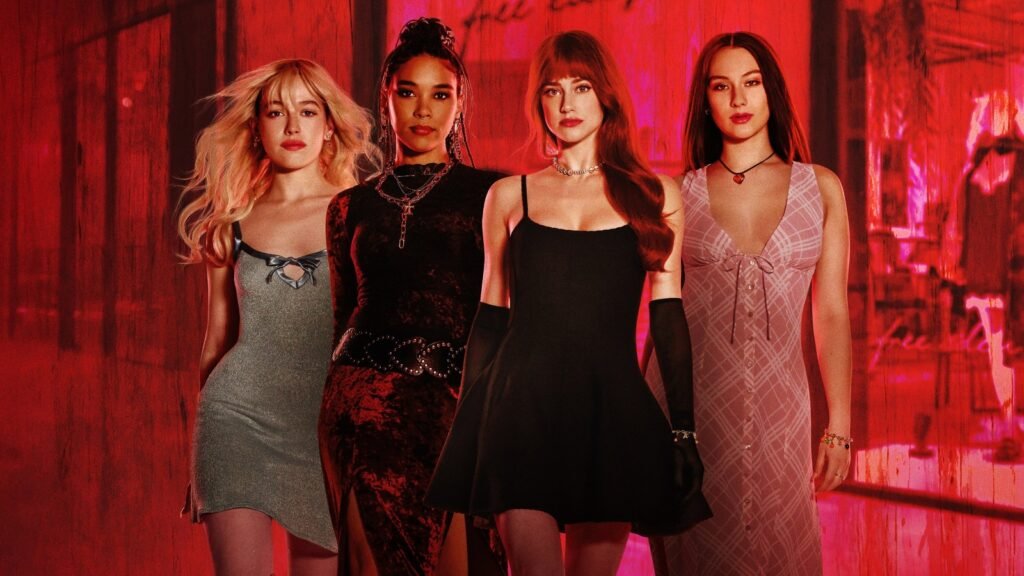
Every mall has one store where the staff are a little too beautiful, a little too coordinated, and a little too interested in whether you belong there. Forbidden Fruits asks the obvious follow-up question nobody wants answered after closing time: what are they doing in the basement when the gates come down?
Forbidden Fruits (2026) is Meredith Alloway’s comedy horror film about a mall clothing-store coven whose new hire cracks the sisterhood open. The store is Free Eden, in a Dallas shopping mall. The coven is its sales team — Apple, Cherry and Fig, glamorous young women who run the floor like a throne room and the after-hours basement like a chapel. Into that arrangement walks Pumpkin, a pretzel-counter worker from the food court, which in this mall’s caste system is roughly like being recruited from another planet. She gets the job, the initiation and the overnight lock-in. What she also gets is a look behind the sisterhood’s curtain — and the sisterhood, it turns out, does not survive being looked at.
Alloway calls her own film “Mean Girls, but a slasher,” and has welcomed The Craft comparison too. What she and co-writer Lily Houghton made is stranger and more specific than either label: a horror film about a friend group whose love language is control, where the spells may or may not be real and the cruelty absolutely is. Harper’s full review lives here: A Coven Behind Employees Only: Forbidden Fruits 2026 Review.
Quick Specs
- Director: Meredith Alloway
- Screenplay: Meredith Alloway and Lily Houghton
- Based on: Of the woman came the beginning of sin, and through her we all die (2019), a play by Lily Houghton
- Producers: Mason Novick, Diablo Cody, Trent Hubbard, Mary Anne Waterhouse
- Executive producers: Charlie Traisman, Katherine Romans, Casey Durant, Rachel Douglas
- Starring: Lili Reinhart, Lola Tung, Victoria Pedretti, Alexandra Shipp, Emma Chamberlain, Gabrielle Union
- Cinematography: Karim Hussain
- Edited by: Hanna Park
- Music: Anna Drubich
- Production design: Ciara Vernon
- Production companies: MXN Entertainment, Quadrant Motion Pictures, Lollipop Woods
- Distributors: Independent Film Company and Shudder (United States and Canada); Universal (international)
- World premiere: 16 March 2026, SXSW Film & TV Festival, Austin
- US release: 27 March 2026
- Running time: 103 minutes
- Certificate: R — for strong violent content/gore, sexual content, nudity, language and brief drug use
- Setting: a Dallas, Texas shopping mall (shot in Toronto)
The fruits and their rules
The official synopsis keeps it clean: “Free Eden employee Apple secretly runs a witchy femme cult in the basement of the mall store after hours — with fellow fruits Cherry and Fig. But when new hire Pumpkin challenges their performative sisterhood, the women are forced to face their own poisons or succumb to a bloody fate.” That is the frame, and the film hangs a lot of poison on it.
As the plot summary tells it, Apple, Cherry and Fig are glamorous Free Eden saleswomen who scam customers into overspending, and Pumpkin — recruited from the food-court pretzel counter despite the Fruits’ disdain for food-court workers — is initiated after hours with a fruit-juice-and-blood concoction and locked in the store overnight. The coven keeps rules, the first of them being no boyfriends. Two spaces matter, and the film keeps them separate even when coverage merges them: the rituals happen in the store’s basement after hours, while the women confess their sins in a changing room, to the spirit — or the memory — of Marilyn Monroe. Pumpkin gifts Apple a doll, named “Marilyn,” which conceals a camera.
The backstories arrive the way mall gossip does, in pieces. Per the plot summary, Apple is living in her car, is repeatedly in trouble with the store’s manager, Sharon, and allegedly poisoned her abusive father. Cherry is sober, and micromanaged by Apple. Fig is secretly seeing a man, Norman, against the coven’s rule. And behind all of them stands the cautionary tale of Pickle, the previous Fruit: she fell in love with a man, Ashton; Apple tricked the coven into hexing her; Ashton fell into a coma and Pickle was institutionalized. The coma and the institutionalization are the load-bearing facts of her story, and both are carried by more than the summary.
Spoilers from here — the ending is discussed. Pickle warns Pumpkin to escape, then dies by suicide, jumping from the mall’s second story in view of Pumpkin and Fig. Under a tornado warning, with the mall locked down, the group comes apart: Fig quits the coven; Cherry strikes Norman with a meat cleaver; Cherry is trapped in the mall’s malfunctioning escalator and Apple refuses to help her — she is crushed to death; Fig is killed by glass from the shattered skylight. Alloway herself discussed the escalator death in her SXSW interviews.
The final reveal is the one Alloway has stated plainly in interviews: Pumpkin is Apple’s paternal half-sister, who tracked Apple down over their father’s killing — “Pumpkin is strangled to death by her half sister in the fountain,” in the director’s own words. Apple goes on the run, and surfaces at a different mall in Scottsdale, Arizona, where three stylish girls wearing matching charm bracelets offer her a job at a soon-to-open Free Eden — the film pointedly declining to name its new flower girls.
One more reported beat: a mid-credits scene in which Sharon is revealed to be an undercover police detective who has been investigating Apple, recovering the still-recording doll from the crime scene as evidence.
The cast
Lili Reinhart leads as Apple, the coven’s centre of gravity — a leader whose authority is part retail management, part religion. Lola Tung is Pumpkin, the newcomer whose questions the sisterhood cannot metabolise. Victoria Pedretti plays Cherry, sober and simmering under Apple’s management, and Alexandra Shipp plays Fig, the rule-breaker keeping a secret the coven’s first rule forbids. Those four are the film’s leads, whatever the announcement billing implies.
Emma Chamberlain plays Pickle, the coven’s former member — institutionalised before Pumpkin arrives, on screen in a handful of scenes. It is Chamberlain’s acting debut, and a supporting turn, not a co-lead. Gabrielle Union plays Sharon, the store’s manager — and here is the thing to know before you watch: Union is heard, not seen, for almost the whole film, and appears on camera only in the film’s closing stretch. Her role was deliberately kept under wraps when her casting was announced in April 2025. The character is credited both as Sharon and as Sharon Sullivan. The credits also carry Jordan Duarte in a bit part, as “Texas Dad.”
From a stage play to the Black List
The film’s roots are theatrical, and the adaptation renamed nearly everything it kept. Lily Houghton’s play Of the woman came the beginning of sin, and through her we all die — “woman,” singular, and styled lowercase — world-premiered on 3 October 2019 at the Medicine Show Theatre in New York, produced by Normal Ave and directed by Kylie M. Brown, running through 20 October at about 90 minutes with no intermission. In the play, the coven is Bluebell, Sweet Pea and Bleeding Heart, working in the basement of a Free People store. The film renames the store Free Eden and the witches after fruits — Apple, Cherry, Fig and the departed Pickle. Pumpkin is the one name that crosses over.
The screenplay Alloway and Houghton adapted from it was featured on the 2023 Black List of most-liked unproduced screenplays. The project was announced on 13 February 2025, with Diablo Cody producing Alloway’s feature directorial debut — and a trap worth stepping around carefully: Cody produced this film, with Mason Novick, Trent Hubbard and Mary Anne Waterhouse. She did not write it. The screenplay is Alloway and Houghton’s, full stop, however often coverage slides a famous producer into the writer’s chair.
Independent Film Company’s predecessor banner, IFC Films, acquired the film with Shudder as production began. Principal photography ran in Toronto in March 2025 — the Dallas mall rebuilt in Canada — and Gabrielle Union joined the cast that April, her role kept under wraps. Alloway described the film in her SXSW interviews as “a razor blade in a Jolly Rancher,” which may be the most accurate production note of 2026.
The production companies are MXN Entertainment, Quadrant Motion Pictures and Lollipop Woods; the festival credits add 100 ZEROS, Bright Panic Pictures and Madhouse Films.
Release
The film world-premiered at the SXSW Film & TV Festival on Monday 16 March 2026, at the Paramount Theatre in Austin, with a second festival screening the next day at Alamo Lamar. IFC’s own trailer publicity announced the premiere as March 17 — that was the second screening’s date. The premiere was the 16th.
US theatres followed on Friday 27 March 2026, a wide release opening in 1,525 theaters, through Independent Film Company and Shudder. (IFC Films rebranded as Independent Film Company in 2025; the release is branded both ways, and they are the same distributor.) Internationally, the film opened day-and-date on 27 March in the United Kingdom, Australia, New Zealand and Uruguay, with Universal handling international distribution; Russia (CIS) followed on 23 April 2026 through Exponenta. The running time is given as both 103 and 104 minutes.
Home release came in two stages that are constantly confused: premium digital and VOD on 28 April 2026, then subscription streaming on Shudder and Sundance Now from Friday 26 June 2026, billed as a Shudder Original Film. April 28 was not the Shudder date, whatever you have read. The film’s festival life continued into the autumn: it screened in the Panorama section of the 59th Sitges Film Festival (8–18 October 2026). Panorama is a section, not a prize — no award outcome for the film is verified.
What the critics made of it
The aggregators land mixed-to-warm — with dates attached, because this film’s headline score has drifted all year. Rotten Tomatoes has it at 76% from 90 reviews, with an average rating of 6.6 out of 10, after 81% in the festival window and 74% at release. The critics’ consensus there calls it “charmingly goofy and packed with incisive insights into the relatable ups and downs of any friend group” — “a campy coven worth hanging out for.” Rotten Tomatoes displays no audience percentage for the film. Metacritic gives it 56 out of 100 from nine critics — five positive, four mixed, none negative — labelled “Mixed or Average.”
In print, the split was the story. One SXSW review found “real cult appeal” in it. A syndicated newspaper review gave it two stars and dismissed it as “the fast fashion of girly pop horror.” Another scored it 50 and called it “a beautiful disaster,” while two more each scored it 75. One pre-release feature framed the film as a cult classic in the making — a posture adopted ahead of release, offered as a headline rather than a measurement, and the year since has been kinder to the prediction than to the arithmetic.
The box office
Forbidden Fruits grossed $2,322,616 in the United States and Canada and $2,444,597 worldwide.
The theatrical run itself was brief: an opening weekend at number ten in those 1,525 theaters, then a fast collapse — 500 theaters in week two, 50 in week three, 15 in week four. No production budget for this film has been published. With no verified budget, there is no hit-or-flop arithmetic. The film’s commercial life was always going to be the IFC and Shudder pipeline — theatres first, then VOD, then the Shudder shelf — and no public revenue figures exist for that side of it.
Where it stands
Forbidden Fruits is a feature debut that arrived with a famous producer, a Black List script and a stage play’s bones, and settled into the afterlife its makers’ metaphors predicted: not a hit, not a disaster, a sharp candy thing waiting on a streaming shelf for the right viewer at the right hour. On this site it sits in the 2026 IFC and Shudder company of films like Bodycam, another small, mean, camera-obsessed nightmare that found its audience at home. The coven just clocked in. It is still on shift.