
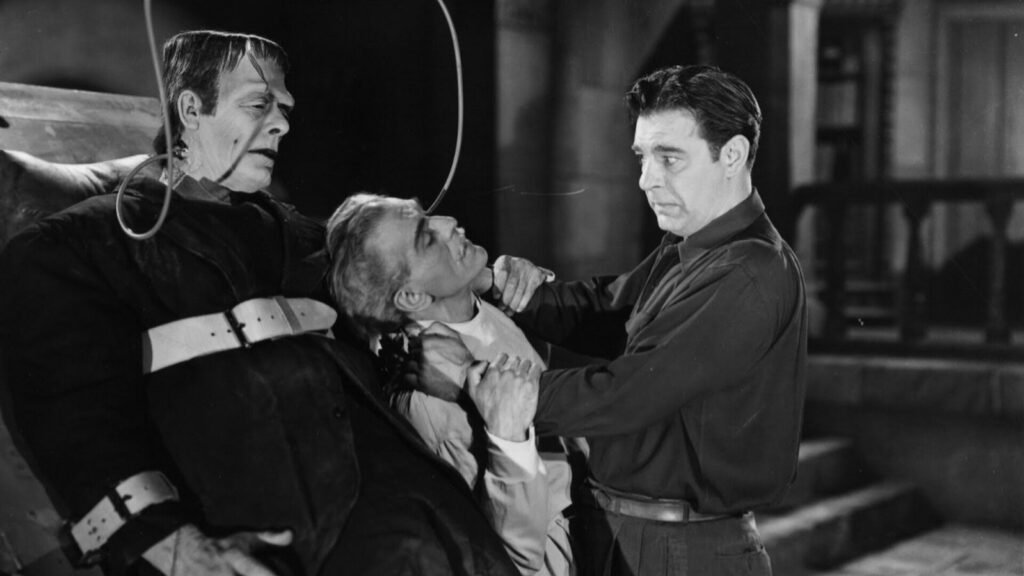
House of Frankenstein (1944) is Universal’s first full monster rally, with Boris Karloff as the mad doctor, not the Monster. Read the poster the way audiences in 1944 read it and you will be lied to beautifully: Dracula, the Wolf Man and Frankenstein’s Monster, all under one roof, with the most famous horror name in the world at the top of the bill. What the poster cannot tell you is that the three monsters never share a single scene — Dracula is dead before the other two are even found — and that the name at the top of the bill belongs to a man who is not under the flat head at all. Karloff, who created the Monster in 1931, spends this film on the other side of the laboratory: frock-coated, grey-templed and quietly murderous, playing the villain who digs the monsters up. This is the sixth film in Universal’s Frankenstein series, and the strangest-shaped of them all — two short films wearing one long coat. It is also, beneath the ballyhoo, a handover. The old Monster passes the bolts to a new man here, and the series never quite looks back.
Quick Specs
- Director: Erle C. Kenton
- Screenplay: Edward T. Lowe Jr.
- Story: Curt Siodmak, “The Devil’s Brood”
- Producer: Paul Malvern
- Cinematography: George Robinson
- Editor: Philip Cahn
- Music: Hans J. Salter, Paul Dessau and Charles Previn
- Makeup: Jack Pierce
- Starring: Boris Karloff, Lon Chaney Jr., John Carradine, J. Carrol Naish, Glenn Strange, Elena Verdugo
- Studio: Universal Pictures
- Released: 15 December 1944 (New York opening); 16 February 1945 (US national release)
- Running time: about 71 minutes (listings vary between 70 and 71)
- Budget: $354,000
- Series position: the sixth Universal Frankenstein film, following Frankenstein Meets the Wolf Man (1943)
The doctor is Karloff; the Monster is not
Start with the billing trap, because everything about this film’s reputation wobbles on it. Boris Karloff plays Dr. Gustav Niemann — a disciple of Frankenstein’s science, imprisoned for trying to repeat the experiments (the period accounts specify an attempt to put a human brain into a dog), who escapes jail with one revenge list and one promise to keep. He is the film’s engine and its villain. He is not the Monster, in any scene, under any makeup. Karloff’s own run as the Monster was the 1930s trio — Frankenstein (1931), Bride of Frankenstein (1935) and Son of Frankenstein (1939) — and by early 1944 he was on record that he would never play the part again. He was 57 when this film opened in New York, back at Universal on a two-picture deal, the star of the picture in every sense except the one the poster implies.
The flat head belongs to Glenn Strange, and this is his first time wearing it. Strange was a Westerns player — Lane Chandler also tested for the part — and by Strange’s own account he did not know what he had been called in for until Jack Pierce’s makeup studio put a scar on him; Pierce then telephoned producer Paul Malvern to say they had found their Monster. It is Pierce’s design on a new face, and the fit was a career: Strange, 45 at the opening, played the Monster here and twice more after it. Standing over him in the laboratory, giving the orders, is the man who used to lie on that table. The film never underlines the poetry of that. It does not have to.
Dracula, first and finished
The film opens in prison, and its first movement belongs entirely to the Count. When the prison is damaged — the reference accounts say an earthquake; reviewer retellings describe a storm and a lightning strike, and the record never settles it — Niemann escapes with Daniel, the hunchbacked prisoner in the next cell, played by J. Carrol Naish, to whom Niemann has promised a new and beautiful body. The pair fall in with Professor Bruno Lampini’s travelling chamber of horrors, murder the showman and steal his exhibit and his identity. Among the wagons is Lampini’s prize: the skeleton of Count Dracula, staked through the chest, which the showman claimed to have collected from the Count’s own castle.
What follows is the film’s most famous effect, and it runs backwards from everything you expect. Niemann does not stake Dracula. He pulls the stake out — and the skeleton re-grows veins, nerves and skin until John Carradine is standing in the wagon, in his first performance as Dracula, aged 38. The bargain is protection for service: Niemann holds the coffin, and Dracula settles the doctor’s oldest score, killing Burgomaster Hussman — one of the men who sent Niemann to prison — and turning his hypnotised eye on the Burgomaster’s granddaughter-in-law Rita as a prospective bride. Then the police close in, and Niemann, fleeing in the carriage, simply throws the coffin out to lighten the load. Dracula scrambles after it and the rising sun takes him. No stake, no hero, no Van Helsing — a vampire destroyed by his own employer’s treachery and the time of day. Anne Gwynne, who plays Rita, summed up her whole assignment years later: “I’m only in the first 25 minutes and then zap, I’m off.” So is the Count. The episode is a self-contained first act — it was, fittingly, the last material shot — and the remaining monsters are still frozen under a castle, waiting for a film that has not reached them yet.
Thawed out: the Wolf Man’s half
The second movement picks up exactly where Frankenstein Meets the Wolf Man ended. On the road to Vasaria, Daniel rescues Ilonka, a Romani dancer, from a whipping — Elena Verdugo, 19 at the opening, in the role that steers everything that follows — and in the frozen cavern beneath the flooded ruins of Castle Frankenstein they find the Monster and Larry Talbot where the flood left them, preserved in the ice. Thawed, Talbot returns to human form: Lon Chaney Jr., 38, in his third turn as the Wolf Man after The Wolf Man (1941) and Frankenstein Meets the Wolf Man.
Niemann buys Talbot’s help finding Frankenstein’s notes with a promise tailored to each man who serves him. Talbot will be cured: his brain transferred into a different body, out from under the curse. Daniel, watching Ilonka fall for Talbot, asks for Talbot’s vacated body as his own beautiful new one. Niemann intends to honour neither promise. His real plan is revenge in its purest laboratory form — he kidnaps Strauss and Ullman, the two former associates who betrayed him, meaning to put their brains into the monsters’ bodies and let them live the creatures’ cursed lives instead. It is a scientist’s revenge: not death, but reassignment.
It collapses the way everything in Vasaria collapses, under a full moon. Talbot transforms and kills a man; the village panics. Knowing the cure will never come, Talbot has Ilonka make silver bullets and wait by his room at night — and when Daniel, desperate, warns her that Talbot is a werewolf, she stays anyway. On the final night the Monster rises and the Wolf Man changes. He fatally wounds Ilonka, and with the silver bullets she made at his own instruction she shoots him dead, then dies herself. Daniel, blaming Niemann for all of it, attacks him — and the Monster, bonded to the man who revived it, hurls Daniel from the window to his death, then carries the half-conscious Niemann out into the marshes with the villagers behind them. There, in quicksand, the Monster and its maker sink and drown together. Two movements, three monsters, and the only embrace any of them share is with the man who dug them up.
Born from a bigger rally that never happened
The film’s shape was set before it had a name. On 7 June 1943 Universal announced Chamber of Horrors, a monster rally bigger than this one — Karloff, Chaney Jr., Bela Lugosi, Peter Lorre, Claude Rains and George Zucco, with the Invisible Man, the Mad Ghoul and the Mummy promised among the characters. It was never made. The concept was shelved and then revived in reduced, workable form as this film, whose production preparations began in August 1943 under the title of Curt Siodmak’s original story: “The Devil’s Brood.” Keep those two titles apart, because they are not the same working title wearing different hats — one is a cancelled project, the other is this film’s own christening, replaced by House of Frankenstein only after filming wrapped in May 1944.
The writing credit needs the same care. Siodmak wrote the story. The screenplay is Edward T. Lowe Jr.’s, and Lowe streamlined as he went — most notably cutting the Mummy, Kharis, out of Siodmak’s story entirely, which is why there is no Mummy in the film so many people misremember as having one. Siodmak’s own verdict on his contribution is the bluntest credit note in the series: “I only wrote the story. I didn’t write the script. I never saw the picture.” The picture itself was shot on a 30-day schedule in the spring of 1944, on redressed standing sets, under director Erle C. Kenton. And note who is not in it: Lugosi, the 1931 Dracula and the Monster of the previous film, appears nowhere — Carradine takes the cape for the first time, Strange takes the bolts. One account, Derek Winnert’s, holds that Lugosi was slated for Dracula and lost the part to touring commitments in Arsenic and Old Lace; it rests on that single carrier, and this page prints it as one man’s account, not as the record. Even the score was built for the occasion: the music by Hans J. Salter, Paul Dessau and Charles Previn was mostly written specifically for this film rather than tracked in from stock.
The money, the minutes and the dates
The budget is the one clean figure in this film’s paperwork: $354,000, the highest budget Universal had yet set for a Frankenstein film — though Frankenstein and Bride of Frankenstein had both outspent their own budgets by running over. Beyond that, 1944 keeps its secrets. The only earnings figure in the record is a bracket in the National Box Office Digest’s annual — somewhere between $200,000 and $500,000 — which reaches us through a single lineage and belongs to the rentals era, not to modern box-office accounting. Printed attributed, it says the film was a mid-level performer: not among Universal’s highest earners that year, though it outdid the studio’s other 1944 horror output. Anyone quoting you a precise gross for this picture is inventing it.
The paperwork argues about everything smaller, too. The running time stands at 70 minutes in the AFI catalogue data and 71 nearly everywhere else — this page prints “about 71 (listings vary between 70 and 71)” and leaves the argument standing. The film opened in New York on 15 December 1944, at the Rialto, and went out nationally on 16 February 1945 — which is why some references, the AFI among them, catalogue it under 1945. It is a 1944 film: premiered, reviewed and copyrighted in 1944. Listings that give 1 December 1944 as the release date are simply wrong.
What the critics made of it
The New York critics, as historian Gregory W. Mank summarised the premiere notices, “made mincemeat” of it. Wanda Hale gave it two and a half stars and conceded the atmosphere while warning the audience to “be sure and check your credulity outside”: the “settings, lighting and costumes, impressively eerie and horrendous, will help you enter into the sinister proceedings.” A. H. Weiler was cooler: “this grisly congress doesn’t hit hard; it merely has speed and a change of pace. As such, then, it is bound to garner as many chuckles as it does chills.” Another New York notice found the plot “stumbles along endlessly in its top-heavy attempt to carry on its shoulders too many of yesterday’s nightmares” — “only a little more terrifying than the house that Jack built.” A trade paper called it “only a mild horror picture, more ludicrous than terrifying,” a rehash of the characters’ previous doings. The dissent came from the Motion Picture Herald, which called it an “excellent horror film,” praised the acting, makeup, photography, lighting and score, and reported the Rialto matinee audience “more than satisfied.”
The star’s own verdict arrived two years later, and it is the one history kept. In 1946 Karloff called the film “the monster clambake,” and credited producer Val Lewton with having “rescued me from the living dead and restored my soul” — Lewton’s RKO horrors were where Karloff had gone to act, in pictures like The Body Snatcher, while the rally paid the bills. Print it as what it is: the leading man’s joke at his own expense, not a review. Modern aggregates keep the split decision. Rotten Tomatoes lists the film at 55% on its Tomatometer with an audience score of 47% (live-checked 25 October 2026) — a divided jury for a divided film, and this page prints no finer figure than the record supports.
One more house
The rally worked well enough to be repeated exactly once in earnest. House of Dracula (1945) ran the formula again — Carradine, Chaney Jr. and Strange all reprising, Kenton directing again — with one absence at the top of the bill: Karloff does not appear. After that, Universal’s monsters met only as a joke, in Abbott and Costello Meet Frankenstein (1948). Which leaves this film standing where it started: the first picture to put Dracula, the Wolf Man and Frankenstein’s Monster under one title, and the honest fine print underneath — together in one film, never in one scene, each handed his own short, strange movement and his own bad end. Dracula burns in a sunrise he almost outran. Talbot is shot by the woman he loved, with bullets he asked her to make. And the Monster, faithful to the wrong man, walks into the marsh carrying the closest thing he had to a father, and the ground takes them both. The clambake, it turns out, had teeth.