
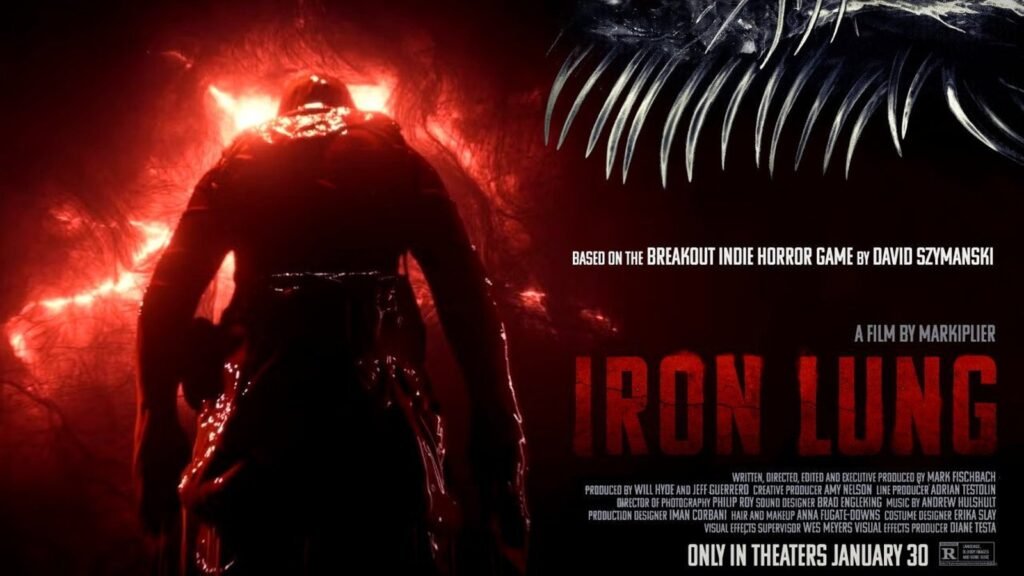
The stars are gone, the planets are gone, and what is left of humanity lives on stations and ships, giving the end of everything a name. Somewhere in that darkness sits a barren moon with an ocean made of blood — and the plan involves welding a prisoner inside a submarine the size of a coffin and pointing him at the bottom.
Iron Lung (2026) is Mark Fischbach’s self-financed science-fiction horror film, welding a convict inside a one-man submarine beneath an ocean of blood. Fischbach — Markiplier to the tens of millions who watch him play horror games — wrote it, directed it, edited it, stars in it, paid for it and then, when the studio offers were not worth surrendering control for, released it himself. It adapts David Szymanski’s 2022 video game, a one-hour nightmare Fischbach had played on his own channel before filming it. A YouTuber treated his audience like a distribution network, and the audience showed up. Harper’s full verdict lives in the Iron Lung review.
Quick Specs
- Director: Mark Fischbach
- Screenplay: Mark Fischbach (sole credit), based on the video game Iron Lung (2022) by David Szymanski
- Producers: Will Hyde and Jeff Guerrero
- Starring: Mark Fischbach, Caroline Kaplan, Troy Baker, Elsie Lovelock, Elle LaMont, Seán McLoughlin
- Cinematography: Philip Roy
- Editor: Mark Fischbach
- Music: Andrew Hulshult
- Production company: Markiplier Studios
- Distributor: Markiplier Studios (self-distributed in North America)
- US release: 30 January 2026
- Running time: 127 minutes
- Certificate: R — language, bloody images and some gore
- Budget: disputed — see “The money, honestly” below
The dive
The plot, as the film’s official synopsis and the reference summaries of it agree in shape, runs like this. In the distant future, the Quiet Rapture has made every star and habitable planet — and the people on them — vanish without warning. Humanity survives only aboard space stations and ships. Simon, a convict imprisoned for his part in destroying Filament Station, is sent to a barren moon designated AT-5, where the Consolidation of Iron has found an ocean of blood. He is welded into the one-man submarine SM-13 — the Iron Lung — its forward viewport encased in metal against the pressure, navigating by a crude camera that is in fact an x-ray imaging device, in radio contact with the surface crew. The official synopsis frames his dive as the 13th expedition. Freedom is the promise if he completes the mission.
Ordered to recover a sample from a vast skeleton on the ocean floor, Simon finds a seed medallion and a recording left by the SM-13’s previous pilot: he is not the first. A living creature attacks the sub; knocked out, he wakes in an uncharted cave system, communications lost, blood leaking in, hallucinations beginning. He finds a second wrecked sub, the SM-8, and begins hearing a woman’s voice directing him toward a godly “light” beneath the ocean. Contact is restored after days missing — far beyond his oxygen supply — and the commander names herself Ava and sends him back to the SM-8 for its data, whose logs confirm the ocean is human blood, and that the monster’s voice is the voice of an SM-8 crew member who drank it.
The ending, in the same account’s form: the monster destroys Ava’s vessel; she begs Simon to protect the SM-8 data while the monster urges him to destroy it. Simon sends the black box to the surface on a life vest, defying the monster; as the flooding blood mutates his body he merges with the seed in the medallion, becoming a giant tree that kills the monster as the sub implodes. The black box is found floating on the surface by an unseen party.
The cast
Mark Fischbach is Simon. Born 28 June 1989 in Honolulu, he was 33 when the film was announced in April 2023 and 36 on release day. The second lead in substance is not the name release-era billing led with: it is Caroline Kaplan (full form Caroline Rose Kaplan) as Ava, the surface commander Simon speaks to by radio — heard long before she is seen, naming herself only late in the film. Troy Baker plays David, a supporting role — one of the voices and faces around Simon’s mission, not a co-lead.
The Monster has two voices: Elsie Lovelock and Elle LaMont share the voice credit, and each also appears on screen as SM-8 research crew. Mick Lauer voices the SM-13’s previous occupant; David Pettitt plays the Father; Alanah Pearce is a Familiar Voice; Szymanski cameos as himself. Seán McLoughlin — Jacksepticeye — plays Jack, an on-screen appearance; in his own words at announcement: “I am in it but not as a voice.” Young Simon is credited to two different performers: one cast list gives Kazuki Jalal, the other Isaac McKee.
One hour of game
The source is Iron Lung (2022), developed and published by David Szymanski — the solo developer of the retro shooter DUSK — released for Windows on 10 March 2022, with console and mobile ports following. It is a short first-person horror game set entirely inside the one-man submarine: the porthole sealed shut against the pressure, the player navigating a blood ocean on an alien moon by an incomplete map, proximity sensors, sound and a primitive external camera. A playthrough runs about an hour. Its store copy describes “a short horror game where you pilot a tiny submarine through an ocean of blood on an alien moon.” The game’s convict is addressed simply as a convict — Simon is the film’s name for him. Fischbach played the game on his channel before adapting it; he was one of the big horror-game creators whose playthroughs made it a cult hit in 2022.
Making it
The strangest part of the timeline is that it began as a joke. On 16 February 2023, Szymanski joked online that Fischbach and McLoughlin would star in an Iron Lung film “this summer”, with a Hulshult soundtrack — before any real announcement existed. Weeks later, Fischbach confirmed in an interview that he was directing, writing and acting in an unnamed film. On 21 April 2023 the film was officially announced with a teaser on his channel; it was reported the same day that Fischbach was self-financing, directing from his own script and starring, with Kaplan co-starring, Hyde and Guerrero producing, and filming already under way in Austin, Texas. Szymanski’s involvement is precise and often misreported, so here it is in his words: he was “heavily involved with production of the Iron Lung movie, from assisting with the script and pre-production to now being on set for the shoot and even having a small cameo in the film.” He assisted, he is credited as the story’s creator, he cameos — he did not direct, and he holds no screenplay credit. The sole screenplay credit is Fischbach’s.
Filming wrapped on 29 April 2023, and the submarine was a real, practical set — a metal cylinder the production could shake and throw around — rather than a green-screen build. The fake blood is Fischbach’s own claim: he said during production the film would beat Evil Dead (2013)’s 50,000 US gallons of fake blood; he was hospitalised during the shoot after getting fake blood in his eyes, by his own account; and in December 2025 he put the amount used at over 80,000 gallons — 79,800, in a February 2026 Q&A. A record, he says.
Post-production was the long road. In July 2023, Fischbach — a SAG-AFTRA member — said the production was delayed by the actors’ strike. The official trailer arrived on 14 October 2023. In June 2024 he announced the film was “officially done” and that he was negotiating its release. The negotiation ended in self-distribution: by his account in trade interviews, the studio deals offered were not advantageous enough to surrender control. Hulshult delivered his first film score — the composer of Szymanski’s DUSK, brought in by that connection.
The release the fans built
On 5 December 2025, Fischbach published the release-date trailer and opened ticket pre-sales. The initial plan is given as 60 independent US theaters in most reporting, as 50–100 in the booking company’s own account, and as 50 in Fischbach’s own livestream telling. Fischbach asked fans to request the film from their local theaters, politely, and organised demand did the rest: within a week of tickets going on sale, bookings passed 1,000 North American venues. Regal committed circuit-wide early — “Regal kicked the door down,” Fischbach said — and Cinemark and AMC followed.
The North American distributor of record is Markiplier Studios — genuinely self-distributed, marketed through Fischbach’s own channels. But the bookings were physically run by Centurion Film Service, a specialist independent theatrical booker, using Vista Group’s systems: hired machinery that let a self-distributor behave like one at scale. Internationally it was not Fischbach at all: Piece of Magic Entertainment released the film across Europe, Rialto Distribution handled Australia and New Zealand, and Warner Bros. India acquired and released it in India, opening there on 13 March 2026.
It opened in North America on 30 January 2026, day-and-date in the UK, Australia, New Zealand, Canada and Piece of Magic’s European territories. The home release kept the same independence: announced at a Cannes panel on 17 May 2026 for 31 May, exclusively as a purchase on YouTube Movies — Fischbach acting as his own aggregator under a special arrangement with YouTube — it actually landed two days early, on 29 May 2026, on YouTube Movies and Google TV in the US, UK, Canada, Australia and New Zealand. Not a free upload, not a streamer pickup: a paid release on his home platform, on his terms.
What the critics made of it
The split is the story. Reviewers praised the atmosphere, the sound design and the audacity, and faulted the pacing, the two-hour runtime drawn from a one-hour game, and Fischbach’s deliberately flat lead performance. Rotten Tomatoes has it at 59–61% from about 49 reviews, up from 44% in the release window. Metacritic gives it 55 out of 100 from 10 critics — five positive, five mixed, none negative. No CinemaScore grade was recorded; self-distributed releases frequently go unpolled.
The notices, in their own words. Simon Abrams praised the attention to detail and cult potential, while finding the performance “distractingly monotonous”. Zachary Lee found the visual language “consistently interesting” and gave two and a half stars. Tasha Robinson compared it with slow-burn horror such as Skinamarink and argued it is “pretty frightening”. Dennis Harvey was cooler: “There’s not a lot of plot here, certainly not enough to sustain a full two hours”. Alison Foreman gave a C+ — “audacious and at times astonishingly boring”. Eric Goldman scored it 4 out of 10 for pacing and “low energy”, while praising Hulshult’s score. Dan Jolin gave two stars — “leaden”, “monotonous” — and Mike McCahill also gave two stars, judging that Fischbach “can’t pull off the dramatic heavy lifting”. The audience that had demanded the film into those theaters answered all of it with the gross.
The money, honestly
The budget is reported as both $3 million and $4 million. Fischbach himself has put the cost at “a little over” $4 million in a February 2026 Q&A, and at “just under” $5 million in a June 2026 interview. Anyone who tells you a single figure — or a tidy “it made seventeen times its budget” — has picked a side in an argument the filmmaker himself is part of.
The grosses, by contrast, are firm. Thursday previews on 29 January 2026 took $3.5 million. Opening day, Friday 30 January, took $8,934,482 including previews — the No. 1 film in North America that day. The opening weekend finished at $18,190,786 from 3,015 theaters: No. 2 for the weekend, behind Sam Raimi’s Send Help. Hold those facts apart, because coverage merging them into “it topped the box office” is wrong — it won Friday, several weekdays after, and its opening weekend outright in Australia and New Zealand, opening at No. 1 in both. The $17.8 million figure you will see quoted was the Sunday estimate, not the actuals. It was the highest opening weekend ever for a self-distributed film. The worldwide opening was about $22 million, and the run closed at about $51 million worldwide: $41.1 million in the United States and Canada, $10.1 million in other territories. On a disputed budget between $3 million and just under $5 million, self-financed and self-distributed, that is the whole argument for the experiment in one line.
Honours
At the National Film Awards in the UK on 2 July 2026, Caroline Kaplan won Best Actress — the film’s confirmed win. The film was also nominated for Best First Feature at the Chainsaw Awards; when the ceremony was held on 25 October 2026, the award went to Backrooms. A nomination, a win for its Ava, and a box-office record for its maker: a respectable haul for a first theatrical feature.
Where it stands
Iron Lung is the proof of concept for a kind of filmmaking the industry kept insisting was impossible: a creator’s audience substituting for a marketing department, a film planned for a few dozen screens opening in 3,015 North American theaters because fans asked for it cinema by cinema, and a filmmaker who kept his rights, his cut and his distribution. It sits naturally beside this site’s other 2026 game adaptation, Exit 8 — two small games, two very different roads to the screen. Whether it frightens you depends on your patience for a man alone in a metal tube, listening to the ocean knock. But the ocean it crossed to get to you? Already history.