
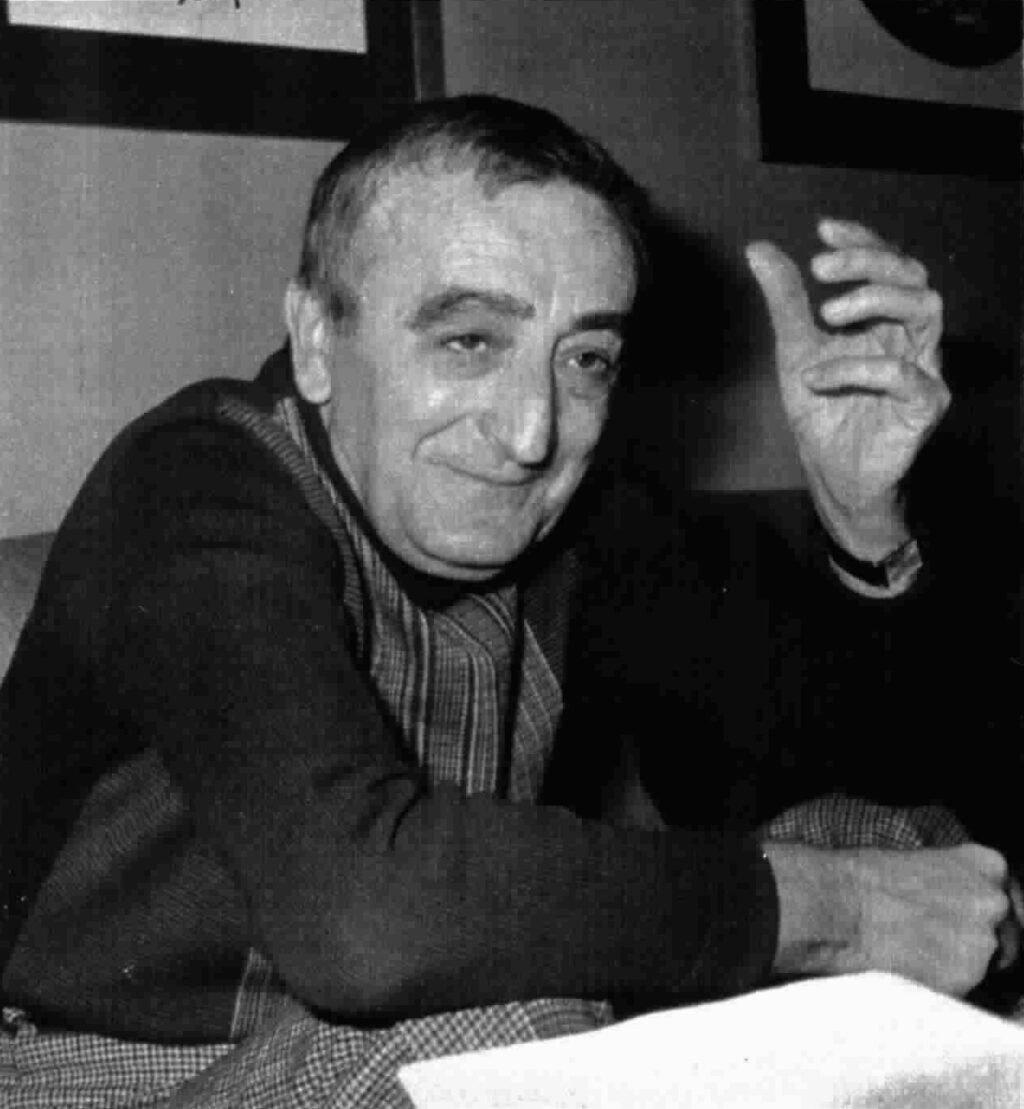
Mario Bava (1914-1980) was an Italian cinematographer and director whose Black Sunday, Blood and Black Lace and A Bay of Blood shaped modern horror.
Quick Specs
| Born | 1914, Sanremo, Italy |
| Died | 1980, Rome, of a heart attack |
| Cinematographer from | 1939 |
| Solo directing debut | Black Sunday (1960) |
| Key films | Black Sabbath (1963), The Girl Who Knew Too Much (1963), Blood and Black Lace (1964), Planet of the Vampires (1965), Kill, Baby, Kill (1966), Danger: Diabolik (1968), A Bay of Blood (1971) |
| Father | Eugenio Bava, sculptor turned silent-era effects cameraman |
| Son | director Lamberto Bava |
| Pseudonym | John M. Old |
Who He Is
Mario Bava was born in Sanremo in 1914. His father, Eugenio Bava, was a sculptor who became a special-effects photographer and cameraman in silent films, so Mario’s craft was inherited. His own first ambition was painting, but he couldn’t sell his paintings at a profit, so he joined his father’s trade, including effects work at the Istituto Luce, and assisted cinematographers such as Massimo Terzano. He became a cinematographer in 1939, starting with two short films with Roberto Rossellini.
He was shy and self-deprecating about his work, and he turned down several chances to work in Hollywood. His son Lamberto assisted him for 14 years, starting on Planet of the Vampires, and became a director himself. Mario sometimes worked under the name John M. Old.
The Work, and What He Did in It
For years before he directed a film under his own name, Bava was Italian cinema’s quiet fixer: a cameraman and effects man who could also finish someone else’s collapsing picture.
On Riccardo Freda’s I Vampiri (1957) he was director of photography and uncredited effects artist. The film’s signature trick is his: aging makeup on Gianna Maria Canale that only shows up under colored light. The budget swelled after a switch to CinemaScope, Freda fought with the producers and walked off, and Bava finished the film in two days. He restructured it around the journalist character, refused the scripted hanging finale and shot an abrupt confession and rapid-aging ending instead, padding with stock footage and newspaper montages.
He was uncredited co-director of The Day the Sky Exploded (1958), the first postwar Italian science-fiction film. When Freda walked again on Caltiki, the Immortal Monster (1959), Bava took over direction, uncredited, and also acted in it. He shot extra interiors for The Giant of Marathon ten days before its premiere. On Hercules and Hercules Unchained he did lighting and effects; Pietro Francisci directed them.
Black Sunday (1960), loosely adapted from Gogol’s story “Viy,” was his first solo credited feature, and he did almost everything: he directed, co-wrote without credit, shot it and did his own matte and effects work. Barbara Steele played both the witch Asa and her descendant Katia, the start of her reign in Italian gothic horror. Bava shot almost all of the exteriors on a stage at Titanus Studios, choosing total control of light and fog over realism.
The Girl Who Knew Too Much (1963) and Blood and Black Lace (1964) are the earliest gialli, the two films the genre grows from. Black Sabbath (1963) was his anthology film, and its title went on to name a band.
In Planet of the Vampires (1965), a crew answers a distress signal and finds a derelict alien ship and a giant fossilized alien skeleton. Critics have long noted how much this resembles Alien (1979), but Ridley Scott and Dan O’Bannon both said they had never seen Bava’s film.
Kill, Baby, Kill (1966), in which the ghost of a little girl with a bouncing ball haunts a Carpathian village, is the film Martin Scorsese regards as Bava’s masterpiece, “a genuinely hypnotic piece of filmmaking.” It was made for almost nothing; biographer Tim Lucas estimates well below $50,000. The money ran out during the shoot. Cast and crew were paid for the first two weeks and finished unpaid, out of affection for Bava, and Luigi Cozzi says Bava himself was never paid.
He auditioned hundreds of girls to play the ghost, Melissa, and found none right, so he cast Valerio Valeri, his concierge’s son. Valeri hated wearing the dress, and Bava goaded the performance by calling him “Valeria.” With no crane, Bava shot from a makeshift seesaw. He filmed Valeri’s movements in reverse to make them uncanny, made her vanish by dimming the light on a reflection in angled glass, and created the opening’s warped view with a sheet of “water glass” his father had made as a silent-film cameraman. Bava said he made the film on a bet with “some Americans.” The score credited to Carlo Rustichelli is library music.
Danger: Diabolik (1968) was his pop-art comic-book adaptation. Years later it became the final episode of Mystery Science Theater 3000’s original run, in 1999.
A Bay of Blood (1971) is an early slasher whose murders became templates. Friday the 13th Part 2 is widely described as explicitly imitating it, restaging two of its kills almost exactly.
Bava’s last decade was full of stranded films. Lisa and the Devil (1972) found no distributor and was recut by its producer into House of Exorcism with new footage shot in 1975. Rabid Dogs (1974) wasn’t released in his lifetime. Shock (1977), his last horror film, was co-directed without credit by Lamberto. His final work was matte effects for Dario Argento’s Inferno (1980). Days after a doctor pronounced him in perfect health, he died of a heart attack in Rome in 1980. He had been about to shoot a science-fiction film, Star Riders, with Luigi Cozzi.
Cool Verified Facts
- The band Black Sabbath took its name from his 1963 film. A cinema across from their rehearsal room was showing it, and the idea that people pay money to be scared struck them as a business model.
- Federico Fellini borrowed Bava’s ghost girl with the bouncing ball for his “Toby Dammit” segment of Spirits of the Dead (1968). Giulietta Masina’s shrug: “Well, you know how Federico is…”
- After Lamberto showed him his directing debut, Macabre, Mario joked, “I am very proud of you. Now I can die in peace.” He died less than two months later.
Signatures, Habits and Behind the Scenes
- Color and fog. He controlled atmosphere completely, even building exteriors indoors.
- In-camera invention. Colored lights, reversed film, glass reflections and his father’s trick glass did the work of money he didn’t have.
- The rescuer. He finished Freda’s films twice, shot a peplum’s missing scenes before its premiere and ended his career painting mattes for Argento.
- Modesty. A shy, self-deprecating craftsman who turned down Hollywood.
Why He Matters
Two genres start with him: the giallo, with The Girl Who Knew Too Much and Blood and Black Lace, and, through documented imitation, the body-count slasher, with A Bay of Blood. Black Sunday revived gothic horror and made a star of Barbara Steele, and Black Sabbath gave heavy metal its founding name. The directors in his wake include Scorsese, Tarantino, Burton, Carpenter, Lynch, Argento and Fulci. Not bad for an underpaid Roman craftsman who spent years saving other people’s films.