
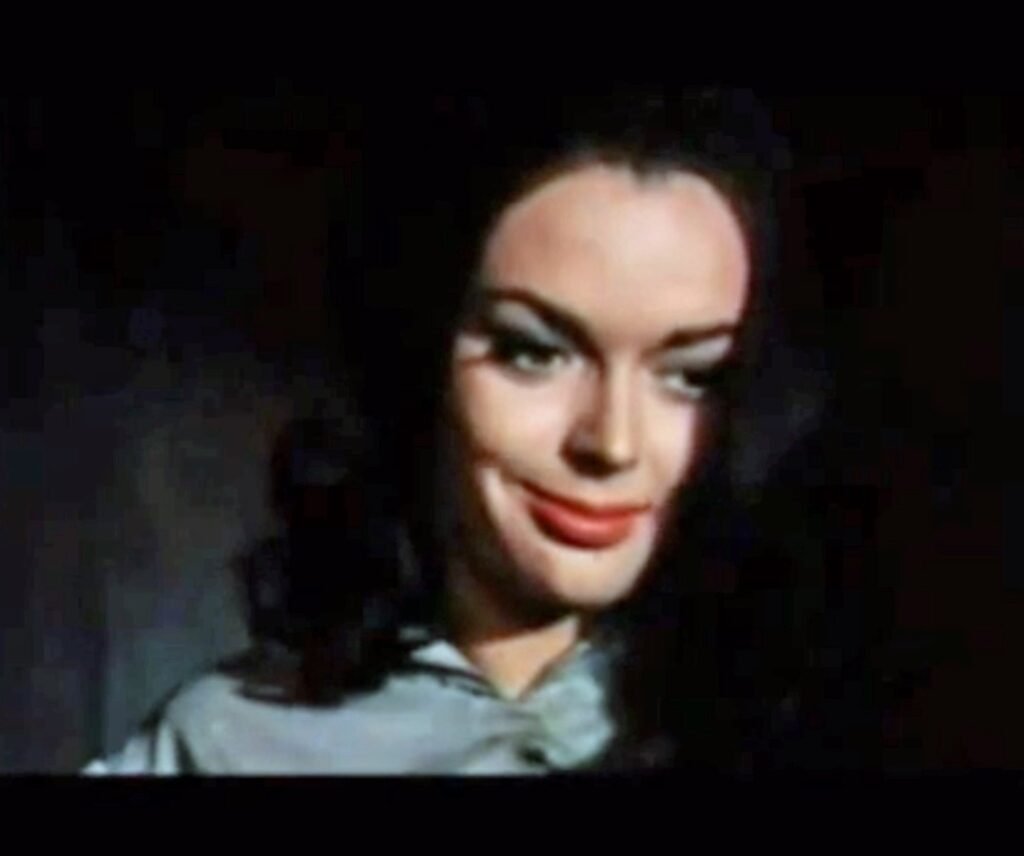
Barbara Steele (born 1937) is the English actress who starred in Mario Bava’s Black Sunday and became the face of 1960s Italian Gothic horror.
Quick Specs
| Born | December 29, 1937, Birkenhead, Cheshire, England |
| Training | art at Chelsea Art School and the Sorbonne in Paris |
| Film debut | Bachelor of Hearts (1958), as a Rank Organisation contract player |
| Breakthrough | Black Sunday (1960), in the dual role of Asa and Katia Vajda |
| Key horror films | The Pit and the Pendulum (1961), The Horrible Dr. Hichcock (1962), Castle of Blood (1964), Nightmare Castle (1965), Shivers (1975), Piranha (1978) |
| Producer | The Winds of War (1983, associate producer); War and Remembrance (1988) |
| Honors | shared the 1989 Primetime Emmy for War and Remembrance; Chainsaw Awards Hall of Fame (2017) |
| Family | married screenwriter James Poe (1969 to 1978); one son, Jonathan |
Who She Is
Barbara Steele was born in Birkenhead, Cheshire, on December 29, 1937. She studied art, first at Chelsea Art School and then at the Sorbonne in Paris, and did stage work and modeling before she went into films.
The Rank Organisation signed her as a contract player. She made her feature debut in Bachelor of Hearts (1958), then appeared in Sapphire (1959), opposite John Richardson, her future Black Sunday co-star, and in Upstairs and Downstairs (1959).
From 1969 to 1978 she was married to the American screenwriter James Poe, and they had a son, Jonathan. During the marriage her work moved from European to North American productions.
The Work, and What She Did in It
Fox bought her Rank contract and cast her as the female lead opposite Elvis Presley in Flaming Star (1960). After a week of shooting she was gone, replaced by Barbara Eden. There are two accounts of why. Steele says she quit after a disagreement with director Don Siegel; Adam Victor’s Elvis Encyclopaedia says Fox executives fired her because her British accent was too strong. The SAG strike of March 1960 then let her walk away from the Fox contract. She went to Italy hoping to work with Federico Fellini. First, though, she worked with Mario Bava.
Black Sunday (1960) was Bava’s first film as director, and Steele plays two women in it. Asa Vajda is the witch executed in the prologue, with a spiked mask driven onto her face. Katia Vajda is her innocent descendant, two centuries later. Steele plays the monster and the maiden, and her legend rests on that double performance. Bava said she “had the perfect face for my films.” Audiences don’t hear her real voice, though. She was dubbed.
Black Sunday brought her to Roger Corman’s attention, and her next film was his The Pit and the Pendulum (1961). She plays Elizabeth Medina, Vincent Price’s wife, mostly a ghostly presence in flashbacks, until the final image: Elizabeth alive inside an iron maiden, her eyes looking out through the slit. It’s a few minutes of screen time, and it built her American reputation. Corman had her dubbed here too. It was an American film shot in English, but he judged her working-class English accent a distraction.
What followed was a run of Italian Gothic films. She played Cynthia in Riccardo Freda’s The Horrible Dr. Hichcock (1962) and Margaret in The Ghost (1963), and stepped out of horror to play Gloria Morin in Fellini’s 8½ (1963), a part she won through an open casting call. Then came Antonio Margheriti’s Castle of Blood (1964), as Elisabeth Blackwood, The Long Hair of Death (1964), Terror-Creatures from the Grave (1965), Nightmare Castle (1965), The She Beast (1966), shot in 21 days, An Angel for Satan (1966) and Curse of the Crimson Altar (1968).
The roles kept splitting her in two. In The Long Hair of Death she plays Helen and Mary Karnstein. In Nightmare Castle she plays Muriel and Jenny. In An Angel for Satan she plays a dual role again. On television in the same years she appeared in Alfred Hitchcock Presents (1961), Danger Man (1965) and I Spy (1966), and later in Night Gallery (1972).
In the 1970s she got out of the Gothic. In Jonathan Demme’s first feature, Caged Heat (1974), she plays the prison’s cold superintendent, McQueen. David Cronenberg cast her as Betts in Shivers (1975), his first commercial feature. She played Josephine in Louis Malle’s Pretty Baby (1978) and Dr. Mengers in Joe Dante’s Piranha (1978), and made Silent Scream (1979). Her part in I Never Promised You a Rose Garden (1977) was cut. Demme, Cronenberg and Dante, three of the defining directors of the next generation, all wanted her.
Then she moved behind the camera. She was an associate producer on the miniseries The Winds of War (1983), with a small acting part, and a producer on War and Remembrance (1988), which won the 1989 Primetime Emmy. She shared it with executive producer Dan Curtis.
In 1991 she was cast in two roles again, 31 years after Black Sunday: Dr. Julia Hoffman and Countess Natalie Du Pres in the Dark Shadows revival. She returned to Dark Shadows in a 2010 audio drama.
In 2010 Mark Gatiss interviewed her about Black Sunday for the BBC’s A History of Horror, and in 2012 about Shivers for Horror Europa. She took the lead, Ann, in The Butterfly Room (2012), appeared in Ryan Gosling’s directing debut, Lost River (2014), and voiced Miranda in Castlevania (2020). In 2017 she was inducted into the Chainsaw Awards Hall of Fame.
Cool Verified Facts
- In her two most famous films, Black Sunday and The Pit and the Pendulum, the voice audiences hear isn’t hers.
- She is an Emmy winner, but as a producer, not for acting, for War and Remembrance.
- She was cast opposite Elvis Presley in Flaming Star and was replaced by Barbara Eden after a week.
- She plays Gloria Morin in Fellini’s 8½, a part she won through an open casting call.
- She was in both Jonathan Demme’s first feature, Caged Heat, and David Cronenberg’s first commercial feature, Shivers.
Signatures, Habits and Behind the Scenes
- The lost voice. “The loss of voice for me has always been devastating,” she has said. “It’s almost like some karmic debt.” The most recognizable face in Italian Gothic was heard in other women’s voices, even in an American film shot in her own language.
- Two women in one face. Asa and Katia, Helen and Mary, Muriel and Jenny, Julia and Natalie: for 30 years directors cast her twice in the same story, because she could hold innocence and menace at once. Bava saw it first.
- The last scare. The Pit and the Pendulum is remembered as Price’s film, but its final image belongs to her: the eyes in the iron maiden.
- She got there by accident. She trained as an art student, modeled, left an Elvis picture after a week and ended up in Bava’s first film.
Why She Matters
Black Sunday is the founding film of Italian Gothic horror, and Steele is its face. The spiked mask driven onto Asa’s face is one of horror’s permanent images, and the woman under it played the innocent heroine too. Every Gothic heroine who is also the villain owes her something. Her career covers the genre’s second half-century: a Rank contract, Italian Gothic, Corman, then Demme, Cronenberg and Dante, then television Gothic in Dark Shadows. Then she went behind the camera and won an Emmy for producing one of the biggest miniseries ever made. And horror made her an icon while hearing someone else’s voice in her two most famous films. The BBC interviews and the Chainsaw Awards Hall of Fame are the genre catching up with the woman herself.