
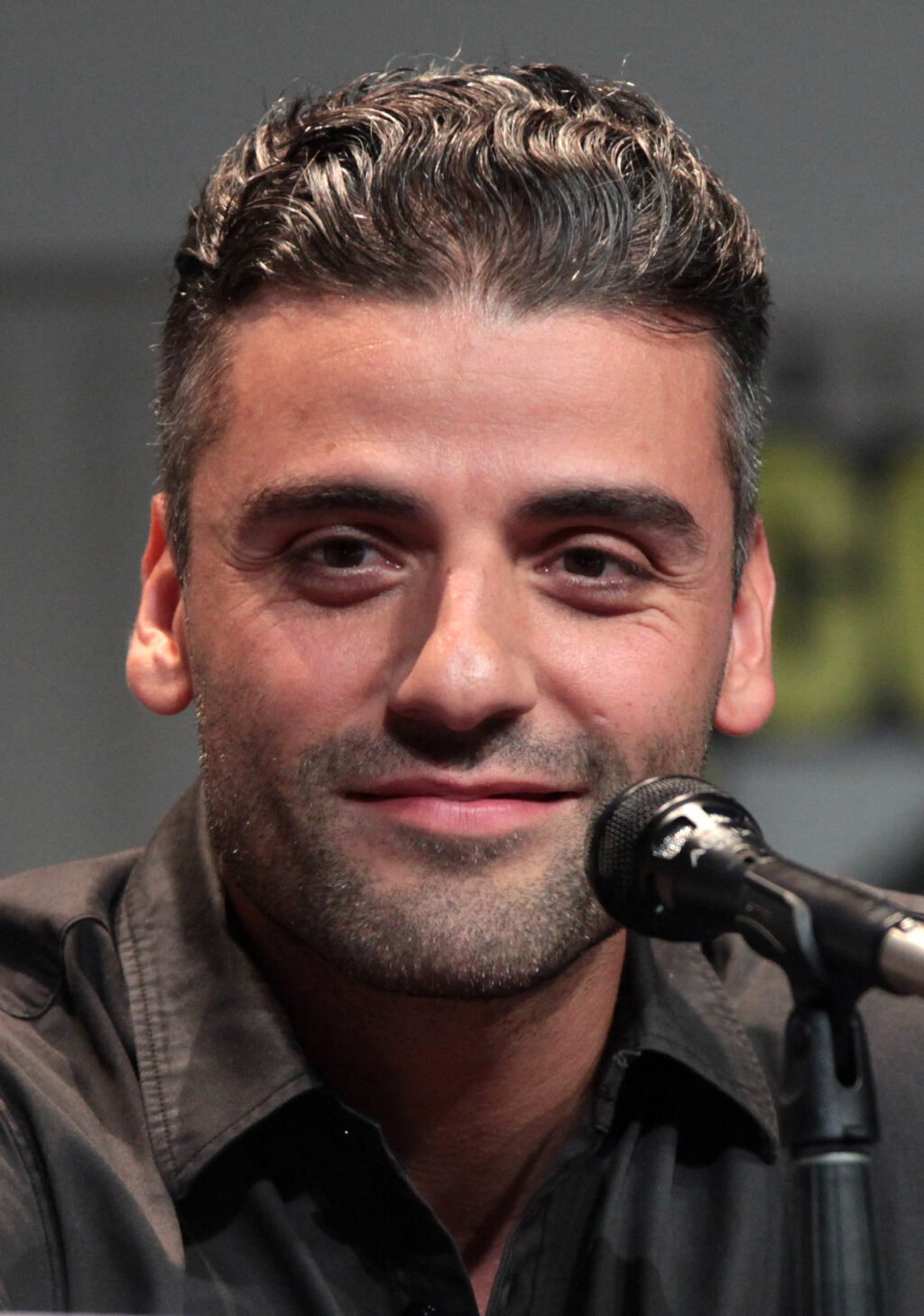
Oscar Isaac (born 1979) is the Guatemalan-born American actor who played Victor Frankenstein for Guillermo del Toro and Nathan Bateman in Ex Machina.
Quick Specs
| Born | March 9, 1979, Guatemala City, Guatemala (as Óscar Isaac Hernández Estrada) |
| Raised | Baltimore and New Orleans, then Miami from age six; US citizen since 2006 |
| Training | The Juilliard School (BFA, 2005) |
| Horror | Nathan Bateman in Ex Machina (2014); Kane in Annihilation (2018); voice of Gomez Addams in The Addams Family (2019) and The Addams Family 2 (2021); Victor Frankenstein in Frankenstein (2025) |
| Signature roles | Llewyn Davis in Inside Llewyn Davis (2013); Poe Dameron in the Star Wars sequel trilogy (2015 to 2019); Duke Leto Atreides in Dune (2021); Marc Spector and Steven Grant in Moon Knight (2022) |
| Honours | Golden Globe for Show Me a Hero; Golden Globe nomination for Inside Llewyn Davis; Primetime Emmy nomination for Scenes from a Marriage; AFI Award (now the AACTA Award) for Balibo |
| Latest release | Nick Tosches and Dante Alighieri in In the Hand of Dante (2026) |
Who He Is
Oscar Isaac was born Óscar Isaac Hernández Estrada on March 9, 1979, in Guatemala City, to a Guatemalan mother, María Eugenia Estrada Nicolle, and a Cuban father, Óscar Gonzalo Hernández-Cano, a pulmonologist. When he was five months old the family moved to the United States so his father could complete his medical residencies. They lived in Baltimore and New Orleans before settling in Miami when Isaac was six. His older sister, Nicole Hernandez Hammer, is a climate scientist, and his younger brother, Mike Hernandez, is a journalist. He grew up in what he has called a “very Christian” Evangelical household, and became a US citizen in 2006. On screen his middle name serves as his surname.
He found acting in middle-school theatre in Miami, but music came first in his teens. In high school he sang lead and played guitar in punk and ska bands, the band of record being the Blinking Underdogs, and he kept performing locally while studying at Miami Dade College. The music was not a hobby. A decade later it was the skill the Coen brothers built a film around.
His route to training was persistence. In 2001, in New York for an Off-Broadway production, he went to the Juilliard School and asked to audition after the deadline had passed. He kept asking, got in, and graduated with a BFA in 2005. He married the Danish filmmaker Elvira Lind in 2017; they have two sons and run the production company Mad Gene Media together.
The Work, and What He Did in It
His first major role came straight out of Juilliard, at 27: Joseph, opposite Keisha Castle-Hughes’s Mary, in Catherine Hardwicke’s The Nativity Story (2006). In Robert Connolly’s Balibo (2009), about the Balibo Five, he played the young East Timorese leader José Ramos-Horta and won the AFI Award (now the AACTA Award) for Best Supporting Actor. A supporting run followed: Prince John in Ridley Scott’s Robin Hood (2010); Standard, the quiet neighbour and getaway driver whose tenderness curdles into violence, in Drive (2011); and small parts in Sucker Punch (2011) and The Bourne Legacy (2012). The pattern of those years mattered later: directors kept hiring him to be memorable and then killing or discarding the character.
Inside Llewyn Davis (2013) made him a leading man. Joel and Ethan Coen’s film follows one week in the life of a 1961 Greenwich Village folk singer whose musical partner has died by suicide, couch-surfing through a career that will not start. Isaac did not act a musician. He sang and played guitar live on camera, in complete takes and without dubbing, on more than half a dozen songs, from the opening “Hang Me, Oh Hang Me” to the closing “Fare Thee Well (Dink’s Song),” arranging material with the film’s executive music producer, T Bone Burnett. He was 34. The film won the Grand Prix at Cannes, and his performance brought a Golden Globe nomination. In J.C. Chandor’s A Most Violent Year (2014) he played Abel Morales, a heating-oil businessman in 1981 New York trying to grow his company without becoming the gangster everyone expects, and won the National Board of Review’s Best Actor award.
Ex Machina is his tech-horror landmark. Alex Garland’s directorial debut premiered at BFI Southbank on December 16, 2014, when Isaac was 35, opened in Britain in January 2015 and reached the US on April 10, 2015, by which time he was 36. He plays Nathan Bateman, founder and CEO of Blue Book, the world’s dominant search engine, who has built a succession of android women in his fortified research house and invites his employee Caleb (Domhnall Gleeson) to test the newest, Ava (Alicia Vikander). Sonoya Mizuno plays Kyoko. Isaac made Nathan a bro-genius barbarian, lifting weights, drinking himself blind and dancing with terrifying precision, running a Turing test whose real subject, the film slowly reveals, may be Caleb himself. He modelled Nathan’s conversational aggression on a friend, “a brilliant astrophysicist” and heavy drinker who interrupts every sentence because he already knows how it ends, and used it on Gleeson through the first week of shooting, unsettling him on purpose so that Nathan would always be “on the front foot.” Both actors have confirmed it since. The film cost $15 million and grossed $36.9 million worldwide in its original tally (some later listings, after reissues, give $38.3 million), and it won the Academy Award for Best Visual Effects.
Soon after, he won his Golden Globe, for David Simon and Paul Haggis’s HBO miniseries Show Me a Hero (2015), playing the real Nick Wasicsko, the 28-year-old mayor of Yonkers destroyed by a desegregated-housing order. Then came Star Wars: The Force Awakens (2015). J.J. Abrams pitched Poe Dameron to him in Paris: Poe opens the movie, Poe is amazing, Poe dies. Isaac, who had been killed off early often enough in supporting roles, hesitated. He went home and accepted anyway, expecting a cameo, and Abrams wrote back: “Never mind. I’ve figured it out. You’re in the whole movie now.” In the finished film Poe is the Resistance’s best X-wing pilot, who in the opening sequence receives the map to Luke Skywalker from Lor San Tekka (Max von Sydow), is captured by Kylo Ren and escapes with Finn. Isaac was 36. The film grossed $2.068 billion worldwide, the biggest of 2015, and Poe carried on through The Last Jedi (2017), where his reckless heroism earns a demotion, and The Rise of Skywalker (2019), where he ends the trilogy as a Resistance general.
X-Men: Apocalypse (2016) was the hard one. In Bryan Singer’s film he plays En Sabah Nur, the first mutant, an ancient Egyptian god-king who moves from body to body. He was buried under extensive prosthetics and a suit of roughly 40 pounds, in platform boots, unable to turn his head, and retreated to a cooling tent between takes because the costume could not shed heat. He has called the experience “excruciating.” He took the part partly to work with Michael Fassbender, Jennifer Lawrence and James McAvoy, and the suit meant he barely saw them. He was 37.
Garland cast him again in Annihilation (2018), adapted from Jeff VanderMeer’s novel. Isaac plays Kane, a special-forces sergeant and the husband of Natalie Portman’s Lena, who returns alone from an expedition into the Shimmer, the iridescent, refracting zone around a crashed meteor. He comes back catatonic, changed and dying, while video recovered from inside shows what the zone did to his team. Isaac plays two registers: the living husband in flashback, warm and ordinary, and the man who came back in the present, whose wrongness is mostly stillness. The film never settles in dialogue what the returned Kane is, and the performance does not either. His minutes are few, but the whole film is Lena walking into the zone to find out what came home wearing her husband. He was 38 at the US release in February 2018.
A different kind of horror followed. Fans had campaigned for years for Isaac to play Gomez Addams because of his resemblance to Raúl Juliá, the live-action Gomez of the 1991 and 1993 films (John Astin originated the role on television in 1964). He got Gomez in animation, voicing him in The Addams Family (2019) and The Addams Family 2 (2021) opposite Charlize Theron’s Morticia, exuberant and adoring. The first film grossed $203 million on a $24 million budget. Around it came Peter Malkin, the Mossad agent who captured Eichmann, in Operation Finale (2018), his first producer credit; Paul Gauguin opposite Willem Dafoe’s Van Gogh in At Eternity’s Gate (2018); Santiago “Pope” Garcia in Triple Frontier (2019); and William Tell, Paul Schrader’s haunted professional gambler, in The Card Counter (2021).
In Denis Villeneuve’s Dune (2021) he is Duke Leto Atreides, head of House Atreides and father of Paul, and the film’s moral centre. Leto accepts the fief of Arrakis knowing it is a Harkonnen trap, goes anyway for his house’s honour, and dies in the Harkonnen and Sardaukar assault, nearly taking the Baron with him through a poison-gas tooth. He was 42. The film grossed $411 million worldwide on its original run, and about $434 million lifetime with its 2024 re-release. Leto is a one-film role: he dies in Dune and is not in Part Two, where he survives only as the father whose loss the saga avenges.
Television gave him two showcases. In Hagai Levi’s HBO remake of Bergman’s Scenes from a Marriage (2021) he plays Jonathan opposite Jessica Chastain, his Juilliard contemporary, across five episodes of a marriage ending in real time, and earned a Primetime Emmy nomination. In Marvel’s six-episode Disney+ series Moon Knight (2022), which he also executive-produced, he plays, at 43, Marc Spector and Steven Grant, an American mercenary and a mild-mannered British gift-shop worker who are two identities of one man with dissociative identity disorder, sharing one body and serving the Egyptian moon god Khonshu as his avatar. A third identity, Jake Lockley, is only teased. The two men are distinguished by accent, posture and tempo, often in the same scene. He then voiced Miguel O’Hara, Spider-Man 2099, the humourless enforcer of the multiverse’s rules, in Spider-Man: Across the Spider-Verse (2023), after a post-credits introduction in Into the Spider-Verse (2018). In 2025 he voiced Jesus in the animated The King of Kings, nineteen years after playing Joseph.
Frankenstein (2025) is his defining horror role. Guillermo del Toro’s long-planned adaptation of Mary Shelley’s novel casts Isaac as Victor Frankenstein, brilliant, egotistical and a showman of galvanism, opposite Jacob Elordi’s Creature and Mia Goth, with Christoph Waltz in support. He plays the maker, not the monster, and the film’s horror is Victor’s narcissism and his abandonment of what he made. Isaac plays him as a rock-star anatomist whose creation scene is staged as a triumph he immediately regrets. The film premiered at Venice on August 30, 2025, when he was 46, opened in a limited US theatrical release on October 17, 2025, and arrived worldwide on Netflix on November 7, 2025. As a Netflix release it has no theatrical gross to quote.
His most recent release is Julian Schnabel’s In the Hand of Dante (2026), from Nick Tosches’s novel. It premiered out of competition at Venice in September 2025 and, acquired by Netflix, opened in US theatres on June 12, 2026, when he was 47, before streaming from June 24. Isaac plays both leads across the film’s two timelines: Tosches, a modern writer drawn into authenticating a stolen manuscript of the Divine Comedy, and Dante himself. On stage he played Hamlet at the Public Theater in 2017 and appeared on Broadway in Lorraine Hansberry’s The Sign in Sidney Brustein’s Window in 2023.
Cool Verified Facts
- He got into Juilliard by asking to audition after the deadline had passed.
- He fronted a Miami ska-punk band, the Blinking Underdogs, before drama school.
- He sang every song live on camera in Inside Llewyn Davis.
- His Golden Globe win is for Show Me a Hero; Inside Llewyn Davis brought a nomination.
- Poe Dameron was written to die early in The Force Awakens.
- The Ex Machina dance routine was in the script from the start.
- He voiced Gomez Addams after years of fans wanting him to play the part.
- He played Joseph in 2006 and voiced Jesus in 2025.
Signatures, Habits and Behind the Scenes
The Ex Machina dance is his signature moment. Nathan cuts off Caleb’s confrontation by launching into a synchronised routine with Kyoko to Oliver Cheatham’s “Get Down Saturday Night.” It was in Garland’s script from the start and, by Isaac’s account, was choreographed by “Mr. Disco — he won the title in 1979.” Isaac’s reading of it, given to the National Board of Review: the routine shows what Nathan has been doing alone in that house, “he’s choreographed the whole thing. It’s very sad as well.” Garland was blunter: “The whole thing about it was aggression.” It is Nathan entire: charming, funny and a warning.
His method, when he shows it, is observation stolen whole and used as an instrument on a scene partner. The astrophysicist’s interruptions turned on Gleeson are the cleanest example. He is a working musician, too: beyond the Blinking Underdogs and Llewyn Davis, he wrote and sang “Never Had” in 10 Years (2011).
The Apocalypse suit is his honest failure, and he tells it that way. An actor whose tools are face, voice and timing spent a film immobile inside 40 pounds of prosthetics, and he has been consistently funny and consistently clear about it since. There is no verified record of a difficult set; the record is preparation, advocacy for his characters and one miserable costume.
Why He Matters
For horror, Oscar Isaac is now one of the genre’s central actors, and Frankenstein is why. The line runs through Nathan Bateman, tech-horror’s defining creator; Kane, the returned husband at the heart of Annihilation’s dread; the voice of Gomez Addams for a new generation; Moon Knight’s fractured avatar; and finally Victor Frankenstein himself, for Guillermo del Toro. The genre’s last decade has kept hiring him for its thinking-person roles: the man who builds the monster, the man the zone sends back, and at last the man who builds the original monster.
He also broke a casting pattern. A Guatemalan-born, Miami-raised Latino actor became, in one decade, a Coen brothers lead, a Star Wars principal, a Marvel lead and del Toro’s Victor, none of them written as Latino characters, and he has been credited with breaking stereotypes for it. Vanity Fair called him the best actor of his generation in 2017, and in 2020 the New York Times put him among the 25 greatest actors of the century so far.
The through-line is the doubled role. Marc and Steven; Tosches and Dante; Kane alive and Kane returned; the actor and the live musician inside Llewyn Davis. Directors keep handing him two people to play because two complete, physically distinct characters from one performer is rare enough to build films on.