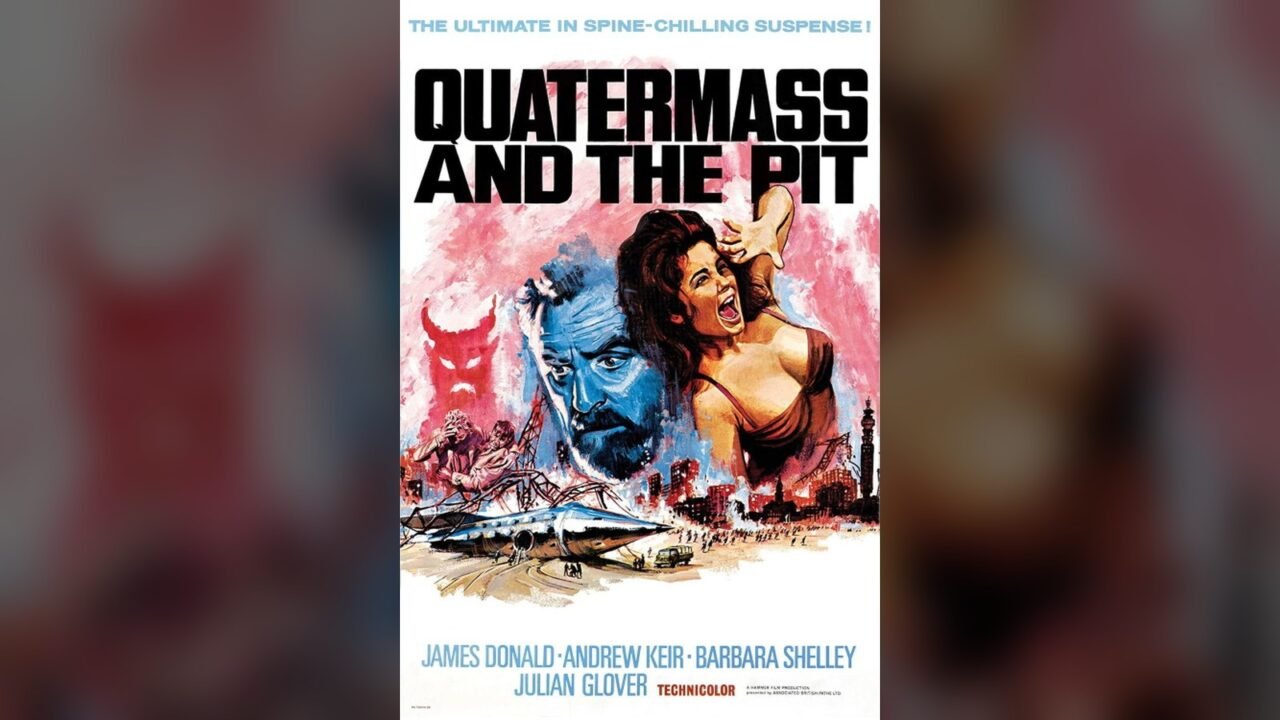
Some horror films frighten you with what leaps out of the dark. This one frightens you with an idea — and then spends its whole running time proving that idea, piece by patient piece, until it is standing over London in the shape of the Devil himself. Workmen extending the London Underground at a station called Hobbs End dig up a skull that should not exist: five million years old, older than any human ancestor on record. Beside it sits a vast metallic object that everyone takes for an unexploded bomb from the Blitz. It is not a bomb. It is something far older and far worse, and the methodical unspooling of what it is makes this the finest Quatermass story in any medium — and one of the finest films Hammer ever made outside the Gothic cycle.
Quatermass and the Pit is Hammer’s 1967 science-fiction horror film in which a Martian spacecraft unearthed in the London Underground reveals humanity’s devil-haunted origins.

Quick Specs
- Director: Roy Ward Baker
- Screenplay: Nigel Kneale
- Starring: James Donald, Andrew Keir, Barbara Shelley, Julian Glover
- Music: Tristram Cary
- Cinematography: Arthur Grant
- Editor: Spencer Reeve
- Producers: Anthony Nelson Keys
- Production Company: Hammer Film Productions, Seven Arts Productions
- Distributor: Associated British Pathé (UK)
- Premiered: November 9, 1967 (UK); 1968 (US, as Five Million Years to Earth)
- Runtime: 97 minutes
- Rating: X (UK)
- Budget: £275,000
- On This Site: Quatermass and the Pit (1967) film page
The Dig at Hobbs End
Palaeontologist Dr Matthew Roney, whose team found the skull, dates it at five million years and knows at once how impossible that is. The army treats the object as a bomb, and bomb disposal cannot so much as dent it. Into this walks Professor Bernard Quatermass, already smarting from the news that the military is swallowing his rocket programme, with Colonel Breen — the officer just imposed on his British Experimental Rocket Group — at his shoulder. Inside a sealed chamber in the hull they find the dead: insectoid creatures with horned heads, five million years in the ground.
Quatermass builds his case the way a prosecutor builds one. The creatures are Martian. Their world was dying, and they could not survive on Earth — so they preserved their line by proxy, experimenting on Earth’s primitive apes and implanting their own faculties in the stock that became us. The horned god of our oldest nightmares, the hauntings recorded around Hobbs End for centuries whenever the ground was disturbed, the static of cruelty and panic buried in the human mind: all of it, Quatermass argues, is racial memory. We are the Martians — and something in the pit is waking up the part of us that remembers.
Ideas with Their Boots On
What lifts the film is that the outrageous premise is never merely asserted; it is demonstrated, in hearing after hearing and experiment after experiment, while Breen’s rival explanation — a Nazi propaganda fake, a leftover stunt of the war — is kept alive as a serious alternative almost to the end. Nigel Kneale adapted his own BBC serial of 1958–59 and wrote this screenplay himself, a first draft as early as 1961; Columbia passed on it twice before Hammer’s 1966 arrangements finally freed it, and six years in a drawer did it no harm at all. Roy Ward Baker, who took the director’s chair when Val Guest was otherwise engaged on Casino Royale, judged that the script needed no work, and the film’s clockwork escalation — from archaeology to occult history to psychic catastrophe — makes you believe him. Producer Anthony Nelson Keys had chosen Baker precisely for the technical command he had shown on A Night to Remember, and the effects-heavy climax is the dividend.
The result plays as a detective story whose solution happens to be the origin of evil. Each set piece grows out of the last: the apparition a soldier watches pass through the hull; the drill operator Sladden, overcome by the ship’s influence, tearing across London in a telekinetic fugue and coming to rest in a church, describing a vision of the creatures beneath an alien sky; the recorded thoughts of the susceptible Barbara Judd, which reveal the Martians purging their own hives of mutation — the film’s cold hint that the final horror will not be an invasion, but a relapse.
The Professor, and the Man Who Out-Bills Him
Andrew Keir is the Quatermass this material always wanted. Where Brian Donlevy’s 1950s incarnation bulldozed, Keir thinks — you can watch the man’s mind working, and his stubbornness reads as intellect rather than ego. It matters that Kneale, who had been scathing about the Donlevy films, lobbied for the recast and was happy with Keir, and with the film itself; that approval is written all over the performance’s confidence. The posters centre Keir, though the billing doesn’t: James Donald is top-billed.
Donald earns it. His Roney is the film’s warm centre, a scientist whose excitement is almost boyish and whose courage, when it is finally asked of him, is absolute — it is Roney who climbs a building crane and swings it into the spectral Martian above London, earthing its energy and dying as the crane burns. Barbara Shelley, in her last film for Hammer, gives Barbara Judd a credible fragility that makes her the story’s seismograph, the person through whom the pit speaks. And Julian Glover’s Breen is no cardboard villain: he is a tidy military mind applying tidy categories to an untidy universe, wrong in a way that feels professionally inevitable.
Craft: Colour, Sound, and a Very Small Budget
This was the first Quatermass film in colour, and the colour is used with restraint — the pit’s ochres and the craft’s strange hull set against the grey of a city still scarred by the war. Hammer had outgrown Bray by 1967, and the film was made at MGM’s British studios at Borehamwood, which gave Baker an otherwise empty backlot on which to build Hobbs End, all on a budget of £275,000 that shows its seams far less often than it should. Tristram Cary’s score, mixing orchestra with electronics, supplies the film’s signature sound: the vibrating, shaking hum of the thing in the tunnel, a noise so unsettling that the BBFC’s John Trevelyan singled it out — along with the Martian massacre and the very image of the Devil — when he ruled that the film would require an X certificate. Les Bowie’s effects team carries the climax: a spectral Martian rearing over a rioting city is a great deal to ask of 1967 model work, and while the joins occasionally show, the conception is so strong that the imagery survives its technique. A footnote I cannot resist: this was the first film billed to “Roy Ward Baker,” plain Roy Baker having collided with a sound editor of the same name.
Where It Creaks
Honesty requires the debit column, and the film’s contemporaries kept one. The Times’ John Russell Taylor found it “genuinely gripping” once past a slowish beginning; the Evening Standard’s Paul Errol dismissed “a well-made, but wordy, blob of hokum,” and the wordiness charge is not baseless. The middle act is heavy with conferences, ministers and position papers; the film argues its case in committee rather more than a thriller ideally should, and The Observer’s Penelope Mortimer spoke for the unpersuaded in calling it nonsense that “totally lacks imagination.” Breen’s refusal to bend, too, finally tips past plausible scepticism into obstruction for its own sake, and the machinery of the ending needs him wrong on schedule. And the effects, Bowie’s ingenuity notwithstanding, are of their year and their budget. These are real flaws — but they are the flaws of ambition, of a film trying to think at full stretch on £275,000.
Legacy
This is the third and last of Hammer’s Quatermass films, after The Quatermass Xperiment (1955) and Quatermass 2 (1957), and the only one in colour. It condenses a six-part serial that had drawn average BBC audiences of 9.6 million, peaking at 11 million for its final episode; the film trims a journalist’s subplot entirely, moves the pit from a building site to the Underground, and drops the serial’s celebrated closing address in favour of a silent final image — Quatermass and Barbara standing amid the ruins — that trusts the audience to do the feeling itself. It is often spoken of as the finest of the Quatermass films, and Keir’s standing in the role has only grown: in 1996 he played Quatermass again, for BBC Radio 3’s The Quatermass Memoirs, making him one of only two actors ever to take the part more than once. The suggestion that Tobe Hooper’s Lifeforce is largely a remake of this film has trailed it for years — Hooper spoke of wanting to go back and make a Hammer film — and whether or not the debt is quite that direct, the main line of British apocalyptic science fiction runs through Hobbs End.
Where to Watch
Checked November 9, 2026. Not currently streaming in the US — the watch is the disc: Scream Factory’s Collector’s Edition Blu-ray. Streaming rights shift, so check your service before you settle in.
Verdict
Quatermass and the Pit is that rare thing: a horror film whose monster is a thesis, and whose thesis grows scarier the harder it is examined. Kneale’s script, Baker’s unfussy direction, Cary’s uncanny sound-world and four perfectly judged central performances turn a Tube-station dig into the end of the world — and the end of the world has rarely felt this thought-through, or this sad. It talks too much in the middle and its effects wear their age, which keeps it a half-step below the very summit; but the summit is where it is aiming, and almost nowhere in British horror do ambition and execution meet this completely.
Rating: 4.5 ravens.
Trivia & Facts
- This was the first film billed to “Roy Ward Baker” — plain Roy Baker had collided with a sound editor of the same name, so the middle name went on the credits for good.
- The BBC serial averaged 9.6 million viewers across its six parts, peaking at 11 million for the final episode.
- The film moves the pit from the serial’s building site to a London Underground station, and drops both a journalist subplot and the serial’s famous closing address to camera.
- Andrew Keir played Quatermass once more, nearly thirty years later, in BBC Radio 3’s The Quatermass Memoirs (1996) — one of only two actors ever to take the part twice.
- It premiered in London on 9 November 1967, and reached America the following year under a new title, Five Million Years to Earth.
Harper’s Extras
The weekly roundup
One letter a week, from the crypt.
- New reviews, with the ravens
- New wiki entries and news
- Cool stuff worth your night
Weekly. No spam, unsubscribe in one click.