
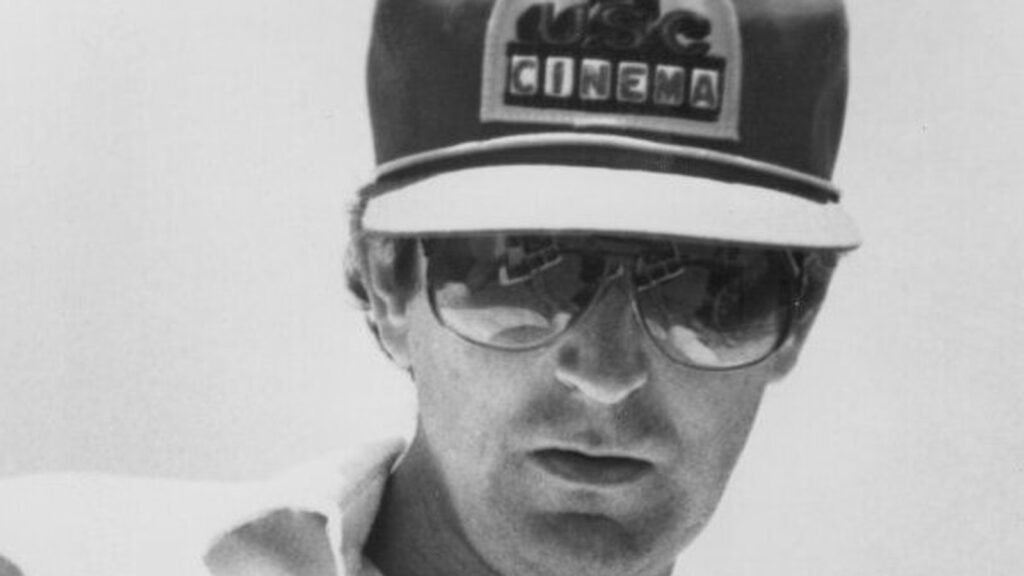
There is a particular kind of nerve required to direct a sequel to Psycho — a straight continuation, twenty-two years later, with the original Norman Bates back in the house on the hill. In 1982 Universal handed that job to an Australian in his mid-thirties whose whole education in suspense came from studying one man — a man who had once telephoned him out of the blue. Richard Franklin (1948–2007) was the Australian director who made Psycho II, the Hitchcock sequel nobody thought could work.
First, a Hitchcock-obsessed Melbourne kid builds a reputation on Hitchcock-shaped thrillers — Patrick, Roadgames — until Hollywood lets him continue the most famous thriller of all. Then he walks away from genre filmmaking. The first half changed horror history more than it gets credit for.
Quick Specs
- Born: 15 July 1948, Melbourne, Victoria, Australia
- Died: 11 July 2007, Melbourne, Victoria, Australia, aged 58
- Occupation: Film director (also producer and occasional writer)
- Known for: Psycho II, Patrick, Roadgames, Link
- Years active: 1975–2003 as a director
A Brighton Kid, a Drum Kit, and Psycho at About Twelve
Franklin was born in Melbourne on 15 July 1948 and grew up in Brighton; his standard biography places his schooling at Haileybury College. The same encyclopedic biography, resting on a published film-reference life, names his parents as Margaret Anne (Jacobson) and Rea Richard Franklin, an engineering company director. Nothing further about the family is reliably carried.
Before film, music: in the 1960s the teenage Franklin drummed in The Pink Finks, a Melbourne band whose line-up also included Ross Wilson and Ross Hannaford, later of Daddy Cool. Several singles, no chart success — and Franklin chose film.
The turning point, by his own oft-told account, was seeing Psycho in 1960. Born in July 1948, he was eleven turning twelve at a 1960 screening — about twelve. The effect is not in doubt: Alfred Hitchcock became the fixed point of his creative life. Tom Holland, who later worked with him, called him “a complete devotee of Hitchcock and John Ford” — devotion meaning study, frame by frame.
USC, a Phone Call from Hitchcock, and the Topaz Set
Franklin studied film at the University of Southern California — USC, full stop. He was never a fellow of the separate AFI Conservatory; accounts that send him there confuse two Los Angeles institutions. One account dates the move to 1967, making him eighteen or nineteen on arrival. Holland independently calls him “part of that USC class of filmmakers like George Lucas.”
The defining story deserves its documented form. There was no schoolboy correspondence, no mentorship by letter. What his obituaries tell is this: Franklin, a USC student, tried to arrange a screening of Hitchcock’s Rope (1948). Hitchcock himself telephoned him. Franklin invited him to lecture at the university; a friendship followed; Hitchcock returned the favour by inviting the young Australian onto the set of Topaz (1969), where Franklin, then twenty or twenty-one, watched his idol work. The Psycho II production record independently confirms the Topaz visit.
First Features: Homicide, Eskimo Nell and Fantasm
Back in Australia in the 1970s, Franklin directed episodes of the police drama Homicide.
His first feature was The True Story of Eskimo Nell (1975) — produced, directed and co-written by Franklin with Alan Hopgood, from the bawdy ballad, starring Max Gillies and Serge Lazareff. That record gives a Melbourne release on 27 March 1975, when Franklin was 26, a budget of A$200,000 from Pike & Cooper’s standard history. It was not a commercial success; the same account records Franklin’s view that the humour “didn’t travel,” pushing him toward universal genre filmmaking.
Next, still on the filmography’s account, came Fantasm (1976), a softcore anthology film directed under the pseudonym “Richard Bruce” — a working name, not a birth name, not a different man. Ross Dimsey wrote it, from a story by producer Antony I. Ginnane; the record dates its release to 16 July 1976, the day after his 28th birthday. Two clarifications: Fantasm is not Phantasm, Don Coscarelli’s unrelated film; and its sequel (1977) was directed by Colin Eggleston, not Franklin. Franklin later called Patrick “my first film. Even though there were one and a half films before it” — the half being Fantasm.
Patrick: The Comatose Killer Who Travelled
Patrick (1978) made everything else possible. Directed by Franklin from a screenplay by Everett De Roche, it was released in Australia on 1 October 1978, when Franklin was 30. Patrick, who murdered his parents, lies comatose in a Melbourne clinic with psychokinetic powers — moving objects, possessing his nurse at a typewriter, killing without leaving the bed. Susan Penhaligon (one L, no second A, whatever junk coverage says) played nurse Kathy Jacquard, with Robert Helpmann as Dr. Roget and Robert Thompson as Patrick. Franklin and Ginnane produced; the record puts the budget at $400,000.
The reception shape, as Stratton’s standard history of the Australian New Wave is cited for it: a disappointment at home, highly successful internationally — sold, by that account, to more than 30 countries. The film’s nominations included Best Film at the Australian Film Institute Awards and a Grand Prize at Avoriaz. Franklin disliked the American version, re-dubbed and recut. An unauthorised Italian sequel (1980) and an official remake (2013) followed — neither a Franklin film.
Roadgames: Rear Window on the Nullarbor
Roadgames (1981) proved he could build dread at sixty miles an hour. The conception, as the production account is widely retold: Franklin handed De Roche the screenplay of Rear Window, and De Roche proposed its plot in a moving vehicle. De Roche scripted; Franklin produced. Stacy Keach plays truck driver Patrick “Pat” Quid, hauling pork carcasses across the Nullarbor with his pet dingo, convinced a green-van driver is a serial killer. Hitchhiker Pamela Rushworth — Jamie Lee Curtis, nicknamed “Hitch” — joins the hunt.
The film’s record puts the budget at A$1.75 million and describes it, as an independent poster-history account also does, as the most expensive Australian movie ever made at the time — and its Australian box office at A$100,000: a flop at home on a record budget. Exact release dates conflict between listings. The afterlife has been kinder: Quentin Tarantino has cited Roadgames as his favourite Australian movie.
Psycho II: Directing — Not Writing — the Sequel
Psycho II was directed by Richard Franklin and written by Tom Holland. That is the Universal press kit’s own billing (8 April 1983): produced by Hilton A. Green, directed by Franklin, written by Holland, based on characters created by Robert Bloch. Franklin never wrote a word of it — nor of Cloak & Dagger, which Holland also scripted. And the film does not adapt Bloch’s 1982 novel Psycho II, a Hollywood satire. Universal, concerned by the book, commissioned Holland to write an entirely different screenplay; Bloch’s sequel novels were not used for, and were unrelated in plot to, the film sequels. Franklin and Bloch had shared convention panels in 1981 — acquaintance, not adaptation.
How he got the job is carried by the film’s production account: hired on the basis of Patrick and Roadgames — and as a man who had actually known Hitchcock. His American feature debut, shot at 33 and 34, it was released on 3 June 1983. The same account records that Green, fearing Hitchcock might not have approved, sent the script to Patricia Hitchcock, who gave her blessing, saying her father would have loved it; that the film began as a planned made-for-cable production; that Anthony Perkins declined, then agreed after reading Holland’s script — “It was really Norman’s story”; that Christopher Walken had been considered for Norman; and that securing Perkins lifted it to a theatrical release.
The shoot, on that same account, ran 30 June to 13 August 1982 at Universal — the 1960 house still standing, the motel rebuilt, original props recovered and reused. Franklin and Holland set out to make a tribute: repeated shots, in-jokes including Hitchcock’s silhouette in Mother’s room, final script pages withheld until the last day. Dean Cundey shot it; Jerry Goldsmith scored it. Production figures: a $5 million budget and a $34.7 million total gross. One contemporary review called it “an impressive, 23-years-after followup”; It holds 67% on Rotten Tomatoes and 54 on Metacritic; John Kenneth Muir has called it “a great film on its own merits,” Kim Newman “a smart, darkly-comic thriller.” The later sequels were other men’s work; Franklin had no part in them.
Hollywood After Norman: Cloak & Dagger, Link and F/X2
Cloak & Dagger (1984), directed by Franklin, written by Holland, starred Henry Thomas and Dabney Coleman in a remake of The Window (1949). It was poorly distributed.
Link (1986) was the passion project. Franklin directed and produced; De Roche scripted; Elisabeth Shue played zoology student Jane Chase opposite Terence Stamp’s Dr. Steven Phillip, with a Goldsmith score. The title character — a superintelligent, murderous ape butler — was Locke, an orangutan dyed and given prosthetic ears to play a chimpanzee. Franklin had optioned the outline in 1979 (“a sort of Jaws with chimps”), was offered Psycho II instead of financing it in Australia, and reactivated it afterwards as what he called an “anthropological thriller.” The record gives it an Avoriaz premiere in January 1986, when he was 37, with a special jury prize — and the wound: Cannon cut eight minutes from the US release over his objections, five more after taking over EMI. His later verdict, carried in that record: “on almost every level… an unsatisfying experience.”
The run closed with F/X2 (1991), with Bryan Brown and Brian Dennehy. Franklin was reportedly disillusioned with Hollywood afterwards.
Home Again: Hotel Sorrento and Brilliant Lies
The 1990s dramas were a deliberate reinvention, in his own words — in a 2003 interview he called them “very conscious attempts to prove that I could do what Australian filmmakers like Peter Weir and Bruce Beresford had done, which was make very classy arthouse types of films… Whereas even in Hollywood I was perceived as a genre filmmaker.”
Hotel Sorrento (1995) — Sorrento, not “Hotel de Love,” a different Australian film by a different director — was directed by Franklin and written by Peter Fitzpatrick and Franklin, from Hannie Rayson’s play. Note the surname: Fitzpatrick. One paragraph in the film’s reference article misprints “Fitzgerald”; both films’ credits say Fitzpatrick. Caroline Goodall, Caroline Gillmer and Tara Morice played three sisters reuniting in Sorrento. The record dates the release to 14 July 1995, the day before Franklin turned 47, and notes he made it without ever having seen the play staged. Its accolades table records a Best Adapted Screenplay win for Franklin and Fitzpatrick at the 1995 Australian Film Institute Awards.
Brilliant Lies (1996) followed: directed by Franklin, written by Fitzpatrick, Franklin and David Williamson from Williamson’s play, a sexual-harassment conciliation drama with Gia Carides and Anthony LaPaglia, released, by its record, on 8 August 1996. Respectful notices; no Weir-making transformation, and he seems to have known it.
Last Work: Television and Visitors
The final years were working years, mostly television. His filmography carries an early-1990s TV film, Running Delilah (1992 or 1993), and a 1997 TV film, One Way Ticket. He directed the pilot and further episodes of The Lost World (1999) and episodes of BeastMaster and Flatland.
His final film brought him home to horror. Visitors (2003) was directed by Franklin, written by De Roche, and produced by Franklin and Jennifer Hadden. Radha Mitchell played Georgia Perry, a solo round-the-world yachtswoman whose isolation unravels her sanity. His brief to De Roche survives in his own words: “Can you give me something that all takes place in one room again?… could it be on a boat?” The record gives a festival premiere on 15 June 2003, when he was 54, and Film Victoria figures of just $34,270 at home. A one-woman horror film in a single cabin, from the man who began with a killer in a single clinic room — a closing bracket almost too neat. It is not a science-fiction miniseries and not about UFOs; a fabricated version claiming both circulates on junk sites and is refused here outright.
Death and the Standing of the Work
Richard Franklin died of prostate cancer in Melbourne on 11 July 2007. Do the arithmetic: born 15 July 1948, he died four days before his 59th birthday — aged 58. He reportedly lectured at Swinburne’s film school in his final years. Two posthumous notes: Not Quite Hollywood (2008), for which he had been interviewed, was dedicated to him; and he had agreed to be interviewed for The Psycho Legacy, but died before filming. He was married by the late 1990s — his own remark that year has his wife likening Link’s recutting to the horse’s plight in Black Beauty.
Where does he stand? He is the rare devotee who tested his devotion at the highest stakes and passed. Franklin studied Hitchcock, was taken up by him as a student, built two Australian thrillers openly in his grammar, and then — handed the sequel to Psycho, with the master’s producer watching and the master’s daughter reading the script — made a film still climbing in estimation forty years on. Then he walked away, and closed with a small, strange, single-room horror film anyway. The Brighton drummer who was about twelve when Marion Crane checked into the Bates Motel ended up directing Norman Bates. There are worse shapes for a life in movies.