
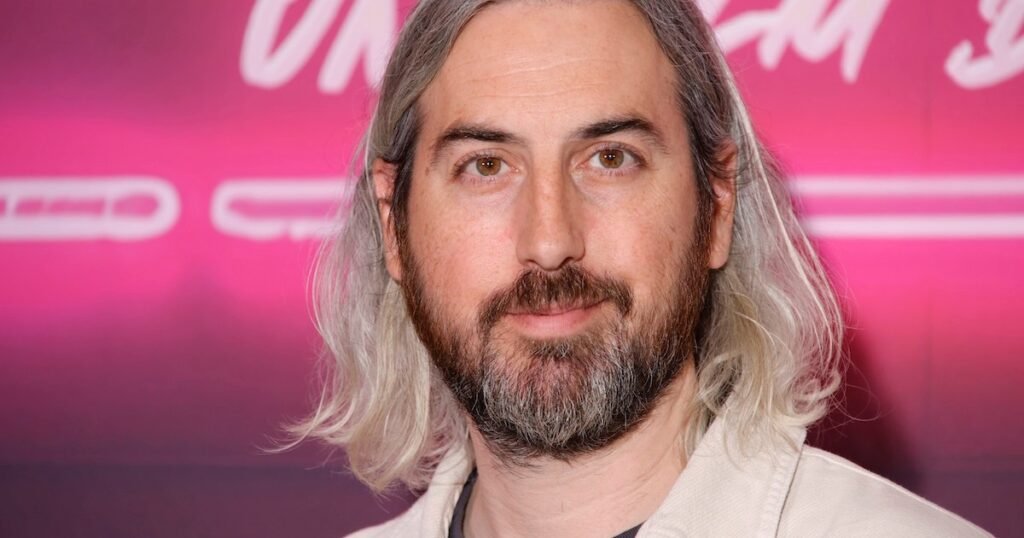
Ti West (born 1980) is an American writer-director-editor known for The House of the Devil, The Innkeepers and A24’s X trilogy.
Quick Specs
| Full name | Timon C. West |
| Born | October 5, 1980, Wilmington, Delaware |
| Education | School of Visual Arts, New York |
| Mentor and first producer | Larry Fessenden (Glass Eye Pix) |
| First feature | The Roost (2005) |
| Horror | The House of the Devil (2009), The Innkeepers (2011), The Sacrament (2013), X (2022), Pearl (2022), MaXXXine (2024) |
| Other films | Trigger Man (2007), In a Valley of Violence (2016) |
| Television | episodes of Scream, South of Hell and Wayward Pines |
| Roles | writer, director, producer and editor of most of his films |
Who He Is
Timon C. West was born on October 5, 1980, in Wilmington, Delaware, and grew up in the wooded suburbs there, going to the Tatnall School from kindergarten through 12th grade. He’ll tell you he has no legendary origin story. “I don’t have any of those cool, ‘I was making Super 8 movies with my friends and they were epic’ stories,” he said. With schoolmate Graham Reznick, later one of his sound designers, he drew comics and blew up army men with firecrackers on a Hi8 camcorder.
What he did have was a video store, Video Frequency, and a weakness for “the sort of stuff you’re not supposed to see as a kid.” The box covers were cooler in the horror section. Peter Jackson’s Bad Taste made filmmaking look possible: “Oh, they just put that camera on a stick and lifted it up.” A high-school film history class, running from German Expressionism to the Coen Brothers, was “the first time I ever got an A.”
With no real plan after school, he made a short film as a “Hail Mary” and got into the School of Visual Arts in New York. His freshman professor was Kelly Reichardt. When she asked if anyone knew Larry Fessenden, West was the only one who had seen Habit, and he bugged her every week to bring Fessenden in until she gave up and handed over the number: “Dude, here’s his phone number.” He called, and Fessenden let him intern at Glass Eye Pix, cleaning the apartment, wrangling cables and, as Fessenden likes to say, using the equipment to dub his own shorts.
The Work, and What He Did in It
Fessenden championed West’s student short The Wicked (2001). When West graduated, Fessenden asked what was stopping him from making a feature. West said he had a script and a crew ready to go. He had neither. “He gave me $50,000, no strings, no nothing,” West said, and he went home and wrote The Roost (2005) fast. He wrote, directed and edited it: four friends on their way to a wedding on Halloween are stranded at a farm where killer bats turn their victims into the undead. It was shot on 16mm in 13 days, and “literally 85% of the budget went to film.” West wrapped the whole thing as an episode of a fake late-night horror show, Frightmare Theatre, hosted by Tom Noonan. Fessenden took a small part and got killed off. It premiered at SXSW in March 2005 and sold.
Trigger Man (2007) was what he made when everything else fell apart, including the first attempt at The House of the Devil. “I need to just go make something arty and experimental,” he said, and Fessenden gave him about $10,000. Three friends on a hunting trip are picked off by an unseen sniper, in long silences. Fessenden was killed off again.
Cabin Fever 2: Spring Fever is the film he disowns, and both sides of the story are on the record. Eli Roth steered him to it. West said he agreed on condition that he could rewrite it entirely, as a John Waters and Paul Bartel-style horror comedy that moved the flesh-eating virus to a high school prom; the released film credits the screenplay to Joshua Malkin, with West credited for the story. West called the shoot “the greatest film experience I’ve ever had” until post-production, when the money ran out, the production stalled, and the producers finished it without him. “Ninety percent of the decisions they made are the opposite of what I would have done,” he said. He asked for the Alan Smithee credit and was refused: “I’m not DGA, so I couldn’t do it.” “I really do not feel like it’s my film.” Producer Lauren Moews disputes the scale of it. She said that except for the tag ending, the film is “probably 90 percent [West’s] cut,” re-edited with John Waters’ editor Janice Hampton to sharpen the comedy West had wanted. Shot in 2007, it went to DVD in 2010.
The House of the Devil (2009) was the breakthrough. West wrote, directed and edited it for about $900,000. Jocelin Donahue plays a broke college student who takes a babysitting job at an isolated house on the night of a lunar eclipse, for Tom Noonan and Mary Woronov, and there is no baby. Greta Gerwig plays her friend. The subject was the 1980s Satanic Panic, and West wanted “a very accurate depiction of that and not do it tongue-in-cheek, or as a parody.” He insists it’s a period piece, not an homage: “a very seamless recreation of that time. You wouldn’t say Zodiac is a homage to the seventies.”
He built the period in on purpose: 16mm grain, zooms instead of dolly moves, yellow credits over freeze-frames, a Walkman, The Fixx on the soundtrack and feathered hair. It was shot in Connecticut, in a Victorian house in Lakeville, where the crew called the film “The House” because locals were touchy about the devil. Then it makes you wait. In his films, he said, “the first half of them are just like regular movies, and then they turn into horror movies.” It premiered at Tribeca, went to video on demand before theaters, and was promoted with a VHS clamshell, like an early-’80s tape. By West’s account, the financiers cut one roughly four-minute scene against his wishes; the rest is his cut.
The Innkeepers (2011) came from that shoot. The House of the Devil crew stayed at the Yankee Pedlar Inn in Torrington because it was cheap, and the town and the staff believed it was haunted. “Slowly our cast and crew started to believe it was haunted as well,” West said. A year later, wanting to make a ghost movie, “it occurred to me that I lived one.” He went back and shot in the real hotel. Sara Paxton and Pat Healy play the last two clerks on the inn’s final weekend, amateur ghost hunters with recording gear, and Kelly McGillis plays a guest. West is not a believer: “I don’t believe in ghosts.” He shot it on 35mm, though he was told repeatedly that digital would have saved $162,000.
He directed “Second Honeymoon” for V/H/S (2012) and “M is for Miscarriage” for The ABCs of Death (2012). The Sacrament (2013), produced by Eli Roth, sends a VICE crew (AJ Bowen, Joe Swanberg, Kentucker Audley) into Eden Parish, a Jonestown-style commune run by Gene Jones’s “Father.” It’s fiction modeled on Peoples Temple, and West refused the found-footage label: “I don’t class this movie as found footage… like a horror Christopher Guest movie.” Since the character holding the camera is a professional, he wanted it shot “90% like someone who does it for a living.” It premiered at Venice.
In a Valley of Violence (2016) was a Western for Blumhouse, written for Ethan Hawke as a drifter whose dog is killed, with John Travolta as a one-legged marshal and Fessenden as a hired gun. West wrote, directed, produced and edited it, shooting 25 days on 35mm in a town built near Santa Fe. Critics liked it and almost nobody saw it in theaters. He headed off the usual label: “It’s a Western from the first shot… it’s always a Western.” Through the 2010s he also directed television, including “The Dance” for MTV’s Scream: “The first movie I drove myself to see when I got my license was @wescraven’s SCREAM. Now I’m directing part [of] the TV Series. Life is weird.”
X (2022), for A24, sends a crew to shoot a porn film on a Texas farm in 1979, owned by an elderly couple named Howard and Pearl. Mia Goth plays both the young star Maxine and, under prosthetics, old Pearl: “a good 10 hours in the makeup chair, and then I’d go and do a 12-hour day on set.” Jenna Ortega co-stars. Texas is only the setting. It was shot in New Zealand’s Manawatu region in early 2021, where a Texas farm was built from scratch because the country was a safe place to film during the pandemic. It premiered at SXSW and grossed $15.1 million worldwide. The often-repeated $1 million budget is a myth; New Zealand Film Commission rebate figures put it at $5.3 million.
Pearl (2022) was written in quarantine. During the two-week mandatory hotel stay to enter New Zealand, West wrote with Goth over FaceTime while she was still in New York; it is her first writing credit. A24 green-lit it before X shot a frame, and West started shooting Pearl three weeks after X wrapped, on the same farm. The logic was practical: “We had already spent all of this time and money building a Texas farm in New Zealand. How do we reuse it for free?” Set in 1918, it trades X’s grime for Technicolor melodrama inspired by Douglas Sirk, The Wizard of Oz and Mary Poppins. Nobody knew it existed until X came out. It premiered at Venice and grossed over $10 million.
MaXXXine (2024) moves Maxine to Los Angeles in 1985, landing the lead in a horror sequel while the Night Stalker murders fill the news, though the real killer is backdrop and the film’s own killer is fictional. Elizabeth Debicki, Kevin Bacon, Michelle Monaghan, Bobby Cannavale, Halsey, Lily Collins and Giancarlo Esposito filled out the biggest cast he’d had. The trilogy, he said, had been “seven days a week, 12 hours a day, for four and a half years.” It premiered at the TCL Chinese Theatre with hired protesters carrying “Horror is not art” signs, and its $22 million worldwide gross made it the trilogy’s biggest earner.
Cool Verified Facts
- Fessenden is killed off in The Roost and again in Trigger Man; Glass Eye Pix calls it “a ghoulish inside joke.”
- West pitched The Innkeepers to Fessenden as “two people sitting in a break room eating sandwiches out of aluminum foil.” Fessenden’s answer: “I’m sold.”
- He acts, mostly for friends. In Adam Wingard’s You’re Next he plays Tariq, a pretentious filmmaker who gets mocked by Joe Swanberg’s character and killed early.
- Four of his films world-premiered at SXSW: The Roost, The Innkeepers, In a Valley of Violence and X. “Between SXSW and Larry Fessenden… I wouldn’t be sitting here now,” he said.
- Martin Scorsese, a fan, described the trilogy as three eras of movies: X is “the ’70s, the slasher era,” Pearl is “’50s melodrama in vivid saturated color,” and MaXXXine is “’80s Hollywood, rancid, desperate.”
Signatures, Habits and Behind the Scenes
- He hates the label everyone uses for him. “I hate the term ‘slow burn,'” he said. “I’m not making these movies to see people get killed, so I’m not in a hurry to get there.”
- Contrast is the theory. Without enough non-horror before the horror, “it’s not shocking when [the horror] shows up… It becomes almost like porn.”
- Movies first. “The Shining… is a movie about a guy who hates his family… The Exorcist is about a woman with a sick daughter… They’re always movies first and horror movies second.”
- He edits his own films. Without the writer-director in the edit, he said, a film is “like a local band playing ‘Billie Jean’ by Michael Jackson. It’s the same notes and the same song, but for some reason it doesn’t sound right.”
- He shoots on film whenever he can: 16mm for The Roost and The House of the Devil, 35mm for The Innkeepers and the Western.
- He works with the same people. Fessenden produced his first four features, Tom Noonan and composer Jeff Grace keep coming back, and Mia Goth has played two characters across three films and co-wrote one of them.
- His models are auteurs: Kubrick, Polanski, Hitchcock, Scorsese, Friedkin, Carpenter and Argento, directors whose films “nobody else could have made.”
Why He Matters
West showed that a period setting could be a method, not a costume. The House of the Devil rebuilt the conditions of early-’80s horror instead of quoting them, made audiences wait, and has become a modern classic. His career is also the best argument for the Glass Eye Pix model: give a young director $50,000 and no strings, and 17 years later you get a trilogy that grossed around $47 million while he still cut his own films. That trilogy came out of a pandemic, a set reused for free and a script written in a quarantine hotel, and it made Mia Goth a horror icon. Along the way came a disowned sequel, a sniper film made for pocket change and a Western nobody saw. His method survived all of it.