
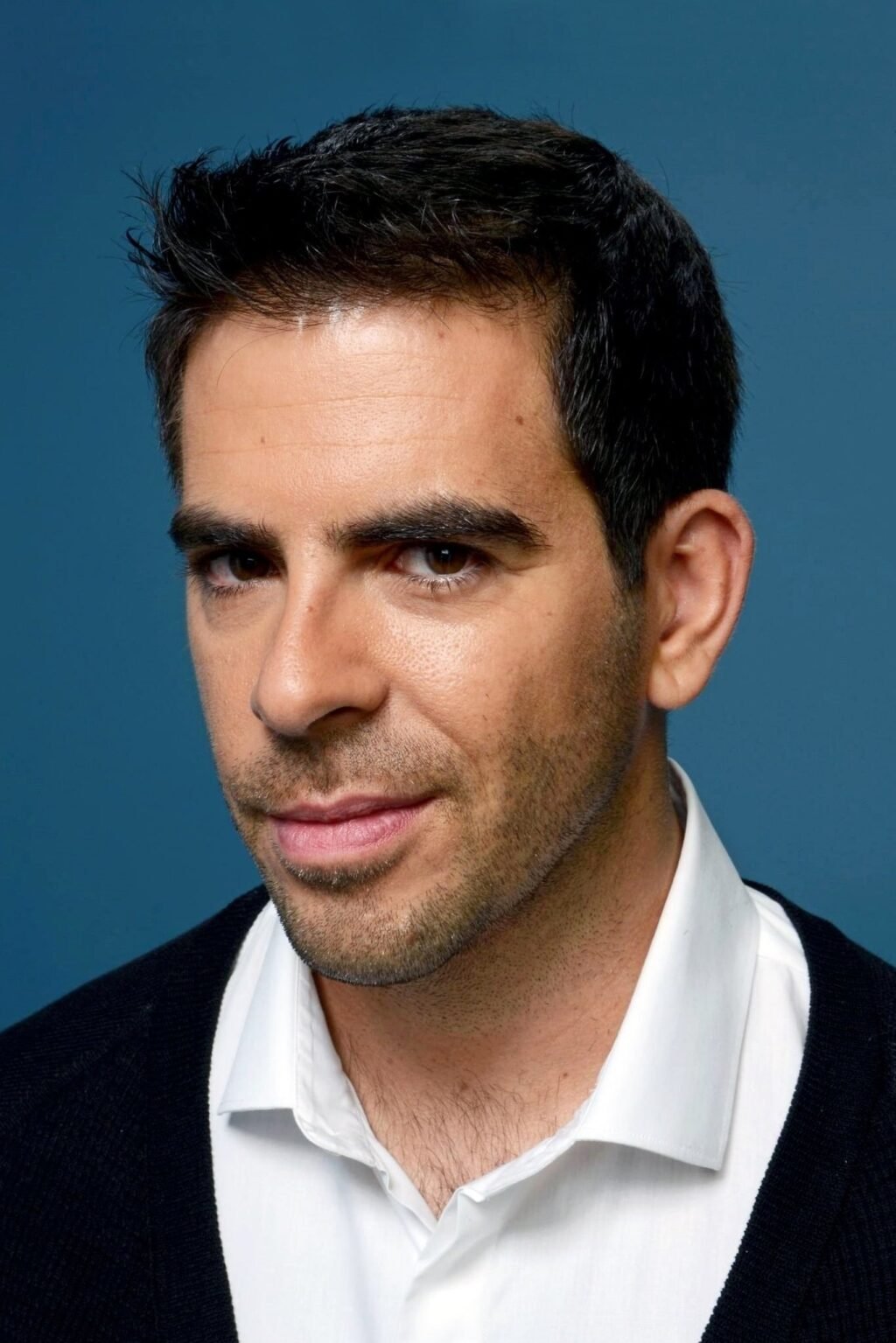
Eli Roth (born 1972) is the American director of Cabin Fever, Hostel, The Green Inferno and Thanksgiving, and Donny Donowitz in Inglourious Basterds.
The people of Callanayacu, a farming village on the Huallaga River in the Peruvian Amazon, had to be shown what a movie was before they agreed to be in one. By the production’s own account, the film they were shown was Cannibal Holocaust. “They thought it was the funniest thing that they had ever seen,” Eli Roth said. They voted to host his shoot anyway.
Quick Specs
| Born | April 18, 1972, Newton, Massachusetts (as Eli Raphael Roth) |
| Education | NYU Tisch School of the Arts, summa cum laude, 1994 |
| Films as director | Cabin Fever (2002); Hostel (2005); Hostel: Part II (2007); The Green Inferno (2013); Knock Knock (2015); Death Wish (2018); The House with a Clock in Its Walls (2018); Thanksgiving (2023); Borderlands (2024); Ice Cream Man (2026) |
| Biggest film as director | The House with a Clock in Its Walls, about $131.5 million worldwide |
| Signature acting role | Sgt. Donny “The Bear Jew” Donowitz in Inglourious Basterds (2009) |
| Company | The Horror Section (2025), co-founded with Jon Schnaars |
| Television | Host and executive producer of Eli Roth’s History of Horror (AMC, 2018 to 2021) |
| Labels attached to him | “Splat Pack” (Alan Jones, 2006); “torture porn” (David Edelstein, 2006) |
| In development, no date | Thanksgiving 2; a Hostel feature |
Who He Is
Eli Raphael Roth was born on April 18, 1972, in Newton, Massachusetts, the middle of three sons. His father, Dr. Sheldon Roth, is a psychiatrist and psychoanalyst and a clinical professor at Harvard Medical School; his mother, Cora Roth, born Bialis, is a painter who showed at the OK Harris Gallery in New York. His grandparents came from Austria, Hungary, Russia and Poland, and he was raised Jewish. His brothers are Adam and Gabriel.
He started making films at eight, after seeing Ridley Scott’s Alien, and made dozens of shorts with his brothers and friends before college. After Newton South High School he went to NYU’s Tisch School of the Arts, graduating summa cum laude in 1994, and as a student he ran the office of the producer Frederick Zollo. His thesis film, Restaurant Dogs, a Reservoir Dogs homage played by fast-food mascots, won its division at the 1995 Student Academy Awards.
Through the Zollo job he met David Lynch and stayed in touch, and in the late 1990s he produced content for Lynch’s website. Through Lynch he met the composer Angelo Badalamenti and someone from the effects house KNB EFX, both of whom ended up on his first feature. In between, by his own accounts, he paid for his NYU films working as an online cybersex operator for Penthouse, posing as a woman, and worked as a production assistant and stand-in, including as Howard Stern’s nighttime assistant at Silvercup Studios on Private Parts (1997), writing scripts while Stern slept, and on Meet Joe Black (1998).
After moving to Los Angeles in 1999 he wrote, directed, edited, produced, animated and voiced Chowdaheads, animated shorts for Mandalay Sports Entertainment, with his childhood friend Noah Belson. They were made to run between matches on WCW Monday Nitro and never aired; in Roth’s account, the WCW chief was fired the day before the debut. The material became the stop-motion The Rotten Fruit (2003).
He married the Chilean actress Lorenza Izzo, the star of The Green Inferno and Knock Knock, on November 8, 2014, on the beach at Zapallar, Chile. They announced their separation on July 16, 2018, saying they would stay friends and keep working together, and the divorce was finalized in August 2019; they had no children.
The Work, and What He Did in It
Cabin Fever (2002)
At 19, working on a horse farm in Iceland, he caught a skin infection from rotted hay. “I had been cleaning out a barn and got a skin infection on my face,” he has said. “I woke up in the middle of the night scratching my cheek, thinking I had a mosquito bite. I looked down at my hand and saw chunks of skin. The next morning I attempted to shave and literally shaved half my face off.” He wrote Cabin Fever with Randy Pearlstein in 1995, when he was 23, the leg-shaving scene restages that morning, and the script circulated for years before the money came.
It was made independently for $1.5 million, with Rider Strong, Jordan Ladd, James DeBello, Cerina Vincent, Joey Kern and Giuseppe Andrews, and music by Nathan Barr and Angelo Badalamenti. It premiered at the Toronto International Film Festival on September 14, 2002, and set off a bidding war among studios, most of which had passed on making it; Lionsgate won. Mental Floss reports he was paid $3.5 million for it, with $12 million promised in prints and advertising. By Mental Floss’s account, Peter Jackson, filming The Return of the King, asked for a print, stopped production twice to screen it for cast and crew, invited Roth to the set and supplied a quote: “Brilliant! Fantastic! Horror fans have been waiting years for a movie like Cabin Fever. I loved it!”
It opened in the US on September 12, 2003, and took about $30.6 million worldwide. Roth plays Justin, the stoned party guest. The two sequels (2009, 2014) and the 2016 remake were made without him as director.
Hostel (2005)
The idea came from a website that Harry Knowles of Ain’t It Cool News showed him, which claimed that for $10,000 you could go to Thailand and shoot a stranger in the head, a stranger who had supposedly signed up so part of the money would reach a destitute family. “It was to give you the thrill of taking another human life,” Roth has said. He thought about a documentary and dropped it, and he has never claimed the site was real. Hostel is not based on a true story, and its Elite Hunting Club is fiction. Abu Ghraib’s imagery is the second influence he has named.
Quentin Tarantino was one of a chain of champions, not a lone discoverer: NYU, then Lynch’s circle, then Jackson after Toronto, then Tarantino, who backed Cabin Fever loudly. When Roth pitched him Hostel, Tarantino told him, in Roth’s telling: “Are you f---ing kidding me? That’s the sickest f---ing idea I have ever heard. You’ve got to do that. F--- it. Do it low-budget. Go to Europe and make it as sick as you want to make it.” Tarantino executive produced, billed as “Quentin Tarantino presents.”
Roth wrote and directed it with Jay Hernandez as Paxton, Derek Richardson and Eythor Gudjonsson, shooting in Prague and Český Krumlov for a story set in Slovakia, with a cameo by Takashi Miike. It cost $4.8 million, and he has said he took a $10,000 directing salary to protect the budget and the violence. It opened at No. 1 in the US on January 6, 2006, with $19.6 million, and took about $80.6 million worldwide, a figure often rounded up to $82 million.
Slovak and Czech officials protested the portrait of Slovakia. “I am offended by this film. I think that all Slovaks should feel offended,” said the Slovak MP Tomáš Galbavý, and a culture ministry official, Linda Heldichova, said it “damaged the image of our country.” The Slovak tourist board invited Roth on an all-expenses-paid trip to see the real place. His answer: “Americans do not even know that this country exists. My film is not a geographical work but aims to show Americans’ ignorance of the world around them.”
On February 6, 2006, David Edelstein’s New York magazine essay “Now Playing at Your Local Multiplex: Torture Porn” took in Hostel, Saw, Wolf Creek and The Devil’s Rejects. It was more ambivalent than the label’s afterlife suggests, praising Roth’s portrait of American entitlement abroad even as it named the trend, but the phrase stuck to him for good.
Hostel: Part II (2007)
The sequel picks up straight after the first film and follows three American students, played by Lauren German, Heather Matarazzo and Bijou Phillips, with Roger Bart and Richard Burgi as the bidding clients and Ruggero Deodato, the director of Cannibal Holocaust, in a cameo as a cannibal client. It opened on June 8, 2007, sixth with $8.8 million, and took about $17.6 million in the US and $35.6 million worldwide on a budget of about $10 million, less than half the first film. A workprint had leaked online before release, and about two million illegal downloads were tracked on opening day; Roth and Lionsgate both cited the leak among the causes, and Lionsgate also blamed the summer slot. Several countries banned or cut it, Germany banned the uncut version, and New Zealand’s classification fight is on record. Hostel: Part III (2011) went straight to video under Scott Spiegel, without Roth.
Grindhouse and the Thanksgiving Trailer (2007)
For Robert Rodriguez and Tarantino’s Grindhouse he directed and narrated the fake trailer Thanksgiving, with a Pilgrim-costumed killer, a trampoline kill and a parade beheading; his childhood friend Jeff Rendell co-wrote it and played the killer. It became the cult favourite of the fake trailers and drew sixteen years of demands for the feature. He also appears as Dov in Tarantino’s Death Proof segment.
Inglourious Basterds (2009)
Sgt. Donny Donowitz, “The Bear Jew,” was first conceived for Adam Sandler, who passed because of Funny People. “No, the only role for me was ‘The Bear Jew,'” Roth has said. “I was like this is it, to be a Jewish guy from Boston that beats Nazis to death with a baseball bat. I have been training for my whole life for that part.” He bulked up and has said he modelled his swing on Ted Williams, and Donowitz’s entrance from the tunnel, bat tapping the wall, is the film’s famous introduction. Uncredited, he also directed the film within the film, the propaganda picture Nation’s Pride starring Daniel Brühl’s Fredrick Zoller. The cast won the SAG ensemble award and the Critics’ Choice acting ensemble award, shared honours.
He hosted the wet T-shirt contest and died in the marina massacre in Piranha 3D (2010).
The Green Inferno (2013)
Between features he starred in and co-wrote Aftershock (2012), a Chilean earthquake horror directed by Nicolás López, where his working relationship with Lorenza Izzo began, and co-wrote The Man with the Iron Fists (2012) with its director, RZA.
The Green Inferno, written with Guillermo Amoedo and announced at Cannes on May 17, 2012, with Worldview Entertainment financing, stars Izzo as Justine with Ariel Levy, Daryl Sabara and Kirby Bliss Blanton. Its title is the name of the film within the film in Cannibal Holocaust, and its debt to the Italian cannibal cycle is open. It was shot in Peru, Chile and New York from November 5, 2012. Callanayacu, with no electricity or running water and almost no outside contact, played the tribe; the production says its Peruvian team came back with a generator and a TV to explain the idea. Before leaving, the production built tin roofs for the village’s 103 huts and a school kitchen.
It premiered at Toronto in September 2013, where Open Road Films bought US rights for a September 5, 2014, release, then pulled it weeks before as Worldview collapsed. Jason Blum’s Blumhouse rescued it, and BH Tilt released it on about 1,000 screens on September 25, 2015. “The Green Inferno is a wild, fun ride that took us deeper into the Amazon than anyone has ever taken a film crew,” Roth said, which is his line rather than a geographical finding. It cost about $5 million and took about $12.9 million worldwide.
Knock Knock (2015)
Knock Knock, written with Amoedo and López, stars Keanu Reeves as Evan Webber, with Izzo as Genesis and Ana de Armas, in her first English-language role, as Bel. It remakes Death Game, shot in 1974 and released in 1977, directed by Peter S. Traynor with Sondra Locke and Colleen Camp. Roth set out to remake it, found the original companies dissolved, and brought in the originals instead: Traynor, Locke and Camp are credited producers, and Camp has a cameo as the neighbour, Vivian. It premiered at Sundance on January 23, 2015, where Lionsgate bought it for a reported $2.5 million, and opened on October 9, 2015. It was shot in Chile, dressed as suburban America. It took about $6.3 million worldwide; budget records conflict, at $10 million in one and $2 million in another.
The 2018 Pair
Death Wish, the remake of the 1974 Charles Bronson film from Brian Garfield’s 1972 novel, came to him at the end of a long chain. Joe Carnahan was announced to write and direct in 2012 and left, though he keeps sole screenwriting credit on a script rewritten many times since. Aharon Keshales and Navot Papushado were set to direct in March 2016 and quit in May, after MGM refused to let them rewrite Carnahan’s script, which Bruce Willis had approved. Roth signed on in June 2016, with Scott Alexander and Larry Karaszewski rewriting. Willis plays Paul Kersey, now a Chicago trauma surgeon, with Vincent D’Onofrio and Elisabeth Shue. Moved from November 22, 2017, it opened on March 2, 2018, and took about $49.6 million worldwide on $30 million.
Six months later came The House with a Clock in Its Walls, from Eric Kripke’s script of John Bellairs’s 1973 novel, for Amblin, released by Universal on September 21, 2018, with Jack Black, Cate Blanchett, Owen Vaccaro and Kyle MacLachlan. It was PG, his first directing credit below an R, and on a $42 million budget it took about $131.5 million worldwide, still his biggest film as director.
Fin (2021)
He wrote, directed and executive produced Fin, a documentary on the shark-fin trade and the criminal business behind shark extinction, for discovery+, premiering on July 13, 2021, during Shark Week, with Leonardo DiCaprio, Nina Dobrev and Craig Piligian among the executive producers. He went out with Sea Shepherd and the Liberian Coast Guard aboard the arrested vessel Labiko 2. “Fin is the scariest film I’ve ever made, and certainly the most dangerous,” he said.
Thanksgiving and Borderlands (2021 to 2024)
Borderlands, from the Gearbox games, co-written with Craig Mazin, stars Cate Blanchett as Lilith, Kevin Hart, Jack Black as the voice of Claptrap, Jamie Lee Curtis, Ariana Greenblatt and Edgar Ramírez. It had been announced in 2015, Roth attached in February 2020, and he shot it in Budapest from April to June 2021, during COVID.
Then he left to make Thanksgiving, and the Borderlands story became five separate records. First, Tim Miller directed two weeks of reshoots in early 2023 because Roth was away; Mazin took his name off in June 2023, and the writing credit went to Roth and “Joe Crombie.” Second, the stunt coordinator Jimmy O’Dee has said Roth shot an R-rated film and the reshoots reshaped it toward PG-13. Third, by Roth’s 2026 account to Variety, the studio required the mature material cut for a PG-13. Fourth, Lionsgate’s chief executive, Jon Feltheimer, told investors in November 2024: “Nearly everything that could go wrong did go wrong. It sat on the shelf for too long during the pandemic, and reshoots and rising interest rates took it outside the safety zone of our usual strict financial models.” Fifth, Roth’s own verdict, given in 2026 and not before, after diplomatic comments in 2024 about COVID and timing: “You got something that belonged to nobody. It’s not a kids’ movie, but it’s trying to appeal to everybody… You just wind up with a movie that’s neither fish nor fowl.”
It opened on August 9, 2024, on a production budget of $110 million to $120 million plus about $30 million in marketing, started at 0 percent on Rotten Tomatoes, reached digital three weeks later and finished at about $33 million worldwide. Trade estimates put the loss at about $112 million to $115 million. The arithmetic is stark: it cost more than Cabin Fever, both Hostels, The Green Inferno, Thanksgiving and Ice Cream Man together, and grossed about what Cabin Fever did.
Thanksgiving, written with Rendell from the trailer and from a script the two had been developing since a childhood short, was financed by Spyglass and released by TriStar on November 17, 2023. Set in Plymouth, Massachusetts, it follows a killer in a John Carver mask hunting the people behind a Black Friday stampede, with Nell Verlaque, Patrick Dempsey, Addison Rae, Milo Manheim, Rick Hoffman and Gina Gershon. It cost $15 million and took about $46 million worldwide, and its 83 percent on Rotten Tomatoes, Certified Fresh, is the best of his films. Thanksgiving 2 was announced on November 30, 2023, aiming at 2025. In January 2026 Roth said the script was finished and cast schedules were the hold-up: “We’re upping the ante but we are not going to do it with more money.” It has no production start and no date.
The Horror Section and Ice Cream Man (2025 to 2026)
In March 2025 he launched The Horror Section, a horror company co-founded with its chief executive, Jon Schnaars, and backed by Media Capital Technologies, for films, television, games, podcasts and live events. He told The Hollywood Reporter he would want Thanksgiving to be “the tamest type of movie that I would do for this new company. That is the baseline.” A Republic campaign let fans invest in the company itself from $100, with more than 2,500 investors and about $5.5 million in the first round. Its first acquisition was Joe Begos’s Jimmy and Stiggs, released on August 15, 2025.
Ice Cream Man, written with Noah Belson from a script the two first wrote in 2003, which everyone who read it told him could never be made, is his return to original horror as director. Variety announced it on May 8, 2025, it sold most of the world at the Cannes market, and the cast was revealed on November 12, 2025: Ari Millen as the Ice Cream Man, Charlie Zeltzer as Jared, and Roth himself among them. In the seaside town of Bayleen Bay, a silent vendor’s free treats turn every child who eats one into a killer, and the boy who cannot eat dairy, Jared Mayfair, is left to survive it. Brandon Roberts scored it with extra music by Snoop Dogg, Steve Newburn and Adrien Morot did the prosthetics, and Nas executive produced. It wrapped in September 2025 and opened wide on August 7, 2026, taking about $7.6 million worldwide on $5.5 million. It reached digital on September 22 and disc on October 20, with a 4K steelbook due on November 17, 2026. The site’s review is Ice Cream Man (2026) Review — We All Scream, Mostly From Boredom.
Separately from that score, Deadline reported at Toronto on September 5, 2025, that Roth and Snoop Dogg were teaming on a feature that began as a faux trailer that August. It has no date.
Hostel, Again (2024 to 2026)
On June 4, 2024, The Hollywood Reporter reported a Hostel TV series with Paul Giamatti attached to a key role, Roth writing, directing and executive producing, and Fifth Season producing. On July 31, 2025, Variety reported it had landed at Peacock in development. In July 2026 Roth said Peacock had passed and that he was redeveloping Hostel as a theatrical feature. Nothing is greenlit.
Cool Verified Facts
- Restaurant Dogs won Division III at the 1995 Student Academy Awards.
- Hostel won the Empire Award for Best Horror.
- He shared the 2007 Scream Award for Best Screamplay for Grindhouse with Tarantino, Rodriguez, Jeff Rendell, Rob Zombie and Edgar Wright.
- The Stanley Film Festival gave him its Visionary Award in 2013, and Universal Studios Hollywood’s Halloween Horror Nights gave him an Eyegore Award in 2010.
- As a producer he had a genuine hit with The Last Exorcism (2010), about $68 million worldwide on about $5 million, and he hired Damien Chazelle to write its sequel. He also shepherded Jon Watts’s fake-trailer short Clown (2014) into a feature.
- He co-founded Crypt TV with Jack Davis in 2014, with Jason Blum as first investor. It made short-form monsters for phones, including The Birch and The Look-See, and was acquired by Brat TV by 2024.
- Eli Roth’s History of Horror ran three seasons and 19 episodes on AMC from October 14, 2018, to November 5, 2021, built from more than 200 interviews, including Stephen King, Tarantino, Jamie Lee Curtis, Jordan Peele and Rob Zombie, and won a 2020 Reelscreen Award.
Signatures, Habits and Behind the Scenes
He puts himself in his films: Justin in Cabin Fever, a café patron in Amsterdam in Hostel, the lead in Aftershock, a role in Ice Cream Man.
He also helped spread his own legend. In 2006 Alan Jones, in Total Film, coined “Splat Pack” for a wave of low-budget, extreme-violence horror directors: Roth, Alexandre Aja, Neil Marshall, Greg McLean and Rob Zombie. Later coverage added James Wan, Leigh Whannell and Darren Lynn Bousman. Roth’s confession: “I totally ran with it and posted it on everyone’s IMDB trivia page without their knowing so that journalists would ask them about it — and it worked!” “Torture porn,” a different label from a different writer, is Edelstein’s.
He keeps a working repertory: Izzo across Aftershock, The Green Inferno and Knock Knock; Amoedo and López as co-writers; Rendell from childhood shorts to Thanksgiving; Belson from Chowdaheads to Ice Cream Man.
Why He Matters
For horror, Roth is the director who proved the mid-2000s wave of extreme low-budget horror could pay, from a $1.5 million Cabin Fever to a $4.8 million Hostel that opened at No. 1, and who then tested how far a horror name could carry a studio blockbuster. Borderlands answered that, and the answer was his own label. Alongside contemporaries such as Ti West, he has kept working small and owning the result, and Ice Cream Man, a script he was told could never be made, is now a film.