
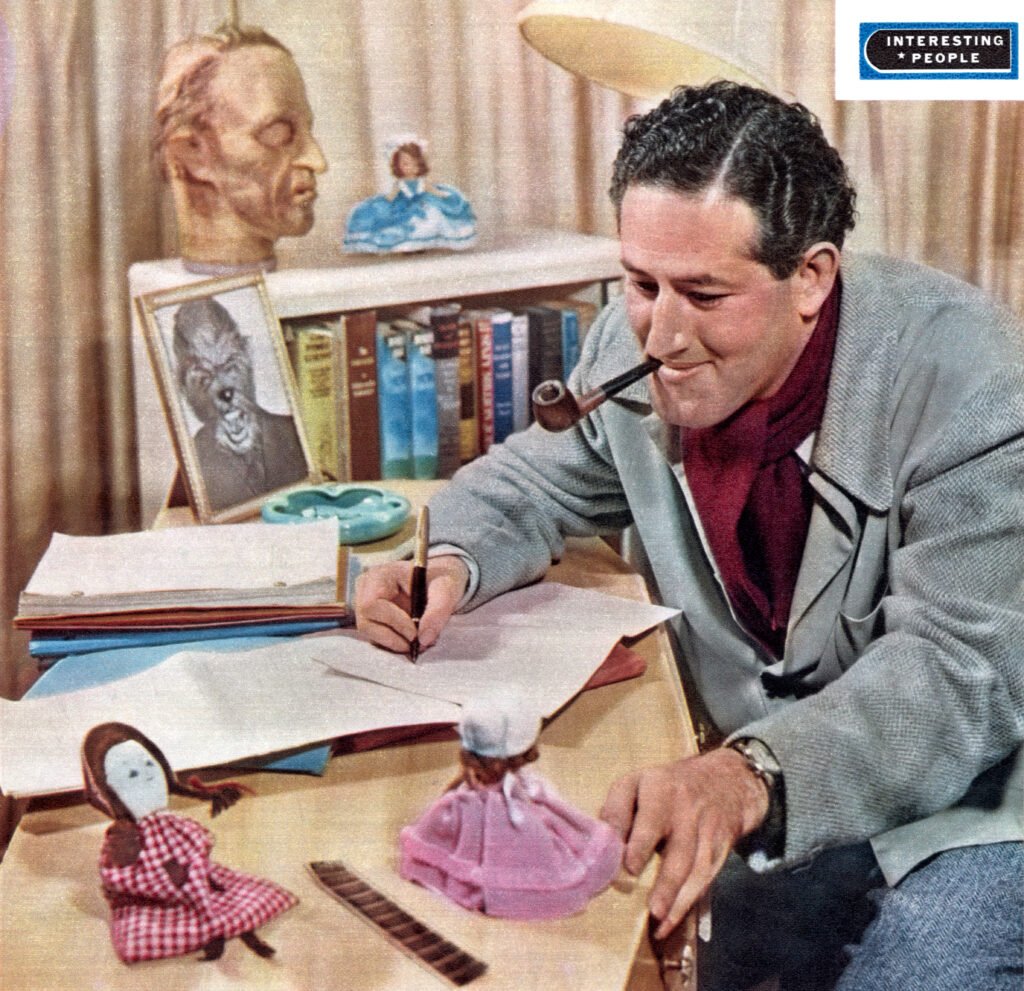
William Castle (1914-1977) was an American director and producer, the gimmick king of 1950s horror and the producer of Rosemary’s Baby.
Quick Specs
| Born | William Schloss Jr., April 24, 1914, New York City |
| Died | May 31, 1977, Los Angeles, aged 63 |
| Directorial debut | Chance of a Lifetime (1943) |
| Signature films | Macabre (1958), House on Haunted Hill (1959), The Tingler (1959), 13 Ghosts (1960), Homicidal (1961), Strait-Jacket (1964) |
| Producer | Rosemary’s Baby (1968) |
| Gimmicks | Fright Insurance, Emergo, Percepto, Illusion-O, the Fright Break, the Punishment Poll |
| Memoir | Step Right Up! I’m Gonna Scare the Pants Off America (1976) |
Who He Is
William Castle was born William Schloss Jr. in New York City to a Jewish family. Schloss is German for castle, so he translated it. He was orphaned as a boy. In 1927 he saw Bela Lugosi in Dracula on Broadway and bluffed his way backstage by saying Lugosi was expecting him. Lugosi took to the kid. When Castle dropped out of school at 15, Lugosi recommended him as assistant stage manager on the Dracula tour, and the teenager was already pitching stunts to sell it: a coffin outside the theater, incense, an on-stage vanishing act. As a summer-camp party piece he was “Spider Boy,” a double-jointed contortionist who could put his legs behind his neck.
He reached Hollywood at 23 and went to work at Columbia Pictures under Harry Cohn. He was a dialogue coach by 1940.
The Work, and What He Did in It
Castle’s directing debut was Chance of a Lifetime (1943) at Columbia. He became a reliable studio hand on the Whistler series with Richard Dix and the Crime Doctor films. He also made When Strangers Marry (1944), which gave Robert Mitchum his first important role. For Orson Welles he was assistant director and ran second-unit location work on The Lady from Shanghai (1947). He made more than 50 features in those studio years, eight in 1954 alone.
Then he saw the lines around the block for Diabolique and decided to make horror. He mortgaged his house to pay for Macabre (1958), written by Robb White and shot in six days. Every ticket came with a $1,000 Lloyd’s of London policy against death by fright. Hearses and nurses waited outside the theaters.
House on Haunted Hill (1959): Vincent Price offers $10,000 to anyone who survives a night in a haunted house. The gimmick was EMERGO. At the climax a glow-in-the-dark plastic skeleton sailed out over the audience on a wire. Some theaters rigged it properly, and some didn’t bother.
The Tingler (1959): Price is back, and this time the monster is a parasite that feeds on fear and can only be killed by screaming. For PERCEPTO, war-surplus airplane de-icing motors were wired under selected seats. At the climax the projectionist set them buzzing while Price, on screen, begged the audience to scream for their lives. Castle also planted screamers and fainters in the crowd and kept nurses on hand.
13 Ghosts (1960): ILLUSION-O. Patrons got a “Supernatural Viewer.” Look through the red filter to see the ghosts, or the blue one to make them go away.
Homicidal (1961): Castle’s answer to Psycho came with the FRIGHT BREAK. A 45-second timer ran on screen before the climax, and anyone too scared to stay could leave for a full refund. The price was humiliation. Yellow footsteps led quitters up the aisle to Coward’s Corner, a yellow-lit booth in the lobby. There a nurse offered blood-pressure tests, a recording chanted “Watch the chicken! Watch him shiver in Coward’s Corner,” and quitters signed a Coward’s Certificate: “I am a bona fide coward.”
Mr. Sardonicus (1961): the PUNISHMENT POLL. Audiences held up glow-in-the-dark thumb cards, or flashed their headlights at drive-ins, to vote on whether the villain got mercy. Castle claimed a mercy ending was filmed. It is widely suspected that only the punishment ending was ever shot.
The gimmicks kept coming. For the comedy Zotz! (1962) he handed out a glow-in-the-dark plastic coin that did absolutely nothing. For 13 Frightened Girls (1963) he ran a worldwide casting search and cast 15 girls. When the backers of Strait-Jacket (1964) told him to drop the gimmicks, he hired Joan Crawford instead, with a script by Psycho author Robert Bloch and the tagline “It’s only a movie…” Promotional axes were handed out. “Strait-Jacket had the biggest gimmick of all: Joan Crawford,” John Waters said. She toured theaters in person. Bloch also wrote The Night Walker (1964) with Barbara Stanwyck. For I Saw What You Did (1965), Castle wanted a giant plastic telephone in theater lobbies. Bell Telephone complained, so he installed seat belts in the back rows instead and called them “Shock Sections.”
Rosemary’s Baby (1968): Castle bought the film rights to Ira Levin’s novel before it was published and mortgaged his home again to do it. Paramount chief Robert Evans insisted on Roman Polanski. Castle produced, and he later conceded that Polanski made it better than he could have. He also cameos in it, as the gray-haired man waiting outside the phone booth. Kidney failure soon after the release stalled him at the peak of his career.
His last film as director was Shanks (1974), with Marcel Marceau as a puppeteer who works corpses. He produced and wrote Bug (1975) and made his last screen appearance in The Day of the Locust (1975). He died of a heart attack in Los Angeles on May 31, 1977, at 63.
Cool Verified Facts
- His fan club had 250,000 members at its height.
- The opening line of his 1976 memoir: “It has always amazed and baffled me that audiences will wait patiently in line and pay money to have their wits scared out of them.”
- His Lloyd’s fright insurance, by one account, effectively insured himself against the payout.
- Robb White wrote five of the gimmick films. The formula was a two-man act: White’s scripts and Castle’s showmanship.
Signatures, Habits and Behind the Scenes
- Castle was always a showman before he was a filmmaker. He was pitching coffins for Dracula at 15, and he took the same instinct into every theater lobby.
- He gambled his own house, twice: once on Macabre and once on Rosemary’s Baby.
- He knew when to step aside. On Rosemary’s Baby he gave the director’s chair to Polanski and admitted the film was better for it.
Why He Matters
Castle invented event horror. Before him, you watched a horror movie. With him, it happened to you: buzzing seats, flying skeletons, life insurance, refund timers and a booth for cowards. Every seat-shaker, immersive screening and viral marketing stunt comes from his playbook. In his day critics called him a poor man’s Hitchcock, but the same years put his name on Rosemary’s Baby. John Waters, his most famous disciple, said, “William Castle was my idol… William Castle was God,” and calls The Tingler his favorite film. Joe Dante’s Matinee (1993), with John Goodman as the showman Lawrence Woolsey, is a portrait of Castle. His daughter Terry Castle co-produced the remakes House on Haunted Hill (1999) and Thir13en Ghosts (2001).