
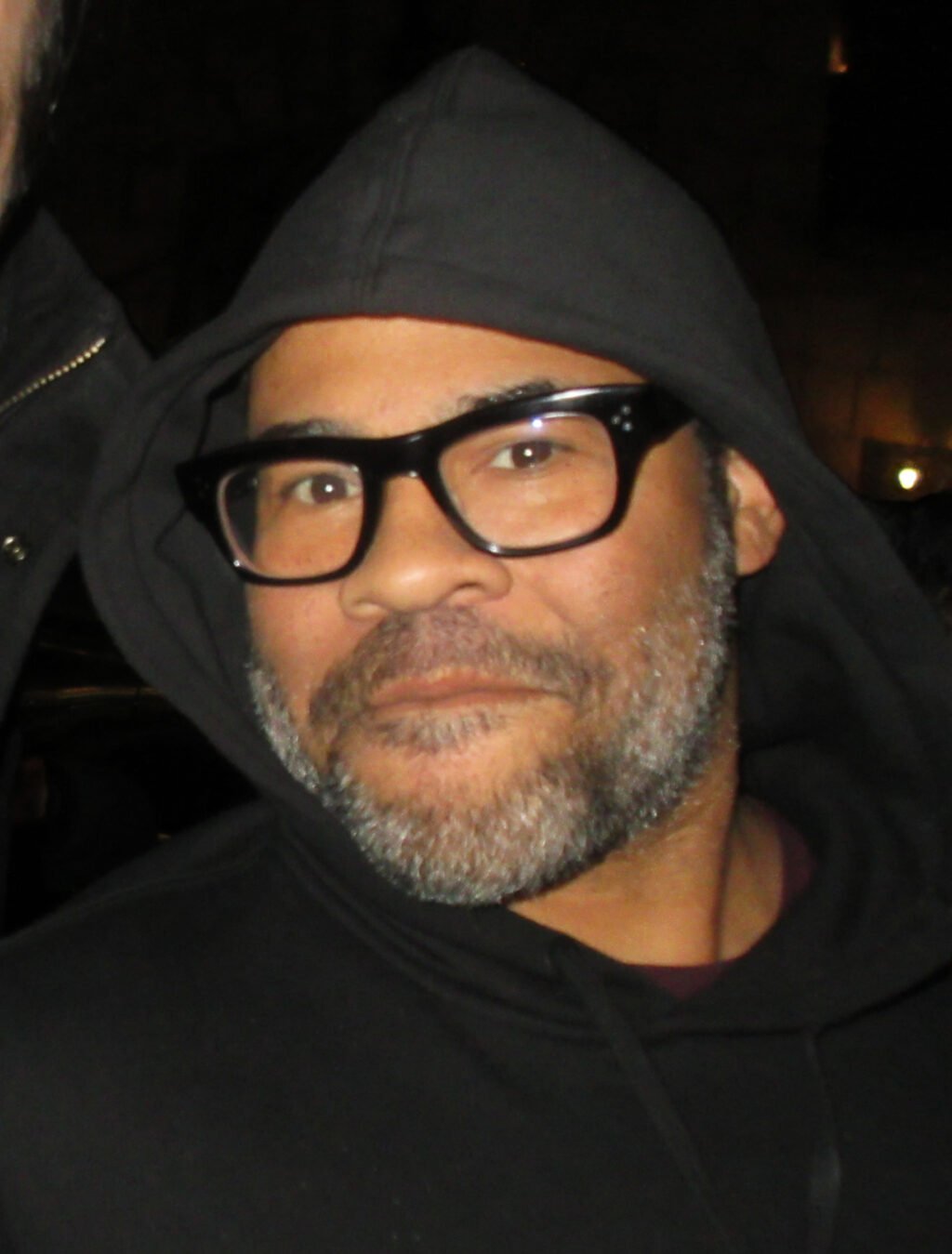
Jordan Peele is the American comedian-turned-filmmaker whose social thrillers Get Out, Us and Nope re-centred modern horror on the Black experience.
Quick Specs
- Born: 21 February 1979, New York City
- Formation: Boom Chicago and Second City improv; five seasons on MADtv; co-creator/star of Key & Peele
- Known for: Get Out, Us, Nope — three directed features, all originals
- The house: Monkeypaw Productions, founded 2012
- The record: First Black winner of the Academy Award for Best Original Screenplay
- The term: “Social thriller” — his own name for the form
Overview
The strangest résumé in modern horror starts in sketch comedy. Jordan Peele spent a decade as one half of a beloved double act, doing impersonations and premise-perfect little sketches — and then, in 2017, he released a $4.5 million horror film he had written and directed himself, and the genre’s centre of gravity moved. That is because the comedy was never the detour. It was the training: premise discipline, timing, the build and release of tension, an ear for exactly when an audience gasps. Peele had wanted to direct horror since he was about thirteen, by his own account. He just took the long way through the funniest room in America to get there — and arrived carrying a new name for what he makes: the social thriller, where the monster is a system and the screaming is the point.
The Life
Jordan Haworth Peele — not Jordan Poole, the basketball player; the record itself carries that disambiguation — was born in New York City on 21 February 1979 and raised by his mother, Lucinda Williams, on Manhattan’s Upper West Side. He attended the Computer School and the Calhoun School, then Sarah Lawrence College, where he intended to study puppetry before improv got him; he dropped out after two years to pursue comedy, and there is no degree — don’t let any bio print one. The apprenticeship was real, though: Boom Chicago in Amsterdam, The Second City in Chicago, and in 2003 a cast spot on Fox’s MADtv, hired alongside Keegan-Michael Key. Five seasons later they left together, and on Comedy Central — keep the networks straight, because everyone swaps them — Key & Peele ran from 31 January 2012 to 9 September 2015, 53 episodes across five seasons, winning a Peabody Award and two Primetime Emmys from 18 nominations. In 2016 he married comedian Chelsea Peretti; their son, Beaumont, was born in July 2017 — the year everything changed. In early 2018 Peele said he was retiring from acting — “Acting is just nowhere near as fun for me as directing” — and apart from voice roles, he has kept to it.
The Work
Get Out (2017) is the debut that rewired the genre: Chris Washington (Daniel Kaluuya) visits his girlfriend’s family estate and finds the Armitages transplanting white consciousness into Black bodies, the victim’s mind sunk into what the film names the Sunken Place. Peele wrote, directed and produced it; he has said he stopped writing it some twenty times because he thought nobody would make it. Made for $4.5 million, it grossed $255.5 million worldwide. Now the record, stated precisely because everyone gets it wrong: Get Out received four Oscar nominations — Best Picture, Best Director, Best Actor for Kaluuya, and Best Original Screenplay — and won exactly one, the screenplay. That win made Peele the first Black winner of the Academy Award for Best Original Screenplay — original, specifically: Black writers had already won in Adapted Screenplay (Geoffrey Fletcher, John Ridley, Barry Jenkins and Tarell Alvin McCraney), and erasing them to shorten the sentence is how the false version spreads. He was also only the third person ever — after Warren Beatty and James L. Brooks — nominated for Picture, Director and Screenplay for a debut film, and the first Black person to receive those three nominations for one film. The Sunken Place, in his own words: “The Sunken Place means we’re marginalized. No matter how hard we scream, the system silences us.”
Us (2019) was the proof it wasn’t a fluke: a straight horror film, no alibi — the Wilson family attacked by their own red-jumpsuited doubles, the Tethered, with Lupita Nyong’o giving a dual performance for the ages. Budget $20 million, worldwide gross $256.1 million, a $70.3 million domestic opening that stood among the largest ever for an original horror film. It received no Oscar nominations — Nyong’o was tipped and passed over, and this page will not promote a tip into a nomination. Nope (2022) is the spectacle picture: siblings OJ (Kaluuya again) and Emerald Haywood (Keke Palmer), heirs to a Hollywood horse-wrangling business, try to capture proof of the predator hiding in a stationary cloud — shot by Hoyte van Hoytema in 65mm and IMAX, framed by Peele himself as a film about “our addiction to spectacle,” and threaded with film history itself: the Haywoods claim descent from the unnamed Black jockey in Muybridge’s motion studies, cinema’s erased origin reclaimed as a founding family. Budget $68 million; about $172 million worldwide; no Oscar nominations, whatever the charts you’ve seen claim.
The Peele Touch
Everything above runs through Monkeypaw Productions, founded in 2012, and Monkeypaw is where credit discipline matters most — because Peele the producer is constantly misreported as Peele the director. So, with exact verbs: he produced Spike Lee’s BlacKkKlansman (2018) — earning a second Best Picture nomination as a producer; the film’s Adapted Screenplay win belongs to Lee and his co-writers, not Peele. He co-wrote and produced Candyman (2021) — a direct sequel to Bernard Rose‘s 1992 original in the Candyman franchise, starring Yahya Abdul-Mateen II and Teyonah Parris, with Tony Todd returning — and it was directed by Nia DaCosta. Peele’s own account of stepping back, given to Empire: he was working on Us at the time, and “quite honestly, Nia is better to shoot this than I am… I’m so glad I didn’t mess it up.” He co-wrote, produced and voiced a role in Henry Selick’s Wendell & Wild; he co-wrote, produced and starred in Keanu, directed by Peter Atencio; he produced Dev Patel’s Monkey Man, which Monkeypaw and Universal took over from Netflix and put into theatres. On television he hosted and narrated the 2019 Twilight Zone revival as its developer and executive producer — stepping into Rod Serling’s presenter role, directing no episodes. And his producer partnership with Blumhouse’s Jason Blum runs under all three directed features. The signature is platforming: the same man who guards his own three films like state secrets spends his leverage putting other directors — Lee, DaCosta, Patel — in bigger rooms.
Why He Matters
For horror: Peele re-centred the genre on the Black protagonist’s interior experience — not the victim-of-the-week or the comic relief, horror’s historical defaults, but the consciousness the whole mechanism is built to steal, double or erase. Get Out‘s numbers broke the industry’s standing excuse that Black-led horror couldn’t open; Us repeating the feat on an original property proved a market, not an accident. For film overall: he is the rare modern auteur whose power rests entirely on original films — Universal built a long-term first-look home around Monkeypaw on the strength of three of them — and he spends that power like a patron. His personal Oscar ledger, stated once and exactly: one win, Best Original Screenplay for Get Out, from four personal nominations. Plus the Writers Guild Award for the Get Out screenplay and a place on the TIME 100 in 2017. The sketch-to-auteur path — Amsterdam improv to an Oscar category no Black writer had ever won — rewrote what a horror director’s résumé is allowed to look like.
Trivia & Facts
- He has directed exactly three features. Every other famous title with his name on it — Candyman, Monkey Man, BlacKkKlansman — is somebody else’s film that he produced or co-wrote.
- He intended to study puppetry at Sarah Lawrence. He dropped out after two years. Somewhere in an alternate timeline, the Sunken Place is a puppet show.
- The Key & Peele awards belong to the series: one Peabody and two Emmys from 18 nominations. His film Oscar ledger is his alone: one win, four personal nominations.
- He hosted The Twilight Zone but directed none of it — he took Serling’s chair, not the director’s.
- His Universal films are announced by date before title or plot. Secrecy is a house rule, not a marketing accident.
FAQ
Did Jordan Peele direct Candyman (2021)?
No. Nia DaCosta directed it. Peele co-wrote the screenplay (with Win Rosenfeld and DaCosta) and produced it through Monkeypaw — his mythology and his script hand, another director’s film, by his own stated choice.
What Oscar did Jordan Peele actually win?
Best Original Screenplay for Get Out, at the 90th Academy Awards on 4 March 2018 — making him the first Black winner in that category. His Best Picture and Best Director nominations for the same film were nominations, not wins.
How many films has Jordan Peele directed?
Three: Get Out (2017), Us (2019) and Nope (2022) — all originals, all written and directed by him, all produced through Monkeypaw.
Was Jordan Peele the first Black screenwriter to win an Oscar?
Not in that flat form. Black writers had won Best Adapted Screenplay before him. Peele’s first is precise: the first Black winner of Best Original Screenplay, and the first Black writer-director to win it for his own film.