
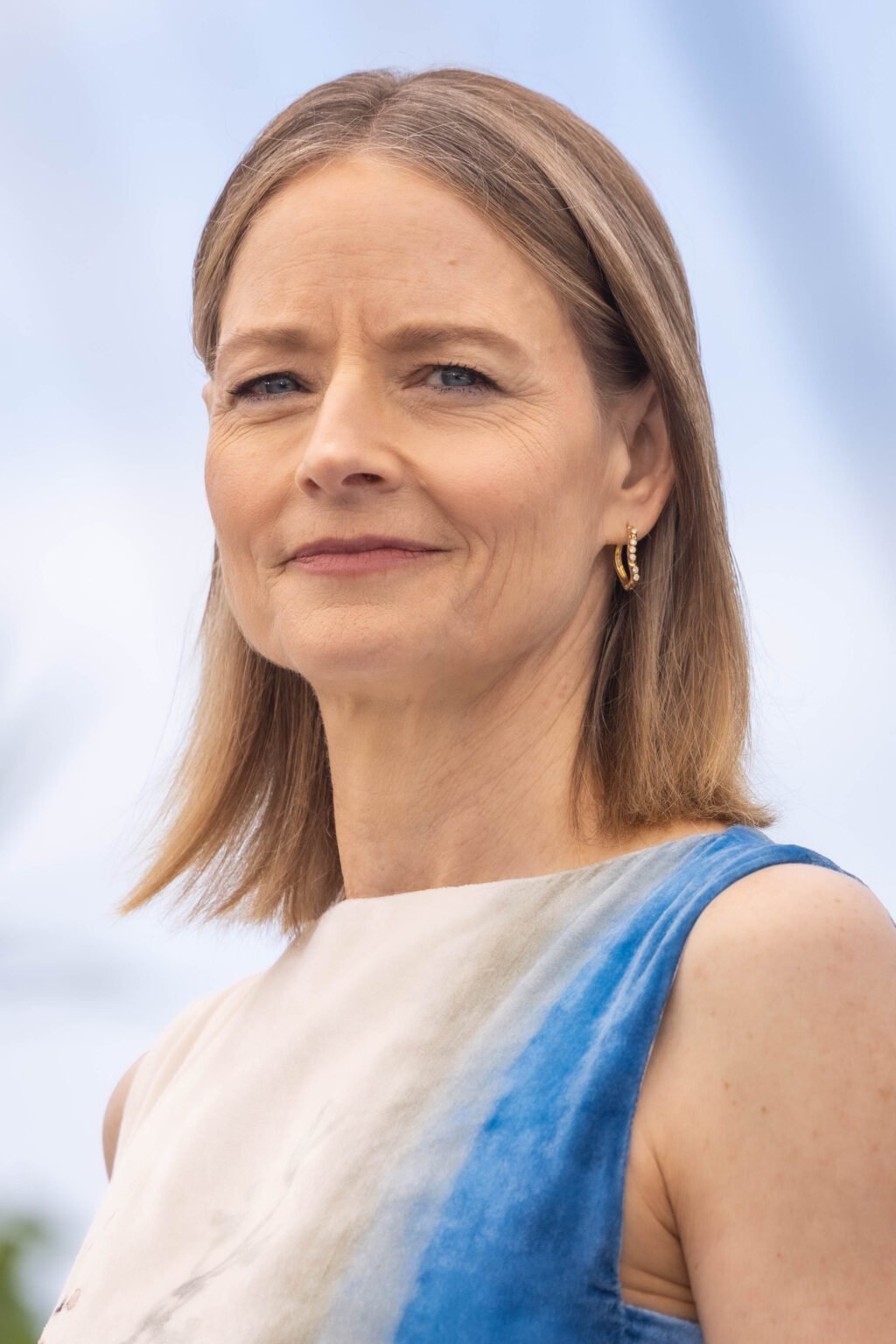
Jodie Foster (born 1962) became Clarice Starling at twenty-eight — two Best Actress Oscars before thirty, horror’s prestige anchor for five decades.
No other career in horror looks like this one, because no other career in film does. Jodie Foster was a professional at three, a Palme d’Or winner’s leading lady at thirteen, an Oscar nominee at fourteen — and instead of burning out on schedule, she went to Yale at the height of her fame, graduated magna cum laude, and then won two Academy Awards for Best Actress before she turned thirty. One of those wins made her the human half of the only horror film ever to win Best Picture. Five decades after the Coppertone ads, she won her first Emmy at sixty-one, walking into the Alaskan dark as a police chief in True Detective: Night Country. The child-star story is supposed to end in collapse or nostalgia. Hers is the standing counterexample.
Quick Specs
Full name: Alicia Christian Foster
Born: 19 November 1962, Los Angeles, California, USA
Family: Married actress and photographer Alexandra Hedison in 2014; two sons
Known for: Iris in Taxi Driver (1976), Sarah Tobias in The Accused (1988), Clarice Starling in The Silence of the Lambs (1991), Liz Danvers in True Detective: Night Country (2024); director of Little Man Tate (1991) and Money Monster (2016)
Honours: Two Academy Awards for Best Actress (The Accused; The Silence of the Lambs) from five nominations; Primetime Emmy winner (Night Country); Cecil B. DeMille Award (2013); Honorary Palme d’Or (2021)
The Coppertone Girl and the Disney Years
Alicia Christian Foster was born on 19 November 1962 in Los Angeles, the youngest child of Evelyn “Brandy” Foster; her parents’ marriage ended before she was born, and she was raised by her mother with her three older siblings — the “Jodie” the world knows was her siblings’ childhood name for her, and it stuck. She learned to read at three, the same age her professional career began, as the Coppertone sunscreen girl in television commercials. Television acting followed — a debut on Mayberry R.F.D., a busy run through series including Paper Moon — and her film debut came in Disney’s Napoleon and Samantha (1972), at nine. A run of Disney and family films (Tom Sawyer, Freaky Friday) made her a teen idol in the very years her other career was detonating. The hinge was Martin Scorsese’s Alice Doesn’t Live Here Anymore (1974), a small part that matters for what it set up: when Scorsese cast Iris, he was re-hiring a child actor he already knew and trusted, not discovering a stranger. And her education ran alongside all of it — the Lycée Français de Los Angeles, where at her 1980 graduation she delivered the valedictorian address for the school’s French division. The fluency that school gave her becomes a second career later in this biography.
Taxi Driver: Twelve, Thirteen, Fourteen
Foster’s age in Taxi Driver is three numbers, and this page attaches each to its event, because aggregators print them interchangeably and get all three wrong. She was twelve years old when she filmed it (1975) — the same age as Iris Steensma, the runaway child prostitute she plays, caught under her pimp Sport (Harvey Keitel) while Robert De Niro’s Travis Bickle fixates on “rescuing” her. She was thirteen at the film’s release (February 1976). And she was fourteen at the Academy Awards ceremony (28 March 1977) where she was nominated for Best Supporting Actress. The performance itself switches between streetwise act and sudden childishness — the toast-and-jam breakfast scene is the famous instance — and the production’s protections are part of the record: she was psychologically evaluated before the role, and her older sister Constance stood in for her in the more sexually suggested material. Foster has repeatedly credited De Niro’s rehearsal process — the two worked their scenes through extensively — with teaching her acting as construction rather than instinct. The film, scored by Bernard Herrmann, won the Palme d’Or at Cannes, and in 1977 she won two BAFTAs in a single year: Best Supporting Actress for Taxi Driver and Most Promising Newcomer for Bugsy Malone.
Yale: Not a Hiatus
She did not take a break to attend Yale — she filmed throughout her university years (The Hotel New Hampshire and Claude Chabrol’s French-language The Blood of Others, both 1984) — but Yale was real, and taken seriously: B.A. 1985, magna cum laude, majoring in literature, with a senior thesis on Toni Morrison advised by Henry Louis Gates Jr., who has recounted vouching for her — under her real first name, Alicia — to secure the famously selective Morrison’s agreement to meet her. She returned as Class Day speaker in the 1990s and received an honorary Doctor of Fine Arts from Yale in 1997. One line of the record belongs here and gets exactly one line: on 30 March 1981, during her freshman year, John Hinckley Jr. shot and wounded President Ronald Reagan and three others in Washington, and stated he had acted to impress her. She was eighteen. Foster’s own stated position across the decades since is that she “values privacy against all else,” having spent most of her life in public — the gaps in the filmography that follow are, by her framing, choices, and this page leaves them as hers.
The Accused: The First Oscar
The Accused (1988), directed by Jonathan Kaplan, converted the former child star into an adult leading actress for good. Foster played Sarah Tobias, a working-class rape survivor who — after the men who raped her in a bar receive a light plea deal — becomes the plaintiff in a precedent-setting prosecution of the onlookers who cheered the assault on. The honour, with film year and ceremony year kept separate as this record demands: she won the Academy Award for Best Actress at the 61st Academy Awards, 29 March 1989, for the 1988 film, at the age of twenty-six, and the Golden Globe for Best Actress in a Drama besides. Hers was the film’s sole Oscar nomination — the first time since 1962 that a Best Actress winner’s film had received no other nominations. The industry now knew what she could carry. It still nearly didn’t give her the role that defines her.
Clarice Starling: The Role She Had to Fight For
The polished version says Jonathan Demme knew she was Clarice the moment she walked in. Demme’s own fuller account, given on stage in 2015, is less convenient and better. His first choice for Clarice Starling was Michelle Pfeiffer, who declined, troubled by the material’s darkness. He approached Meg Ryan, who he said was “slightly offended” by the offer. He next wanted Laura Dern; the producers vetoed her as a relative unknown. Foster, meanwhile, had read Thomas Harris’s novel, pursued the part and met Demme twice — and the producers backed her on the strength of her Accused Oscar, a performance Demme admits he had not believed, accent included. He relented. Then, during production, he “fell madly in love with her,” and named his production company Strong Heart Productions for her quality of character. Print the Austin account, not the DVD fairy tale: she was the choice the director resisted, and she converted him.
The Silence of the Lambs, released 14 February 1991 — Ted Tally adapting Harris, Demme directing — sent FBI trainee Starling into the cell of Hannibal Lecter (Anthony Hopkins) to catch Buffalo Bill (Ted Levine) while he was still killing. Foster built the performance on controlled fear and a precise West Virginia accent, and has framed Clarice in later years as “a hero and a victim at the same time” — the trainee who hunts one monster while a worse one studies her. The film grossed over $272 million worldwide on a $19 million budget, and on 30 March 1992, at the 64th Academy Awards, it became only the third film ever to win the Big Five — Picture, Director, Actor, Actress, Screenplay — and the first horror film to win Best Picture. Foster’s Best Actress win, her second, came at twenty-nine. Two acting Oscars before thirty. And the discipline the franchise demands: she did not play Clarice in Hannibal (2001). She declined the sequel; Julianne Moore’s Starling is a different actress’s performance, whatever merged filmographies claim. The casting record is traced on Demme’s page.
The Director’s Chair
The same year as Lambs, Foster made her feature directorial debut with Little Man Tate (1991), starring as the mother of a child prodigy — a gifted-child story directed by the most famous gifted child in Hollywood. She founded her production company, Egg Pictures, in 1992; its first effort, Nell (1994), brought her a further Best Actress Oscar nomination (ceremony 1995) for playing a woman raised in isolation. The directing filmography, kept exact because aggregators conflate it: Home for the Holidays (1995) — directed and produced, did not star; The Beaver (2011) — directed and co-starred, alongside Mel Gibson; Money Monster (2016) — directed only, with George Clooney and Julia Roberts in front of the camera. Television directing runs from a Tales from the Darkside episode in 1988 through Orange Is the New Black, House of Cards, the Black Mirror episode “Arkangel” (2017) and Tales from the Loop. The acting ran in parallel — Contact (1997), Fincher’s Panic Room (2002) as a mother besieged inside her own house, Flightplan (2005), The Brave One (2007), a Golden Globe win for The Mauritanian (2021), and her fifth Oscar nomination for Nyad (2023, ceremony 2024). Five nominations, title by title; two wins. Any total of six is a summary line with no sixth film behind it.
The Second Language
The Lycée Français gave Foster something almost no American star has: a parallel career in French. Her fluency means she performs her own French-language dubbing for most of her English-language films — the record’s word is “most,” not every one — and she has acted in French on screen since Moi, fleur bleue (1977) and The Blood of Others (1984). Jean-Pierre Jeunet cast her, in fluent French, as Élodie Gordes in A Very Long Engagement (2004) after meeting her in Paris while she was there dubbing Panic Room. Acting in French changes the instrument, in her own account: “in French my voice is very high… I’ve always been known for my froggy voice,” and for decades she declined French leads, believing the roles should go to native speakers — until Rebecca Zlotowski persuaded her otherwise. The result, Vie Privée (A Private Life, 2025), premiered out of competition at Cannes: her first French-language leading role, as a psychiatrist turned amateur investigator, at sixty-two. Not her first French film — her first French lead, forty-eight years after her first French performance.
Night Country: The Emmy at Sixty-One
Then television gave her the summit the filmography seemed to have finished without. In True Detective: Night Country (2024) — Issa López showrunning, Foster also executive producing — she played Chief Liz Danvers, investigating the disappearance of eight men from an Arctic research station outside Ennis, Alaska, partnered against Kali Reis’s trooper Evangeline Navarro. At the 76th Primetime Emmy Awards in September 2024 she won Outstanding Lead Actress in a Limited or Anthology Series or Movie — her first Emmy win, after four previous nominations, the first acting Emmy won by any True Detective performer, at sixty-one — and thanked the Iñupiaq and Inuit people of northern Alaska in her speech: “They just told us their stories and they allowed us to listen.” A Golden Globe for the same role followed in January 2025. Add the 2013 Cecil B. DeMille Award and the Honorary Palme d’Or at Cannes in 2021, and the honours column closes where the career began: everywhere, in two languages, across six decades.
Why Jodie Foster Matters
For horror, she is the human half of the genre’s highest honour: The Silence of the Lambs remains the only horror film to win Best Picture, its Big Five sweep ran through her Clarice — a heroine who hunts a monster while interviewing a worse one, played without a single scream-queen note — and Iris at twelve, Meg Altman besieged in Panic Room, and Danvers walking into the Alaskan dark extend that prestige line across five decades, all without her ever being marketed as a horror actress. For film generally, she is the child-star exception that disproves the rule: the controversial child performance converted into a Yale degree taken at fame’s height, two Best Actress Oscars before thirty, a directing career, and an Emmy at sixty-one. And the two-language career is a second filmography in itself — a major American star who dubs herself, leads French films in French, and carried a Cannes premiere in her second language at sixty-two. You’ll find her in our Horror Actors index, at the end of the longest arc the genre has.