
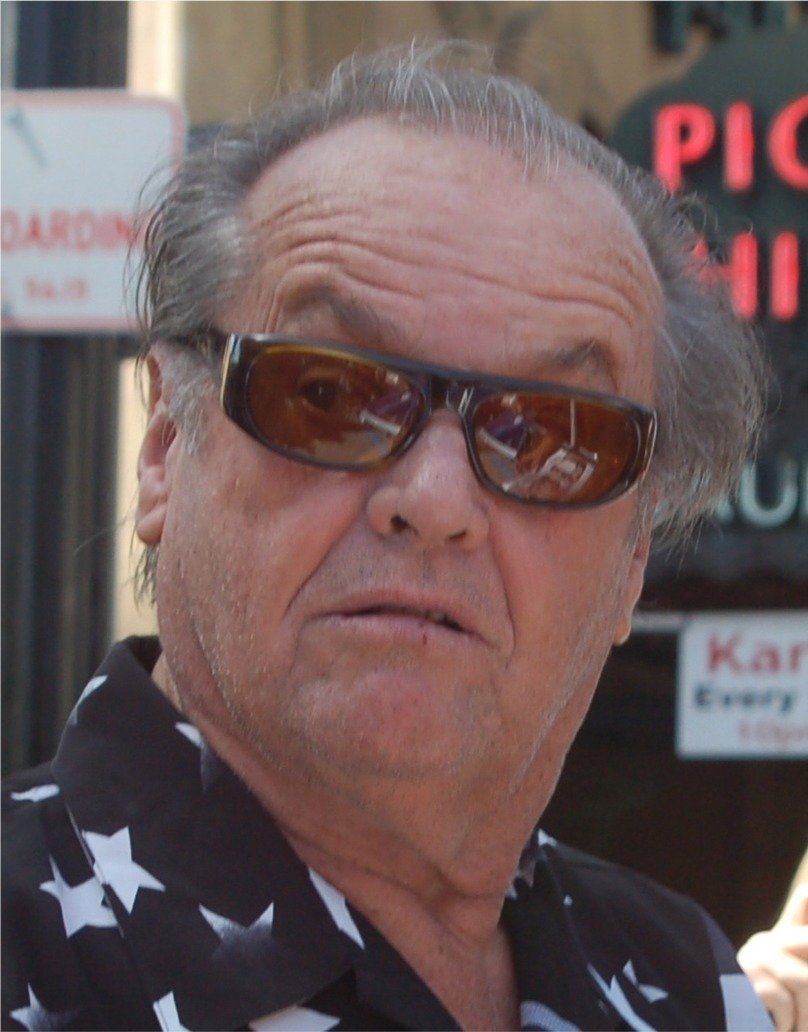
Jack Nicholson (born 1937) is the American actor who played Jack Torrance in The Shining and has won three Oscars from twelve nominations.
Quick Specs
| Born | April 22, 1937, Neptune City, New Jersey (as John Joseph Nicholson); raised in Neptune, New Jersey |
| Age | 89 |
| Film debut | The Cry Baby Killer (1958), for Roger Corman |
| Breakthrough | Easy Rider (1969), as George Hanson |
| Horror centrepiece | Jack Torrance in The Shining (1980), directed by Stanley Kubrick |
| Oscars | Twelve nominations, the most of any male performer, and three wins |
| Wins | Best Actor, One Flew Over the Cuckoo’s Nest (1975); Best Supporting Actor, Terms of Endearment (1983); Best Actor, As Good as It Gets (1997) |
| Other key roles | Jake Gittes in Chinatown (1974); the Joker (Jack Napier) in Batman (1989); Frank Costello in The Departed (2006) |
| Most recent film | How Do You Know (2010) |
| Honours | Cecil B. DeMille Award (1999); Kennedy Center Honors (2001) |
| Marriage | Sandra Knight (1961 to 1966), his only marriage |
Who He Is
John Joseph Nicholson was born on April 22, 1937, in Neptune City, New Jersey. He is 89, and he is the only living subject in this run of features, so his story is told in the present tense.
With a name this common, database merges are a real hazard. He is not any other Jack or John Nicholson in the listings, and he is not the golfer Jack Nicklaus, whose near-identical name and decades of fame overlap his.
The family story has to be told exactly. He was raised in Neptune, New Jersey, by his grandparents, John and Ethel May Nicholson, and he believed they were his parents. His actual mother, June Frances Nicholson, a showgirl who was 17 when he was born, was presented to him as his older sister.
The truth reached him in 1974, when he was an adult and already famous. It came from researchers working on a Time magazine cover story, not from anyone in his family. By then both women were dead: June had died in 1963, and Ethel May in 1970. His own response is on the record. It was, he said, “a pretty dramatic event, but it wasn’t what I’d call traumatizing… I was pretty well psychologically formed.”
His father’s identity has never been publicly confirmed. Competing accounts exist, and none is settled, so this page names nobody.
At Manasquan High School he was, in the standard school record, voted class clown and piled up detentions. The school later named a drama award for him. He passed on college, worked as a lifeguard and as a cinema assistant manager, and moved to Los Angeles in 1954.
In Los Angeles he took a job in the mailroom of MGM’s animation department. He was noticed there and offered an audition in passing. The audition went nowhere, but it led him to acting classes and a job at a local theatre. The line from a cartoon studio’s mailroom to the Overlook Hotel is verified, and it is the best early beat in his story.
He married the actress Sandra Knight in 1961. They divorced in 1966, and it is his only marriage. His family life beyond that is not this page’s business.
The honours outside the Oscars include the Cecil B. DeMille Award in 1999 and the Kennedy Center Honors in December 2001. Away from the work, his best-known public persona is a fan’s: he has been an ardent, famously courtside Los Angeles Lakers supporter for decades.
The Work, and What He Did in It
The Corman apprenticeship ran from 1958 to 1968, a decade of everything. His film debut was in Roger Corman’s The Cry Baby Killer (1958), and in the summary of the reference record he “worked in film for 10 years before his breakthrough role in Easy Rider.” Across those years he did three jobs.
- He acted. In The Little Shop of Horrors (1960) he is Wilbur Force, the masochistic dental patient, in a two-scene comic detonation. He also appeared in The Raven (1963) and The Terror (1963).
- He wrote and produced. He wrote and produced Ride in the Whirlwind (1966), and he co-wrote the Monkees’ film Head (1968).
- He learned. He learned low-budget filmmaking from the inside, on a unit where everyone did everything.
Easy Rider (1969) was the breakthrough, and he got it as a replacement. He was cast as the alcoholic lawyer George Hanson after Rip Torn left the production. In about 17 minutes of screen time he walks off with the film. The “Nick, nick, nick” Jim Beam scene is, in the standard account, close to his own invention. The role brought his first Academy Award nomination, for Best Supporting Actor. It was a nomination, not a win. Dennis Hopper directed the film and co-starred in it. The New Hollywood had found its face.
The seventies ascent followed fast:
- Five Easy Pieces (1970): the diner scene, “I want you to hold it between your knees,” was his first great starring statement.
- Carnal Knowledge (1971).
- The Last Detail (1973).
- Chinatown (1974): Jake Gittes, the defining private-eye performance of the decade, ending on “Forget it, Jake. It’s Chinatown.”
One Flew Over the Cuckoo’s Nest (1975) brought the first win. As Randle P. McMurphy he won Best Actor, at the 1976 ceremony. The film swept the five major Oscars, one of only three films ever to do so. That sweep belongs to the film, not to him alone.
The Shining (1980) is the horror centrepiece, and the performance this page exists for. Stanley Kubrick directed, with Nicholson as Jack Torrance, the caretaker and would-be writer who unravels at the Overlook. Three of his contributions are on the record:
- He improvised the most famous line. “Here’s Johnny!” was his, borrowed from Ed McMahon’s nightly introduction of Johnny Carson.
- He co-wrote a scene with Kubrick. It is the confrontation in which Wendy finds the manuscript, and he drew on his own experience of divorce and of a writer’s obsession.
- He broke through real doors. The prop department’s fake doors splintered too easily, because Nicholson had been a volunteer fireman during his late-1950s Air National Guard service and knew how to swing an axe. Real doors had to be fitted.
What made the casting work is an analysis, not a quote: Kubrick cast the one actor whose warmth audiences trusted completely, then spent the film withdrawing it. The typewriter, the ballroom and the axe are the stages of that withdrawal.
It matters what he brought to the Overlook. By 1980 he had more than two decades of film work behind him, a Best Actor Oscar, and Easy Rider, Five Easy Pieces and Chinatown on his record. Kubrick was not hiring a horror specialist’s tricks. He was hiring the full equipment of an Oscar-winning dramatic star and turning it on the genre, opposite Scatman Crothers as Dick Hallorann. The full production record of the film, including its disputed takes count, belongs to the Kubrick and Shining pages rather than to this one.
The eighties made him an institution:
- Reds (1981): as Eugene O’Neill, the writer he compared himself to as an Irishman.
- Terms of Endearment (1983): Garrett Breedlove, and the second win, for Best Supporting Actor, at the 1984 ceremony.
- Prizzi’s Honor (1985).
- Batman (1989): the Joker, whose given name in the film is Jack Napier, top-billed over the hero. His contract took a percentage of the gross, a structure that became industry legend. The printed dollar totals vary wildly, and none is verified, so this page prints none.
Across the decade he alternated prestige ensembles with star vehicles and never once played a forgettable man. Jack Torrance and Jack Napier are two different men, by the way, in two different films, and they should never be merged.
A Few Good Men (1992) made him Colonel Jessup. He delivered “You can’t handle the truth” in a supporting turn that earned another nomination. In the production lore he shot his courtroom scenes in a handful of days, though the count varies with the telling.
As Good as It Gets (1997) brought the third win, his second for Best Actor, at the 1998 ceremony. With it the totals came to twelve nominations and three wins, across four decades of nominations from 1969 to 2002. He remains the most-nominated male actor in Academy history.
The late run included About Schmidt (2002), a nomination for playing small, quiet and old, the anti-Torrance. Then came The Departed (2006), as Frank Costello for Martin Scorsese, and The Bucket List (2007). How Do You Know (2010) is his most recent film. He has not appeared in a film since How Do You Know (2010) and has never formally announced a retirement.
Cool Verified Facts
- He grew up believing his grandmother was his mother and his mother was his sister, and he learned the truth from Time magazine researchers in 1974.
- He did not win an Oscar for Easy Rider. It was his first nomination.
- His twelve Academy Award nominations are the most of any male performer, and he has won three.
- “Here’s Johnny!” was his improvisation.
- He co-wrote the Shining scene in which Wendy finds the manuscript.
- The Shining’s doors had to be real because he knew how to use an axe from his time as a volunteer fireman.
- He got Easy Rider only because Rip Torn left, and he stole the film in about 17 minutes.
- His first Hollywood job was in the mailroom of MGM’s animation department.
- He wrote and produced Ride in the Whirlwind and co-wrote the Monkees’ Head before he was a star.
- His three wins came at the 1976, 1984 and 1998 ceremonies, across three decades.
- He was in Corman horror films, The Little Shop of Horrors, The Raven and The Terror, two decades before The Shining.
Signatures, Habits and Behind the Scenes
The grin and the eyebrows are the instrument. It is criticism’s cliché because it is true. Across Easy Rider, Chinatown, Cuckoo’s Nest and The Shining, the performances turn on charm curdling in real time. For horror the operative case is The Shining, where the warmth the audience trusts is exactly what the film takes away.
Improvisation inside discipline is his working method. “Here’s Johnny!” is the famous instance of a career habit. Directors from Corman to Kubrick left him room because his inventions landed. The McMurphy, Gittes and Torrance performances all carry improvised or co-written beats, and the Shining scene-writing is the documented peak.
He learned the whole business before he was allowed to star in it. The writing, the producing, the mailroom and the Corman unit add up to a ten-year apprenticeship. It is why the later Nicholson could co-write with Kubrick and negotiate the Batman deal. It is also the honest counterweight to any “natural” framing: the ease was earned off camera.
His horror roots run deeper than The Shining. The Corman unit gave him The Little Shop of Horrors, The Raven and The Terror, all before Easy Rider and two decades before the Overlook. He came back to the genre in 1980 as an Oscar-winning star, and he gave Torrance the same full-craft seriousness he had given McMurphy and Gittes.
The 1974 answer is the most revealing quote in his record. Told that the family story he had grown up with was not true, he called it “a pretty dramatic event, but it wasn’t what I’d call traumatizing.” Then he went straight on to the next decade of work.
Why He Matters
The Shining is one of the genre’s two or three most influential performances. It is influential precisely because it is an A-list dramatic actor’s full-craft performance, not a genre turn. Torrance’s disintegration at the typewriter, in the ballroom and with the axe set the template for the prestige-horror protagonist: the monster as the man you married, hired and trusted. Every “ordinary man unravels” horror performance since 1980 is measured against it. On this site the Shining pages, from the film itself to Jack Torrance, Dick Hallorann’s Scatman Crothers and Danny Lloyd, form one of the richest clusters we have, and this performance is the reason the cluster exists. The imbalance in links toward the Overlook is the site’s, not the subject’s: his other great films do not yet have pages here.
For cinema overall, the record of twelve nominations and three wins across four decades, the arc from Corman apprentice to Kubrick collaborator, and a run of defining performances in Easy Rider, Five Easy Pieces, Chinatown, Cuckoo’s Nest, The Shining and Batman make him the standard answer, in the critical consensus, to the question of who is the greatest screen actor of his generation.
The ending is still open. He is alive, he is 89, and he has never retired on paper. The last word on the man who made the Overlook’s caretaker the face of domestic horror has not been written, and this page leaves it that way.