
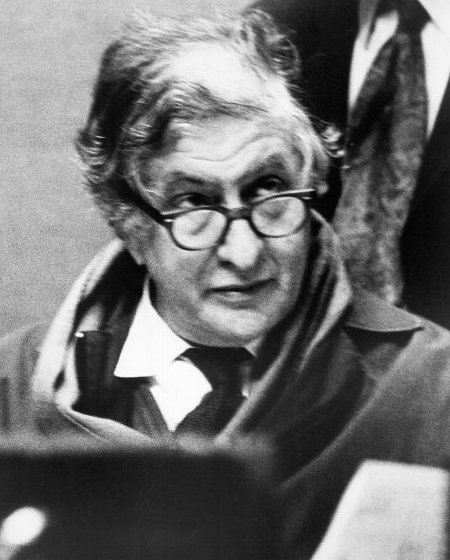
Bernard Herrmann (1911 to 1975) was the American composer who scored Psycho with strings alone and changed how horror sounds.
Quick Specs
| Born | June 29, 1911, New York City |
| Died | December 24, 1975, Hollywood, Los Angeles, California, aged 64 (apparent heart attack, in his sleep) |
| Buried | Beth David Cemetery, Elmont, New York |
| Education | DeWitt Clinton High School; studied at New York University and the Juilliard School |
| Known for | Citizen Kane (1941); The Day the Earth Stood Still (1951); Vertigo (1958); North by Northwest (1959); Psycho (1960); Cape Fear (1962); Taxi Driver (1976) |
| Hitchcock work | seven scores, plus sound consultant on The Birds (1963) and an unused score for Torn Curtain (1966) |
| Horror and thriller | Psycho (1960); Cape Fear (1962); Sisters (1972/73); It’s Alive (1974); Obsession (1976) |
| Academy Awards | five nominations, one win, for The Devil and Daniel Webster (1941) |
| Also | BAFTA Award for Best Film Music, Taxi Driver |
Who He Is
Bernard Herrmann, the surname spelled with two r’s and two n’s, was born in New York City on June 29, 1911, into a Jewish middle-class family of Russian and Ukrainian origin. His father encouraged music, took him to the opera and had him learn the violin. At 13 he won a composition prize, and at about the same age he found Berlioz’s Treatise on Instrumentation, a book that shaped his ear for orchestral colour for the rest of his life.
He went to DeWitt Clinton High School, then studied at New York University, with Percy Grainger and Philip James, and at the Juilliard School. At 20, in 1931, he founded his own ensemble, the New Chamber Orchestra of New York.
In 1934 he joined CBS as a staff conductor and composer. In 1940 he became chief conductor of the CBS Symphony Orchestra, a post he held until the orchestra was disbanded in 1951. As a conductor he championed lesser-known composers, above all Charles Ives, long before the mainstream did. From 1938 he was composer and conductor for Orson Welles’s The Mercury Theatre on the Air, including the 1938 War of the Worlds broadcast, and when Welles went to Hollywood, Herrmann followed.
He married three times: the writer Lucille Fletcher, librettist of his opera Wuthering Heights, from 1939 to 1948; Lucy Anderson, from 1949 to 1964; and Norma Shepherd, in 1967. He had two children. He spent more and more time in London from the mid-1960s and made it his permanent home in August 1971.
He was in Hollywood in December 1975 only to record Taxi Driver. The sessions finished on December 23, and he died in his sleep at his hotel, of an apparent heart attack, on December 24, 1975. He was 64. He was buried in Elmont, New York.
The Work, and What He Did in It
Citizen Kane (1941) was Welles’s directing debut and Herrmann’s first film score. Instead of wall-to-wall Hollywood scoring, he brought radio technique with him: brief cues, often 5 to 15 seconds long, to bridge sharp photographic contrasts, and a score built from short cellular motifs rather than long leitmotifs. In the breakfast-table montage a waltz darkens with each variation as Kane’s first marriage falls apart. The score earned an Academy Award nomination.
The same year he won the Oscar, for The Devil and Daniel Webster (1941), also released as All That Money Can Buy, directed by William Dieterle. It won the Academy Award for Best Score of a Dramatic Picture.
The Magnificent Ambersons (1942) was his second Welles score, and a wound. RKO cut the film and roughly half his score and had a staff composer write a new finale. Herrmann threatened legal action and had his name removed in protest.
The gothic-romance line followed: Jane Eyre (1943/44) and The Ghost and Mrs. Muir (1947), a lush, melancholy, sea-haunted score that Herrmann late in life named as his own favourite of his film scores. For Anna and the King of Siam (1946), which brought another Oscar nomination, he researched Siamese scales and melodic phrases.
The Day the Earth Stood Still (1951), directed by Robert Wise, is the theremin landmark. He built an otherworldly ensemble with no conventional string or woodwind body: two theremins, a high and a low, played by Samuel Hoffmann and Paul Shure; electric violin, cello and bass; several pianos and harps; Hammond and Wurlitzer organs; and a large brass section. His own summary lists “two high and low electric theremins, four pianos, four harps and a very strange section of about 30-odd brass.” It was a landmark early use of electronics in film music, not the first.
He also became the composer of fantasy cinema, with The 7th Voyage of Sinbad (1958), Journey to the Center of the Earth (1959), The 3 Worlds of Gulliver (1960), Mysterious Island (1961) and Jason and the Argonauts (1963). He gave each creature and character its own instrumental combination and motif, big and brassy and rhythmically blunt; in Jason, the skeletons and Talos live on the weight of brass and percussion.
The centre of the career is Alfred Hitchcock. Herrmann scored seven Hitchcock features:
- The Trouble with Harry (1955), light, sardonic and autumnal: the partnership began in black comedy, not suspense.
- The Man Who Knew Too Much (1956). Herrmann did not write the song “Que Sera, Sera,” which is by Jay Livingston and Ray Evans, or the Storm Clouds Cantata, which is by Arthur Benjamin. He re-orchestrated the cantata for the Royal Albert Hall climax and appears on screen conducting the London Symphony Orchestra.
- The Wrong Man (1956), a restrained, jazz-tinged, bass-heavy score for a docudrama whose hero is a jazz bassist.
- Vertigo (1958): swirling, unresolved ostinato arpeggios and a habanera-like rhythm that enact Scottie’s obsession rather than illustrate it. In Herrmann’s account, Hitchcock asked for the recognition scene to play on music alone, with no dialogue. Critics often hear Wagner’s Tristan in its endless yearning.
- North by Northwest (1959): a fandango overture, and then silence for the crop-duster sequence, with music entering only at the crash.
- Psycho (1960), the horror score. He scored the entire film for string orchestra only, what he called a “black-and-white sound” to match the black-and-white photography. Hitchcock had asked for no music in the shower murder. Herrmann wrote the cue anyway, the shrieking, stabbing strings, and by Herrmann’s own account Hitchcock heard it and reversed himself. Those shrieks are closely miked strings, not electronics or bird sounds. The film cost $806,947 and took $50 million worldwide.
- Marnie (1964), the last completed Hitchcock score: big, romantic and neurotic, over a story of trauma and compulsion.
Two other Hitchcock credits are not scores. On The Birds (1963) he was sound consultant: the film has no conventional score, and he supervised its electronic bird sounds. And he wrote a score for Torn Curtain (1966) that was never used. Under pressure from Universal for a more pop and jazz-influenced score, Hitchcock asked him to change with the times. Herrmann delivered a score on his own terms; Hitchcock heard the prelude, confronted him and rejected it, and John Addison wrote the replacement. His reported retort was, “Look, Hitch, you can’t outjump your own shadow … I don’t write pop music.” The partnership and the friendship ended there.
Cape Fear (1962), directed by J. Lee Thompson, has a brutal, low, pounding main theme of menacing brass and string figures that became the sound of the stalker thriller. For Martin Scorsese’s 1991 remake, with Robert De Niro, Scorsese and producer Steven Spielberg insisted on Herrmann’s music, and Elmer Bernstein adapted the 1962 score, using passages from the unused Torn Curtain score and some new music of his own in Herrmann’s style.
For François Truffaut he wrote Fahrenheit 451 (1966), one of his most lyrical late scores, for strings, harps and percussion. Truffaut, a Hitchcock devotee, hired him the same year Hitchcock discarded him, and called the Torn Curtain rejection “a flagrant injustice.” He scored Truffaut’s The Bride Wore Black (1968) and Roy Boulting’s Twisted Nerve (1968), whose whistled main theme is the tune Elle Driver whistles in the hospital corridor in Quentin Tarantino’s Kill Bill: Vol. 1 (2003).
The late years belong to the directors who grew up on him. Brian De Palma hired him for Sisters (1972/73) and Obsession (1976), an organ, chorus and orchestra score for a romance haunted by Vertigo, which brought a posthumous Oscar nomination. For Larry Cohen he scored It’s Alive (1974), the mutant-baby horror film, and he viewed the rough cut of Cohen’s God Told Me To on his last evening; Cohen dedicated that film to his memory.
Taxi Driver (1976) was his last completed work, for Scorsese, who came to him on De Palma’s recommendation in the standard account. It is a nocturnal, jazz-inflected score: a lush, romantic saxophone theme for the city’s seductive surface, smashed against brass, snare drum and harp figures of dread for Travis Bickle’s interior rot. It was recorded on December 22 and 23, 1975, and he died that night. It brought a posthumous Oscar nomination and won the BAFTA Award for Best Film Music. Scorsese dedicated the film to him: “Our gratitude and respect, Bernard Herrmann, June 29, 1911 to December 24, 1975.”
His Academy record, exactly: five nominations and one win. The win was The Devil and Daniel Webster; the nominations were Citizen Kane, Anna and the King of Siam, Obsession and Taxi Driver. Psycho, Vertigo and North by Northwest were never nominated.
He also wrote concert music, including a Symphony (1941), the cantata Moby Dick (1938), dedicated to Charles Ives, and the opera Wuthering Heights, composed from 1943 to 1951, and in his London years he recorded his own concert works.
Cool Verified Facts
- He appears on screen in The Man Who Knew Too Much (1956), conducting the London Symphony Orchestra.
- The Psycho score uses a string orchestra only.
- The theremins in The Day the Earth Stood Still were played by Samuel Hoffmann and Paul Shure, not by Herrmann.
- He wrote the first-season theme and episode scores for The Twilight Zone (1959 to 1960); the famous later theme is by Marius Constant.
- The whistled tune in Kill Bill: Vol. 1 is his Twisted Nerve theme.
- He died the night after finishing the Taxi Driver sessions.
- The American Film Institute ranked Psycho No. 4 and Vertigo No. 12 on its 2005 list of the 25 greatest film scores.
Signatures, Habits and Behind the Scenes
He orchestrated everything himself. “To orchestrate is like a thumbprint,” he said. “I can’t understand having someone else do it. It would be like someone putting color to your paintings.” That is the practical reason his scores sound like nobody else’s: the orchestration is the composition. Nine harps for the underwater world of Beneath the 12-Mile Reef, four alto flutes in Citizen Kane, twelve flutes in the unused Torn Curtain.
Short cells and ostinatos, not tunes to hum. He built scores from brief motifs and repeating patterns, with unresolved harmonies and chords that hang in the air: music of obsession, suspension and dread rather than melody and development. The critic Alex Ross wrote that over four decades he “revolutionized movie scoring by abandoning the illustrative musical techniques that dominated Hollywood in the 1930s and imposing his own peculiar harmonic and rhythmic vocabulary.”
Silence was a cue. The crop-duster scene in North by Northwest and the 5 to 15-second cues of Citizen Kane are the same radio-trained instinct at two scales: music enters only where it changes what the scene means.
He finished Hitchcock’s pictures, by his own boast: “Alfred Hitchcock only finishes a picture 60 percent, I have to finish it for him.” The same temperament ended the partnership on Torn Curtain.
The Psycho reversal is the most consequential composer-over-director override in horror history, by Herrmann’s own account: he wrote the shower cue against an explicit instruction, played it, and Hitchcock conceded.
He believed in the music itself. “A film score will live longer than any other kind of music,” he is quoted as saying. His favourite line from Tolstoy, “Eagles fly alone, and sparrows fly in flocks,” is given in the biographical record as his creed: he composed only when he had creative control. It explains both the Hitchcock golden age, when Hitchcock gave him freedom, and its end, when Hitchcock took it away.
Why He Matters
For horror, the Psycho score rewired what fear sounds like. Before it, horror meant full-orchestra gothic or electronic novelty. After it, a shrieking string figure was fear itself, the most imitated cue in film history in the standard critical judgement. Cape Fear, Sisters, It’s Alive and the Twisted Nerve whistle extend the line: Herrmann invented the musical grammar of ostinato dread, withheld music and the motif that stalks, and horror scoring still speaks it.
For film music overall, he is the bridge from radio drama to modern scoring: short cues, psychological rather than illustrative music, orchestration as authorship, and the composer as the film’s co-author rather than its decorator. The AFI rankings and the line of younger directors who sought him out, Truffaut, De Palma, Scorsese and Cohen, are the institutional proof.
And his music kept working after him. Bernstein’s Cape Fear adaptation carried it to a new generation in 1991, and Tarantino carried the Twisted Nerve whistle around the world in 2003. Few composers of his era are still quoted, sampled and revived as living material half a century after their death.