
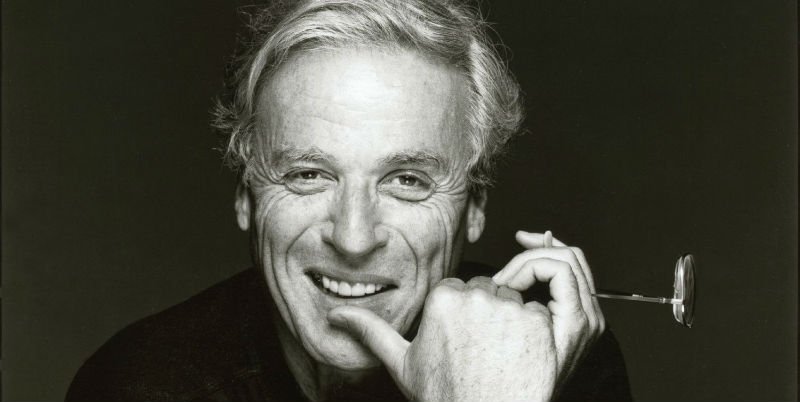
William Goldman was the American novelist and screenwriter who wrote Marathon Man, Magic and Misery, and coined “Nobody knows anything.”
He is the screenwriter as author: the man whose name alone sold a script for a record price, who won Academy Awards in both writing categories, who invented a line so complete that history absorbed it as a real quotation — and who then wrote the book that told the whole industry it was guessing. For horror he worked inside the genre at its highest level, three different ways: his own paranoia thriller, his own ventriloquist nightmare, and the great Stephen King chamber piece, where his most famous fight was over making the violence smaller. He identified as a novelist to the end. The record — credits kept surgically separate, because with Goldman they constantly blur — supports him.
Quick Specs
- Born: 12 August 1931, Chicago, Illinois
- Died: 16 November 2018, Manhattan, New York City, aged 87
- Education: Oberlin College — B.A. 1952; Columbia University — M.A. 1956
- Known for: Marathon Man (1976), Magic (1978), Misery (1990), The Princess Bride (1987)
- Honours: Academy Awards for Butch Cassidy and the Sundance Kid and All the President’s Men
The Novelist First
Goldman was born in Chicago, the second son of Marion and Maurice Goldman, and grew up in Highland Park, the Chicago suburb — sources that call Highland Park his birthplace are compressing the two facts. At Oberlin College he was fiction editor of the college literary magazine and graduated in 1952. Drafted during the Korean War, he was assigned — because he could type — as a clerk at the Pentagon, and was discharged in September 1954 with the rank of corporal. On the G.I. Bill he took a master’s degree from Columbia in 1956, declined the Ph.D. track, and wrote his first novel: The Temple of Gold, published in 1957, drafted in under three weeks by his own account and then lengthened at his publisher’s request. The novel career ran for a decade before the screen career began — Soldier in the Rain (1960), Boys and Girls Together (1964) — and one early book carries a private joke in its byline: No Way to Treat a Lady (1964) appeared under the pseudonym “Harry Longbaugh,” Goldman’s variant spelling of Harry Longabaugh, the Sundance Kid’s real name, a subject he had been researching since the late 1950s for the script that would make him famous. He married Ilene Jones in 1961; they had two daughters, Jenny and Susanna, and divorced in 1991. Across a five-decade screen career he remained a confirmed New Yorker who declined to work in Hollywood, flying to Los Angeles for short conferences and returning home to Manhattan to write. He died at home in Manhattan on 16 November 2018; his daughter Jenny gave the cause as complications of colon cancer and pneumonia.
One namesake discipline, because databases keep merging two brothers: his older brother James Goldman (1927–1998) was a playwright and screenwriter in his own right who won the Academy Award for The Lion in Winter (1968). The brothers collaborated early — the play Blood, Sweat and Stanley Poole (1961), the musical A Family Affair (1962) — but the famous works are separate. The Lion in Winter is James’s. Butch Cassidy is William’s. Each brother won exactly one writing Oscar before William won his second.
The Breakthroughs: Harper and Butch
His screen debut was rewrite work on Masquerade (1965), hired through Cliff Robertson before he had ever finished a screenplay. The breakthrough was Harper (1966), directed by Jack Smight with Paul Newman: Goldman himself proposed Ross Macdonald’s Lew Archer novels to the producer and adapted the first of them, The Moving Target (1949) — with the detective renamed Lew Harper for the screen. Macdonald wrote the book; Goldman wrote the film; and the film won him the Edgar Award for Best Motion Picture Screenplay in 1967, the Mystery Writers of America’s verdict on a first-rank adaptation.
Butch Cassidy and the Sundance Kid (1969) was his first original screenplay, directed by George Roy Hill with Newman and Robert Redford. After eight years of research, by his own account, he wrote it on speculation and sold it for $400,000 — the highest price ever paid for an original screenplay at that time, a figure stated here in exactly that form. It won him the Academy Award for Best Original Screenplay at the 42nd Academy Awards in April 1970. His second Oscar came seven years later for All the President’s Men (1976), directed by Alan J. Pakula — Best Adapted Screenplay, from Woodward and Bernstein’s non-fiction book. The total is two Academy Awards, both for writing, and this page states it that way every time, because the horror credits that follow keep attracting Oscars that belong to other people.
Marathon Man: “Is It Safe?”
Marathon Man is Goldman’s twice over: his thriller novel (1974), then his own screenplay for John Schlesinger’s film (1976), with Dustin Hoffman as Thomas “Babe” Levy, Laurence Olivier as Dr. Christian Szell and Roy Scheider. He carried his paranoia thriller from page to screen intact, including its centrepiece — Szell, a Nazi war criminal who was also a dentist, torturing Babe by probing a cavity and then drilling a healthy tooth without anaesthetic, repeating one quiet question: “Is it safe?” The line ranks No. 70 on the American Film Institute’s list of the hundred greatest movie quotes, and the scene No. 66 on Bravo’s hundred scariest movie moments. Goldman’s own appraisal of his gift, given in 2000 and attributed here as his words: he was “the guy who gave Babe over to Szell in the ‘Is it safe?’ scene,” “the guy who put Westley into The Machine” — “I think I have a way with pain… Because I come from such a dark corner.” Awards discipline: the film’s only Oscar nomination was Olivier’s, for supporting actor; Goldman’s script was Golden Globe- and Writers Guild-nominated, not Oscar-nominated. He also tells, in his own book, the story he treasured most from the production: Olivier, in rehearsal, asking if he might change a line slightly — and calling him “Bill.” Goldman describes it as the high point of his career; it is printed here as what it is, his own account from his own memoir.
The Seventies Run: Stepford, Presidents, Magic
The Stepford Wives (1975), directed by Bryan Forbes, is Goldman’s screenplay from Ira Levin’s 1972 novel — Levin’s book, Goldman’s film — suburban satire played as psychological horror, the film that put “Stepford wife” into the language. Goldman later said Forbes rewrote much of his script and that he tried, unsuccessfully, to have his name removed; the screen credit is flat fact, the grievance is his account, and this page keeps them in those separate forms. All the President’s Men followed in 1976, and with it his most durable invention: “Follow the money.” The phrase is Goldman’s, written for the screenplay and spoken on screen by Hal Holbrook’s Deep Throat. It appears nowhere in Woodward and Bernstein’s book, their articles, or the Watergate record — a screenwriter’s line so complete it was absorbed into history as a quotation, quoted ever since by people who have no idea a screenwriter wrote it.
Magic (1978) is the first-rank horror credit a decade before Misery, and it is his twice over again: the psychological horror novel (1976) about Corky Withers, a failing magician whose act ignites when he adds Fats, a foul-mouthed ventriloquist’s dummy who progressively takes him over — then his own screenplay for Richard Attenborough’s film, with Anthony Hopkins playing Corky and voicing Fats, alongside Ann-Margret and Burgess Meredith, with a score by Jerry Goldsmith. It won him his second Edgar Award for Best Motion Picture Screenplay, in 1979 — the same honour Harper had won him twelve years earlier, now for a horror film adapted from his own novel.
The Princess Bride, and the Morgenstern Joke
The Princess Bride began as stories Goldman told his two daughters — one asked for a story about a princess, the other about a bride — and became his 1973 novel before it became Rob Reiner‘s 1987 film, from Goldman’s screenplay, with Cary Elwes as Westley and Robin Wright as Buttercup. The novel presents itself as Goldman’s “good parts” abridgment of a classic by one “S. Morgenstern” of Florin. Discipline, because the joke has fooled real reference works: Morgenstern is not a real author, Florin is not a real place, there is no original book, and the wife and son Goldman writes about inside the novel’s frame are inventions too. The book is entirely Goldman’s, frame and all — he later extended the gag by publishing The Silent Gondoliers (1983) under Morgenstern’s name. The film itself took over a decade to get made despite a screenplay Goldman had written in the 1970s: the standing exhibit for his own doctrine.
Misery: The Hobbling
Misery (1990) is Stephen King‘s novel — Goldman’s screenplay, Reiner directing, James Caan as Paul Sheldon and Kathy Bates as Annie Wilkes. What Goldman did was adapt what the standard record calls one of King’s least adaptable books — a two-hander chamber piece, one room, one bedridden protagonist — into a straight psychological thriller. The signature fight is documented on both sides. In King’s novel, Annie severs Paul’s foot with an axe and cauterises the wound with a blowtorch. Goldman’s draft kept the amputation; reading that scene, by his own account, was the moment he knew he had to write the film. Reiner insisted on the change: Annie breaking Paul’s ankles with a sledgehammer — the film’s hobbling. Goldman fought it, and then, having seen the film, wrote in print that Reiner was right: a depicted amputation would simply have made audiences hate Annie, rather than stay inside her madness. The axe belongs to the novel only; any account that puts it in the film has merged the two texts — the exact error the production itself avoided. Awards discipline, one more time: Misery‘s Academy Award was Bates’s, for Best Actress — the film’s only Oscar, and the only Oscar ever won by a film based on a Stephen King novel in the standard record. Goldman’s screenplay was not Oscar-nominated.
The later credited run, stated at credit weight: shared screenplay credit on Chaplin (1992) — William Boyd, Bryan Forbes and William Goldman, never a sole Goldman script; Maverick (1994); The Ghost and the Darkness (1996), his original built on the true Tsavo man-eater story; Absolute Power (1997); The General’s Daughter (1999). Two more King adaptations close the horror ledger: Hearts in Atlantis (2001), from King’s collection — principally “Low Men in Yellow Coats” — reuniting him with Hopkins as Ted Brautigan, his Magic star a generation later; and Dreamcatcher (2003), a shared credit — Goldman wrote the script first, and Lawrence Kasdan, directing, added his own work; both men are credited, Kasdan directed, and neither fact should be flattened. His final produced credit, Wild Card (2015), closed the loop his career began with: his own novel Heat, his own script, filmed again.
The Doctor, and the Denial
Goldman was also one of Hollywood’s top script doctors, and the discipline is the labels. The standard record lists him as consultant on A Few Good Men (1992), Malice (1993), Dolores Claiborne (1995), Extreme Measures (1996) and Good Will Hunting (1997), and uncredited on Twins (1988), Indecent Proposal (1993), Last Action Hero (1993) and Fierce Creatures (1997). Consultant and uncredited rewrite are different jobs, and neither is a writing credit: A Few Good Men is Aaron Sorkin’s. The biggest doctoring rumour of all is one Goldman denied, in print, repeatedly: he did not write or doctor Good Will Hunting. At Reiner’s request he read the Damon and Affleck script, and his advice was to agree with Reiner — drop the thriller plot, keep the therapy story. That is the whole of his role, by his own account in Which Lie Did I Tell? The Oscar Damon and Affleck won is theirs.
His doctrine outlived the films. Adventures in the Screen Trade — 1983, whatever some obituaries print — opens with the passage the industry has quoted at itself ever since: “Nobody knows anything. Not one person in the entire motion picture field knows for a certainty what’s going to work. Every time out it’s a guess and, if you’re lucky, an educated one.” Its companion line, from the same book: “In terms of authority, screenwriters rank somewhere between the man who guards the studio gate and the man who runs the studio (this week).” His self-description, given to the New York Times in 1979: “I’m not a screenwriter. I’m a novelist who writes screenplays.” Aaron Sorkin’s obituary tribute called him “the dean of American screenwriters” — the profession’s verdict, in the profession’s own words.
Why He Matters
For horror, Goldman is one of the very few prestige literary writers who worked inside the genre at its highest level — and he did it three ways. Marathon Man‘s dental scene is a landmark of screen dread: torture built on a repeated quiet question rather than gore, institutionally certified by the AFI and Bravo lists. Magic took the ventriloquist’s-dummy premise into genuine psychological horror, novel and film both his. And Misery is the restraint lesson the genre keeps relearning: its most famous adaptation argument ends with the screenwriter publicly conceding that less — broken ankles, not an amputated foot — was scarier and truer. Add The Stepford Wives and the three King adaptations, and he is, quietly, one of the major horror screenwriters — who happened also to win two Oscars outside the genre. For screenwriting overall, he is the writer as author: a record script sale, both writing Oscars, a line absorbed into history, and the craft’s defining insider book. Sixteen novels and five decades of screenplays ran in parallel, feeding each other — his own thrillers became his own films; other men’s books became his other films. Nobody knows anything. He knew that first, and said it best.
Keep it locked on Think Horror — is it safe?