
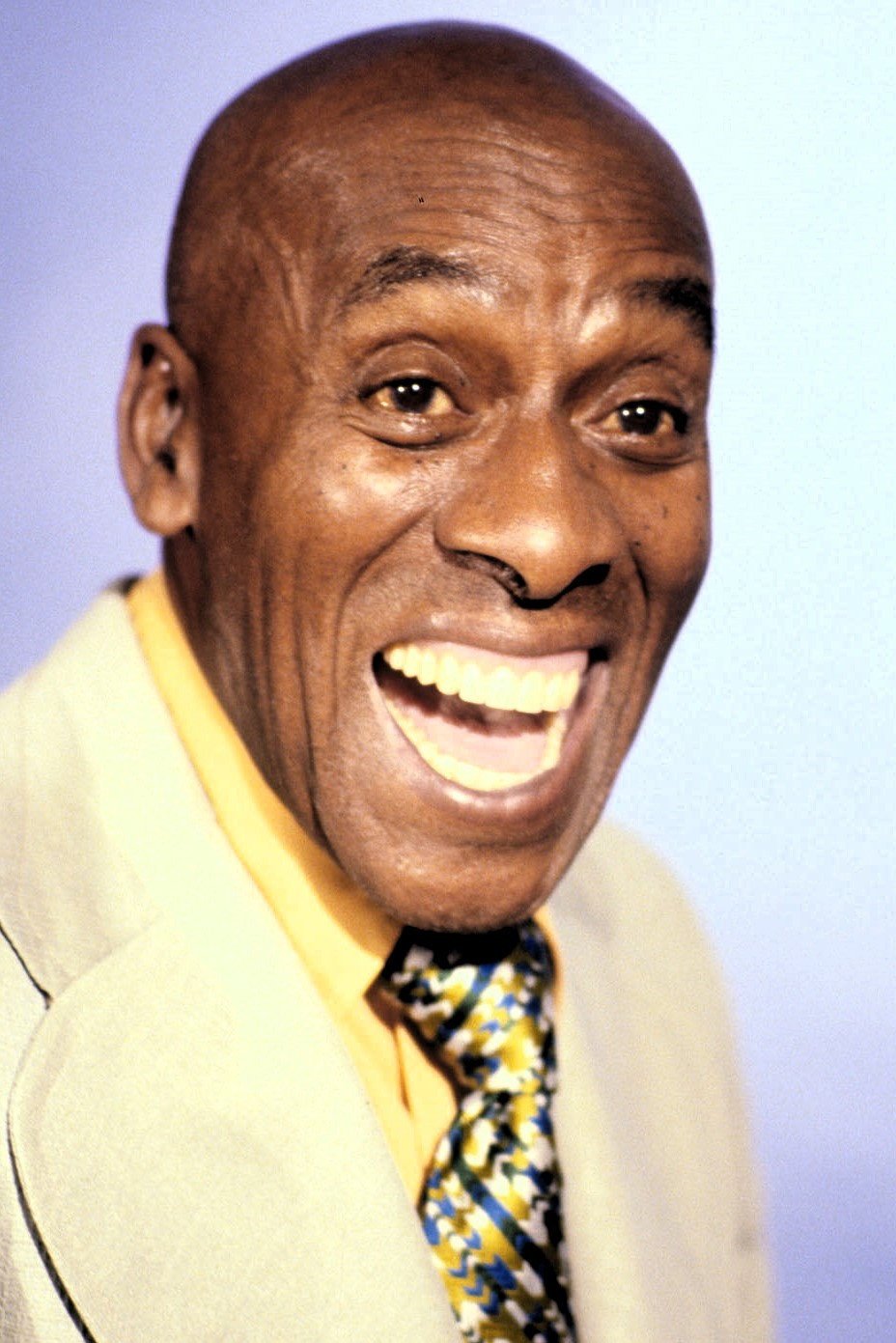
Scatman Crothers (1910-1986) was an American musician and actor, best remembered in horror as Dick Hallorann, the shining cook of The Shining.
Quick Specs
| Born | Benjamin Sherman Crothers, May 23, 1910, Terre Haute, Indiana |
| Died | November 22, 1986, Van Nuys, California, aged 76 |
| Trades | singer, drummer, guitarist, actor, voice actor |
| Horror | Dick Hallorann in The Shining (1980); Mr. Bloom in Twilight Zone: The Movie (1983) |
| Also | Louie in Chico and the Man (1974-78), Turkle in One Flew Over the Cuckoo’s Nest (1975), Scat Cat in The Aristocats (1970), Hong Kong Phooey (1974), Jazz in The Transformers (1984-86) |
| Honors | Saturn Award, Best Supporting Actor (The Shining); Hollywood Walk of Fame star (1981); Black Filmmakers Hall of Fame (1987, posthumous); NAACP Image Award |
Who He Is
Benjamin Sherman Crothers grew up in Terre Haute, Indiana, and taught himself drums and guitar. In his early teens he was already playing in a band in the town’s speakeasies. In the 1930s he formed his own band, lived eight years in Akron, Ohio, and played five days a week on Dayton radio. His band toured the Midwest, and in many rooms they were the first Black entertainers ever to play there. Crothers remembered a “clean-cut band, well dressed, intelligent, young men,” who got booked for three or four months at a stretch.
The name came at a 1932 radio audition in Dayton, when a director told him his own name wasn’t catchy enough. He came up with “Scat Man” on the spot, “because I do a lot of scat singing.” The irony is that his real scat talent came later. Arthur Godfrey later squeezed it into one word, “Scatman.” In 1937 he married Helen Sullivan of Steubenville, Ohio. They were together 49 years and had a daughter, Donna.
In the 1940s the couple moved to California. Crothers worked clubs in Los Angeles and Las Vegas and played the Apollo on tour. He cut singles for Capitol Records, toured with Bob Hope for the USO and drummed with Slim Gaillard. He also made history on local television, joining Dixie Showboat as the first Black performer to appear regularly on a Los Angeles TV show.
The Work, and What He Did in It
His movie break came through a club gig at The Oasis in Los Angeles, where actor Dan Dailey saw him and offered him a part. After a few musical shorts, he made his feature debut as Enoch Jones in Meet Me at the Fair (1953). Two decades of small parts followed, many uncredited: Porgy and Bess (1959), The Patsy (1964), Hello, Dolly! (1969), and TV guest spots on Alfred Hitchcock Presents, Dragnet and Bonanza.
His sixties turned out to be his best decade. In Disney’s The Aristocats (1970) he voiced Scat Cat and led “Ev’rybody Wants to Be a Cat.” The part had been written for Louis Armstrong as “Satchmo Cat,” and when Armstrong fell ill, Crothers took it over. Scat Cat still plays trumpet, a leftover from Armstrong. Crothers became the voice of Meadowlark Lemon on the Harlem Globetrotters cartoon and the title hero of Hong Kong Phooey (1974), along with the hero’s alter ego, Penry the janitor.
In One Flew Over the Cuckoo’s Nest (1975) he was Turkle, the night orderly McMurphy talks into the ward’s after-hours party. Jack Nicholson, who had worked with him on The King of Marvin Gardens (1972), got him the role. He was the porter Ralston in Silver Streak (1976) and the liveryman Moses Brown in The Shootist (1976), John Wayne’s last film. On TV he was Louie Wilson, the singing garbage man of Chico and the Man, in 65 episodes from 1974 to 1978, the role he was best known for. In Roots (1977) he was Mingo, the old cockfighter who teaches Chicken George the trade.
The Shining (1980): Crothers wanted Dick Hallorann before he knew there was a film. A fellow golfer at a Houston tournament told him Stephen King “must have had you in mind,” so he read the book. After Cuckoo’s Nest, Nicholson told him, “Old buddy, I might have something else for you in about another year or so.” It became their fourth film together. Hallorann is the Overlook Hotel’s head cook, who shares Danny Torrance’s gift. In the kitchen he gives that gift a name, “the shining.” Later, in Florida, he senses the boy is in danger and flies back through a blizzard. He drives a Sno-Cat up to the hotel and is killed with an axe by Jack Torrance moments after he walks in.
Crothers arrived in London in May 1978. “I turned 68 while we were in London,” he said. He did his own death scene, with a bag of fake blood rigged on his chest. Before the take he told Nicholson, “Now look, old buddy, don’t go crazy.” Nicholson had already promised Kubrick, “Don’t worry, Stanley. My man can fall.” By Crothers’s count the death took 25 takes, each ending on a hard floor. He also counted 87 takes for a ballroom scene and 40 for climbing out of the Sno-Cat and walking to the door, with no dialogue. “Around the 39th take, I asked Stanley, ‘How do you want me to do it?'” Kubrick biographies later reported even higher counts for single scenes. The continuity records published in 2024 don’t support the record-book numbers.
The script he shot still had Hallorann as the book’s rescuer. When he arrived, Nicholson introduced him with “My man’s the hero of the movie.” Crothers said he never understood why Kubrick changed the ending, and he never asked. The role won him the Saturn Award for Best Supporting Actor.
The same year he played Doc Lynch, the ringmaster of Clint Eastwood’s Bronco Billy (1980). Doc is an ex-con who once practiced medicine without a license. Crothers loved the contrast with Kubrick. “Clint would do a shot once or twice and I’d ask him, ‘Is that alright?’ … ‘Well sure, Scat.’ I’d say, ‘Okay, man!'” The ten-week shoot in Boise wrapped in six. “That only happens when everybody likes each other,” he said.
Twilight Zone: The Movie (1983): in Steven Spielberg’s segment “Kick the Can,” he played Mr. Bloom, a newcomer at a retirement home who insists that age doesn’t end play. One night he leads the residents out to play kick the can, and the game turns them into children again. Most choose to go back to being old, but with young minds, and Bloom moves on to the next home to do it again.
He played Sam in the 1983 Casablanca TV series and kept working through the mid-1980s. His last great voice role was Jazz, the music-loving Autobot, in 33 episodes of The Transformers (1984-86) and in The Transformers: The Movie (1986), where Jazz survives. Around 1985 he was diagnosed with an inoperable tumor in his lung, which spread to his esophagus in 1986. He kept working. He died of pneumonia and lung cancer at home in Van Nuys on November 22, 1986.
Cool Verified Facts
- He wrote Kubrick a song. On the set, with Kubrick’s permission, he sang “Stanley (Does It All)” at the table in the Overlook lobby. One verse admits “he might work you days and days… a perfectionist, you know.”
- He had never heard of Kubrick before he was cast. “I’m not a moviegoer,” he said. A friend at NBC had to tell him who he was about to work for.
- In 1955 he was part of The Ramparts, who recorded “The Death of Emmett Till,” a protest song released the year of the murder.
- His Hollywood Walk of Fame star, awarded in 1981, is at 6712 Hollywood Boulevard.
- He taught scat singing to college students.
Signatures, Habits and Behind the Scenes
- Music never stopped. On The Transformers, Dan Gilvezan, the voice of Bumblebee, remembered him bringing his guitar to every recording session and playing for the cast while they waited. Others remembered his ukulele. On Sanford and Son he backed Redd Foxx on tenor guitar.
- He spoke well of Kubrick. “Stanley’s excellent at working with actors. His attention to technical details didn’t bother me at all,” he said, though “when Stanley’s on the set, he’s god; you could have heard a pin drop.” In Vivian Kubrick’s Making ‘The Shining’ he grew emotional. “If you see tears, they will be tears of joy,” he said. “I’ll never forget this.”
- On The Shining there were no stand-ins. Kubrick kept the actors themselves on set for lighting. Crothers skipped the video playback, asking, “Stanley, is that compulsory?”
- He was close to Freddie Prinze. He recalled telling the young star, on the day Prinze died in January 1977, “Don’t talk that way, son.” The show went on for another season without Prinze, with Crothers still in it.
- Friends remembered him the same way. Producer James Komack said, “He always had a smile on his face.” His biographer Jim Haskins wrote, “There was no dark side to Scatman Crothers.”
- His philosophy, in his own words: “Keep that love in your heart for the human race, do unto others as you’d have them do unto you and you cannot miss.”
Why He Matters
Crothers worked in speakeasies, radio, records, early television, movies, a hit sitcom and Saturday-morning cartoons, a career that ran from the 1920s to the Transformers. Along the way he broke barriers on Los Angeles TV and put his voice on a civil-rights record. For horror, he gave The Shining its one plainly kind adult: the man who explains Danny’s gift, believes him and crosses a blizzard for a child who isn’t his. That is why his death hurts the way it does. Three years later Mr. Bloom was almost the same man with the ending Hallorann was denied, leading the old and frightened back into play. He was Nicholson’s peer, Kubrick’s songwriter and, for three generations of kids, a voice they knew before they ever saw his face.