
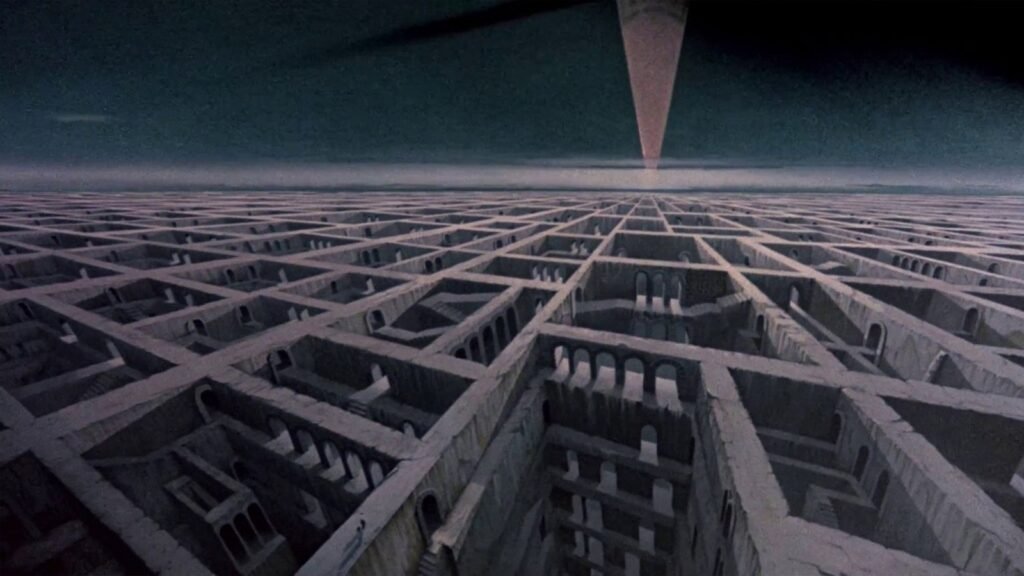
Most directors fight their way onto a set. Tony Randel was already inside the building — running the department that finished other people’s films and cut the trailers that sold them — when the biggest job of his life opened up down the hall. The sequel to Hellraiser needed a director. The post-production chief walked into his boss’s office and asked for it. Sit down. This is how a man goes from the mailroom to Hell.
Tony Randel (born May 29, 1956) is the American director who took Clive Barker’s Hell bigger with Hellbound: Hellraiser II, his credited feature debut. Before that debut he was New World Pictures’ director of post-production and the producer of the American version of Godzilla 1985; after it, a long working life as a director, writer, producer and editor in the low-budget trenches.
Quick Specs
- Born: May 29, 1956 (grew up in West Los Angeles)
- Occupation: Film director, screenwriter, producer, editor
- Known for: Directing Hellbound: Hellraiser II (1988); running post-production at New World Pictures; producing the American version of Godzilla 1985
- Years active: 1980–2020
The mailroom, the cutting room, the top of post-production
Randel grew up in West Los Angeles. The standard account of his schooling has him at University High School, then Santa Monica College and California State University, Northridge, majoring in film production and working as a grocery clerk through his school years.
It led to Roger Corman. In his own words: “I was a film editor, and I worked for Roger Corman before I worked for New World Entertainment.” The colour around that start — beginning in Corman’s mailroom and moving within weeks into editorial work on Battle Beyond the Stars (1980) — is reported; the substance is Randel’s own testimony.
When the re-formed New World Pictures got going, Randel joined about three months into its inception and rose to director of post-production — in another interview he gives the same job as head of post-production. The work: approving final colour timing and technical delivery on releases and acquisitions, on titles he names such as The Philadelphia Experiment, Children of the Corn, Soul Man and House. And his department did more than finish films — it sold them. “My department created most of the trailer campaigns that were done for those films, too,” he says.
1985: Godzilla, Def-Con 4 and a wrestling mockumentary
Three credits from 1985 show the range of the job — all three billed under his fuller name, Anthony Randel. On Def-Con 4, the Canadian post-apocalypse film released in March 1985, when Randel was 28, his credited job was post-production supervisor. The film is Paul Donovan’s — Donovan holds the on-screen directing credit alone — and Randel also contributed uncredited additional directing. His most lasting contribution may have been a phone call: the film needed a re-score, and he hired a young composer named Christopher Young. “I had a re-cut of a film that needed a score, so I hired him to do this film called Def-Con 4,” Randel says. The Randel–Young partnership starts there.
Then came the giant. As head of post-production, Randel — 28–29 across the production and release of Godzilla 1985 — was asked to devise the Americanization of Toho’s The Return of Godzilla (1984). He produced the American inserts: new scenes built around Raymond Burr, reprising his 1956 role — Burr was Randel’s proposal, against an executive’s idea of Lorne Greene. The American footage was directed by R. J. Kizer, an editor Randel had worked with. “Bob (R. J.) Kizer, who directed it, had just been an editor I had worked with,” Randel says. Randel produced; Kizer directed. He also devised the heavy re-edit, reused some of Young’s Def-Con 4 music — “We pirated music from Def-Con 4” — and came up with the title itself, borrowed from Frankenstein (1970): “‘Ooh, the future.'” The trailer he devised, written by Nelson Lyon, was nominated among the year’s five best trailers, by his account. He is credited as Anthony Randel, producer of the U.S. version; the filmography record also carries a U.S.-version writing credit for him.
The same year brought Grunt! The Wrestling Movie (1985), a mockumentary directed by Allan Holzman, with story by Holzman, Anthony Randel, Lisa Tomei and Barry Zetlin, produced by Don Zormann and Anthony Randel. After Godzilla 1985 Randel was promoted from post-production to production executive; the titles he names from that stretch — supervising Pretty Smart, Patricia Arquette’s first film, Paul Morrissey’s Spike of Bensonhurst and Reform School Girls, among others — rest on his own account alone.
The executive who backed Hellraiser
“Then, I supervised on Hellraiser as a production executive, and that’s how I got involved in the series.” Head of production Steve White disliked the dailies coming back from Clive Barker’s shoot and sent Randel in to assess it, a couple of weeks into production. Randel backed the film. “We spent more money, and we shot probably an additional three weeks over what was planned, and we added scenes” — among them Frank’s rebirth from the floorboards, the rat scene, a re-shot Cenobite hospital arrival and a changed ending.
He also worked on the film with his hands: Randel was an uncredited editor on Hellraiser, alongside the credited editor, Richard Marden. Bill him as “the editor of Hellraiser” without the “uncredited” and you have stolen Marden’s credit and shrunk Randel’s real role, which was the executive one he describes himself.
His other signature contribution to the first film is a hiring decision. Barker wanted the band Coil to score it; New World rejected the notion, and Coil later withdrew after a screening meeting. Randel, who had hired Christopher Young for a trailer piece and then for Def-Con 4, pressed Young’s case: “I immediately told Chris Figg, the producer, and Clive that I wanted Chris to do the music for Hellraiser. They heard his stuff, they liked it.” The director of the sequel had already changed the first film twice over — once in the cutting room, once in the orchestra.
Hellbound: taking Hell bigger
The sequel’s directing job was not originally his. Producer Christopher Figg and Barker first wanted Michael McDowell to write and direct Hellbound: Hellraiser II; McDowell withdrew early in pre-production. Why he withdrew is told differently by different sources — one account points to Beetlejuice rewrites and health problems, while Randel recalls a tragedy in McDowell’s life, his partner seriously ill. Peter Atkins then wrote the script.
Randel went to his boss, Steve White, New World’s head of production: “I think I’d really like to direct this. After some discussion, he agreed.” The credit block: directed by Tony Randel; screenplay by Peter Atkins; story by Clive Barker, who also served as executive producer; produced by Christopher Figg. Randel has no writing credit on Hellbound — though by his own account he travelled to England with ideas and notes on Atkins’s first draft, and “we collaborated on the script very successfully… we collaborated and changed things and added things.” Collaboration is not a credit.
It was, in the credited sense, his first film — “It was my first film,” he says plainly — and he was 32 when it opened in the US on December 23, 1988. Festival listings carried for it place the premiere at Toronto on September 9, 1988, with the UK release following on June 16, 1989. His aim: “Our main focus was that we wanted to make a bigger film than the original Hellraiser. We wanted to expand the universe.”
Expand it he did. Where the first film’s Hell was a room with chains in it, Randel built a world: the Labyrinth, an Escher-inspired maze-world ruled over by Leviathan, whose horn sound in Christopher Young’s score incorporates the Morse code for “god.” His Hell is psychological and symbolic rather than religious: “I don’t think you’ll find any religion in any of my movies… I’m an atheist, so my concept of Hell was a symbolic view of what goes on in the subconscious mind.” Even the villain’s name is his work — in Atkins’s draft the character was Malahide; Randel renamed him Channard, merged from Christiaan Barnard, the heart-transplant surgeon. The film’s credited company, as its credit listing carries it, includes Clare Higgins as Julia, Ashley Laurence returning as Kirsty and Kenneth Cranham as Channard, with Robin Vidgeon shooting, Richard Marden editing and Young scoring.
The censors took their cut first. The MPAA initially rated the film X; about six minutes were cut to reach an R. Randel personally appealed in New York, lost, and made one further cut. What survived still made money: the box-office accounting carried for the film puts its US and Canada gross at $12.1 million — $12,090,735 in the precise figure that accounting gives — a success on a sequel whose planned budget had shrunk mid-production as New World’s finances worsened. The accolades on record are a nomination for Best Horror Film at the 16th Saturn Awards, with Young winning the Saturn for Best Music; the nomination belongs to the film and the win to Young, not to Randel personally. His verdict on the series after him is brisk: “After the second Hellraiser, I feel like it really went off the rails.” The full arc is mapped on our Hellraiser franchise hub.
The directing years: vampires, a haunted clock and killer ticks
Randel’s follow-up was Children of the Night (1991), a vampire film distributed by Columbia Pictures. The writing credits are four names: Nicolas Falacci, William Hopkins, Tony Randel and Christopher Webster, with the screenplay also credited to Falacci alone, from a story treatment by all four. In one line: two girls swimming in a flooded crypt wake the ancient vampire Czakyr, and a schoolteacher helps one of them fight a town turning into vampires. The cast on record is headed by Karen Black, Peter DeLuise, Ami Dolenz and Garrett Morris, with music by Daniel Licht; 92 minutes. It premiered at Toronto in September 1991, when Randel was 35.
Next: Amityville 1992: It’s About Time, released direct-to-video on July 16, 1992, when he was 36. It is the sixth Amityville film — the only one he directed — and he did not write it: the script is by Christopher DeFaria and Antonio Toro, from John G. Jones’s Amityville writing. The haunted object this time is a clock from the Amityville house, carried into a California suburb; the cast is headed by Stephen Macht, Shawn Weatherly, Megan Ward and Damon Martin. One neat symmetry: Steve White, the boss who had given Randel the Hellbound job, is among its producers.
Then the killer ticks. Ticks (1993), also released as Infested — one film, two titles — sends mutated, steroid-fed ticks after a wilderness retreat for troubled teens. Randel, 36–37 across its production and release year, directed; Brent V. Friedman wrote it. Its cast runs from Peter Scolari and Rosalind Allen to a returning Ami Dolenz, Alfonso Ribeiro, Clint Howard and a young Seth Green as Tyler Burns. Its budget is reported at $1.5 million.
Two more credits tie the period together. For Fist of the North Star (1995), the live-action adaptation of the manga by Buronson and Tetsuo Hara, Randel directed and co-wrote the screenplay with Peter Atkins — the Hellbound writer, now his co-writer — with Gary Daniels as Kenshiro, Costas Mandylor as Lord Shin, Chris Penn as Jackal and Malcolm McDowell as Ryuken; it premiered on HBO and went to video. And inside his own series, he holds a writer’s credit fans often miss: Hellraiser III: Hell on Earth (1992) is directed by Anthony Hickox from Atkins’s screenplay, on a story by Peter Atkins and Tony Randel. Randel did not direct it and did not write its screenplay — the story credit is the credit.
The editor-producer years
Randel’s later career is the working filmmaker’s career: fewer marquees, more jobs. He directed the thriller The Double Born (2008), starring Sammi Davis and Jon Lindstrom. Hybrids (2015), also titled The Hybrids Family — one film, listed under both names — is a horror-comedy about a vampire-and-witch family and their two hybrid children, directed, produced and edited by Randel, written by Tony Schweikle, starring Paul Sorvino and Carolyn Hennesy; released January 15, 2015, when Randel was 58.
The Doggone films split his roles film by film. A Doggone Christmas (2016) and A Doggone Hollywood (2017) were directed by Jim Wynorski; Randel was their editor and a producer. Only the third, A Doggone Adventure (2018) — Randel then 61–62 — did he direct, again also editing and producing. Through the same years, his credit record is dominated by editing jobs on other directors’ independent productions — among them Yes, and… (2014), CobraGator (2015), Nessie & Me (2016), The Duel (2016, additional editor), IO (2019) and Tidy Tim’s (2020), plus several shorts. His filmography listing also carries a tail of further credits — directing One Good Turn (1996), the TV movie Rattled (1996) and Assignment Berlin (1998), Inside Out anthology segments, and producing Sleeping Dogs Lie (2006). He also appears as himself in the documentaries Leviathan: The Story of Hellraiser and Hellbound: Hellraiser II and Hell on Earth: The Story of Hellraiser III (2015).
Off screen
Randel is married. He has called radio his “other love”: he has been a licensed amateur radio operator since 1968, call sign K6BBC.
Where he stands
Tony Randel turned 70 on May 29, 2026, and his place in horror is a peculiar, secure one. He never had a second shot at a studio horror picture on Hellbound’s scale. What he has is authorship of a different kind: he argued the first film into its extra weeks, hired its composer, cut it without credit — and then, given one sequel, he did the thing sequels rarely manage. He made Hell bigger, stranger and sadder, and gave the series the geography — the Labyrinth, Leviathan, a Hell built out of the mind’s own corridors — that everything after it has had to live in. The post-production chief stepped out of the finishing room exactly once at full scale. Once was enough.