
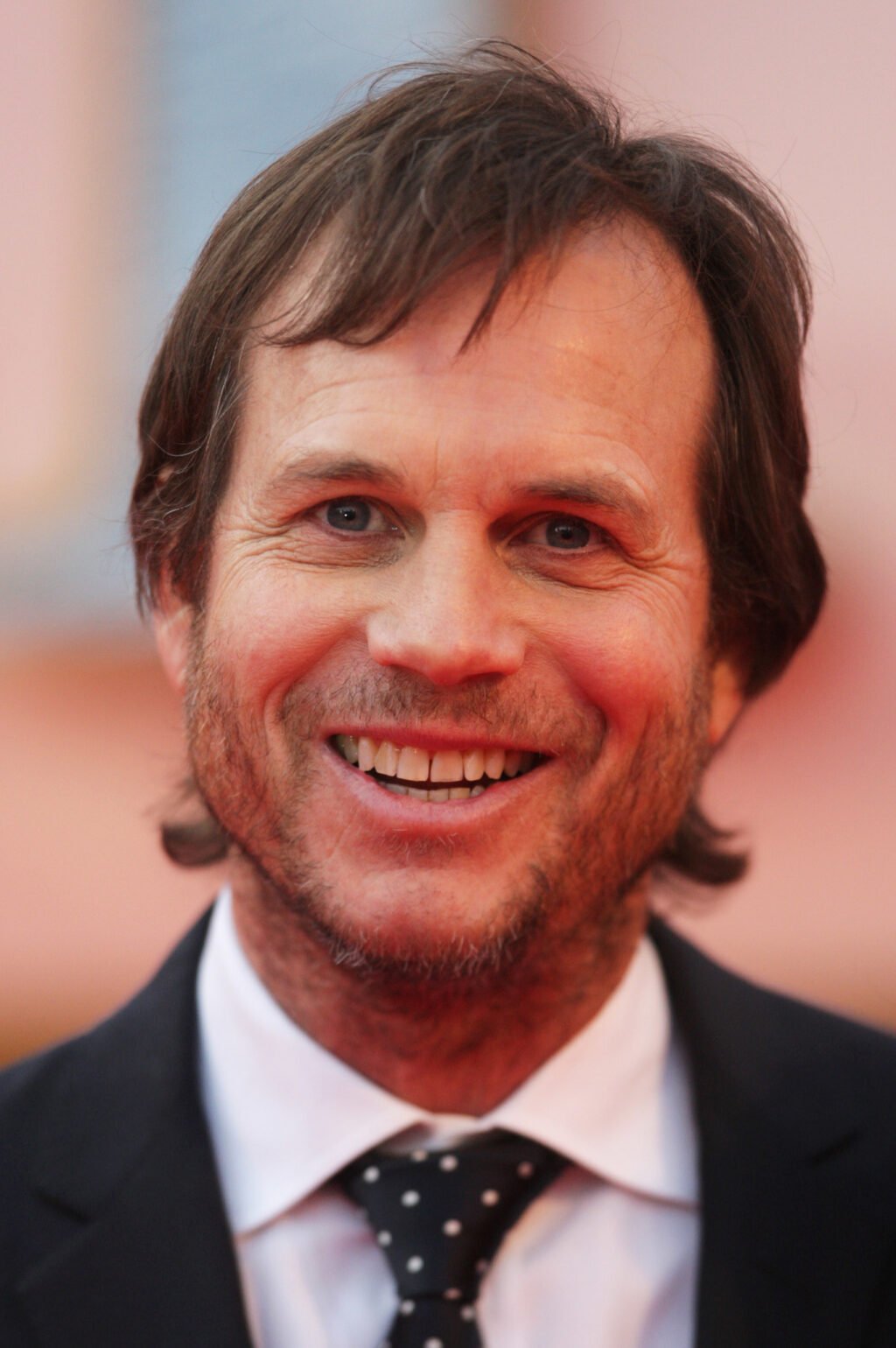
Bill Paxton (1955 to 2017) was the American actor and director who played Hudson in Aliens and Severen in Near Dark, and directed Frailty.
Quick Specs
| Born | William Paxton, May 17, 1955, Fort Worth, Texas |
| Died | February 25, 2017, Los Angeles, aged 61 |
| Started in | Roger Corman’s art department, as a set dresser at New World Pictures |
| Horror and sci-fi roles | the Punk Leader in The Terminator (1984), Private Hudson in Aliens (1986), Severen in Near Dark (1987), Detective Lambert in Predator 2 (1990) |
| As director | Frailty (2001), in which he also stars as “Dad” Meiks; The Greatest Game Ever Played (2005) |
| With James Cameron | The Terminator, Aliens, True Lies, Titanic and the documentary Ghosts of the Abyss |
| Honors | Saturn Award for Best Supporting Actor (Aliens); four Golden Globe nominations; an Emmy nomination for Hatfields and McCoys |
Who He Is
William Paxton was born in Fort Worth, Texas, on May 17, 1955, to Mary Lou and John Lane Paxton. His father was a businessman, lumber wholesaler and museum executive who later took small acting parts himself. Bill had no middle name, and said so: “I don’t have a middle name! My father doesn’t like middle names.”
On the morning of November 22, 1963, eight-year-old Bill went with his father and older brother Bob to see President Kennedy speak outside the Hotel Texas in Fort Worth, hours before the assassination in Dallas. Photographs of him lifted above the crowd are on display at the Sixth Floor Museum at Dealey Plaza, where he recorded an oral history in 2007. Paxton recalled being hoisted onto the shoulders of a man he had only just met, so he could see. Fifty years later he was one of the producers of Parkland (2013), about the chaos at the hospital that day.
At 13 he caught rheumatic fever and spent much of seventh grade in bed. The illness damaged his heart valve, the problem that would end his life. He graduated from Arlington Heights High School in 1973 and studied at Richmond College in London, where he and his school friend Danny Martin met another Texan, Tom Huckabee. Back home the three made Super 8 films and built their own sets.
He wanted to direct. In Los Angeles he was turned down by film schools, so he switched to acting, studied with Stella Adler in New York for about two years and came back west. His first marriage, to Kelly Rowan, ended in divorce. In 1987 he married Louise Newbury, whom he’d met on a London bus when she was a student. They lived in Ojai, California, and had two children, James and Lydia.
The Work, and What He Did in It
Paxton started behind the camera, as his family’s statement said when he died. He moved to Los Angeles at 18, worked as a production assistant on an industrial film, then as a set dresser for Roger Corman’s New World Pictures, on films like Big Bad Mama and Eat My Dust. His first screen role was a small, uncredited part in Jonathan Demme’s Crazy Mama (1975). Working on Corman’s no-budget sets he met James Cameron, then a production designer. “He came in to work on set, and I slapped a paint brush in his hand and pointed to a wall, saying ‘Paint that!'” Cameron recalled. They stayed close friends for 36 years.
He was a director before he was a known actor. In 1980, aged 25, he directed and appeared in the music video for Barnes and Barnes’s novelty song “Fish Heads,” which aired on Saturday Night Live on December 6, 1980, and later went into rotation on MTV. Meanwhile he took bit parts: a soldier in Stripes (1981), a mortuary assistant in the horror film Mortuary (1983), a bartender in Streets of Fire (1984).
In The Terminator (1984), his first acting job for Cameron, he’s the blue-haired leader of the three punks the naked T-800 confronts at Griffith Observatory, credited as “Punk Leader.” He does the talking, pulls a switchblade when the Terminator demands their clothes, and is thrown into a fence and left for dead. A year later he stole Weird Science (1985) as Chet, the sadistic older brother who extorts the heroes until Lisa turns him into a foul, talking toad-like creature.
Aliens (1986) made him. As Private William Hudson, a Colonial Marine combat technician, he starts as the squad’s loudest braggart, becomes the first to panic as the mission falls apart and, after the dropship crashes, delivers the film’s most quoted line: “Game over, man! Game over!” Paxton improvised it. He said he’d decided Hudson was a gamer who “probably came up on video games,” so “game over” was how he’d describe a catastrophe. He also admitted he was “not great at improvising on the spot,” which tells you it came from preparation. In his last scene Hudson makes a desperate stand, rifle blazing, and is dragged down through the floor grating by a xenomorph, never to be seen again; the film never shows his death. The part won him the Saturn Award for Best Supporting Actor.
The next year he was a monster. In Kathryn Bigelow’s neo-Western vampire film Near Dark (1987), written by Bigelow and Eric Red, he plays Severen, the most psychotic member of a nomadic vampire family, the one who enjoys it. His set piece is the bar massacre, where Severen toys with the customers before killing them. The family is headed by Lance Henriksen and Jenette Goldstein, so three people from Aliens came back a year later as vampires. Near Dark flopped, opening the same weekend as The Lost Boys, and has since been reclaimed as one of the defining vampire films of its era.
In Predator 2 (1990) he is Detective Jerry Lambert, the wisecracking new man on Danny Glover’s team. In the subway attack Lambert helps the passengers, then turns and charges the Predator, and is killed; this time the death is on screen. That role is the root of the line his obituaries repeated: Paxton is widely credited as the only actor whose characters were killed by a Terminator, an Alien and a Predator, in three separate films. It’s a fan formulation more than a record. The punk is only presumed dead, Hudson’s death is never shown, and some fans argue Lance Henriksen shares the distinction, depending on whether the android Bishop counts as “killed.”
The 1990s showed his range. He was the small-town sheriff Dale “Hurricane” Dixon in Carl Franklin’s One False Move (1992), a film he cherished; in its final scene Franklin never shows Dale’s face, and one critic wrote that Paxton’s greatest asset may have been his voice, “full to bursting with a generosity of feeling.” He played Morgan Earp in Tombstone (1993), the sleazy fake spy Simon in Cameron’s True Lies (1994), the astronaut Fred Haise in Apollo 13 (1995), the storm chaser Bill Harding in Twister (1996), and the treasure hunter Brock Lovett, whose search for the Heart of the Ocean frames Titanic (1997). In Sam Raimi’s A Simple Plan (1998) he played Hank Mitchell, a decent bookkeeper who finds $4.4 million in a crashed plane and talks himself, one reasonable step at a time, into murder.
Frailty (2001) is his horror centerpiece, and he made it twice over: he directed it, his first feature, and he starred. Brent Hanley wrote it. In 1979 Texas a widowed mechanic, credited only as “Dad” and never named, says an angel has told him his family must destroy demons disguised as ordinary people, whose names will come to him. He is given three weapons: a length of pipe, a pair of work gloves, and an axe with the name “Otis” carved into its handle. His younger son Adam believes; his older son Fenton watches his father become either a serial killer or a prophet. The story is told in flashback by a man calling himself Fenton (Matthew McConaughey) to an FBI agent (Powers Boothe) hunting the “God’s Hand” killer.
Paxton was sent the script to act in. “I read the script and it scared the hell out of me,” he said. He went back to producer David Kirschner with storyboards and color palettes and asked to direct it. He worried that a “wild-eyed director” would sensationalize it, and as an actor he refused to play a madman: critics agree his Dad is a warm, ordinary, loving father who believes, which is the horror. Lionsgate paid for it, its biggest investment in an in-house production at the time, on an $11 million budget. It premiered on November 7, 2001, and most audiences saw it after its US release on April 12, 2002. Roger Ebert gave it four stars and called it “an extraordinary work,” and it earned Paxton a Saturn nomination for Best Director.
He directed one more feature, Disney’s golf drama The Greatest Game Ever Played (2005), which couldn’t be less like Frailty. From 2006 to 2011 he starred in HBO’s Big Love as the polygamist Bill Henrickson, earning three Golden Globe nominations, and he was Emmy-nominated as Randall McCoy in Hatfields and McCoys (2012). Late scene-stealers included the villain John Garrett in Agents of S.H.I.E.L.D., Master Sergeant Farrell in Edge of Tomorrow and the freelance cameraman Joe Loder in Nightcrawler, all in 2014. He was starring in CBS’s Training Day when he died, and his last film, The Circle, came out two months later.
Cool Verified Facts
- He stenciled “Louise,” his wife’s name, over the heart of Hudson’s armor.
- Martini Ranch, the new-wave band he formed with Andrew Todd Rosenthal, released one album, Holy Cow (1988), produced by Devo’s Bob Casale. James Cameron directed their video for “Reach,” with Kathryn Bigelow in it.
- He played a Nazi radio officer in Pat Benatar’s “Shadows of the Night” video, learning German for it.
- He and Cameron dove to the real Titanic wreck in Russian submersibles for Ghosts of the Abyss (2003), which Paxton narrates.
- The day after he died, nearly 200 storm chasers and spotters used the Spotter Network to spell his initials, “BP,” in GPS dots across a map centered on Wakita, Oklahoma, where Twister was shot. The network had only ever done that for chasers who had contributed to the field, never for a non-chaser. Its president said that hundreds, if not thousands, of meteorologists, himself included, had been inspired by Twister and Paxton’s role in it.
Signatures, Habits and Behind the Scenes
He built characters from invented life stories and let the lines come out of them. Cameron asked the Aliens Marines to work out their own backstories, and “Game over, man!” is what came out of Paxton’s.
On Aliens he kept apologizing to the young Carrie Henn every time Hudson had to swear in front of her, and he hung out with her between takes to make her comfortable. Producer Gale Anne Hurd said, “He made going to work fun.” The knife-trick scene, where Bishop stabs between Hudson’s spread fingers, was Lance Henriksen’s idea. By one much-told account Paxton didn’t know his hand would be used; Henriksen’s own version has Paxton volunteering. What both sides agree on is that on one take Henriksen nicked Paxton’s pinkie and gave him a blood blister.
Weather was a real enthusiasm. He narrated the IMAX documentary Tornado Alley (2011), and for years he pitched a darker Twister sequel he wanted to direct, calling the original “the Pepsi Lite version” and saying “there was a Jaws version of that movie.” He based it on the Tri-State Tornado of 1925 and visited the towns it hit to research it. He played a storm chaser; he never claimed to be one.
Weeks before he died he talked publicly about his damaged valve. On February 14, 2017, he had open-heart surgery at Cedars-Sinai to repair the valve and his aorta. His family’s statement said he died of complications from surgery; his death certificate gives a stroke, on February 25, 2017, eleven days after the operation. He was 61. In 2018 his family sued the hospital and the surgeon for wrongful death; the defendants denied negligence, and the case was settled on confidential terms in 2022. His Big Love co-star Chloë Sevigny called him “one of the less cynical, jaded people” she had ever met in the business. Cameron called him “a good man, a great actor, and a creative dynamo.”
Why He Matters
Bill Paxton connects the Cameron era, and horror sits at the middle of it. He is the only actor in The Terminator, Aliens, True Lies and Titanic; add Near Dark and Predator 2 and one working actor links the Terminator, the xenomorph, the Predator and Bigelow’s vampires.
Hudson changed how a genre ensemble could sound. Paxton made panic funny, articulate and finally brave, and the line he built from his own invented backstory is still quoted and parodied nearly forty years later. Severen, a year later, is the opposite: horror’s most gleeful monster, played by the same man. And Frailty proves he was never only an actor for hire. The kid the film schools turned down, who learned the trade painting Corman sets, made a Southern Gothic horror film Roger Ebert gave four stars, by refusing to sensationalize it and refusing to play a madman.
His status as a much-loved working actor tended to overshadow his range. The storm chasers had the last word, spelling his initials across Tornado Alley for a man who had only played one of them.