
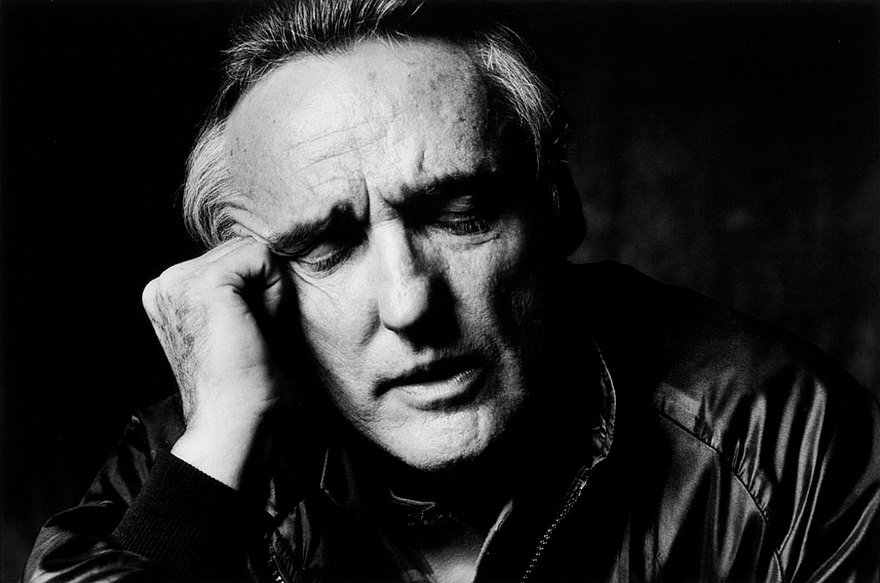
Dennis Hopper (1936 to 2010) was the American actor, director and artist who played Lefty Enright in The Texas Chainsaw Massacre 2.
Quick Specs
| Born | Dennis Lee Hopper, May 17, 1936, Dodge City, Kansas |
| Died | May 29, 2010, at home in Venice, California, aged 74, of prostate cancer |
| Training | Old Globe Theatre in San Diego (scholarship); the Actors Studio in New York |
| Horror centerpiece | Lt. Boude “Lefty” Enright in The Texas Chainsaw Massacre 2 (1986) |
| Also in 1986 | Frank Booth in Blue Velvet; Shooter in Hoosiers |
| As director | Easy Rider (1969), The Last Movie (1971), Out of the Blue (1980, took over mid-production), Colors (1988) |
| Oscar nominations | Best Original Screenplay for Easy Rider (shared with Peter Fonda and Terry Southern); Best Supporting Actor for Hoosiers |
| Other honors | Cannes award for Best First Work (Easy Rider); Emmy nomination for Paris Trout; star on the Hollywood Walk of Fame (March 2010) |
Who He Is
Dennis Lee Hopper was born in Dodge City, Kansas, on May 17, 1936, to Marjorie Mae and Jay Millard Hopper. The family moved to California in his early teens. After high school he won a scholarship to San Diego’s Old Globe Theatre, where he played Shakespeare, and he later studied at the Actors Studio in New York. James Dean’s acting style influenced him deeply, and the two worked together twice.
He was never only an actor. From the 1960s he was a serious photographer, and later a painter and collector exhibited around the world. The Encyclopedia of the Great Plains describes his photography as training “specifically calculated to teach him the art of filmmaking.”
He married five times: Brooke Hayward (1961 to 1969), Michelle Phillips (married October 31, 1970, and divorced eight days later), Daria Halprin (1972 to 1976), Katherine LaNasa (1989 to 1992) and Victoria Duffy (from 1996). He had four children. Phillips later called those eight days the happiest of her life.
The Work, and What He Did in It
He started in television in 1954 and was first praised as a teenager for playing an epileptic on NBC’s Medic (1955). Then came the two Dean films: a small part as Goon in Rebel Without a Cause (1955) and Jordan Benedict III, Rock Hudson’s son, in Giant (1956). After clashing with director Henry Hathaway on From Hell to Texas (1958), he found studio film work hard to get. He spent much of the 1960s in television, with supporting film roles in Gunfight at the O.K. Corral (1957), The Sons of Katie Elder (1965), directed, as it happens, by Hathaway again, Cool Hand Luke (1967), Hang ’Em High (1968) and True Grit (1969).
Easy Rider (1969) changed everything. Hopper directed it, co-wrote it with Peter Fonda and Terry Southern, and played Billy opposite Fonda’s Wyatt. It won the award for Best First Work at Cannes and earned the three writers an Oscar nomination for Best Original Screenplay. A low-budget independent that became the cinematic symbol of the 1960s, it helped prove the economics of the New Hollywood, which is why a studio handed him the next film. That was The Last Movie (1971), shot in Peru, which failed with critics and audiences and cost him his credibility as a studio director.
He didn’t disappear. He lived much of the 1970s in Taos, New Mexico, and kept acting in American and European films: Mad Dog Morgan (1976), Tracks (1976), and Tom Ripley opposite Bruno Ganz in Wim Wenders’s The American Friend (1977). In Francis Ford Coppola’s Apocalypse Now (1979) he is the manic Photojournalist, Kurtz’s worshipful acolyte, and with limited screen time he became one of the film’s defining images. Hired as an actor on Out of the Blue (1980), he took over direction mid-production and finished the film, which was honored at Cannes.
1986 was his year, with three major performances. The horror one is The Texas Chainsaw Massacre 2, directed by Tobe Hooper and written by L. M. Kit Carson for Cannon Films, the third film in Hooper’s three-picture Cannon deal after Lifeforce and Invaders from Mars. It was released on August 22, 1986. Hopper plays Lt. Boude “Lefty” Enright, a former Texas Ranger and the uncle of Sally and Franklin Hardesty, the victims of the 1974 original. He has spent the years since hunting the Sawyer family, and he enlists the radio DJ Vanita “Stretch” Brock (Caroline Williams), who recorded a Sawyer killing over an open phone line, to draw them out.
What Hopper does is play the avenger as deranged as his quarry, and the whole film turns on that mirror. At the Cut-Rite chain-saw store, Lefty buys three saws, one big and two small that he wears like six-shooters, and test-saws a log in a frenzy. He preaches (“I am the Lord of the Harvest”). In the family’s amusement-park lair he fights a chainsaw duel with Leatherface (Bill Johnson) and impales him before a grenade set off by Drayton kills Lefty, Leatherface, Grandpa and Drayton together. In the medium and long shots of that duel a stunt double is visibly at work. The film split critics on release, and Roger Ebert gave it one star and called it a “geek show.” It found its cult on home video.
The same year he was Frank Booth in David Lynch’s Blue Velvet: the gas-inhaling, screaming crime boss who terrorizes Dorothy Vallens (Isabella Rossellini) and Jeffrey Beaumont (Kyle MacLachlan). Booth ranks No. 36 on AFI’s list of the 50 greatest screen villains. And he was Wilbur “Shooter” Flatch, the alcoholic former player turned assistant coach in Hoosiers, which brought his acting Oscar nomination, while the National Society of Film Critics recognized his Blue Velvet work. In one year he was the most frightening villain in American film and its most pitiable drunk.
He returned to studio directing with Colors (1988), with Sean Penn and Robert Duvall, his first feature as director in sixteen years by the Encyclopedia of the Great Plains’ count. He earned an Emmy nomination for the title role in HBO’s Paris Trout (1991). In True Romance (1993) he is Clifford Worley, Clarence’s father. Knowing he is about to be tortured for his son’s whereabouts, Worley deliberately provokes Christopher Walken’s Vincenzo Coccotti into killing him quickly, and protects Clarence by doing it. Quentin Tarantino has said on his commentary that the speech came from a story told by a man who once lived in his house. Many critics consider it Hopper’s finest late scene.
He was President Koopa in Super Mario Bros. (1993), a critical and commercial failure. He was Howard Payne, the ex-bomb-squad officer who holds a bus and then a subway train to ransom opposite Keanu Reeves and Sandra Bullock, in Speed (1994), and the Deacon, leader of the Smokers, in Waterworld (1995). He never slowed down: genre work like Land of the Dead (2005), the narration on Gorillaz’s “Fire Coming Out of the Monkey’s Head” (2005), a lead role in TV’s Crash, and at least 25 films in his last ten years, no fewer than six of them released in 2008.
Cool Verified Facts
- His two Oscar nominations are for different things: writing for Easy Rider and acting for Hoosiers. He didn’t win either.
- In 1983, after a screening of Out of the Blue at Rice University in Houston, he performed the “Russian dynamite death chair” stunt at a nearby racetrack, sitting amid dynamite timed to leave a survivable pocket at the center. He survived, with effects on his hearing reported afterward. Wim Wenders, Terry Southern and a young Richard Linklater were among the witnesses.
- His substance abuse peaked in the early 1980s with commitment to a psychiatric hospital in 1983 to 1984, and he said he stopped drinking and using drugs in the mid-1980s.
- Lynch’s script called for Frank Booth to inhale helium. Hopper argued for something heavier, the gas is never named on screen, and in a 2002 documentary Hopper said he had conceived it as amyl nitrite.
- His role in Orson Welles’s The Other Side of the Wind was shot in the 1970s and only released in 2018.
- In March 2010, already frail, he received his star on the Hollywood Walk of Fame, with Jack Nicholson, Viggo Mortensen and David Lynch among those present. He died at home in Venice two months later.
Signatures, Habits and Behind the Scenes
When he read Blue Velvet he called Lynch and said: “You have to let me play Frank Booth. Because I am Frank Booth!” Others had turned the part down, Willem Dafoe and Richard Bright among them. Hopper was sober by then, and he meant it as a recovering man claiming his own past as technique. Lynch has said he was grateful for what Hopper knew about the inhalant.
That was his method more often than not: playing men at the edge he had personally occupied. The recovering alcoholic Shooter was played by a recovering alcoholic, and he took on zealots and predators in the Photojournalist, Booth and Payne. Lefty’s spree in the chain-saw store works because he plays obsession without a wink in a film pitched as black comedy. Reviewers then and since note that Lefty matches the family’s madness instead of opposing it.
The sober decades turned the uninsurable rebel into one of Hollywood’s most employable character actors. One obituary summed them up as “a tireless phase of his career in which he claimed to have turned down no parts.”
He collected art from the late 1950s and photographed the art world he moved in. In 1987 he built a corrugated-metal main house at his Venice compound to show the collection.
Why He Matters
Dennis Hopper is one of horror’s great one-film immortals, twice. Frank Booth is on AFI’s all-time villains list, and Lefty Enright is the rare horror hero who out-crazies the monsters, in the genre’s most famous chainsaw duel. Both came in 1986, his comeback year.
He also directed a film that changed the business. Easy Rider’s Cannes prize, Oscar-nominated script and independent economics opened the New Hollywood decade, and everything that came after, the fall, Taos, Coppola, Lynch, follows from having made that moment and then lost its rewards.
The recovery is as much his legacy as the wildness: Dean-era prodigy, counterculture filmmaker, casualty, and then, sober from the mid-1980s, a quarter-century of relentless, decorated character work that ended with a Walk of Fame star weeks before his death.