
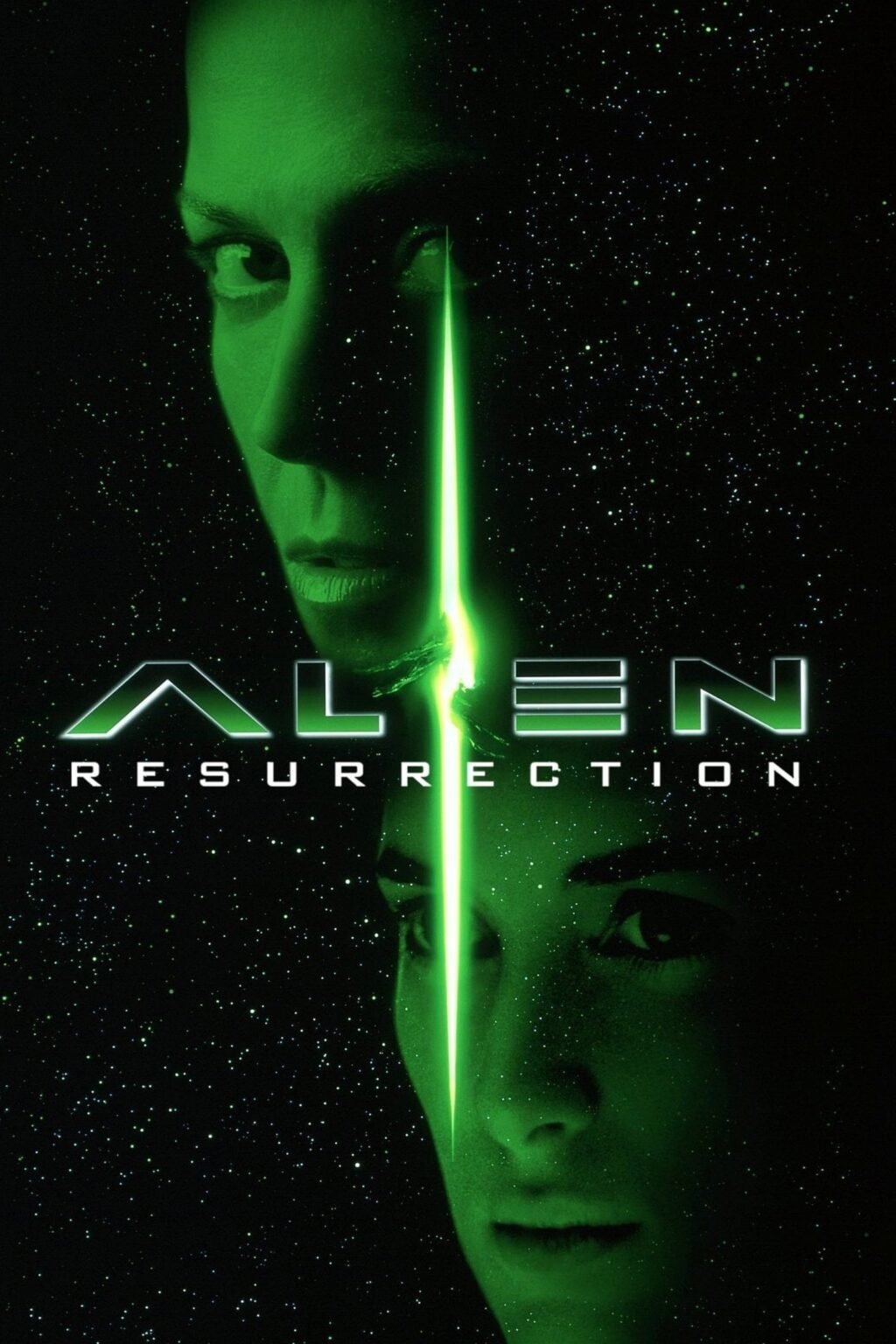
Alien Resurrection (1997) is a science-fiction horror film directed by Jean-Pierre Jeunet and written by Joss Whedon. It is the fourth film in the Alien franchise. Two hundred years after Alien 3, military scientists on the USM Auriga clone Ellen Ripley (Sigourney Weaver) to recover the alien queen that died with her. The clone, Ripley 8, shares the Xenomorphs‘ DNA. She joins a band of mercenaries, including Winona Ryder‘s Call and Ron Perlman‘s Johner, when the bred aliens escape and the ship heads for Earth. It was the first Alien film shot outside England. It was the least successful of the series in the US and Canada but did well internationally, grossing $161.4 million. Reviews were mixed: critics praised Weaver and Jeunet but criticized the script.
At a glance
| Release date | November 6, 1997 (Paris premiere); November 12, 1997 (France); November 26, 1997 (US) |
| Director | Jean-Pierre Jeunet |
| Writer | Joss Whedon |
| Based on | Characters created by Dan O’Bannon and Ronald Shusett |
| Starring | Sigourney Weaver, Winona Ryder, Ron Perlman, Dan Hedaya, J. E. Freeman, Brad Dourif, Michael Wincott |
| Runtime | 109 minutes |
| Rating | R (US), for strong sci-fi violence and gore, some grotesque images and language |
| Budget | $70 million |
| Box office | $161.4 million |
| Franchise | Alien: fourth film; follows Alien 3 (1992) |
Plot summary
Using blood samples from Fiorina 161, military scientists on the Auriga clone Ripley, and the queen embryo comes with her. They remove it, raise the queen and harvest her eggs, but keep the clone, Ripley 8, alive for study. The alien DNA has given her enhanced strength, acid blood, fragments of Ripley’s memories and a psychic link with the creatures. The mercenary crew of the Betty arrives with abducted humans in stasis, delivered to be used as hosts. One of the crew, Call (Winona Ryder), tries to kill Ripley 8 but is too late: the aliens already exist.
The adult aliens kill one of their own and use its acid blood to escape. They overrun the ship, which automatically sets course for Earth. Ripley 8, the surviving mercenaries, the scientist Wren and the host Purvis head for the Betty. On the way, Ripley finds a laboratory holding seven failed earlier clones of herself. She ends the suffering of the one still alive and burns the lab. The group then swims through a flooded kitchen with two aliens close behind.
Spoiler section: the ending
Call is revealed as an “Auton,” a synthetic. She uses her link to the ship’s computer to crash the Auriga into Earth. The traitorous Wren dies when the embryo inside Purvis bursts free. In the nest, the queen, changed by Ripley’s DNA, gives birth to a humanoid Newborn. It kills the queen and takes Ripley 8 as its mother. The Newborn follows them aboard the Betty. Ripley melts a small hole in a window with her acid blood, and the creature is sucked through it into space. As the Auriga explodes on impact, Call asks what Ripley will do now. “I don’t know. I’m a stranger here myself.”
Production and behind the scenes
Fox hired Whedon, who first wrote a treatment about a clone of Newt, since Ripley had died. The studio then decided to bring back Ripley, whom it saw as the anchor of the series. Producers David Giler and Walter Hill suggested cloning, even though they opposed the film and thought it would ruin the franchise. Weaver had let Ripley die partly to avoid becoming “a figure of fun,” but she was impressed by Whedon’s script. Whedon wrote five versions of a final act set on Earth, and none reached the screen. Danny Boyle was the first choice to direct, and Peter Jackson and Bryan Singer were also approached. Jeunet thought the series had ended with Alien 3 but accepted on a $70 million budget. He needed an interpreter on set and brought his City of Lost Children collaborators, effects supervisor Pitof and cinematographer Darius Khondji.
Filming took place at Fox’s Los Angeles studios from October 1996 to February 1997. Weaver chose to stay out of England, feeling earlier shoots had exhausted the crews. The underwater chase came first. Stage 16 was rebuilt as a tank holding 548,000 gallons. Amalgamated Dynamics, returning from Alien 3, gave the aliens pointed tails for swimming and built the Newborn as an animatronic, which Jeunet wanted more human than alien. Blue Sky Studios created the first CGI aliens on film for shots where the creatures’ legs were visible. All the spaceships were miniatures. Newcomer John Frizzell spent seven months on a score with themes of romance and eroticism.
Release and reception
After a Paris premiere on November 6, 1997, the film topped the French box office with over a million admissions in its first week. It opened in the US on November 26 at No. 2 behind Flubber, with $25 million over five days. It finished with $47.8 million in the US and Canada, the series’ lowest there, and $113.6 million internationally, for $161.4 million in total. Reviews were mixed: 56% on Rotten Tomatoes and 63 on Metacritic, with a “B−” CinemaScore. The consensus praises “Sigourney Weaver’s feral performance” but says the film “corrodes whatever emotional investment audiences had left.” Lisa Schwarzbaum of Entertainment Weekly gave it a “B+.” It received six Saturn nominations, including for Weaver, Ryder and Jeunet.
Legacy and influence
Whedon’s Earth-set Alien 5 was never made. Weaver didn’t like the setting and wanted to return to the planetoid from the first film, though she said she was open to playing Ripley again if she liked the story. James Cameron had been developing a fifth film with another writer but stopped when Fox greenlit Alien vs. Predator (2004). He predicted it would “kill the validity of the franchise,” though he later admitted he liked it. The series moved on to the crossovers and to Ridley Scott’s prequels, Prometheus (2012) and Alien: Covenant (2017). Ripley’s planned story did not continue on screen. The film’s storylines were continued in tie-in comics and novels, such as Aliens: Original Sin. For a later return to the series’ roots, see Alien: Romulus.
Trivia
- Studio space was scarce because Titanic, Starship Troopers and The Lost World: Jurassic Park were shooting at the same time.
- Jeunet had just finished the script for Amélie when he was offered the film.
- Production designer Nigel Phelps had designed Gotham City for Batman and Mega-City One for Judge Dredd.
- A 2003 special edition restores about 13 minutes of footage, including an alternate ending with the Betty landing near the ruins of Paris.
- A.C. Crispin wrote the novelization, and Argonaut Games made a 2000 PlayStation game.
Related links
- Ellen Ripley and the Xenomorph (characters)
- Alien franchise
- Alien (1979), Aliens (1986) and Alien 3 (1992)
- Sigourney Weaver and Winona Ryder (cast)
- Jean-Pierre Jeunet (director) and Joss Whedon (writer)
Trailer
Go Behind the Screams
Check out these behind-the-scenes looks at how Alien Resurrection (1997) was made: