
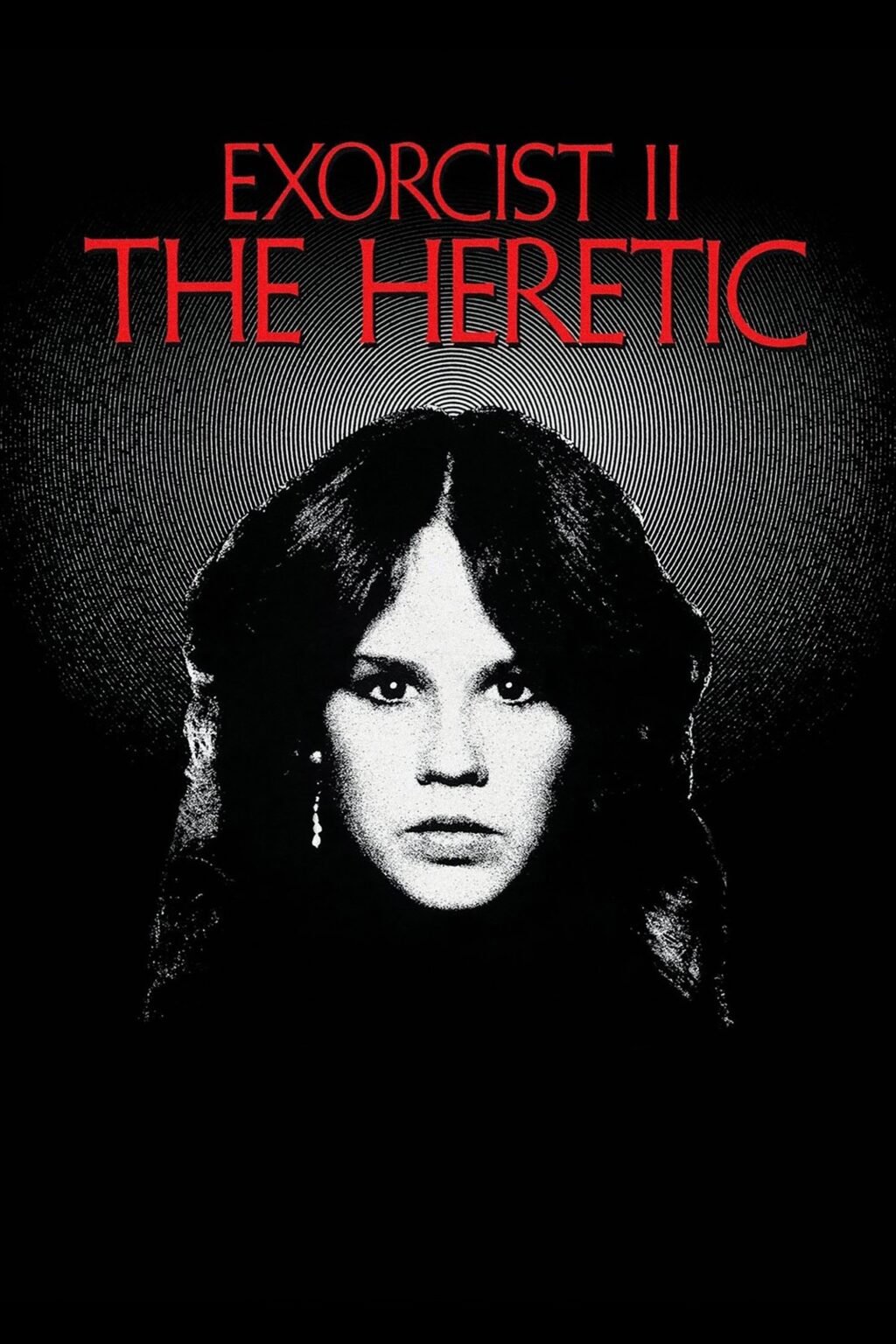
Exorcist II: The Heretic (1977) is a supernatural horror film directed by John Boorman and written by William Goodhart. It is the sequel to The Exorcist (1973). Four years after her possession, sixteen-year-old Regan MacNeil (Linda Blair) seems well. Father Lamont (Richard Burton) is sent to investigate the death of Father Merrin (Max von Sydow). He is drawn through a hypnosis device into the demon Pazuzu’s past in Africa. Louise Fletcher and James Earl Jones co-star, and Ennio Morricone composed the score. Neither William Peter Blatty nor William Friedkin took part. The film turned a profit but was savaged by critics and audiences. It is often called one of the worst films ever made, though it has notable defenders, including Martin Scorsese and Pauline Kael.
At a glance
| Release date | June 17, 1977 (US) |
| Director | John Boorman |
| Writer | William Goodhart (rewritten by Rospo Pallenberg and John Boorman) |
| Based on | Characters created by William Peter Blatty |
| Starring | Linda Blair, Richard Burton, Louise Fletcher, Max von Sydow, Kitty Winn, Paul Henreid, James Earl Jones |
| Runtime | 102 minutes |
| Rating | R (US) |
| Budget | $14 million |
| Box office | $30.7 million (US) |
| Franchise | Exorcist: sequel to The Exorcist (1973); followed by The Exorcist III (1990) |
Plot summary
Father Philip Lamont (Richard Burton), a priest whose faith is shaken after an exorcism ends in a woman’s death by fire, is assigned to investigate Father Lankester Merrin. Merrin died four years earlier while exorcising the Assyrian demon Pazuzu from Regan MacNeil, and now faces posthumous heresy charges over his writings. Regan, living in New York with her guardian Sharon Spencer (Kitty Winn), says she remembers nothing. Her psychiatrist, Dr. Gene Tuskin (Louise Fletcher), believes the memories are repressed.
Tuskin uses a “synchronizer,” a biofeedback device that links two people’s brainwaves, to hypnotize Regan. Joined to her through it, Lamont is carried by Pazuzu into the past to see Merrin exorcising an African boy, Kokumo. Pazuzu appears as a swarm of locusts. Lamont defies his superiors and travels to Africa to find the adult Kokumo (James Earl Jones), now a scientist studying locusts. He learns that the demon attacks people with psychic healing gifts. Merrin believed people like Kokumo and Regan were forerunners of a new, spiritually gifted humanity, and Regan helps a mute autistic girl speak.
Spoiler section: the ending
Lamont and Regan return to the Georgetown house, followed by Tuskin and Sharon. Their taxi crashes into the house, and Sharon sets herself on fire. Pazuzu tempts Lamont with a succubus double of Regan. Lamont at first gives in, then, brought back by Regan, kills the double by tearing out its heart as locusts pour in and the house falls apart. Regan banishes the locusts and the demon with the bullroarer ritual Kokumo once tried in Africa. Sharon dies, and Tuskin asks Lamont to watch over Regan as the two leave together.
Production and behind the scenes
Blatty and Friedkin wanted nothing to do with a sequel. They had sued the studio and each other over the first film. Co-producer Richard Lederer said the original idea was a cynical, roughly $3 million “rehash,” with a priest interviewing witnesses intercut with unused footage. Playwright Goodhart’s script, The Heretic, instead built a metaphysical story around the theories of Pierre Teilhard de Chardin, the Jesuit thinker who had inspired Blatty’s Merrin. Boorman was unhappy with it. When Goodhart refused to rewrite, Rospo Pallenberg and Boorman rewrote it during filming, uncertain how it should end. Blair returned but refused to wear demon makeup, so a double was used in flashbacks. Ellen Burstyn flatly refused to return. Jon Voight signed to play Lamont, but left in April 1976 and was replaced by Burton. Fletcher took the role of Tuskin, originally written for a man, just after winning the Best Actress Oscar for One Flew Over the Cuckoo’s Nest.
Filming began at Burbank Studios on May 24, 1976, on an $11 million budget that grew to $14 million. Boorman’s hopes of shooting in Ethiopia and the Vatican came to nothing, so key exteriors were built on the Warner backlot. The MacNeil house and the “Hitchcock Steps” were also recreated after permission to film the real ones was refused. Regan’s sleepwalking scene was shot atop 666 Fifth Avenue, where Warner’s offices then were, with no stunt double or effects: Blair’s feet at the roof’s edge, with Fifth Avenue far below.
Release and reception
Warner opened the film on June 17, 1977, in 725 theaters, its largest day-and-date launch at the time, and set a studio record with a $6.7 million opening weekend. Poor word of mouth followed. It still grossed $30.7 million in the US, a profit, but far below the original. Audiences reportedly laughed at the New York premiere. Blatty claimed he started the laughter, comparing it to watching The Producers. Friedkin called it “the worst piece of crap I’ve ever seen” and “a freaking disgrace.” Variety wrote that “it isn’t even close” to the original.
Legacy and influence
The film still appears on worst-film lists, but it has had serious champions. Pauline Kael preferred it to the original and wrote in The New Yorker that it “had more visual magic than a dozen movies.” Martin Scorsese called Regan “a modern-day saint” and said, “The Heretic surpasses it. Maybe Boorman failed to execute the material, but the movie still deserved better than it got.” Kim Newman found it, like Morricone’s “mix of tribal and liturgical music,” at least “very interesting.” Its reception meant the next sequel, Blatty’s own The Exorcist III, didn’t arrive until August 1990. Scream Factory’s 2018 Collector’s Edition includes the theatrical cut and a shorter alternative version. The 2025 documentary Boorman and the Devil covers its troubled production. Blair returned to the series nearly five decades later in The Exorcist: Believer (2023).
Trivia
- William O’Malley couldn’t return as Father Dyer, so the role became Father Lamont.
- Jack Nicholson, Christopher Walken and David Carradine were among those considered for Lamont.
- Before Fletcher, Chris Sarandon and George Segal were considered for Tuskin when the role was male, then Ann-Margret and Jane Fonda.
- Scenes were also shot at Pennsylvania Station in Newark, New Jersey.
Related links
- Regan MacNeil and Father Merrin (characters)
- The Exorcist (1973), The Exorcist III (1990) and The Exorcist: Believer (2023)
- Linda Blair and Max von Sydow (returning cast)
- John Boorman (director)
- William Friedkin and William Peter Blatty (makers of the original)