
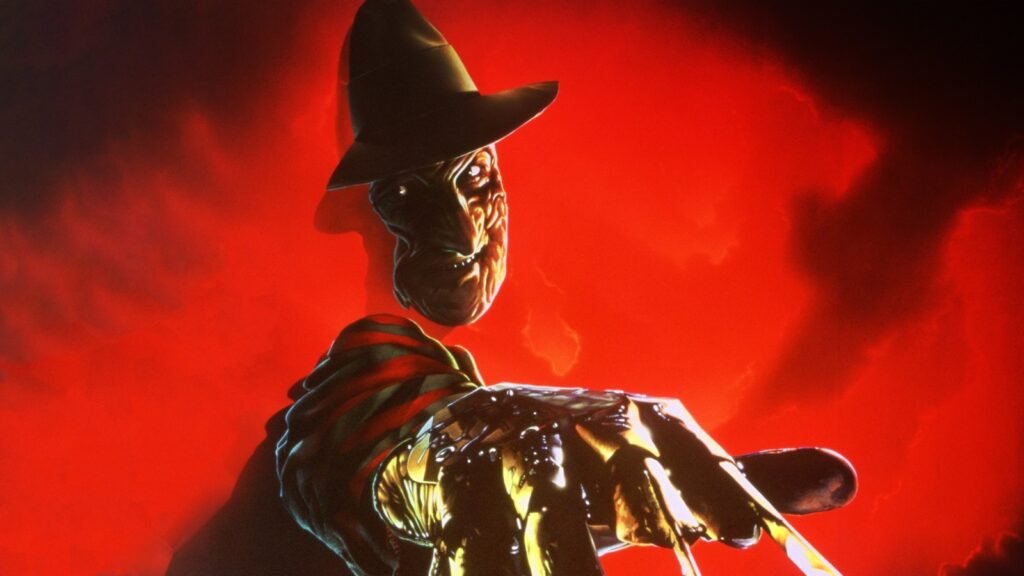
Freddy’s Dead is the 1991 Elm Street finale that wasn’t: Freddy’s daughter Maggie drags him into the real world to end him for good.
Quick Specs
- Director: Rachel Talalay
- Screenplay: Michael De Luca
- Story: Rachel Talalay
- Based on characters by: Wes Craven
- Producers: Robert Shaye and Aron Warner
- Music: Brian May
- Starring: Robert Englund, Lisa Zane, Shon Greenblatt, Lezlie Deane, Ricky Dean Logan, Breckin Meyer, Yaphet Kotto
- Released: 13 September 1991 (United States)
- Runtime: 89 minutes (a 105-minute original-release figure also circulates)
- Rated: R
- Studio: New Line Cinema
- Series: Sixth film in the Nightmare on Elm Street franchise; sequel to The Dream Child (1989)
The last teenager in Springwood
The film opens “ten years from now” — a date its own record cannot agree on, with accounts placing it in 1999 and others in 2001, so this page prints the framing and neither year. What is certain is the body count: Freddy Krueger has killed nearly every child and teenager in Springwood, and the town’s adults have curdled into a childless psychosis, holding a dilapidated fair for children who no longer exist. One teenager survives — an amnesiac who wakes outside the city limits with a head wound, a Springwood newspaper clipping, and no name. The shelter that takes him in calls him John Doe. His doctor, Maggie Burroughs, reasons that Springwood itself is the missing memory, and drives him home to find it — with three of the shelter’s residents stowed in the van: Spencer, a rich stoner at war with his father’s conformity; Carlos, deaf in one ear from his mother’s abuse, hearing aid in the other; and Tracy, a boxer who does not like to be touched, for reasons the film does not flinch from.
Springwood cannot be left — the teens drive in circles — and it cannot be survived. At the orphanage, John learns that Freddy had a child, taken when the parents of Elm Street burned him. Freddy has spared John again and again, and John draws the conclusion the film wants him to draw: the child must be him. It is the movie’s central lie, told by Freddy himself. Freddy does not have a son in this story. He has a daughter — and John is not his family. He is his envelope, addressed to her.
The deaths, in order
Carlos Rodriguez dies by his own surviving sense. Freddy, wearing Carlos’s mother’s face, rams a cotton swab through his ear, tears the hearing aid out, and later returns it mutated — a clawed clamp that turns Carlos’s hearing superhuman. Then, in the boiler room, Freddy drops pins and drags his glove down a chalkboard, and the amplified screech blows Carlos’s head apart. Only the hearing aid is left. Spencer Lewis dies inside a video game, in both worlds at once: Freddy takes the controller — a bladed Power Glove — and plays Spencer’s character while Spencer’s real body bounces like a pogo stick down the stairs and through rotten floorboards into a pit. Summaries that list only the fall are telling half a death.
John Doe dies learning the truth. Falling through a dream sky, he hears Freddy saw through his parachute cords and say it plainly — do you think I’m your daddy? Wrong. He was used, Freddy tells him, “to bring me back my daughter… and now she’s gonna take me to a whole new playground.” John hits a bed of steel spikes Freddy has pushed onto the road, and with his last breath in the real world he gives Maggie the message: Freddy’s child is a girl. He is not killed by the glove, and he is not Freddy’s son — the two errors follow this film everywhere, and both stop here.
And the survival the death lists keep getting wrong: Tracy Swan lives. Trapped in a dream of her father, she fights Freddy wearing his face and burns her own forearms on a stove to shock herself awake. She, Maggie and Doc are the three still standing at the end. The flashbacks carry their own dead, and they belong to Freddy’s human life, not the teenagers’: his foster father Edward Underwood — played, in the film’s most inspired cameo, by Alice Cooper — killed with a straight razor off-screen; and Loretta, Freddy’s wife, strangled on-screen after she found the workroom where the children died.
The daughter
Back at the shelter, nobody remembers John, Spencer or Carlos — except Doc, who has learned to govern his own dreams, and Maggie, who finds her adoption papers. Her birth name is Katherine Krueger. She was Freddy’s daughter, renamed Maggie Burroughs when her father was arrested and burned, and her nightmares are not symptoms. They are inheritance. Doc has found the rest of the puzzle on his own wall: Freddy’s power comes from three ancient dream demons who roam the dreams of the living looking for the most evil soul available, and lend him the strength to cross over. What crosses over by dream rules dies by real ones — pulled bodily into the waking world, Freddy can be killed like a man. Maggie volunteers to go and get him.
How it ends
Doc gives her 3D glasses — the audience cue, and the film’s signature gimmick — and inside Freddy’s mind Maggie walks the biography the series had only ever hinted at: the taunted child (“son of a hundred maniacs”), the belt from Underwood, the teenager slicing his own stomach with a razor, the wife murdered in the workroom, the fire, and the demons arriving in the flames with their offer. She tears a piece of his sweater loose — if this can come out, he can come out — and drags him through into the real world, where Freddy is suddenly just a burned man with a glove, fighting a daughter armed with everything the shelter confiscated from its patients. She takes the glove off him with a spiked bat, pins him to a beam, puts his own glove on at his taunting and stabs him deep — and then Tracy throws her a lit pipe bomb, and Maggie puts it in his chest. Accounts of the scene preserve her line — “Happy Father’s Day,” with a kiss on his cheek — and Freddy’s last words, straight into the camera: “Oh… kids.” The demons fly out of the empty body, unable to raise him in a world with rules. “Freddy’s dead,” Maggie declares.
He was not, of course — but credit the intent. New Line meant it: the posters carried a tombstone reading BORN November 2, 1984 — DIED September 13, 1991 (the “birth” is a gimmick, the original film’s release era, not a biography) above the tagline “They saved the best… for last.” Three years later Wes Craven’s New Nightmare arrived, a meta-film Wikipedia describes as non-canonical; in 2003 came Freddy vs. Jason; in 2010, the remake. The final nightmare was a marketing season. Everybody involved knew the demons would find another vessel eventually — they nearly did inside this very film’s cutting room, as the production section below explains.
The accountant who inherited Freddy
Rachel Talalay’s path to this director’s chair is the franchise’s best internal story. She started at New Line as an accountant, became an assistant production manager on Wes Craven‘s original film, production manager on Freddy’s Revenge, line producer on Dream Warriors and producer on The Dream Master — and when the studio decided to end the series, the job of ending it went to the woman who had kept its books. It was her feature directing debut, and production histories of the film note the milestone: the first major franchise sequel directed by a woman. Shaye has said the thinking was blunt — “frankly it was time to move on and we had other projects we wanted to focus on.” Talalay’s own instincts ran the other way from solemn: she refused a “Part 6” title, wanted more humour than The Dream Child had allowed, and took the then-airing Twin Peaks as licence for the film’s surreal comedy — the Power Glove duel, the Wile E. Coyote spikes, Freddy riding a broomstick through the opening dream in full Wicked Witch drag. John Carl Buechler returned to run the makeup effects. The special guest list was the marketing: Johnny Depp, seven years after Glen Lantz died in a geyser of blood, appears as a teen on a television, credited under the joke name Oprah Noodlemantra; Roseanne Barr and Tom Arnold cameo as the Childless Woman and Childless Man, credited as Mrs. and Mr. Tom Arnold (the name “Ethel” attached to Barr’s character is a fandom label, not the credit); and New Line’s own Robert Shaye, who had played a teacher in the fourth film, sells tickets.
Freddyvision
Only the climax is 3D — the final stretch inside Freddy’s mind, roughly the last ten minutes by Wikipedia’s count, with other careful counts putting it nearer fourteen or fifteen. It was New Line’s first 3D release, and the gimmick is wired into the story: when Maggie puts on the glasses, the audience put on theirs (theatre pairs came with root-beer coupons). The dimension did not survive the trip home — the effect was dropped from VHS, television and most disc releases for years, surviving in a handful of rental and LaserDisc editions, before the 1999 DVD box set restored it with two pairs of glasses in the box, and the 2025 seven-film Ultra HD collection restored it again with one pair. A finale designed to be watched through cardboard, forgotten by the formats that replaced cardboard.
The scripts that died first
The film that exists is the third ending New Line considered for Freddy. The first script kept Alice: fifteen-year-old Jacob, the Dream Child baby grown, was to lead, Freddy would kill Alice in front of him, and the Dream Warriors would return to help. It was discarded. One account says the plan died when Lisa Wilcox was unavailable; Wilcox’s own account — the primary one, as on the Dream Child page — is that the producers never called her at all, only asking about archive footage. Peter Jackson, years before his own trilogy, wrote another unused version in which teenagers who no longer feared Freddy took sleeping pills to go in and fight him for sport, while a police officer was held comatose inside his realm permanently. Even the ending had understudies: a shooting-script coda followed Maggie’s victory to another town and another abused boy hearing demonic whispers — the cycle restarting with a new killer — dropped, by the account that preserves it, to make sure audiences believed it really was the last one. And Talalay has said a different coda was actually filmed, the demons leaving Freddy to find a new vessel, and that the footage is simply lost: “I know we shot it, and I even had an edit, but it’s gone MIA.” Freddy’s death had more escape routes than Freddy did.
The money
The budget is an argument with six sides — $5 million at the low end, $11 million at the high — and this page prints the sanctioned spread: $9–11 million per Wikipedia, with The Numbers listing $9 million and dvdmg $11 million. The grosses, by contrast, are settled, and they correct a durable slander: this film did not die at the box office. Opening 13 September 1991 on 1,862 screens, it took $12,966,525 and first place — the biggest opening of the series to that point, a record it held until Freddy vs. Jason, and the biggest September opening yet recorded. A second weekend at number one ($6,626,378) followed, and the final domestic total was $34,872,033, agreed by every tracker. That is well above The Dream Child‘s $22,168,359 and New Nightmare‘s $18,090,181 — at release it stood third-highest in the series, behind only The Dream Master and Dream Warriors, and it stands fifth today. The failure of Freddy’s Dead was never commercial. It was reputational — which brings us to the reviews.
The reviews
They were savage, and the aggregates have not softened: Rotten Tomatoes stands at 23% from 40 reviews (checked October 2026) — the series’ second-lowest score, above only the 2010 remake — with a consensus that needs no paraphrase: “Reducing the once-terrifying Dream Reaper into a goofy caricature, this joyless climax will leave audiences hoping Freddy stays dead.” Metacritic gives it 39 from 14 critics, “generally unfavourable.” The Austin Chronicle’s contemporary verdict has become the standard summary: Freddy “has devolved from the horrific, ill-defined phantasm posited in the original film, into a bland and annoyingly predictable bogeyman loved by kids everywhere.” The marketing leaned into the funeral anyway — a mock burial at Hollywood Forever Cemetery with the cast in attendance, and Los Angeles mayor Tom Bradley proclaiming 13 September “Freddy Krueger Day,” a stunt criticised for glorifying a mass murderer; Robert Englund‘s defence, “we have to separate crime reality from movie escapism,” is more graceful than the day deserved. Iggy Pop’s “Why Was I Born? (Freddy’s Dead)” was nominated for Worst Original Song at the 12th Golden Raspberry Awards. And the dissent exists: at least one long-running horror database’s reviewer scores it 7 out of 10 and loves everything about it. History has mostly sided with the Chronicle. But the grosses say the kids the Chronicle pitied showed up twice at number one — Freddy was dead, and business was fine.
Start the series at the 1984 original or browse the full run on the franchise hub — and for the man behind the glove, the Freddy Krueger page keeps the whole biography, demons and all.