
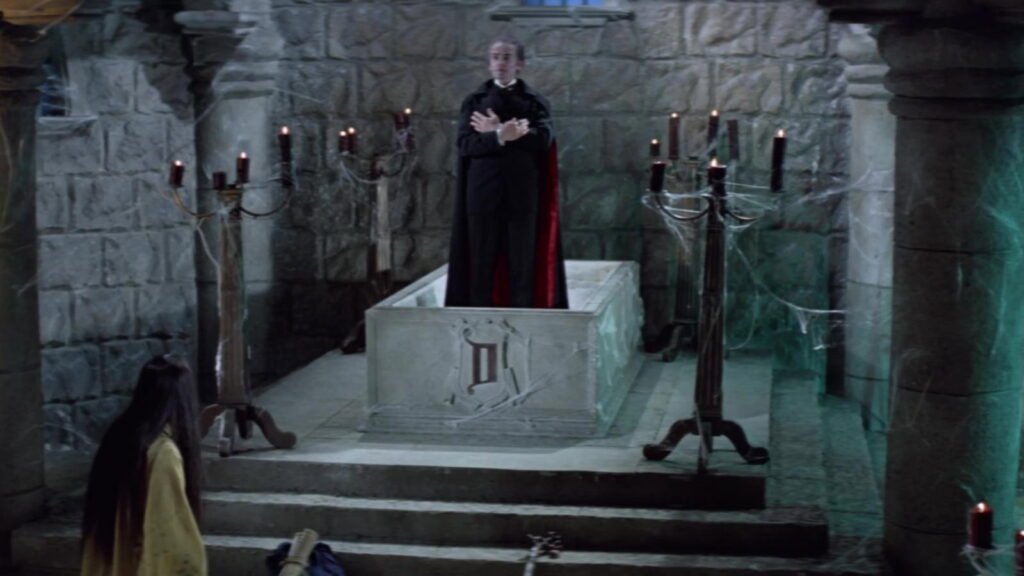
The Legend of the 7 Golden Vampires is Hammer’s ninth and final Dracula film — a 1974 Hong Kong kung fu horror co-production.
Every Dracula series has to end somewhere. Hammer’s ended in Hong Kong — with Peter Cushing holding the line, the Shaw Brothers supplying the fists, and the most famous vampire in film history played by a man who wasn’t Christopher Lee, speaking in a voice that wasn’t his own. If you’re settling in expecting the Count’s grand farewell tour, adjust the picture: this is a kung fu film that wanders into a vampire legend, a gamble two studios took together at the far end of the Gothic road. And somehow, that’s exactly why it still gets talked about.
Quick Specs
- Title: The Legend of the 7 Golden Vampires
- Year: 1974
- Director: Roy Ward Baker (additional martial-arts sequences directed, uncredited, by Chang Cheh)
- Screenplay: Don Houghton
- Producers: Don Houghton and Vee King Shaw
- Starring: Peter Cushing, David Chiang, Julie Ege, Robin Stewart, Shih Szu, Chan Shen, and John Forbes-Robertson as Count Dracula (Dracula’s voice: David de Keyser, uncredited)
- Music: James Bernard
- Cinematography: John Wilcox and Roy Ford
- Editor: Chris Barnes
- Art direction: Johnson Tsao
- Studios: Hammer Film Productions and Shaw Brothers Studio
- Released: 11 July 1974 (Hong Kong); 6 October 1974 (UK); June 1979 in the US, recut as The 7 Brothers Meet Dracula
- Running time: varies by version — about 110 minutes (Eastern version), 89 minutes (uncut), 83 minutes (UK theatrical cut), 75 minutes (US recut)
- Certificate: X (UK, 1974)
- Rotten Tomatoes: 50% from 6 reviews
The Count who isn’t Christopher Lee
Start with the correction, because everything else hangs on it: Christopher Lee is not in this film. His Hammer Dracula run ended with The Satanic Rites of Dracula (1973), the second of the two modern-day entries, and after those he refused to play the Count for Hammer again. The studio made one more Dracula film anyway.
The Count here is John Forbes-Robertson — the only actor other than Lee ever to play Dracula for Hammer. He is properly credited in the role; the uncredited performance is the voice, dubbed by David de Keyser. Forbes-Robertson had stood in for Lee at Hammer once before, as the Man in Black in The Vampire Lovers (1970), another part first offered to Lee. He was 46 when the film opened in Hong Kong, a Worthing-born stage actor — and no, despite what some obituaries said, he was not Sir Johnston Forbes-Robertson’s son; he was the grandson of one of Sir Johnston’s brothers.
Even then, you barely see him. Outside the 1804 prologue and the climax, Dracula spends the film inside the body of Kah, the Taoist high priest played by Chan Shen — so the villain of Hammer’s last Dracula picture is, for most of its running time, a presence wearing another man’s face. One more oddity for the shelf, as the series histories point out: it’s the only Hammer Dracula film whose title doesn’t name Dracula at all. The marketing knew better — the British posters sold Cushing’s Van Helsing against the Count, and when America finally got the film, the retitle put Dracula’s name straight back on it.
How Hammer ended up in Hong Kong
The film exists because of a family connection. Don Houghton had written the two modern-day entries, Dracula A.D. 1972 and The Satanic Rites of Dracula; his wife, the actress Pik-Sen Lim, had a father who knew Run Run Shaw. Houghton flew out to Hong Kong, and Run Run Shaw and his brother Runme agreed to finance half the film, Hammer the rest. This time Houghton produced as well as wrote, alongside Vee King Shaw.
The BFI’s Screenonline frames the gamble plainly: with the Gothic cycle “petering out,” Hammer “formed a pact with Hong Kong’s Shaw Brothers, masters of the then-flourishing martial arts movie market.” It was a pact, not a one-off — the same year, the two studios also made the action thriller Shatter together, again with Cushing. Shooting ran from 22 October to 11 December 1973 at Shaw Brothers Studio in Hong Kong, with mountain scenes on Kowloon Peak. Gordon Hessler was set to direct and left the production before shooting began; Roy Ward Baker — who had made The Vampire Lovers and Scars of Dracula for Hammer — took over.
The story
Transylvania, 1804. Kah, high priest of the Temple of the Seven Golden Vampires in rural China, begs his way into Castle Dracula: his cult’s power is fading, and he wants the Count to restore it. Dracula agrees — on his own terms. He displaces his spirit into Kah’s body, walks out of a castle that had become his prison, and leaves for China.
A century later, Professor Van Helsing is lecturing at a Chungking university on Chinese vampire legend. His set piece is a village terrorised by the Seven Golden Vampires, and the farmer Hsi Tien-en, who fought his way into their temple, tore the golden medallion — a vampire’s life source — from one of them, and died for it; a vampire that lunged for the medallion where it hung on a jade Buddha statue burst into flames. Six of the seven remain. The hall scoffs — except Hsi Ching. Tien-en was his grandfather, the village still suffers, and he has the medallion to prove the story. David Chiang, Shaw Brothers’ leading martial-arts star of the period, plays both men: Ching in the present, Tien-en in the legend.
Van Helsing signs on, travelling with his son Leyland, Ching, and Ching’s seven kung fu-trained siblings — six brothers and a sister, Hsi Mai Kwei. The money comes from Vanessa Buren, a wealthy widow the party rescued from a tong attack, who bankrolls the expedition and insists on coming along. Ambushed in a cave by three of the vampires and their undead army, the party destroys all three. At the half-ruined village they ring their ground with stakes and a fire trench and make their stand: two more vampires fall along with much of the undead host, and Vanessa — bitten and turned — bites Ching, who throws himself and her onto a stake, killing them both. The last vampire drags Mai Kwei to the temple to drain her; Leyland rides after it, and Van Helsing and the surviving brothers follow and destroy the final vampire at the altar. Alone, the professor senses the presence behind it all. Dracula, still wearing Kah’s form, is forced to reveal himself — and Van Helsing drives a silver spear through the Count’s heart, and the legend ends in dust.
Two directors, one credit
The director’s credit on the film is Roy Ward Baker’s, and Baker’s alone. The Shaw Brothers were unhappy with his handling of the picture and set up a second unit under Chang Cheh — the studio’s top action director, and Chiang’s mentor — to shoot additional martial-arts material, which took the Eastern version to about 110 minutes. Modern databases that list the two men as co-directors are following database convention, not the film’s credits: Chang Cheh’s work here is uncredited.
Baker never pretended otherwise — or pretended much at all. “The understanding was that they would do the kung-fu stuff and I would do the rest of it,” he said later, and his verdict on the result was blunter: “Terrible picture, but some of the Chinese were very nice. The leading man was David Chang, a nice man… the whole set-up was slip-shod, and nobody knew what anyone was doing… a failure, an absolute failure.” Hammer’s Michael Carreras was gentler — it “wasn’t such a good idea,” though “some of the film is quite good.” Even the plot’s central trick was a hand-me-down: Fellner’s history of the studio notes that Dracula assuming another man’s form was a device Houghton had first written for The Satanic Rites of Dracula and cut there. Here, it became the engine of the whole film.
Cushing’s last Van Helsing
Strip away the experiment and what remains is a farewell. This was Peter Cushing‘s fifth Hammer Dracula film as Van Helsing — after Dracula (1958), The Brides of Dracula (1960), Dracula A.D. 1972 and The Satanic Rites of Dracula — and his last performance in the role. He was 61 when the film opened in Hong Kong, and Graeme Clark’s verdict stands: Cushing, “in his last Hammer Dracula film, is as commanding as ever.”
The count needs one footnote, because Hammer counts are where arguments start. The series tally of nine includes The Brides of Dracula, in which Van Helsing hunts vampires but the Count himself never appears — and in Dracula A.D. 1972 Cushing played two Van Helsings, Lawrence in the prologue and his descendant Lorrimer in the modern day. Count films, not faces, and the numbers behave. What no counting changes: Lee and Cushing never faced each other in the series again after Satanic Rites. The finale belongs to Van Helsing — with Dracula a brief, borrowed presence at the edges of his own legend.
Four cuts of the same legend
Ask how long this film is and the honest answer is: which one did you watch? The Eastern version, with Chang Cheh’s extra fights, ran about 110 minutes. The uncut version familiar today runs 89. British cinemas in 1974 got an 83-minute cut under an X certificate. And America — America got a different film.
The picture sat without US distribution for five years. When Dynamite Entertainment finally released it in June 1979, it had been re-titled The 7 Brothers Meet Dracula, stripped of some twenty minutes, its remaining scenes looped to pad the length and its structure reordered. It is a recut of this film, not a sequel — and nothing about it, not its plot details, its length or its reputation, belongs on this film’s record; other titles, The Seven Brothers Meet Dracula and Dracula and the 7 Golden Vampires, have circulated for it too. The original did no better at home: by every account it was a financial failure, not a box office success. No verified budget or gross figures survive to put a number on that, and any database offering one is guessing. Home video was kinder — the 1998 Roan Group LaserDisc and the Anchor Bay DVD each carried both versions, and in April 2019 a 2K restoration of the uncut film reached Blu-ray from Scream Factory.
The verdicts
The notices in 1974 were rough but not empty. The Times allowed that the film “would be tedious if it were not for the distinguished presence of Peter Cushing as a Dracula-hunter and for some advanced exercises in the practice of vampire disintegration.” Cinema TV Today sighed that “it is a pity that this blend of two popular genres could not have been more carefully thought out.” Verina Glaessner, in the Monthly Film Bulletin, landed the phrase that stuck: a “fascinating failure,” split between “an equivocal attitude towards its subject” and “a misunderstanding of the role that hand-to-hand combat plays in Chinese films.”
Time has been warmer. Keith Phipps called it “flawed” but “enjoyable,” adding that it’s “pretty much as ridiculous as it sounds.” Peter Dendle, in The Zombie Movie Encyclopedia, singled out the raising of the undead army as “one of the most visually spectacular in zombie cinema,” and Glenn Kay called the film “boisterous, action-packed, and very likeable.” Matt Brunson’s summary may be the fairest headstone: “an entertaining — if not particularly distinguished — way in which to put the final nail in Hammer Films’ long-running Dracula franchise.” On Rotten Tomatoes it stands at 50% from six reviews — a small jury, and a split one, which feels about right for a film that tried to end Dracula with a flying kick.
Endings matter. Hammer’s Dracula didn’t go out in triumph or in whimper — he went out in somebody else’s body, in somebody else’s voice, on the far side of the world, while Peter Cushing closed the book on the role that made him. As finales go, it’s the strangest one the series could have had. It might also be the most honest.