
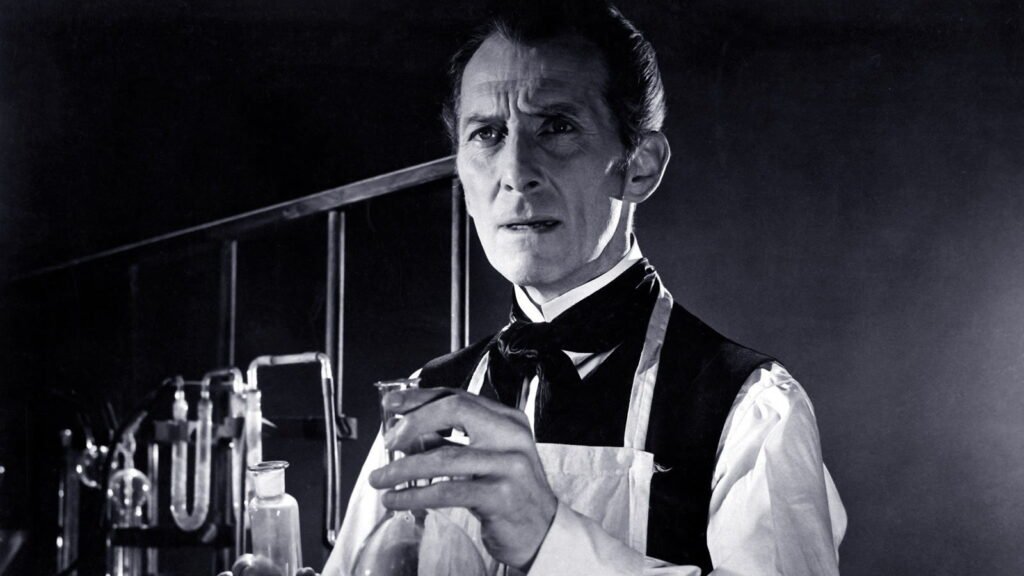
Frankenstein Must Be Destroyed (1969) is the fifth Hammer Frankenstein film, the one where Peter Cushing’s Baron stops being the hero of his own story. For four films the Baron had been the engine — arrogant, brilliant, always one step ahead of the rope. Here the charm is gone. What’s left is a man who opens the picture carrying a severed head in a bucket, blackmails two young lovers into helping him steal a brain, and ends it screaming in a burning house. If you’ve only ever met the cuddly mad scientist of the poster art, sit down. This is the entry where Hammer lets its Baron be the monster outright — and where everybody involved knew exactly how dark it was getting.
Quick Specs
- Title: Frankenstein Must Be Destroyed
- Year: 1969
- Studio: Hammer Film Productions
- Director: Terence Fisher
- Screenplay: Bert Batt, from a story by Anthony Nelson Keys and Bert Batt
- Producer: Anthony Nelson Keys
- Cinematography: Arthur Grant
- Editor: Gordon Hales
- Music: James Bernard
- Cast: Peter Cushing (Baron Victor Frankenstein), Veronica Carlson (Anna Spengler), Simon Ward (Dr Karl Holst), Freddie Jones (Professor Richter), George Pravda (Dr Frederick Brandt), Maxine Audley (Ella Brandt), Thorley Walters (Inspector Frisch)
- Running time: About 101 minutes (listings vary between 97 and 101 by version and territory)
- UK release: 1969 — dated 22 May in some listings, 8 June in others; the record conflicts and this page does not pretend otherwise
- US release: 11 February 1970, through Warner Bros.–Seven Arts
- Series: The fifth of Hammer’s seven Frankenstein films
A head in a bucket
The film starts with a murder and a housebreaking, and they’re the same evening’s work. A masked man takes Dr Heidecke’s head off outside his own house while, across town, a burglar is helping himself inside an underground laboratory. The masked man comes home carrying the head, fights the burglar hand to hand, and unmasks: Baron Victor Frankenstein. The burglar runs straight to Inspector Frisch with a story nobody would believe if the headless body hadn’t just been found.
The Baron is in town under the name Mr Fenner, lodging at Anna Spengler’s boarding house, and he has come for one thing. His former collaborator Dr Frederick Brandt is locked in the local asylum, driven insane by his own research — research that produced a method of transplanting and preserving the brain, a secret the Baron means to have at any price. Anna’s fiancé, Dr Karl Holst, works at that asylum. Karl also steals narcotics to pay for treatment for Anna’s ailing mother, and the moment the Baron learns it, the young couple belong to him.
What follows is blackmail with a body count. Raiding a warehouse for equipment, Karl is caught by the night watchman and panics and stabs him — handing the Baron a murder to hold over him forever. The couple help kidnap Brandt from the asylum, and a laboratory goes up in the boarding-house cellar.
Then Brandt suffers a heart attack, and the Baron does the arithmetic out loud: the brain is the prize, so the brain gets a new home. He and Karl kidnap the asylum’s administrator, Professor Richter, and transplant Brandt’s brain into Richter’s body. Brandt’s own body is buried in the garden, where a burst water main nearly gives the whole game away. Brandt’s widow Ella recognises the Baron in the street, confronts him, and goes to Frisch when he won’t let her see her husband. As the police close in, the party flees to a deserted manor — where the man with Brandt’s mind wakes up, sees a stranger’s face in the glass, and understands what has been done to him.
The Baron at his worst
Peter Cushing was 55 when the film opened, playing the Baron for the fifth time, and nothing about the performance reaches for your sympathy. Reviewers have been reaching for the same word ever since. ReviewFocus calls this “by far the darkest of the Hammer Frankenstein series, and the best.” Surgeons of Horror says Cushing “delivers his darkest turn as Baron Frankenstein.” Warner’s own DVD copy sold it as “his most cold-blooded portrayal of the mad Baron in his fifth turn.” One Hammer history puts it without any varnish at all: in this film Frankenstein “is the real Monster.”
Hold those as attributed judgements rather than gospel — but notice the pattern. Across independent reviewers, across fifty years, nobody describes this Baron as misunderstood. He murders, he blackmails, he buries a body in a landlady’s garden and eats her dinners upstairs. The horror of the earlier films was what the Baron made. The horror here is the Baron.
A sane mind in a stranger’s face
Which brings us to the performance that breaks your heart in the middle of all that cruelty. Freddie Jones plays Professor Richter — and get the billing right, because the whole tragedy lives in it. Richter is not a creature the Baron built. He is the asylum’s administrator, a man with a life and a face of his own, whose body receives the transplanted brain of Dr Frederick Brandt. Brandt’s body dies after the operation. Brandt’s mind — sane again, cured — wakes inside Richter.
So the film’s “monster” is a healthy man imprisoned in a body its owner never consented to give up, married to a wife who cannot see him in it. He reaches his old home and speaks to Ella from behind a screen before he lets her look at him, and it changes nothing: she cannot accept this stranger as her husband, and he loves her enough to let her go. Then he soaks the house in paraffin and waits for the Baron to come for Brandt’s papers. Karl follows and fights the Baron; the transplanted man knocks Karl out, picks up the screaming Baron, and carries him into the fire he has lit — creator and creation going into the flames together, both presumably dead. One Hammer history calls it maybe the best handled of Hammer’s climactic conflagrations. It is certainly the only one that plays as an execution and a mercy at the same time.
Made at Elstree, patched as it went
The film was shot at Elstree — Hammer had left Bray Studios behind by this point — with location work at Stanmore Hall in Middlesex, the house the party flees to. Bernard Robinson designed it; one production history notes it was the last Hammer film he designed. James Bernard scored it, Arthur Grant shot it, and Terence Fisher directed — his fifth Frankenstein, a point worth making precisely because a good source gets it wrong: the Radio Times Guide calls this Fisher’s fourth in the series. Count them. He had already directed the previous four.
The script was still moving while the cameras were. Bert Batt’s screenplay came from a story by Batt and producer Anthony Nelson Keys; one production history adds that Anthony Hinds began a version in 1967 that Batt and Keys discarded wholesale. And Inspector Frisch — Thorley Walters, one S in the middle, however often you see it spelled otherwise — wasn’t in the original conception at all. Frisch and Geoffrey Bayldon’s police doctor were late additions, written in during shooting by that same account, and critics have called the Frisch scenes unnecessary comic relief that lengthens the film — a judgement worth carrying next to the fact, because the scenes do sit oddly against a picture this humourless. Hammer’s continuity was always loose, too: the Baron’s scarred hands from the previous film are whole again here, and his history with Brandt implies a backstory the earlier films never contained. Same Baron, same actor, same cold centre — never a chapter in a tight saga.
The scene that was never in the script
Now the part of this film’s history that has to be told straight, because it is too often told blurred. The night before the transplant, the Baron enters Anna’s room and rapes her. The film never mentions it again — not one line, not one look. That silence exists because the scene was never meant to be there.
It was not in Bert Batt’s original script. It was added at the insistence of James Carreras — Hammer’s chief, named, not “the studio” and not his son Michael — who was under pressure from the American distributors, Warner Bros.–Seven Arts, to give the film more sex. It was filmed over the objections of Peter Cushing, of Veronica Carlson, and of Terence Fisher. Fisher halted the scene when he judged enough had been shot; one production history adds that he stormed off the set. Every solid account of this film agrees on those bones, and this page prints them in that form, because softening who demanded the scene — or who tried to stop it — would be its own kind of lie.
What happened to the scene afterwards is a genuinely open question, and it stays open here. It was omitted entirely from the US theatrical release; that much is agreed. Horror Cult Films holds that it remained in the UK theatrical version, with the BBFC requiring only the shortening of a couple of shots and sound effects from the brain-transplant sequence. Derek Winnert states flatly that “the BBFC cut the rape of Anna and shots and sounds of sawing during the brain operation (now restored).” Those two accounts cannot both be wholly right. What they agree on is this: the transplant-sequence material was cut by the BBFC, and the assault scene was reinstated for the 1989 UK video release. The Board’s own 1969 record would settle the rest, and until it is pulled, both accounts stand on this page, side by side, unresolved.
Two dates, four runtimes
Even the plain facts of release arrive with an argument attached. The US date is settled — 11 February 1970, through Warner Bros.–Seven Arts, without the assault scene. The UK date is not: 22 May 1969, carried by IMDb’s date line, Classic Monsters and a 1969 UK release calendar, against 8 June 1969, from Tom Johnson’s Hammer filmography. Whether one was a première and the other the general release, no source on record says, so both stand here too.
The running time is the same story told four ways: 101 minutes in Johnson’s filmography and the Hammer histories; 97 from Winnert, FilmAffinity and Rotten Tomatoes’ listing; an older reference splitting it 98 in the UK and 101 in the US; the Warner DVD print measured at 100 minutes 33 seconds, with a UK DVD listing’s 96 consistent with PAL speedup of a roughly 100-minute master. This page prints “about 101” and shows its working. Money gets the same honesty: the one budget figure in circulation, £186,331, traces to a single source — Wayne Kinsey’s Hammer history — and no verified gross surfaced at all, so neither appears here as fact.
One last release oddity, because it deserves its immortality: in 1978, HTV Cymru/Wales broadcast a Welsh-language dub, Rhaid Dinistrio Frankenstein, and it was rebroadcast on S4C’s launch in 1982. The Baron’s darkest hour, dubbed into Welsh. Somewhere out there is a viewer whose first Frankenstein was that broadcast, and honestly, what an introduction.
What the critics said
Variety, in June 1969, called it “a good-enough example of its low-key type, with artwork rather better than usual… a minimum of artless dialogue, good lensing by Arthur Grant and a solid all round cast.” The Monthly Film Bulletin went warmer: “the most spirited Hammer horror in some time. The crudities still remain, of course, but the talk of transplants and drugs seem to have injected new life into the continuing story of Baron Frankenstein.” Leslie Halliwell, later, landed the film’s whole tone in one line: “Spirited but decidedly unpleasant addition to the cycle, made more so by a genuine note of pathos.”
The modern verdict has mostly climbed. The Radio Times Guide gives it 3/5, “graced by an incisive performance from Peter Cushing,” and calls Freddie Jones “astonishing as the anguished victim of the transplant, whose wife fails to recognise him and rejects him, prompting a revenge plan.” Time Out says Fisher “taps a rich vein of Romanticism here, making this the high point of a series that afterwards degenerated into the sloppy self-parody of Jimmy Sangster’s The Horror of Frankenstein.” Joshua Vasquez, writing in Slant Magazine, scores it 3.5/4: “One of the finest of the seven entries in Hammer’s Frankenstein cycle.” Dennis Schwartz goes furthest of all: “Hammer’s fifth of seven Frankenstein films might be the best one in the series,” with “the bad Baron at his most craven, ruthless and sexually perverse.” On Rotten Tomatoes the film holds a 70% Tomatometer from 10 reviews, as last checked. And the dissent stands on the record too — Matt Brunson calls it “might be the worst picture in Hammer’s entire Frankenstein cycle,” at 2/4. Read the film, then pick your side.
The fifth of seven
Hammer made seven Frankenstein films, and this is the hinge the whole series swings on. It began with The Curse of Frankenstein (1957) and The Revenge of Frankenstein (1958), returned with The Evil of Frankenstein (1964) and Frankenstein Created Woman (1967), and arrives here in 1969 with the Baron played as outright villain. After it, the series handed the role to Ralph Bates for The Horror of Frankenstein (1970) — the one Hammer Frankenstein Cushing sat out — before Fisher and Cushing reunited for the last of the seven, Frankenstein and the Monster from Hell (1974). Fisher directed every entry except the Bates film: six of seven, with this as his fifth.
So put it where it belongs. Not the cosiest Hammer Frankenstein, not the most famous — the darkest, the bleakest, and the one where the series finally admits the thing it had been circling since 1957: the man in the title was always the Baron. The creation just kept taking the blame for him.