
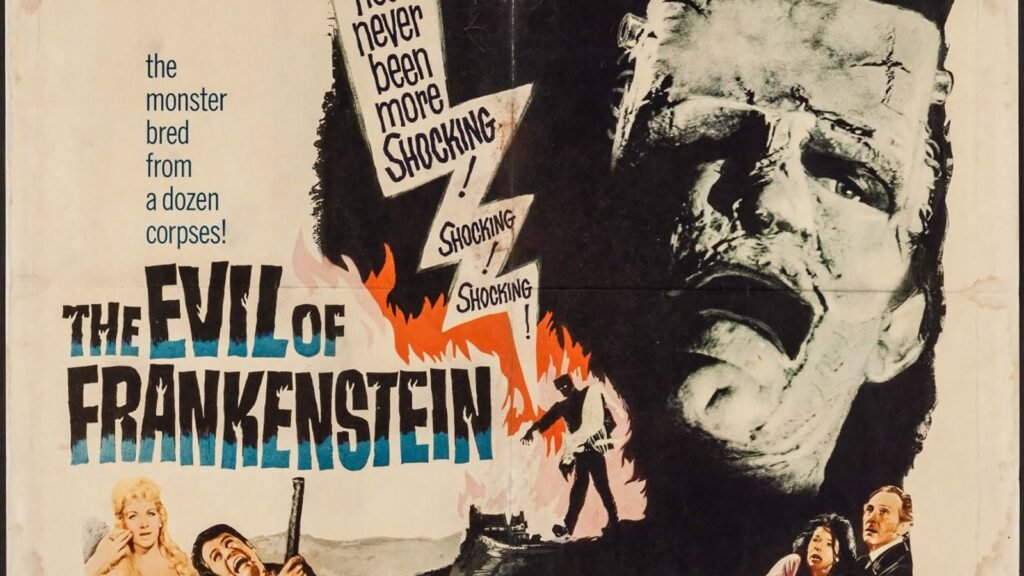
The Evil of Frankenstein (1964) is the third Hammer Frankenstein film, the one where a Universal deal lets the Creature wear Karloff’s face. Sit with that a second, because everything strange about this movie flows out of it. Hammer built its Frankenstein series by running away from Universal — new Baron, new monster, new rules. Then, three films in, the studio signed a distribution deal with the very people it had been dodging, and suddenly the flat head was legal. So this is the Hammer Frankenstein that behaves like a Universal one: a colour remake of somebody else’s classic, wearing the series’ clothes, telling the Baron’s story over again from the beginning as if the first two films never happened. It is the odd one out in Cushing’s run — and precisely because of that, it might be the most revealing film Hammer ever made about itself.
Quick Specs
Title: The Evil of Frankenstein
Year: 1964
Country / Language: United Kingdom; English (colour)
Director: Freddie Francis
Screenplay: Anthony Hinds, credited as John Elder
Producer: Anthony Hinds
Starring: Peter Cushing, Peter Woodthorpe, Duncan Lamont, Sandor Elès, Katy Wild, Kiwi Kingston
Cinematography: John Wilcox
Editor: James Needs
Music: Don Banks
Make-up: Roy Ashton
Production company: Hammer Film Productions
Distributed by: Rank Film Distributors (UK); Universal Pictures (US)
Released: 8 May 1964 (US); 31 May 1964 (UK)
Running time: 84 minutes
Series position: Third Hammer Frankenstein film, after The Curse of Frankenstein (1957) and The Revenge of Frankenstein (1958)
The Baron comes home broke
Ten years after Karlstaad drove him out, Baron Victor Frankenstein is working in secret in another town when it all collapses in a single night: his body-snatcher is caught stealing a corpse, and a priest smashes up his makeshift laboratory. Penniless, the Baron and his assistant Hans head for the one place with anything left to sell — Karlstaad, and the family chateau.
The chateau turns out to have been stripped bare, and not by strangers. The town authorities looted it themselves; the Burgomaster is wearing the Baron’s own ring. Frankenstein confronts him in the middle of the carnival crowds, is recognised, and has to run — covered, in the scuffle, by a fairground hypnotist named Zoltan, who is busy brawling with the police himself. A deaf-mute beggar girl, Rena, leads the fugitives up into the mountains, to a cave.
And in the cave, frozen in the ice, is the Baron’s first Creature.
Thawed out and revived back at the chateau, the Creature’s body lives — but its brain will not answer. That is the problem the whole film hangs on, and the Baron solves it the way desperate men do: he hires the one person in Karlstaad who works on minds. Zoltan the hypnotist wakes the Creature’s brain. He also discovers, very quickly, that the Creature now answers to him alone.
The hypnotist holding the leash
Understand who Zoltan is, because the film’s engine depends on it. He is not a professor, not a scientist, not a colleague. He is a carnival mesmerist with a grudge: Karlstaad threw him out years before for working without a licence, and now the town’s greatest creation takes its orders from his voice. So he uses it. The Creature robs for him, and settles his scores — the Burgomaster and the Chief of Police are terrorised in their own homes, and the Burgomaster is battered to death.
Meanwhile the Creature forms the film’s one gentle bond: with Rena, the only person who is kind to it. It is the oldest Frankenstein idea there is — the monster is never the worst thing in the room — and this film states it plainly. The Baron made a creature. Zoltan made it a weapon. There’s your evil of Frankenstein, and it isn’t the flat head.
The end comes fast. The Baron throws Zoltan out; Zoltan orders the Creature to kill its maker; the Creature kills Zoltan instead. Rampaging through the laboratory, it drinks from the wrong bottle, and in its agony knocks the apparatus over and sets the place ablaze. Hans escapes with Rena. The laboratory explodes, and the whole section of the chateau topples off the cliff — killing the Baron and the Creature together. This film ends with Victor Frankenstein dead. Remember that. The series didn’t.
A reboot wearing the series’ clothes
Here is the thing nobody warned 1964 audiences about: this film does not continue the story. Not even slightly.
In The Revenge of Frankenstein, the Baron cheated the guillotine, took a new name and set up practice in Carlsbrunn. This film ignores every word of that. Its flashback retells the Baron’s history in a completely different version: a first creation that rampaged, was shot by its pursuers and ended up frozen in a mountain cave — a back-story lifted from Universal’s Frankenstein Meets the Wolf Man (1943). Denis Meikle’s verdict has become the standard one: “Any pretext of a connection to The Revenge of Frankenstein is dispensed with in a brazen display of contempt for continuity.”
And then, having killed the Baron outright at the end, the series simply carried on — Frankenstein Created Woman (1967) resumes with him alive, no explanation offered or, by then, expected. The Hammer history books are blunt about this film’s legacy: it permanently breaks the chronological continuity of the series. Watch it as a sequel and it will drive you mad. Watch it as what it is — a reboot that arrived decades before Hollywood admitted reboots existed — and it settles into its own strange shape.
Karloff’s face, by licence
So why does the Creature suddenly look like that?
Hammer’s first two Frankenstein films had deliberately kept their distance from Jack Pierce’s Universal monster — the flat head, the heavy-lidded eyes, the whole silhouette Pierce designed for Boris Karloff — because that look belonged to Universal, and borrowing it meant lawyers. What changed was a deal: under Hammer’s new distribution arrangement with Universal, which financed and distributed this film in the US, Hammer had free rein to duplicate Pierce’s make-up and Universal-style laboratory hardware. Roy Ashton, who took over the make-up chair for this film, delivered a Creature that is a close approximation of Karloff’s — by permission, on purpose, as part of the arrangement.
That distinction matters. This is not Hammer caught copying, and it is not Pierce’s own work — it is Ashton’s licensed homage, and it makes the film a genuine historical curiosity: the one moment the two great Frankenstein traditions, Universal’s and Hammer’s, were allowed to occupy the same face. Compare it with The Curse of Frankenstein, where Christopher Lee’s Creature had to be invented from scratch precisely because this door was closed.
Cushing, a wrestler, and a beggar girl
Peter Cushing was 50 years old when he shot this, his third outing as the Baron, and he plays him as a man running out of money, allies and road — the charm is still there, but it has a hunted edge now. Around him: Peter Woodthorpe as Zoltan, all carnival oil and spite; Duncan Lamont as Karlstaad’s Chief of Police; David Hutcheson as the Burgomaster wearing stolen property on his hand; Sandor Elès as Hans, the loyal, unquestioning assistant — this film’s Hans, a new man, nobody carried over from the earlier pictures.
The Creature is played by Ernest “Kiwi” Kingston — a New Zealand-born professional wrestler who worked the European circuit, sometimes under the ring name “The Great Karloff,” which tells you the wrestling business understood this film’s marketing before the film did. He is not Christopher Lee; Lee wore the bandages in Curse and does not appear here. And Katy Wild plays Rena, the deaf-mute beggar girl — the film gives her no voice and no romance, just the Creature’s trust, which in a Frankenstein picture is worth more than either.
Behind the camera: the Oscar winner in Fisher’s chair
The director’s chair is the other famous switch. Terence Fisher, who had directed both Curse and Revenge, was slated to direct this one and could not; contemporary review accounts say a car accident ruled him out, though at least one Hammer fan history says illness — the reason is told more than one way, so take the accident as the reviews’ version, not gospel. What is certain is who replaced him: Freddie Francis, who had directed Paranoiac for Hammer the year before, and who arrived with a cinematographer’s pedigree nobody at Bray could match. Francis had already won the Academy Award for Best Black-and-White Cinematography for Sons and Lovers (1960). His second Oscar, for Glory, was still a quarter-century away — in 1964 he was a cameraman rebuilding himself as a director, and this film is part of that rebuild. The result is a trivia point that holds up: of the six Frankenstein films Cushing made, this is the only one Fisher did not direct.
The screenplay carries its own doubling. It is credited to “John Elder,” which is not a second writer — it is the pen name of Anthony Hinds, the film’s producer, Hammer’s in-house architect writing under his usual alias. Behind the script sits older material again: it descends from work prepared for Hammer’s aborted 1958 Tales of Frankenstein television series. Whose synopsis, exactly, is where the accounts part company — one version credits a story Peter Bryan submitted in May 1958, another traces it to a television episode called “The Hypnotist” — so the 1958 origin is the fact, and the byline underneath it stays disputed.
Production ran from 14 October to 16 November 1963 at Bray Studios in Windsor, with location work at Black Park Country Park in Buckinghamshire — the classic Hammer arrangement of a permanent home lot and one good stretch of gloomy trees. The film was made during Hammer’s six-year co-production pact with Columbia Pictures, the arrangement that brought a few Universal productions a year; by the standard Hammer encyclopedia’s account, this was the only film Universal financed for Hammer in 1963. That same encyclopedia gives the budget as £130,000 — a figure carried here as its author’s number, since no second source stands behind it, and no verified box-office gross for this film survives at all. Anybody who quotes you one is inventing it.
The version American television made longer
American viewers who met this film on TV met a slightly different animal. Universal shot additional scenes on 14 January 1966 at its Los Angeles studios — a new subplot built around Steven Geray, Maria Palmer and William Phipps, playing Rena’s parents and a doctor drawn into the story — purely to pad the running time for broadcast. None of those actors is in the 1964 film; their material exists only in the television version, which runs about 86 minutes against the theatrical film’s 84, and which reached American screens on NBC’s Saturday Night at the Movies on 2 January 1968. So if you remember this movie being longer, slower and stranger around the edges than the version in the box set, you are not misremembering. You saw the padded one.
What the critics said
The notices in 1964 were lukewarm with flashes of real respect. Critic Howard Thompson caught the film’s split personality in one breath: “For the first half, the latest Frankenstein go-round has a succinct pull and a curious dignity… the picture begins to say something about superstition and hypocrisy. Then it simply goes hog-wild (monster gets drunk) and heads for the ash heap.” The trade press found the direction deft enough over the preposterous patches and allowed there was always something going on, while noting the dialogue sometimes drew the wrong kind of laugh. The British monthly bulletin welcomed the monster’s return to tradition — a close approximation of Karloff’s celebrated make-up, the laboratory gear as photogenic as ever — and then called the rest of the film sadly tatty, its Bavarian village hopelessly stagey.
Posterity has been rougher, though not unanimous. AllMovie’s retrospective verdict is the harsh one that gets quoted: “dismal,” and “the worst of Hammer Films’ Frankenstein series.” Other later voices push back, calling it a much livelier affair than the derision it collects would suggest. Both camps are really arguing about the same film: a beautifully mounted oddity whose script restarts a series that didn’t need restarting. Harper’s ruling, for what it’s worth: the weakest of Cushing’s run, yes — but a weak Cushing Frankenstein still has Cushing, that laboratory, and a hypnotist stealing scenes with a monster on a leash. There are worse ways to spend 84 minutes, and the series has offered some of them.
Where it sits in the series
The line runs like this. The Curse of Frankenstein (1957) started it — Fisher directing, Cushing’s Baron, Lee’s Creature. The Revenge of Frankenstein (1958) followed, ending with the Baron’s brain transplanted into a new body in London — the ending this film cheerfully ignores. The Evil of Frankenstein (1964) is third, and the break point. After it: Frankenstein Created Woman (1967), with Fisher back and the Baron simply alive again; Frankenstein Must Be Destroyed (1969); The Horror of Frankenstein (1970), the one entry without Cushing; and Frankenstein and the Monster from Hell (1974), which closed the series.
The film itself is easy to find in good shape now: a UK Blu-ray from Final Cut Entertainment (2013, carrying a BBFC 12 certificate), a US Blu-ray from Shout Factory’s Scream Factory line (2020), and an earlier appearance in Universal’s 2005 Hammer Horror Series DVD set. Watch the theatrical cut. Then, if you can find it, watch the American television version back to back — same Baron, same Creature, two different movies, and the whole strange story of this production hiding in the difference.