
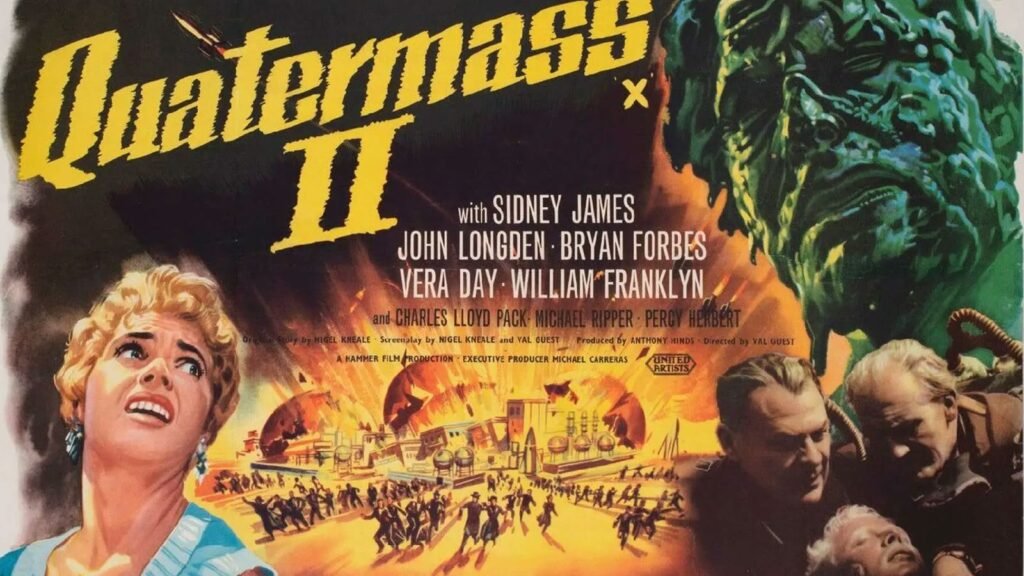
Quatermass 2 is Hammer’s 1957 science-fiction sequel, credited as the first film sequel to carry a number in its title. Professor Bernard Quatermass is losing his fight for the money to build a Moon colony when the sky starts dropping stones on one small patch of England: hundreds of meteorites, every one of them falling around Winnerden Flats, where somebody has built an enormous secret complex to the Professor’s own blueprints. In America it played as Enemy from Space. At home it played as something colder — an invasion that arrives by memorandum, wears a uniform, and stamps its victims with a V.
Stay with that number a moment, because it is doing more work than any monster in the picture. Sequels in 1957 did not count out loud. They came back as a son of, a bride of, a returns — anything but an admission that this was the same goods a second time. Hammer simply wrote a 2 on it and, in one stroke of type, invented the way every franchise on Earth now introduces itself. Then the film underneath the number turned out to be the bleakest thing the studio had yet made: a conspiracy picture in which the enemy has already won the paperwork.
Quick Specs
- Title: Quatermass 2 (UK posters stylised it Quatermass II)
- US title: Enemy from Space
- Year: 1957
- Studio: Hammer Film Productions
- Director: Val Guest
- Screenplay: Nigel Kneale and Val Guest
- Based on: Quatermass II (1955), the six-part BBC Television serial by Nigel Kneale
- Producer: Anthony Hinds
- Starring: Brian Donlevy, John Longden, Sid James, Bryan Forbes, Vera Day, William Franklyn
- Cinematography: Gerald Gibbs
- Editor: James Needs
- Music: James Bernard
- Production design: Bernard Robinson
- Running time: 85 minutes
- Certificate: ‘X’ (original BBFC classification)
- Première: 24 May 1957, London Pavilion · UK general release 17 June 1957 · US release September 1957
- Distributors: Exclusive Films (UK); United Artists (US)
- Budget: unsettled — £92,000 and £117,731 both circulate from scholarly sources, and Guest himself later quoted £90,000; no single figure is agreed
First, the number
The claim needs its hedge kept on, so here it is with the hedge: Quatermass 2 is credited as the first film sequel to carry a number in its title — far from the first movie sequel ever produced, but apparently the first to use a plain “2” to announce the fact. What it was not is Hammer‘s first sequel, whatever the shorthand histories say. The studio’s Dick Barton pictures had already formed a series across 1948–50, and Guest himself had directed The Lyons in Paris (1955), the sequel to Life with the Lyons, for Hammer two years before this film. The genuine first is narrower and better: the numbered title itself. And the number carries a double meaning, because Quatermass 2 is also the name of the Professor’s atomic rocket — the machine the whole climax turns on.
Stones over Winnerden Flats
Quatermass’s Moon project is starved of government backing when the reports come in: meteorites, hundreds of them, falling only around Winnerden Flats. He drives out with his assistant Marsh and finds a huge complex under construction — built, to his own lunar-colony designs. Marsh picks up an intact meteorite, a small stone rocket, and it cracks open in his hands: gas, and a V-shaped mark burned into his face. Then the guards arrive — machine guns, and the same V on their own faces — and Marsh is taken while Quatermass is driven off the land.
An MP, Vincent Broadhead, is already probing the secrecy around the plant and takes Quatermass in on an official tour. The complex, they are told, manufactures synthetic food. Broadhead slips inside one of the great domes and is found dying, covered in a corrosive black slime, with just enough left in him to warn Quatermass what the domes really hold. The “food” is a cover story. The domes recreate an alien atmosphere and incubate the creatures themselves: ammonia-breathing beings from a moon of Saturn, arriving inside the meteorites, taking over human minds and leaving the V-mark on the skin of the taken. And the takeover has reach — when Inspector Lomax carries the warning upward, the Commissioner of Police himself is wearing the mark.
Journalist Jimmy Hall is shot dead by plant guards at the telephone, mid-sentence, as he phones the story in. When a meteorite crashes through the community centre roof and marks Sheila, the barmaid, the locals stop asking questions: the mob storms the complex and barricades itself into the pressure control room with Quatermass and Lomax. Quatermass’s counterattack is the film’s coldest idea. The creatures live on ammonia, hydrogen and methane — and oxygen is a deadly poison to them. He floods the domes with pure oxygen. Out at the rocket base, the marked guards attack; Brand is shot, but with his last strength he fires the unmanned atomic rocket at the aliens’ near-Earth asteroid. The creatures merge into three 150-foot masses that burst out of the domes — and with their base destroyed and Earth’s own air flooding in, the giants collapse and die. The marks fade from the controlled, who remember nothing. Lomax doubts he can write a believable report. Quatermass doubts how final it can be.
The serial television built first
The film adapts Nigel Kneale’s second Quatermass serial — Quatermass II, with the Roman numerals, which belong to television; the film’s catalogue title keeps the Arabic 2. Six half-hour episodes went out live from Lime Grove Studios on Saturday nights, 22 October to 26 November 1955, produced and directed by Rudolph Cartier: “The Bolts,” “The Mark,” “The Food,” “The Coming,” “The Frenzy,” “The Destroyers.” The BBC had commissioned it in early 1955 as a weapon against the brand-new ITV network, and Kneale wrote it as a deliberate sequel. Its pre-filmed location inserts, shot at the Shell Haven refinery, were the most ambitious yet attempted in British television drama.
The serial’s Quatermass was John Robinson — a replacement at terribly short notice. Reginald Tate, who had played the Professor in 1953, collapsed and died on 23 August 1955, weeks before location filming began. And unlike the 1953 serial, of which only two episodes remain, Quatermass II survives whole: all six episodes were telerecorded and sit in the BBC archives, the oldest Quatermass serial to survive in its entirety. Hammer, meanwhile, had bought the film rights from the scripts alone, before the serial was even made or transmitted — the reverse of the usual wait-and-see, and a measure of what The Quatermass Xperiment had done for the studio two years earlier.
This time, Kneale holds the pen
Here is the sequel’s quiet reversal, and it is the real story of the production. On the first film, Kneale had been shut out entirely. This time he pressured the BBC — in the last months of his staff contract — and was allowed in: he wrote the first draft himself, with producer Anthony Hinds’s input. Then Guest took the script and tailored it, by his own cheerful account: “lots of philosophising… too long, it would not have held screenwise. So, again, I had to tailor it and sharpen it and hopefully not ruin it.” The result is a condensed but largely faithful retelling — the Winnerden Flats plant, the marked takeover, Broadhead’s slime death, the workers’ assault and the oxygen gambit all survive the crossing.
What the film drops, it drops decisively. Quatermass’s daughter Paula and his assistant Leo Pugh, both serial people, are gone — the new character Brand absorbs part of Pugh’s function. Lomax and Marsh run the other way: they are carried over from the first film, having never been in this serial at all, and Sheila the barmaid is invented for the screen. The serial’s sister plants in Brazil and Siberia go unmentioned. One serial scene never stood a chance: a Winnerden Flats guard murdering a picnicking family was the BBFC’s main objection when the script was submitted in April 1956, and it was struck out at script stage — it exists on television, and was never in the film at all. And the climax is rebuilt. On television, Quatermass and Pugh fly the rocket to the asteroid themselves. In the film, nobody flies: the dying Brand fires it unmanned. Kneale, for the record, still disliked the finished film — mainly, this time, because of the one thing his script could not change.
The deal that remade Hammer
That one thing was Brian Donlevy, and his return was not Hammer’s free choice. Where the first film’s American partner had been an independent co-producer, this time Hammer pre-sold the US rights to United Artists — the first time the studio had ever pre-sold a film to a major American distributor — and the advance bankrolled a much bigger budget, with Donlevy’s return built into the arrangement. The pre-sale model became the norm for Hammer afterwards, and it eventually led to the winding-down of the studio’s own distribution arm, Exclusive Films, in the mid-1960s. As for what the film actually cost, the record refuses to settle: £92,000 and £117,731 both circulate from named scholarly sources, and Guest himself later quoted £90,000. This page prints the disagreement rather than a winner — anyone who gives you one tidy figure for this budget is tidier than the evidence.
Oil, concrete and matte paint
Filming ran 28 May to 13 July 1956, at Bray Studios and on Stages 2 and 5 of New Elstree — the first Hammer production to shoot there. The Winnerden Flats complex is the Shell oil refinery at Shell Haven, on the Thames Estuary, the same refinery where the serial’s location inserts had been filmed; Les Bowie’s matte paintings added the domes. Guest staged the climactic gun battle inside the working refinery, where for some scenes a clockwork camera had to be used because electrical sparks were too dangerous. Hemel Hempstead, the real new town then rising, doubled for the fictional Winnerden Flats new town; there was location work in Trafalgar Square and the House of Lords foyer, and the climactic hurricane was shot on the South Downs near Brighton. Guest shot for realism throughout — cinéma-vérité technique, hand-held cameras, meticulous daily storyboards — with Gerald Gibbs’s moody, overcast photography and extensive day-for-night on the climax. Behind the camera, a piece of Hammer’s future was quietly installed: production designer Bernard Robinson, on his first film for the studio, on his way to becoming its regular designer.
Recasts, misspellings and one running argument
Donlevy, 56 at the première, remains the only actor to play Quatermass in two films — on television the part had already passed from Tate to Robinson, and on film it would pass to Andrew Keir a decade later. Around him, the sequel shuffles its familiar faces. Inspector Lomax is recast: Jack Warner, the first film’s Lomax, was unavailable — his theatre schedule conflicted — and John Longden took the role, only for the film’s own credits to misspell him as “John Longdon.” Kneale greatly preferred Longden’s authoritative Lomax to Warner’s “breezy sergeant.” Sid James plays Jimmy Hall, the film’s softened version of the serial’s journalist Hugh Conrad, whom Roger Delgado had played straight-faced on television; James is credited as “Sydney James” in the film and billed “Sidney James” on the poster. Michael Ripper turns up as Ernie, a plant workman who joins the fightback and survives to the last scene.
And then there is the argument that has outlived everyone in it. Kneale’s account of Donlevy on set — “so full of whiskey he could hardly stand up,” lines read off an idiot board — is flatly denied by Guest: “It’s absolute balls… he was a pro and he knew his lines.” Both men were there; neither backed down; this page prints the dispute, not a verdict. What is documented is simpler and stranger: the writer finally got his pen back, and the performance he liked least in British science fiction came back with the deal.
What the papers said
The contemporary notices split, and split interestingly. Campbell Dixon found it “all good grisly fun, if this is the sort of thing you enjoy.” The Times praised Kneale and Guest for keeping “things moving at the right speed, without digressions,” and noted “an air of respect for the issues touched on.” The dissent was blunter: Jympson Harman judged that “Science-fiction hokum can be convincing, exciting or just plain laughable. Quatermass II fails on all these scores,” while another daily shrugged that “the whole thing is daft and full of stilted dialogue.”
Posterity has kept the argument going rather than settling it. John Baxter called it “a faithful but ponderous adaptation”; John Brosnan held that “Quatermass 2 isn’t as good as the first one, despite a bigger budget”; Bill Warren rated it “one of the best science fiction films of the 1950s,” with a story idea “more involving” and a production “livelier”; Kim Newman called it “extraordinary,” and read it as a specific attack on the Conservative government of the day where Invasion of the Body Snatchers works as a general allegory. The split endures in the modern numbers: the film stands at 83% on the Tomatometer from 12 reviews. A respectable score for a film whose own writer spent decades telling people what was wrong with it.
Eclipsed in its own month
Quatermass 2 was a commercial success — and it was eclipsed anyway. The Curse of Frankenstein opened the same month, May 1957, to record-breaking business, and Hammer’s priority swung to Gothic horror for a generation. The Professor waited ten years for his next film, Quatermass and the Pit (1967). The sequel with the number had to make its reputation slowly: a Region 2 DVD in 2003 carried a Guest and Kneale commentary, an American disc from Anchor Bay followed from an archival print, and in 2025 Hammer’s own Limited Collector’s Edition 4K UHD gathered the UK theatrical cut, the American Enemy from Space version, an “as-filmed” fullscreen cut and the complete surviving 1955 serial into one box. Which is the right way to meet it, finally: the film and the serial side by side, the 2 and the II, the invasion told twice by the same cold imagination — once live on Saturday nights, and once with a number on the poster that the whole industry has been copying ever since.