
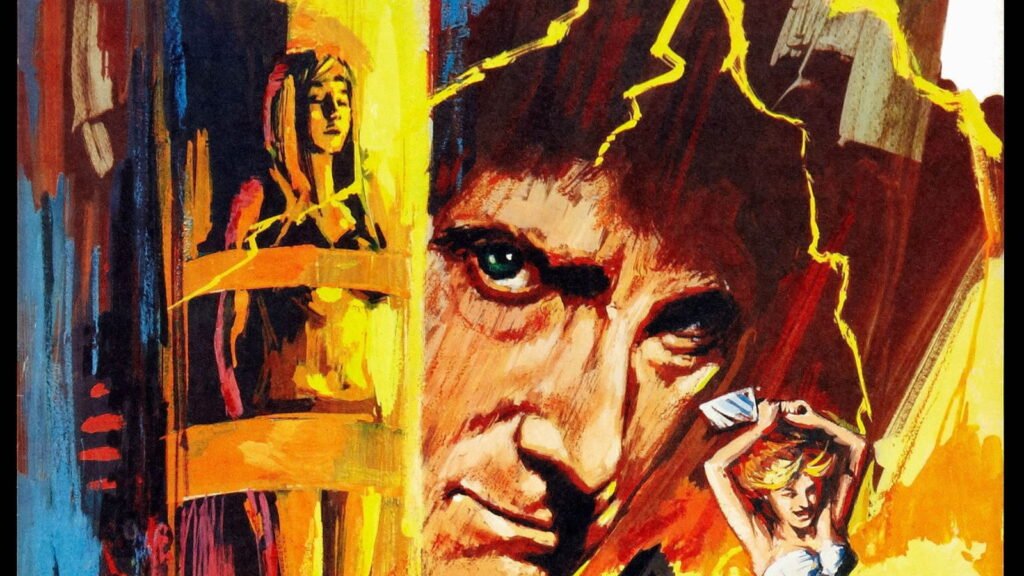
Frankenstein Created Woman (1967) is Hammer’s fourth Frankenstein film, the one where Peter Cushing’s Baron stops building bodies and starts trapping souls. Sit with that title a moment, because it is the film’s first and best joke. Nobody in this picture creates a woman. No bride is stitched together on a slab, no lightning-bolt assembly line hums into life. What the Baron builds here is a trap for something nobody can hold in a jar — a human soul, caught at the instant of death and poured into the nearest empty vessel. The poster promises you a monster in a woman’s shape. The film delivers something stranger and sadder: a love story run through a guillotine.
This is the Hammer Frankenstein series turning inward. The run began a decade earlier with The Curse of Frankenstein (1957) and The Revenge of Frankenstein (1958), where the Baron’s work was all hands and organs. Frankenstein Created Woman asks what is left of a man when the body is gone — and whether what is left can still want revenge. It brought director Terence Fisher back to the series, gave Peter Cushing one of his most humane monsters of science to play, and divided critics so cleanly that half of them were still grumbling about it decades later while the other half called it the finest Frankenstein Hammer Films ever made. Both halves were looking at the same quiet, cruel little film.
Quick Specs
- Director: Terence Fisher
- Screenplay: Anthony Hinds (credited as John Elder)
- Producer: Anthony Nelson Keys
- Starring: Peter Cushing, Susan Denberg, Thorley Walters, Robert Morris
- Cinematography: Arthur Grant
- Edited by: Spencer Reeve
- Music: James Bernard
- Studio: Hammer Film Productions
- Released: 15 March 1967 (US); 18 June 1967 (UK)
- Running time: 92 minutes (US); 86 minutes (UK)
- Budget: £140,000
- Distributors: Warner-Pathé (UK); 20th Century-Fox (US)
- Series: The fourth Hammer Frankenstein film
The title is a joke at the Baron’s expense
The title is a wink at Roger Vadim’s …And God Created Woman — Et Dieu créa la femme (1956), the Brigitte Bardot hit whose success was still echoing when this project was first mooted back in 1958. That is all the two films share. This is not a remake of Vadim, and it is not a remake of James Whale’s Bride of Frankenstein either, whatever the title leads you to expect. The Vadim film donated a punchline. The picture underneath it is a tragedy about a soul with nowhere to go.
Here is the misconception to bury before anything else, because sloppy synopses keep digging it up: there is no brain transplant in this film, and no female creature is constructed. The experiment is metaphysical, not surgical. When Hans Werner is executed, the Baron and his collaborator Dr Hertz trap Hans’s soul at the moment of death. When Hans’s lover Christina drowns herself, her body is revived — her own body — and Hans’s soul is transferred into it. Then, over months of treatment, the two men cure the physical deformities she has carried all her life. The “created woman” is a healed woman with a dead man’s grief installed inside her, and the film never lets you settle into thinking that is a triumph.
It will not even let you settle into thinking it is simple possession. Frankenstein assumes Hans’s soul is working through her like a hand in a glove. The film leaves Christina at least a willing participant in what follows — her closing line to the Baron is “I know who I really am.” Hold onto that ambiguity. It is the difference between a shocker and the film Fisher actually made.
An innocent man, a river, a second life
The film opens before its own credits with a small boy watching his father die. Werner, a drunken prisoner, is guillotined while young Hans looks on — the blade is this story’s first and last argument. Years later, Hans Werner works as assistant to Baron Victor Frankenstein, who survived the destruction of his castle in the previous film, and to the Baron’s collaborator Dr Hertz. The two men are close to the breakthrough of the Baron’s career: they believe the soul of a recently deceased person can be trapped, and that a trapped soul can be transferred into another recently deceased body to restore it to life.
Hans loves Christina Kleve, the local innkeeper’s daughter, whose entire left side is disfigured and partly paralysed. Three young dandies — Anton, Johann and Karl — make a sport of bullying father and daughter at the inn. Hans fights them and cuts Anton’s face. That night the three come back to steal wine, and when Kleve catches them at it, they beat him to death.
Hans spent that night with Christina. It is a complete alibi, and he will not use it — he will not clear his name at the cost of hers. His overcoat is found by the body, his threat against Kleve was overheard, and his father’s execution is held against him like a family trade. The Baron and Hertz defend him and it changes nothing. Hans is innocent of the murder he dies for, and everyone who matters knows the machinery that kills him anyway. He is convicted and guillotined, as his father was. Frankenstein takes the fresh corpse and traps Hans’s soul.
Christina, returning from a specialist her father had paid for, arrives in time to see Hans die, and throws herself in the river. Her body is brought to Hertz. She is revived, and Hans’s soul is transferred into her. Over months of treatment her deformities are cured. She wakes healthy and beautiful with no memory of either life — not Christina’s, not Hans’s — and the Baron insists she be told nothing but her name.
What wakes up in her is not content to stay buried. Hans’s vengeful spirit takes her over, and she kills Anton and Karl. The Baron and Hertz, suspicious, take her to the guillotine — the place that made her twice over — and misread what possesses her. By the time Frankenstein realises the truth, she is killing Johann too. Told she has no one and nothing left to live for, Christina drowns herself a second time. The Baron, apparently having learned a lesson, walks away in silence. For once in this series, the monster-maker is the one left standing in the wreckage with nothing to say.
The people in it
Peter Cushing, born 26 May 1913, was 54 when the film reached British screens, and this is among the most restrained of his Baron performances — the cruelty here is intellectual, a man so certain the soul is a thing to be handled that he never stops to ask whose hands it ends up in. Opposite him, Thorley Walters plays Dr Hertz as the Baron’s kindly, drink-prone collaborator: not a villain, not a coward, just a decent man lending his decency to an indecent experiment, which is its own kind of horror.
Susan Denberg plays Christina Kleve. Born Dietlinde Zechner on 2 August 1944 in Bad Polzin, Germany — now Połczyn-Zdrój, Poland — and raised in Klagenfurt, Austria, she had been Playboy’s Playmate of the Month for August 1966, and she was 22 at the UK release. The role asks her to play two women and one ghost: the disfigured girl the village pities, the beauty who wakes with no past, and the dead man looking out from behind her eyes. Robert Morris is Hans Werner, with Stuart Middleton as the young Hans of the pre-credits sequence. The three dandies are Peter Blythe as Anton, Derek Fowlds as Johann and Barry Warren as Karl, and Duncan Lamont plays Werner, the father whose execution opens the film and echoes through everything after it.
Nine years in a drawer
For a film this distinctive, it spent a long time not existing. The project was first mooted as a follow-up to The Revenge of Frankenstein back in 1958, while Vadim’s film was a success and its title was there to be riffed on. It finally went before the cameras at Bray Studios in July 1966 — and it was Hammer’s penultimate production at Bray, the studio’s home turf, which gives the film a quiet end-of-an-era charge whether it wants one or not.
It also brought Terence Fisher back to the series he had started. The Evil of Frankenstein (1964) is the only Cushing Frankenstein Fisher did not direct, and the series’ continuity is loose enough that this film does not draw attention to its own placement in the chronology — the Baron simply survived, as Barons do. Fisher referred to his Hammer work as “dark fairy stories for adults,” and this film has been read as almost a fairy-tale tragedy: the girl by the river, the three cruel young lords, the wish granted in its cruellest possible form. On release it was paired with The Mummy’s Shroud (1967) as a double bill.
Anthony Hinds wrote the screenplay under his usual pen name, John Elder — one writer, two names, and worth stating plainly because listings keep splitting him into a writing team. The producer was Anthony Nelson Keys. Hammer made the film; Warner-Pathé distributed it in the UK and 20th Century-Fox in the US, and in a reversal of the usual Hammer pattern, America got it first — 15 March 1967, three months before the UK release on 18 June 1967.
Half the critics walked out, half knelt
The contemporary notices set the pattern the film has followed ever since: admired technique, argued-over script. Variety, reviewing it in March 1967, praised “the excellent technical aspects which have come to be expected of the Hammer Film people,” but found the script “often seems overly influenced by other and better-written screen efforts.” The Monthly Film Bulletin dissented at length — the creation “is the very point in the story that is casually glossed over,” the script “more concerned with the gory murder spree which follows,” concluding that “of genuine Frankensteiniana there is little beyond the Baron’s initial resuscitation… the poverty of the script is little compensation for loss of the old tradition.”
The later guides split just as hard. Leonard Maltin: “Everything goes wrong, including script.” Halliwell: “Crude and gory farrago.” Against them, Time Out found it “full of cloying Keatsian imagery which somehow transcends the more idiotic aspects of the plot,” and the Radio Times Guide to Films, giving it 3/5, called it “considered by Hammer aficionados to be the best Frankenstein made by the House of Horror,” praising “Terence Fisher’s neat balance of psychological horror and murky sexuality.” Critic David Kalat calls it “a remarkably accomplished creation,” praising how Fisher tempers “the craziest aspects with a sense of reserve so that the affair never feels tawdry or exploitative.” Critics have framed the film as the series’ turn from the physical to the metaphysical — where the earlier entries were concerned with the physical aspects of the Baron’s work, this one explores “the question of the soul and its relationship to the body.”
The endorsement that follows the film around came from Martin Scorsese, who programmed it in his 1987 National Film Theatre season of favourite films and said: “If I single this one out it’s because here they actually isolate the soul… The implied metaphysics are close to something sublime.” That is a critic’s judgement, not a verdict this site is handing down — but when a filmmaker of Scorsese’s weight singles out a £140,000 Hammer picture for its metaphysics, the picture has earned a second look. On Rotten Tomatoes the film stands at 62% from 13 reviews, as checked on 25 October 2026.
The film on disc
The restored version reached Blu-ray in October 2013 in the UK and on 28 January 2014 in the US from Millennium Entertainment, with an audio commentary by Robert Morris and Derek Fowlds — Hans and Johann, the executed man and one of his killers, talking over the film together — moderated by Hammer historian Jonathan Rigby. If you want the fairy tale with its makers’ voices in the room, that is the edition the film’s reputation now travels on.
The Baron’s story on screen continues in Frankenstein Must Be Destroyed, where the soul gives way to colder instruments again. But this is the entry that asked the biggest question the series ever posed, and asked it with a straight face: if you could catch the thing that leaves the body at death, whose body would you dare put it in — and who gave you the right? The Baron walks away in silence at the end. Sixty years on, the silence still lands.