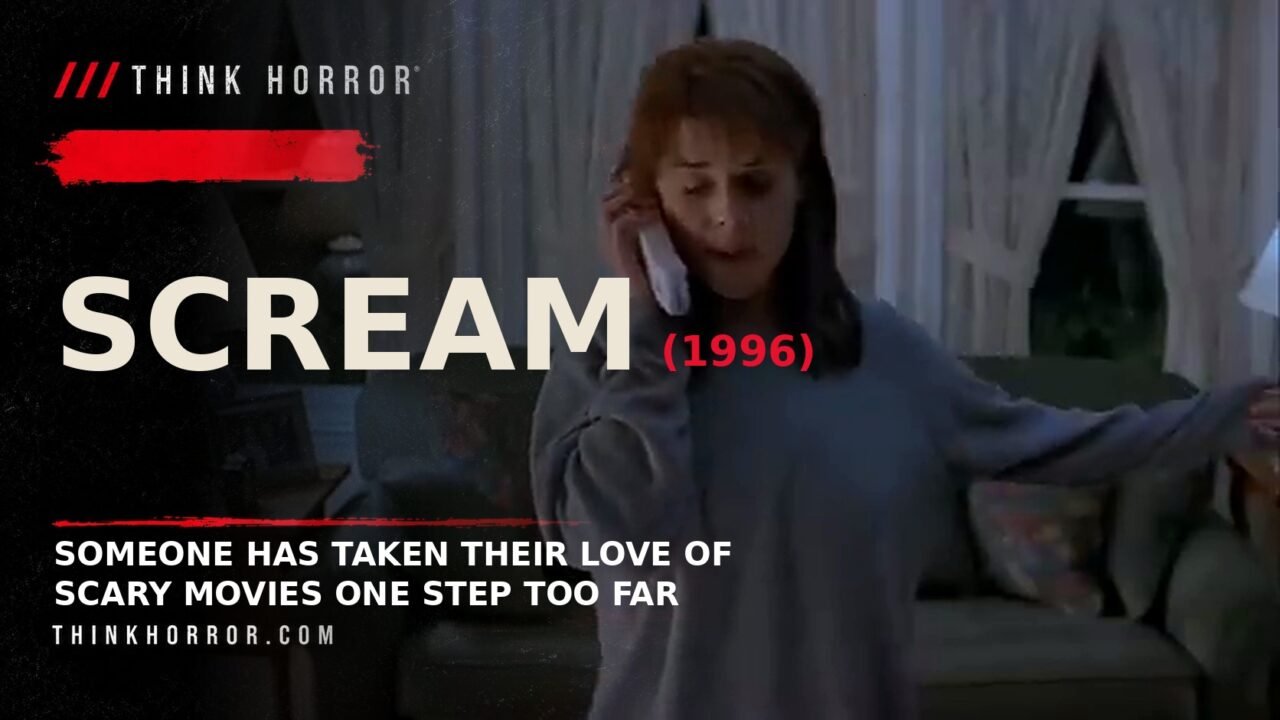
Scream is Wes Craven’s meta-slasher: a masked killer who quizzes Woodsboro’s teenagers on horror trivia — and a dead genre stands back up.
You’re home alone, and the phone rings. A stranger, voice like velvet over gravel, wants to talk about scary movies. Harmless — until he mentions your boyfriend, tied up out on the patio, and asks one question for the boy’s life: who was the killer in Friday the 13th? Answer carefully, fiends. Everybody in Woodsboro gets this answer wrong exactly once.
Welcome back to the crypt. Tonight’s file is the film that raised a genre from its own grave: by 1996 the slasher was a punchline, and one December weekend a masked telephone stalker made it dangerous, profitable and smart again — then spent a thirtieth-anniversary autumn back in theaters proving it never left. Wes Craven’s Scream. Check the locks. Then answer the phone anyway.
Watch the Trailer

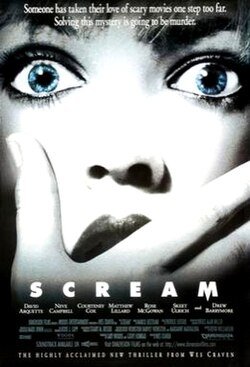
Quick Specs
- Director: Wes Craven
- Writer: Kevin Williamson
- Producers: Cathy Konrad, Cary Woods
- Cast: David Arquette, Neve Campbell, Courteney Cox, Matthew Lillard, Rose McGowan, Skeet Ulrich, Jamie Kennedy, Drew Barrymore
- Studio: Dimension Films / Woods Entertainment
- Distributor: Dimension Films
- Release Date: December 20, 1996
- Runtime: 111 minutes
- Rating: R
- Budget: $14–15 million
- Box Office: $173 million worldwide ($103 million North America)
The Review
The script began, by Kevin Williamson’s own telling, with a fright. House-sitting in Palm Springs in 1994, the struggling writer watched a documentary about Danny Rolling, the “Gainesville Ripper” who murdered five Florida students — and then found a window standing open he had never noticed. He spent that night with a kitchen knife close and a friend on the phone, talking horror villains. Over the next three days, to John Carpenter’s Halloween score, he wrote the screenplay first called Scary Movie. Studios bid for it; producer Cathy Konrad carried it to Dimension. Then came the hard part — a director. “He said no to the script,” Williamson recalls of Wes Craven. “He said no and no and no.” Craven, in producer Marianne Maddalena’s words, wanted out of “the horror ghetto.” His people kept sliding it back across his desk. Horror is better for their stubbornness.
What Craven shot opens with the most famous twelve minutes in modern horror. Casey Becker — Drew Barrymore, the film’s biggest star, billed like its lead — answers a flirtatious wrong number that curdles, question by trivia question, into a death game, and loses. The British Film Institute has called that prologue a “masterclass” in building tension; it is also a declaration: nobody is safe here, not even the poster. The film then settles on Sidney Prescott, Casey’s classmate, days short of the first anniversary of her mother Maureen’s murder — the crime Cotton Weary was convicted of. When the calls come for Sidney, tabloid reporter Gale Weathers arrives with her book arguing Cotton was framed, and video clerk Randy Meeks lays down the law that made the film immortal: never have sex, never drink or do drugs, and never, ever say “I’ll be right back.” The killer, Ghostface, is a fan with a knife — and the finale’s cruelty doubles when the mask comes off twice: Billy and Stu, playing survivor by stabbing each other, until Sidney turns their script on them and lives to see the sunrise.
Then came December 20, 1996 — Christmas counterprogramming, from a cast and crew who largely expected it to die. It opened fourth, with $6.4 million, and then did the thing slashers never do: it climbed. The second weekend grossed $9.1 million. The third, $10 million. Nine weeks in the top ten, $103 million at home, $173 million worldwide — the highest-grossing slasher in history, a title it kept for twenty-two years, until Halloween (2018) finally took it. The late-nineties teen-horror wave that followed is this film’s aftershock, and half of it still lives in its house.
What Works
- The opening breaks the contract, and the whole film lives on the proceeds. Killing the star in the first reel was Barrymore’s own design — more on that in the trivia crypt below — and it buys two hours of genuine uncertainty: every phone ring after it is a loaded weapon. Its trivia-game structure makes the audience’s own horror knowledge the stakes: we know the Friday the 13th answer. Casey doesn’t. That gap is where the dread lives.
- The rules are an engine, not a gag. Randy’s survival lecture would be a cute skit in a lesser film. Here it’s the operating system: characters who know the rules die anyway, the killers hide behind the audience’s expectations, and the film obeys its own commandments and breaks them in the same breath. Meta, in 1996, wasn’t a wink — it was suspense built from everything the viewer brought in.
- Sidney Prescott is the genre’s new center of gravity. Neve Campbell plays Sidney’s grief as the plot, not the backstory: a girl whose trauma is being monetized by a tabloid press while her mother’s killer — or killers — redials her number. She is suspicious, funny, exhausted, and finally furious, and when the finale comes she doesn’t wait for rescue. She rewrites the ending herself. The final-girl line from Laurie Strode runs straight through her.
- The voice is a performance, not an effect. Roger L. Jackson recorded every call live on set — the first night crouched outside the house in the rain, watching Barrymore through the window — kept hidden from the cast he was terrorizing. “I never met any of the actors in the films,” Jackson says, “but they all knew I was watching them, hidden somewhere nearby.” The fear at the other end of that line is answering something alive.
What Doesn’t
- The middle idles in procedure. Between the opening and Stu’s party, the film spends long stretches on police work, school closures and news vans. The pieces are necessary — the Cotton Weary thread has to be laid — but the momentum sags in a way the first and third acts never do.
- The cheek has a ceiling. The finale’s reveal is electric, but the killers’ plan — stab each other and play the survivors — tips from deranged into slapstick at the moment dread should peak, and one performance goes broad enough to let the air out. The period critics who called it too self-satisfied were wrong about the whole — but in that kitchen, you can see their point.
The ledger, this time, needs no resurrection narrative. Scream was crowned in its own day: 78% on Rotten Tomatoes, Certified Fresh; an 80% audience score held for thirty years; a Metacritic 66 drawn from the original 1996 notices — favorable then, no asterisk now; a B+ CinemaScore, this franchise’s best; and Saturn Awards for Best Horror Film, Best Writing and Best Actress. This desk’s monuments mostly had to be dug up. This one was carried out on the crowd’s shoulders.
Full disclosure, fiends, because Harper keeps an honest crypt: this is a desk verdict — built from the verified record, the ledger, the awards shelf and the consensus, not a fresh team screening. Nobody on the Think Horror crew re-screened the film for this review, and we won’t pretend otherwise. This one changed the rules while we were all watching.
Harper’s verdict: 4.5 ravens — one phone call short of perfection.
Trivia & Facts
- The star asked to die first. Drew Barrymore read the script and signed on to play Sidney — then asked for Casey instead. In her own words: “I asked if I could be Casey Becker so we would establish this rule does not apply in this film.” The marketing sold her as the lead anyway, so audiences walked in wearing exactly the assumption the film was built to murder.
- The mask came off a stranger’s wall. Williamson’s script asked only for a “ghostly white mask,” the effects house’s customs were rejected, and on a location scout producer Marianne Maddalena found a novelty mask hanging in a scouted house. Fun World’s “Peanut-Eyed Ghost,” store-bought. Craven himself once claimed the find before correcting the record: it was Maddalena’s. The most famous face in modern horror cost retail.
- The censors’ problem was that it worked. Scream was first rated NC-17, and the board’s objection, as Craven tells it, was “not a specific shot, it’s not blood, it’s just too intense.” Up to nine resubmissions followed. When Kenny’s throat-cutting was shortened because W. Earl Brown’s expression was judged too disturbing, the production’s answer was Brown’s own: “It’s murder, it should be disturbing.” The successful appeal leaned on the film’s satire; by Bob Weinstein’s telling, the winning move was asking the board to view it as a comedy.
Harper’s Extras
- Scream (1996) — the full wiki file: the complete case file — production, release and legacy in crown-jewel depth.
- Ghostface — the wiki file: every face behind the mask, film by film.
- Wes Craven — the wiki file: the master, from The Last House on the Left to the long afterlife.
- Scream 7 (2026) — Harper’s review: thirty years on, Ghostface comes for Sidney’s family — and Harper was there with the ravens.
- Kevin Williamson — the wiki file: the writer who turned one bad night into the genre’s new rulebook.
- Crank it: Marco Beltrami’s score. He won the job with one weekend’s test cue, and with an orchestra under fifty players he fattened the strings by having the musicians whistle along — Craven and the producers among the whistlers. Ghostface gets no theme. Sidney does: “Sidney’s Lament.”
Where to Watch
As of November 5, 2026, it’s streaming on Paramount+, HBO Max, fuboTV and Cinemax, and streaming free on Kanopy and Hoopla; rent or buy it on Amazon Video, Apple TV Store or Fandango At Home — and the full seasonal board lives in our Halloween Watch Guide.
Frequently Asked Questions
Is Scream based on a true story?
Inspired, not based. Williamson has told it for years: house-sitting in 1994, he watched a documentary about Danny Rolling, the “Gainesville Ripper,” found a window open that night, and spent the small hours armed with a kitchen knife, talking horror with a friend by phone. Woodsboro, Sidney and Ghostface are his invention — the fear was real.
Why is Drew Barrymore killed off so early?
Because she asked to be. Barrymore signed on as Sidney, then requested the Casey role so the audience’s safest assumption — the star survives — would die with her, twelve minutes in. The campaign still billed her as the lead. It’s the Psycho play, pulled off with the victim’s own permission.
Was Scream the highest-grossing slasher film ever?
For twenty-two years, yes: its $173 million worldwide stood as the slasher record until Halloween (2018) passed it. It was also only Miramax’s second film to cross $100 million in North America, after Pulp Fiction.
Until next time, fiends — keep the lights low, keep the popcorn close, and if a stranger calls to ask your favorite scary movie, answer like your life depends on it. In Woodsboro, it does. Harper will leave a light on for you.
The weekly roundup
One letter a week, from the crypt.
- New reviews, with the ravens
- New wiki entries and news
- Cool stuff worth your night
Weekly. No spam, unsubscribe in one click.