The Mummy (1932)
The Mummy is a 1932 American pre-Code supernatural horror film directed by Karl Freund and starring Boris Karloff, Zita Johann, David Manners, Edward Van Sloan, and Arthur Byron. Produced and distributed by Universal Pictures, it was the studio’s third great monster hit after Dracula (1931) and Frankenstein (1931), and it established the reanimated mummy — and the doomed, centuries-spanning romance behind it — as one of horror’s permanent archetypes. Karloff plays Imhotep, an ancient Egyptian high priest buried alive for attempting to resurrect his forbidden lover, who returns to life in 1921 and spends the next decade hunting for her reincarnation in modern Cairo.
At a glance
| Title | The Mummy |
| Year | 1932 |
| Directed by | Karl Freund |
| Produced by | Carl Laemmle Jr. |
| Written by | John L. Balderston |
| Story by | Nina Wilcox Putnam and Richard Schayer |
| Starring | Boris Karloff, Zita Johann, David Manners, Arthur Byron, Edward Van Sloan |
| Cinematography | Charles Stumar |
| Production company | Universal Pictures |
| Distributed by | Universal Pictures |
| Release date | December 22, 1932 (United States) |
| Running time | 73 minutes (most listings; AFI lists 72 or 78) |
| Country | United States |
| Language | English |
| Budget | About $196,000 (estimated) |
| Format | Black and white, 8 reels, mono, 1.37:1 |
Plot
Spoilers follow — the full story, including the ending.
In 1921, a British archaeological expedition in Egypt led by Sir Joseph Whemple unearths the mummy of Imhotep, an ancient Egyptian high priest. Dr. Muller examines the body and finds something wrong: the viscera were never removed and there is no embalmer’s incision. Imhotep was not mummified after death — he was buried alive, punished for attempting to resurrect his forbidden lover, the Princess Ankh-es-en-Amon. Muller warns the party to put the body back and bury it where they found it.
Sir Joseph’s assistant, Ralph Norton, ignores the warning. He opens the casket, finds the Scroll of Thoth, translates it, and reads the life-giving words aloud. Imhotep revives. The sight drives Norton mad — he collapses into hysterical laughter — and Imhotep escapes into the night, taking the Scroll with him. The Scroll’s text is shown on screen after the credits: “This is the Scroll of Thoth. Herein are set down the magic words by which Isis raised Osiris from the dead. Oh! Amon-Ra — Oh! God of Gods — Death is but the doorway to new life — We live today — we shall live again — In many forms shall we return — Oh, mighty one.”
Ten years later, Imhotep is living in Cairo under the name Ardath Bey, posing as a modern Egyptian. He calls on Sir Joseph’s son Frank Whemple and Professor Pearson and shows them where to dig for the tomb of Ankh-es-en-Amon. The tomb is found, and its treasures go to the Cairo Museum. But Ardath Bey has another purpose: he has identified Helen Grosvenor, a young woman living in Cairo, as the reincarnation of the princess, and he means to have her back.
Imhotep kills Sir Joseph to stop him burning the Scroll, then turns his hypnotic power on Helen, compelling her to his temple. There he dresses her in the princess’s clothes and jewels and burns the mummy of Ankh-es-en-Amon, preparing to restore her to life. Frank and Muller rush to the temple but are held back by Imhotep’s magic. It is Helen herself who ends it: possessed by — or remembering — the spirit of Ankh-es-en-Amon, she appeals to the goddess Isis. The statue of Isis raises its arm, and the Scroll of Thoth is destroyed by fire, breaking the spell that sustained Imhotep’s immortality. His body ages, dies, and crumbles to dust. The princess’s spirit leaves Helen, and she awakens as herself in Frank’s arms.
Production
Development
After Dracula and Frankenstein — both adapted from novels — Universal production chief Carl Laemmle Jr. wanted another literary source for an Egyptian horror film. He commissioned story editor Richard Schayer to find a novel. Schayer found nothing fitting except Arthur Conan Doyle’s vaguely suggestive short tale “The Ring of Thoth.” Schayer and Nina Wilcox Putnam then wrote a nine-page treatment titled “Cagliostro” — a screen story dated February 19, 1932 — about a 3,000-year-old magician who survived by injecting nitrates, set in San Francisco, murdering women who resembled a former lover.
Laemmle hired John L. Balderston to write the script. Balderston had worked on Dracula and Frankenstein, and had covered the opening of Tutankhamun’s tomb as a newspaper reporter a decade earlier. He moved the story to Egypt and Cairo, replaced the scientific survival mechanism with a supernatural one — revival by reading the Scroll of Thoth — and renamed the title character “Im-ho-tep,” after the real dynastic Egyptian architect. He submitted the script on September 12, 1932, under the title Im-Ho-Tep. The working titles during production were Imhotep and The King of the Dead before the film became The Mummy.
The film is not based on a novel, and there is no Balderston play behind it — a common error, since Balderston’s stage work is connected to Dracula, not to The Mummy. Nor is it a curse story in the usual sense. Howard Carter’s opening of Tutankhamun’s tomb in 1922 and the “Curse of the Pharaohs” press sensation supplied the commercial climate, but the curse itself is read out once in the film and punishes nobody: apart from the unfortunate Norton, none of the tomb’s defilers suffers for sacrilege. Sir Joseph is murdered for practical reasons — to stop him destroying the Scroll — not by a curse. One scholarly study goes further, arguing the film is close enough to Dracula in structure — the same expert in Edward Van Sloan, the same fiancé in David Manners, the same hypnotic powers and city setting — to be called a disguised remake. That is an attributed critical view, not a settled fact.
Direction and cast
Karl Freund directed. The German-Bohemian cinematographer — born January 16, 1890, in Dvůr Králové, Bohemia — had photographed Metropolis (1927), Dracula (1931), and Murders in the Rue Morgue (1932) for Universal before this, his American directorial debut. He had directed in Germany earlier in his career, so the film was his first directorial effort for Universal, not his first film as a director. Freund was a pioneer of the unchained camera, and he later became best known to television audiences as the cinematographer of I Love Lucy (1951–1957). He died May 3, 1969, in Santa Monica.
Boris Karloff — born William Henry Pratt in London on November 23, 1887 — was 44 during the September–October 1932 shoot and turned 45 a month before release. He was billed at the time as “Karloff the Uncanny.” Zita Johann plays Helen Grosvenor, David Manners plays Frank Whemple, Arthur Byron plays Sir Joseph Whemple, and Edward Van Sloan — Dracula’s Van Helsing — plays Dr. Muller. Bramwell Fletcher is Ralph Norton, the assistant driven mad in the opening scene, and Noble Johnson is the Nubian servant. In the credited supporting cast, Kathryn Byron plays Frau Muller, Leonard Mudie plays Professor Pearson, and James Crane plays the Pharaoh — credited with the role misspelled as “Pharoh.”
Makeup and filming
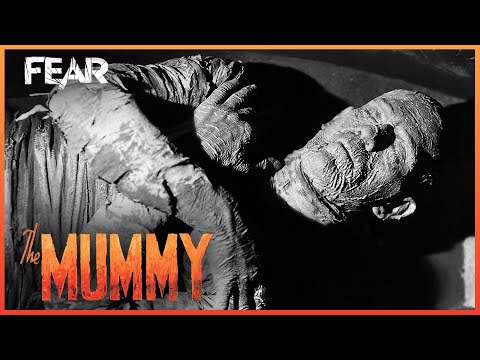
Jack Pierce’s mummy makeup for Karloff is one of the most famous transformations in horror history, and one of the most punishing. The full application took eight hours — one modern account says up to seven hours a day — using cotton strips dipped in collodion, with Fuller’s earth brushed over for the dry, desiccated look. Yet Karloff appears in the full mummy makeup for only a few minutes of screen time; for most of the film he plays Imhotep as the living Ardath Bey, in ordinary dress, with only his lined face and stiff, deliberate movement suggesting the centuries beneath.
Filming ran from mid-September to mid-October 1932, on the Universal lot for interiors, on an estimated budget of about $196,000 — a widely repeated figure that traces to a single lineage and should not be printed as a hard number. Claims of desert location shooting (Cantil, Red Rock Canyon, the Mojave) come from fandom sources that disagree with each other and are not verified.
A substantial sequence was shot and cut. Additional footage showed Helen in later incarnations — an ancient Christian, a medieval princess, a Norse Viking, and a French noble — and was removed by Freund for time. Henry Victor was credited as the Saxon Warrior, but his scenes were in that cut sequence, so he never appears in the finished film. A shooting-script analysis describes the cut material differently — 18th-century France, 13th-century crusaders, an 8th-century Saxon stockade, ancient Rome — but both accounts agree on the substance: multiple historical lives, filmed and removed.
Release and reception
The Mummy was copyrighted by Universal Pictures Corp. on December 14, 1932, and released in the United States on December 22, 1932, opening in New York at the RKO Mayfair. Contemporary reception was mixed. The New York Times review of January 7, 1933, praised two scenes and dismissed the rest: “For purposes of terror there are two scenes in The Mummy that are weird enough in all conscience. In the first the mummy comes alive and a young archaeologist, going quite mad, laughs in a way that raises the hair on the scalp. In the second Im-Ho-Tep is embalmed alive, and that moment when the tape is drawn across the man’s mouth and nose, leaving only his wild eyes staring out of the coffin, is one of decided horror. But most of The Mummy is costume melodrama for the children.” The Los Angeles Times was positive, hailing it as a thrilling success.
At the box office the film was a modest success — strong in England and reported as a major hit in Australia — but no dollar gross figure exists for it. 1930s reporting is rentals-era, and no verified worldwide or domestic gross has surfaced; none is printed here.
Legacy
Unlike Frankenstein and Dracula, the 1932 film had no official sequel. The 1940s films that followed re-imagined the premise with a different mummy, Kharis — played by Tom Tyler in The Mummy’s Hand (1940) and by Lon Chaney Jr. in The Mummy’s Tomb (1942), The Mummy’s Ghost (1944), and The Mummy’s Curse (1944). Karloff appears in none of them except as uncredited recycled footage in The Mummy’s Hand, which reuses the 1932 film’s origin flashbacks. The Kharis films also introduce tana leaves as the device that sustains the mummy — a mechanism that does not exist in the 1932 film, where the Scroll of Thoth is everything. The spoof Abbott and Costello Meet the Mummy (1955) features a mummy named Klaris, played by Eddie Parker.
Hammer’s The Mummy (1959), with Christopher Lee as Kharis, is often misdescribed as a remake of the Karloff film. It is not: it is based on Universal’s The Mummy’s Hand (1940) and The Mummy’s Tomb (1942). It was directed by Terence Fisher — not Terence Young, as one AFI note wrongly states.
The 1932 story has been remade twice in name and spine. The Mummy (1999), directed by Stephen Sommers and starring Brendan Fraser, Rachel Weisz, and Arnold Vosloo as Imhotep, keeps the name and the tragic-love spine but rebuilds the film as an action-adventure set around the lost city of Hamunaptra: Evy is not the reincarnation, Ardeth Bay is a separate Medjai character rather than Imhotep’s alias, and the heroes defeat Imhotep themselves — there is no prayer to Isis. It was followed by The Mummy Returns (2001) and The Mummy: Tomb of the Dragon Emperor (2008), with the prequel The Scorpion King (2002). The Mummy (2017), directed by Alex Kurtzman and starring Tom Cruise, Sofia Boutella as Princess Ahmanet, and Russell Crowe as Dr. Jekyll, was planned as the first film of Universal’s Dark Universe; negative reviews and box-office failure scrapped the shared universe.
A third, unrelated film, Lee Cronin’s The Mummy (2026), written and directed by Lee Cronin and released theatrically in the United States on April 17, 2026, by Warner Bros. Pictures and New Line Cinema, stars Jack Reynor, Laia Costa, and May Calamawy in a possession and family-trauma horror. It is not a Universal film and is not connected to the 1932 story. The historical Imhotep, for the record, was a real Third Dynasty chancellor, architect, and physician under Pharaoh Djoser — the film’s Imhotep is fiction wearing a real name.
What endures from 1932 is the template: the mummy as a romantic, articulate, centuries-patient figure rather than a shambling monster, the reincarnated lover as the story’s engine, and Karloff’s performance — still, lined, and weary — as the measure every later screen mummy is judged against. The film set the pattern for mummy-themed horror so completely that its plot beats, from the Scroll of Thoth to the prayer that ends it, are still being quoted, remixed, and argued over nearly a century later.
Trivia
- Karloff is barely a mummy. After an eight-hour makeup application, Karloff appears in full mummy makeup for only a few minutes of the film. The rest of the time he plays the living Ardath Bey.
- The credited actor who never appears. Henry Victor is credited as the Saxon Warrior, but his scenes were in the cut “past lives” flashback sequence, so he is nowhere in the finished film.
- A misspelled credit. James Crane is credited as “Pharoh” — the Pharaoh’s title misspelled in the film’s own credits.
- Not a novel, not a play, not a curse. The film was built from an original treatment, not a book; there is no Balderston play behind it; and the “mummy’s curse” is read out once and punishes nobody in the story.
- Imhotep, not Kharis. Karloff’s mummy is Imhotep. Kharis is the different mummy of the 1940s films.
- Ardath Bey, not Ardeth Bay. Imhotep’s modern alias is Ardath Bey. Ardeth Bay is the separate Medjai character from the 1999 film.
- The age trap. Karloff was 44 during the shoot and turned 45 a month before release — so “44 at release” is wrong, and this page does not print it.