The devil’s most patient servant does not kick down doors, horror lover. He founds an order, raises a child inside it like a flower in a walled garden, and waits eighteen years for her birthday. Mind the nuns at the airport — and the father waiting to meet her plane, who has already signed for the delivery.
To the Devil a Daughter (1976) is Hammer‘s last occult stand, where Christopher Lee’s excommunicated priest raises a girl to become a demon’s vessel.
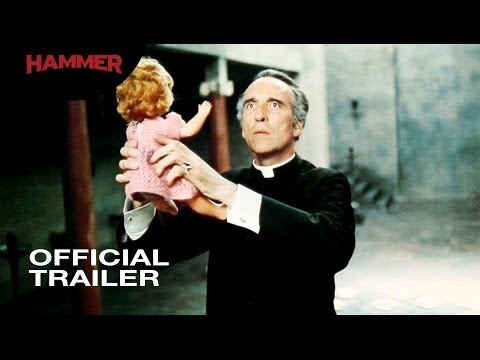
Watch the Trailer
Quick Specs
- Director: Peter Sykes
- Screenplay: Christopher Wicking
- Starring: Richard Widmark, Christopher Lee, Honor Blackman, Denholm Elliott, Nastassja Kinski
- Music: Paul Glass
- Cinematography: David Watkin
- Editor: John Trumper
- Producers: Roy Skeggs
- Production Company: Hammer Film Productions, Terra Filmkunst
- Distributor: EMI Films (UK); Constantin Film (West Germany); Cine Artists Releasing (US)
- Premiered: March 4, 1976 (UK)
- Runtime: 95 minutes
- Rating: R
- Budget: £330,000
- Box Office: No reliable total
- On This Site: To the Devil a Daughter film page
The Review
Every To the Devil a Daughter 1976 review has to reckon with the strangest credit sequence in Hammer’s history: nearly everybody who made the film disowned it. Dennis Wheatley, whose 1953 novel it adapts, found the result obscene and told Hammer never to film his books again. Richard Widmark feuded with the production, threatened to walk, and called Hammer “Mickey Mouse Productions.” Screenwriter Christopher Wicking called the picture “an awful mess,” and Hammer’s own Michael Carreras delivered the epitaph: the people who made it, he said, forgot about the ending — and when he asked EMI for the money to shoot a proper one, EMI refused. And yet the film exists, and it is not nothing: it was one of Hammer’s most profitable releases of the decade, it holds one of Christopher Lee‘s finest late performances, and it stands as the studio’s last occult horror of the classic era — the penultimate Hammer film of the twentieth century, made on location in Bavaria and London when the castles-and-candelabra world that built the studio was already gone.
The architecture is The Devil Rides Out inverted. Hammer had filmed Wheatley’s black-magic world triumphantly in 1968, with Lee as the hero, the Duc de Richleau. Eight years later Lee championed this second Wheatley novel to the studio — and cast himself on the other side of the circle. His Father Michael Rayner is a Catholic priest excommunicated for heresy who has built the Children of the Lord, a serene Bavarian order that is, in truth, a cradle: Catherine Beddows has been raised inside it from birth to become, at a Halloween baptism on her eighteenth birthday, the earthly avatar of the demon Astaroth. Her father Henry, a cultist with cold feet, begs occult novelist John Verney to intercept the girl at Heathrow and hide her until the birthday passes. What follows is Wheatley’s machinery modernised — airports, docks, London streets — as Rayner’s people reach for Catherine across a secular city that has no defences for this, and Verney assembles the truth from bishops, grimoires and a metal pact hidden in a church: there is also a second child coming, a demonic infant born to a cultist named Margaret, whose blood is meant to seal the baptism.
Lee is the film’s dark engine, and he is magnificent in a way that makes the surrounding mess sadder. His Rayner is no ranter: he is soft-spoken, courteous, absolutely certain — a man who has read the same books as the heroes and drawn the opposite conclusion, and Lee plays certainty as the most frightening thing in the world. When he explains that Astaroth is the road to perfected human power, and therefore the true God, you hear a theologian, not a villain. Around him, Widmark — an American noir titan visibly wondering what he has signed — brings a flinty, impatient gravity to Verney that the film uses well: this hero does not believe gracefully, he investigates, and his scepticism makes the supernatural land harder when it comes. Denholm Elliott, all nerves and guilt as Henry, steals his scenes; Honor Blackman and Anthony Valentine give Verney’s corner warmth that the plot then spends cruelly. And Peter Sykes, shooting entirely on real locations with David Watkin behind the camera, finds images that outlast the script: the order’s white habits in torchlight, Catherine wandering London in a trance, the climax in the Dashwood Mausoleum yard at West Wycombe — hard by the Hellfire Caves, where England’s original rakehell club once played at exactly this blasphemy.
Two honest counts against it, one artistic and one moral. Artistically, the film’s third act collapses: subplots pile up unjudged, telephone calls do the work scenes should do, and the climax — prepared with blood circles, sacrifice and two films’ worth of Wheatley cosmology — is resolved with a thrown rock, an ending so abrupt that the studio’s own boss conceded it had simply been forgotten. The audience is left holding a partly-baptized heroine and a villain who vanishes like a switched-off light. The moral count is graver, and no modern review may skip it: Nastassja Kinski was fourteen years old during filming, and the production put her, a child, into nude scenes she later said she regretted. Whatever latitude 1976 claimed, that was a failure of care by every adult in the chain, and it permanently shadows the film — a real darkness next to which the staged kind pales.
So the ledger is genuinely strange: a disowned script, a furious star, a betrayed novelist, a botched ending, a moral stain — and inside it all, a performance for the ages, a clutch of unforgettable images, and a hit. To the Devil a Daughter is not the Wheatley adaptation anyone wanted; The Devil Rides Out remains that film. But as a document of Hammer’s end — the budgets shrunk, the sets replaced by airports, the Devil himself gone corporate and patient — it is essential viewing for the faithful, watched with open eyes and argued about afterwards. Which, for a film about damnation, may be the most fitting afterlife of all.
Spoiler Section
Stop here if you have never seen it. The baptism is not for first-timers.
Catherine is to be baptized in the blood of Margaret’s demonic infant and made Astaroth’s avatar on her eighteenth birthday, Halloween. Margaret is murdered by morphine injection on Rayner’s order the moment the child is born. Under Rayner’s influence, Catherine kills Anna Fountain; David Kennedy burns to death touching the pact pendant Henry hid in a church altar; Henry himself barely survives. At the Dashwood Mausoleum, inside a protective circle drawn in the blood of a devotee named Eveline, Rayner sacrifices the demon child over Catherine’s body. Verney — who has learned from the grimoire that Rayner has misread the rite — breaks the circle’s protection using a rock smeared with the blood of George De Grass, whom he has just bludgeoned, hurls the rock, and Rayner vanishes into nothingness. Catherine lives, and is carried out — but a few drops of the blood reached her first. The baptism was partial. The film ends, deliberately or not, without telling us what that means.
Trivia
- Lee championed this one himself. It was Christopher Lee who persuaded Hammer to film Wheatley’s novel — and, having played the hero in The Devil Rides Out, he took the villain’s part here.
- It began as a television episode. The project started life as an instalment of a planned Wheatley TV series that never materialised; the feature inherited the ambition without the running time.
- The novelist slammed the door. Wheatley found the finished film obscene and informed Hammer they were never to adapt his books again — ending a relationship that had produced one of the studio’s classics.
- Nobody shot the ending properly because nobody paid for it. Carreras had a corrected ending written and ready; the money was refused, and the rock stayed.
- It was filmed where the real Hellfire Club played. The climax was shot at the Dashwood Mausoleum and the Hellfire Caves in West Wycombe, playground of the eighteenth century’s most notorious gentlemen occultists.
- A hit that everyone hated making. For all the feuds and disowning, the film became one of Hammer’s most profitable releases of the 1970s.
- It closed an era twice over. This was Hammer’s last horror film of its classic run and Christopher Lee’s last film for the studio until The Resident in 2011.
Where to Watch
To the Devil a Daughter is streaming free with ads on Fawesome in the US. You can also rent or buy it on Amazon Video and Apple TV. Checked November 9, 2026 — streaming lineups change.

The Verdict
To the Devil a Daughter earns its place in the Hammer canon the hard way: not as the triumph its source deserved, but as a fascinating ruin with a cathedral standing in the middle of it. Lee is superb, the location photography gives the occult a cold modern daylight to haunt, and the first hour builds a genuinely dreadful patience. Then the structure buckles, the ending abdicates, and the film’s treatment of its fourteen-year-old star stands as a permanent rebuke to everyone who let it happen. Two and a half ravens is the honest count: essential for Lee, instructive for the rest of us, and impossible to love without reservation.
Her eighteenth birthday is coming whether we are ready or not, horror lover, and the order keeps its appointments. Mind the guest list.
Rating: 2.5 ravens out of 5.
The weekly roundup
One letter a week, from the crypt.
- New reviews, with the ravens
- New wiki entries and news
- Cool stuff worth your night
Weekly. No spam, unsubscribe in one click.