The Brides of Dracula (1960) Review
The Brides of Dracula (1960) is Hammer’s sequel without the Count: Peter Cushing’s Van Helsing hunts Baron Meinster, Dracula’s disciple, through Transylvania.
You’re a stranger in a castle, a guest of a gracious old baroness, and you can’t sleep. Across the courtyard a young man stands on a balcony in the moonlight, pale and handsome and impossibly sad, and when you creep to his rooms you find him chained to the wall by the ankle. His mother did this, he says. She stole his lands. The key is in her bedroom. You’re kind, fiends, and kindness is exactly what he’s counting on. Go and fetch it. He’ll wait.
Welcome back to the crypt. Tonight’s file is the sequel Hammer made when its star said no: Christopher Lee walked away from the cape, the Count stayed dead, and the studio built a new monster around the one man who could still carry the franchise, Peter Cushing. What could have been a cheat became, for a long line of Hammer devotees, the best of the studio’s vampire films. Terence Fisher’s The Brides of Dracula. Bolt the shutters. Check your neck in the morning.
Watch the Trailer

Quick Specs
- Director: Terence Fisher
- Screenplay: Jimmy Sangster, Peter Bryan and Edward Percy
- Starring: Peter Cushing (Doctor Van Helsing), David Peel (Baron Meinster), Yvonne Monlaur (Marianne Danielle), Martita Hunt (Baroness Meinster), Freda Jackson (Greta), Andrée Melly (Gina)
- Music: Malcolm Williamson
- Cinematography: Jack Asher
- Editor: Alfred Cox
- Producers: Anthony Hinds (Michael Carreras, executive producer)
- Production company: Hammer Film Productions
- Distributor: Rank Film Distributors (UK); Universal-International (US)
- Premiered: July 7, 1960 (UK)
- Runtime: 85 minutes
- Rating: X certificate (UK)
- Budget: £120,000
- Box office: No reliable total
- On This Site: The Brides of Dracula in the wiki · Hammer Films · Peter Cushing · Terence Fisher
The Review
After Dracula (1958) made a fortune, Hammer wanted the Count back, and the Count’s actor didn’t want to come. Christopher Lee was asked to return and declined, fearing typecasting; he would not wear the cape again until Dracula: Prince of Darkness in 1966. So the studio went to work on the problem. Jimmy Sangster wrote a sequel called Disciple of Dracula, about an acolyte of the vampire with the Count reduced to a cameo. Peter Bryan rewrote it to remove Dracula and bring in Van Helsing; Edward Percy revised it again, and by most accounts Sangster, Fisher and Cushing all had hands in the final shape. What emerged has Dracula in the title, in the prologue narration and almost nowhere else. The narrator tells us the monarch of all vampires is dead, but his disciples live on. The film is about one of them.
Marianne Danielle (Yvonne Monlaur), a young French teacher bound for a post at a girls’ school, is abandoned at a village inn by her coachman. Against every warning from the locals she accepts a night’s lodging at the castle of the Baroness Meinster (Martita Hunt), whose son is said to be insane and kept confined. The son is David Peel’s Baron Meinster, and the chain on his ankle is the best secret the Baroness has. Marianne frees him. He kills his mother, drinks her blood and goes out into the countryside, while the Baroness’s servant Greta (Freda Jackson) cackles over the empty shackle. Into the aftermath walks Doctor Van Helsing (Cushing), summoned by the village priest, who finds a dead girl with wounds at her throat, a father who will not listen, and a grave that will not stay closed.
From there the film becomes a hunt across a small, beautifully dressed world: the castle, the cemetery, the girls’ academy run by the fussing Herr and Frau Lang (Henry Oscar and Mona Washbourne), and finally the old windmill where the Baron keeps his coffin and his new brides.
What Works
- Cushing gets the whole film: Cushing carries the picture the way he carried Hammer — with a ferocity he never shows on his face. Without the Count at his back he is free to think his way through, and the film lets him: Van Helsing as detective, surgeon and executioner in one, the hero of a Dracula film with no Dracula in it.
- David Peel’s Baron is the kind of vampire you can frame: Peel is not replacing Lee, and that is exactly the point. His Baron is young, beautiful and malevolent — a spoiled aristocrat who treats vampirism as one more inheritance — and he is all the more frightening for looking like a choirboy.
- Malevolent women — the baroness, the servant and the schoolgirl brides: The film’s most effective move is handing the danger to its women. Martita Hunt is impeccable: a mother who chained her own son and feeds him victims to keep him hers. Freda Jackson’s Greta is the pinnacle of Hammer’s supporting loathing — she runs the household as a hospital for the dead and cackles over the empty shackle. Andrée Melly’s Gina, the schoolgirl who rises smiling from her coffin, is the film’s most unsettling transformation. Yvonne Monlaur’s Marianne is a worthy heroine — young, strong, intelligent, and charming even now.
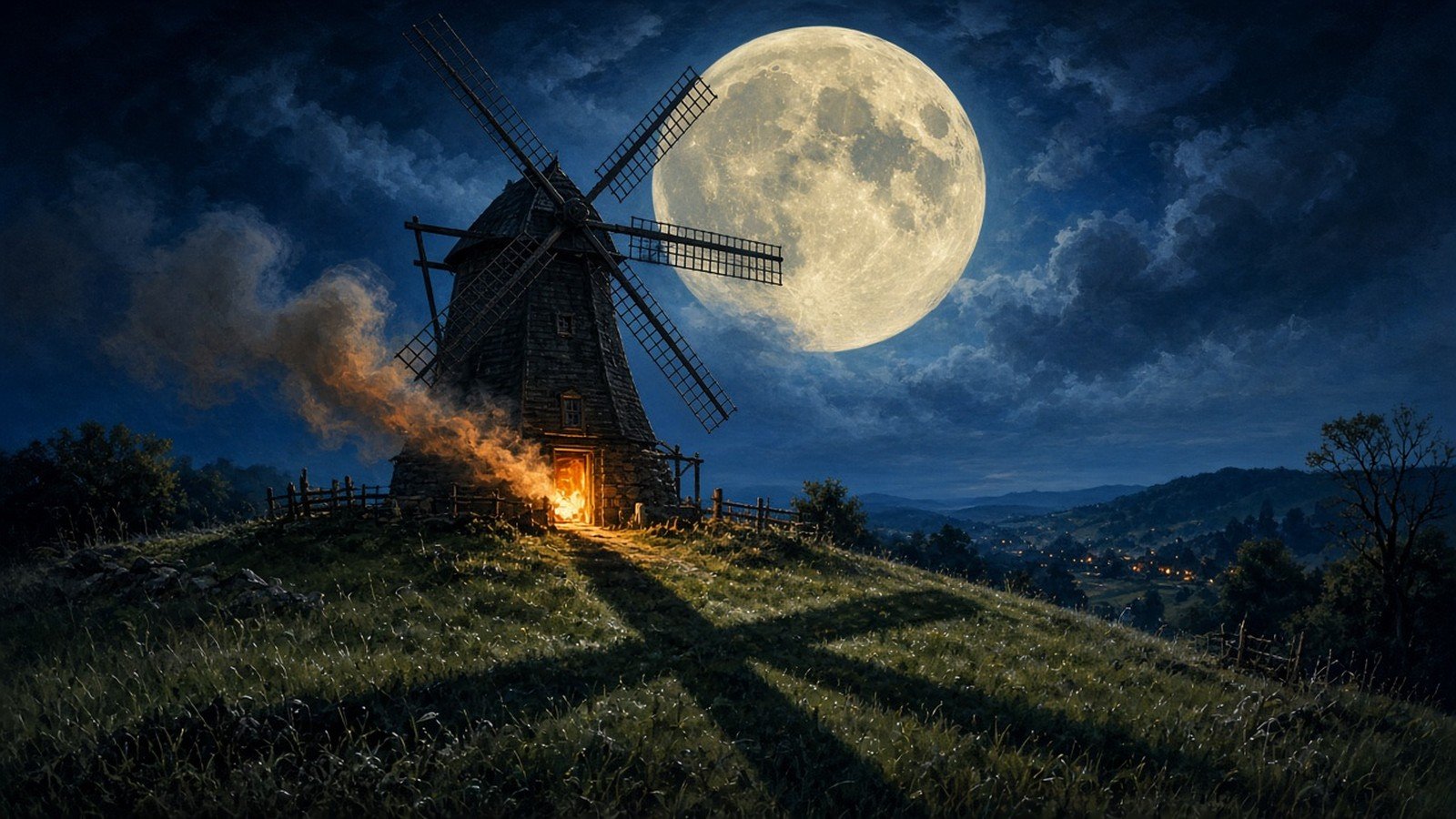
- The windmill and the cross-shaped shadow: The film’s most famous sequence is the climax at the mill, where Van Helsing traps the Baron and drags the sails round until their moonlit shadow falls across him in the shape of a cross. The mill burns, the shadow holds, and the Baron dies under a crucifix made of light and wood. It is the most inventive vampire-killing Hammer ever staged.
What Doesn’t
- The middle section is all too-familiar Hammer: The middle sags, with Van Helsing doing the legwork, the village priest arguing with the fathers of the dead girls, and the Baron’s habits circling the plot until the mill finally heaves into view.
- It is not Dracula: Without Lee, the film trades a menace you can feel for a pretty boy with a cape. The Baron is a moonlit shadow in a coat; he is not a legend — and in the end, a shadow is all it takes to stop him.
- The plot runs on murderous convenience: Marianne frees the Baron because the plot needs him freed, the village hides a vampire it buries girls for, and the final solution needs a windmill, a moon and a clear sky all in the same place at the same time. It works because Fisher sells it, not because it makes sense.
The ledger, in 1960, was cool. The Monthly Film Bulletin found that it added little to the Dracula legend other than a youthful, good-looking vampire, and Bosley Crowther of the New York Times called it nothing new or imaginative; even Harrison’s Reports, which admired Hunt and Jackson as excellent and the direction and photography as first class, found it not overly frightening. British audiences paid no attention, and the film made Kine Weekly’s list of the year’s money makers. Time has done the rest. Leslie Halliwell called it the best of the Hammer Draculas, with plenty of inventive action, some classy acting and a good sense of place and period. The crypt sides with Halliwell, with one bat-shaped reservation.
Harper’s verdict: 4 ravens — no Count, no problem, one terrible bat.
Trivia and Facts
- The Count stayed home: Christopher Lee did not return as Dracula — accounts differ on whether Hammer would not meet his price or Lee feared being trapped in the cape; most likely both. The studio built the sequel around Van Helsing instead, and Lee did not wear the fangs again until Dracula: Prince of Darkness in 1966.
- Four writers, one film: Jimmy Sangster’s first draft, titled Disciple of Dracula, still starred the Count. Peter Bryan’s rewrite removed Dracula and restored Van Helsing; Edward Percy rewrote again, and producer Anthony Hinds rewrote on top of all three. The shooting script is a palimpsest — and somehow it sings.
- The first ending went up in smoke: The script originally destroyed the vampires with a swarm of bats. The effect proved too expensive to stage, and the windmill-cross finish was devised in its place.
- Restored for home video: A brief shot of the Baroness’s staking, trimmed from cinema prints, was restored by Universal for the 2007 DVD. Modern viewers see a slightly bloodier film than 1960 did.
- It was shot close to home. Interiors were filmed at Bray Studios, with exteriors in nearby Black Park and at Oakley Court, a riverside Gothic house that Hammer used again and again. Filming began on January 26, 1960.
- The bat is a puppet: The bat that menaces the Baron is a marionette on wires — a little painted model that has never convinced anybody, and the one reservation in Harper’s verdict above.
Harper’s Extras
- The Brides of Dracula — the full wiki file: the complete case file, from Disciple of Dracula to the windmill.
- Dracula (1958) — the wiki file: the film that started it, with Lee as the Count and Cushing as Van Helsing.
- Abraham Van Helsing — the wiki file: every version of the great vampire hunter, Cushing’s included.
- Dracula: Prince of Darkness (1966) — the wiki file: where Lee finally put the cape back on.
- Hammer Films — the wiki file: the whole house of horror, gothic to the rafters.
- Peter Cushing — the wiki file: the gentleman hero, at his athletic best here.
- Crank it: Malcolm Williamson’s score. Williamson, an Australian composer who later became Master of the Queen’s Music, wrote Hammer a score that swoons and stabs by turns. It is the sound of a fairy tale turning on its reader.
Where to Watch
Checked November 9, 2026. Not currently streaming on a subscription service in the US; to rent or buy on Amazon Video, Apple TV, Google Play and Fandango at Home. It is also available on Blu-ray.
Frequently Asked Questions
Is Dracula in The Brides of Dracula?
No. Count Dracula does not appear. The prologue establishes that he is dead and that his disciples live on, and the villain is one of them, Baron Meinster, played by David Peel. Christopher Lee declined to return, fearing typecasting.
Who are the brides in The Brides of Dracula?
They are Baron Meinster’s brides, not the Count’s. The title is Hammer marketing at its cheekiest: Dracula never appears, and the
women in white are the Baron’s victims — the schoolgirls he turns, led by Gina, Marianne’s friend, who rises from her coffin smiling.
How does Baron Meinster die?
Van Helsing throws holy water in his face, which scars him, and the fire that follows burns the mill. What kills him is the moonlit shadow of the windmill’s sails, which Van Helsing turns into the shape of a cross across the Baron.
Is The Brides of Dracula a sequel to Horror of Dracula?
Yes. It follows Dracula (1958) directly — same Van Helsing, same Transylvania, the Count destroyed at the end of the first film and present here only as the Baron’s master. It also stands alone perfectly well; everything you need walks in with Cushing.
Until next time, fiends — keep the lights low, keep the holy water close, and if a handsome stranger asks you to fetch a key, leave it exactly where it is. Harper will leave a candle in the window for you.
The weekly roundup
One letter a week, from the crypt.
- New reviews, with the ravens
- New wiki entries and news
- Cool stuff worth your night
Weekly. No spam, unsubscribe in one click.