The robe itches, the chant is in a language your briefing never covered, and you are counting exits in a country-house cellar while a minister of the Crown bows his head over a chalice. You are a Secret Service man, and this was supposed to be photographs and home by morning. It is not going to be home by morning, fiend. What you develop in London tomorrow will show four smiling faces — and one empty doorway.
The Satanic Rites of Dracula (1973) is the eighth Hammer Dracula film and Christopher Lee’s seventh and last performance as the Count.
And he does not spend it in a crypt. He spends it in a penthouse. London, November 1974: a British agent dies raving about a Black Mass attended by a government minister, a lord, a general and one of the country’s top scientists, and the photographs his handlers develop show four smiling faces — and a fifth frame, an empty doorway, that the lab insists is a mistake. It is not a mistake. It is the only honest portrait of D. D. Denham ever taken: the reclusive property developer who is never seen in public, whose new tower stands on a Chelsea churchyard, and who, if Van Helsing reads him right, is tired — five centuries tired — of being alive.
Harper has a soft spot for a monster with an exit strategy, fiends, and this is the strangest one Hammer ever built. The last time we met this Count, in Dracula A.D. 1972, Hammer dropped him into swinging Chelsea and he never got out of one ruined church. This time the same director and writer bring him back and finally let him conquer modern London — not with fangs, but with property, plague and a board of directors. It is Lee’s farewell to the role that made him, made under open protest, shelved in America for five years, and dumped there under a title promising a bride who does not exist. It is also, buried inside a threadbare spy picture, the single best idea any late Hammer film ever had. Both of those things are true, and the film lives in the fight between them.

Quick Specs
- Director: Alan Gibson
- Screenplay: Don Houghton
- Starring: Christopher Lee (Count Dracula / D. D. Denham), Peter Cushing (Professor Lorrimer Van Helsing), Michael Coles (Inspector Murray), William Franklyn (Peter Torrence), Joanna Lumley (Jessica Van Helsing), Freddie Jones (Dr. Julian Keeley), Richard Vernon (Colonel Mathews), Richard Mathews (John Porter, MP), Patrick Barr (Lord Carradine), Lockwood West (General Sir Arthur Freeborne), Barbara Yu Ling (Chin Yang), Valerie Van Ost (Jane)
- Music: John Cacavas
- Cinematography: Brian Probyn
- Editor: Chris Barnes
- Producers: Roy Skeggs
- Production Company: Hammer Film Productions
- Distributor: Columbia-Warner Distributors (UK); Dynamite Entertainment (US, 1978, as Count Dracula and His Vampire Bride)
- Premiered: November 3, 1973 (West Germany); UK release January 13, 1974
- Runtime: 87 minutes
- Rating: X (UK); R (US)
- Budget: No citable figure exists
- Box Office: £223,450 (UK takings, per The Hammer Story)
- On This Site: The Satanic Rites of Dracula in the wiki · Dracula A.D. 1972 review · Christopher Lee · Peter Cushing · Hammer Films
The Review
Start with the commission, because it explains the shape of the thing. When the American Count Yorga, Vampire proved in 1970 that a present-day vampire could still sell tickets, Warner Bros. ordered two modern-dress Draculas from Hammer. The first, Dracula A.D. 1972, aimed the Count at youth culture and mostly missed. This is the second, and it corrects the aim: if the first film dropped Dracula among the kids, this one seats him among their rulers. Director Alan Gibson and writer Don Houghton both returned, and so did the survivors — Lee, Peter Cushing’s Lorrimer Van Helsing, Michael Coles as Inspector Murray — with one face changed, which we will come to. The series had been running since 1958. This is the eighth film, and everybody on the call sheet seems to have known, without saying it, that it was the end of something.
The machinery is pure seventies spy picture, and it creaks, but the mystery at its centre is genuinely good. A Secret Service agent named Hanson infiltrates a satanic rite at a country house and crawls home to die, naming the congregation: John Porter, a government minister; Lord Carradine; General Sir Arthur Freeborne; and Dr. Julian Keeley, a bacteriologist of international standing. The cult is fronted by a high priestess, Chin Yang, and because Porter can smother any official inquiry, the service’s chief, Colonel Mathews, works around his own government — Murray is brought in off the books, and Murray, remembering the Alucard business, brings in Van Helsing. Then the photographs arrive. Four of the five frames show what Hanson said they would. The fifth shows an empty doorway, and Van Helsing, very calmly, delivers the film’s best line of reasoning: a vampire casts no image. The camera did not fail. It photographed Count Dracula, and there was nothing there to photograph.
That photograph leads where every thread in this film leads — to money. Keeley’s plague research is being bankrolled by a developer nobody has ever met, D. D. Denham, whose headquarters stand on the site of St Bartolph’s churchyard, the ground where Dracula died in 1972. And here the film plays its one great card, the idea that earns it its place in the series: Denham is not Dracula’s servant, his descendant or his front. He is Dracula — suited, soft-spoken, running an empire — and what he is building is not an empire at all. It is a funeral. That is Van Helsing’s reading of him, delivered to his face, and the film endorses it — the bleakest reading of the character Hammer ever allowed: the Count is tired of existing. He cannot simply die — something in him refuses the grave — so he will do the next best thing, and take his food supply with him. Keeley’s new bubonic plague is the weapon; the four acolytes, plus Van Helsing himself, are to be its carriers, his four horsemen; Jessica is to be kept above the ruin as his consort. World domination is the one thing not on the agenda. This is a suicide with the whole species invited.
Against that, the film sets the third and last of the great face-offs. Lee and Cushing had opened the saga together in 1958 and met again in 1972, and everything between them here has the weight of a closing argument. The boardroom confrontation is the film’s centrepiece and its best scene: Van Helsing walks into the penthouse, names his host, and fires a silver bullet — the first ever aimed at a vampire on screen, film historians believe — and it fails, which is exactly right. This Dracula cannot be dispatched by a gadget, and he will not take the easy revenge either; killing Van Helsing outright, he explains, would be too simple. Cushing plays Lorrimer as a man who has buried everyone and expects to be buried by this, and he gives the threadbare production a gravity it has not earned anywhere else. When the two of them are in a room together, The Satanic Rites of Dracula is a Hammer film again.
The trouble — and there is plenty — is how long the film keeps them out of one. Lee’s grievance with the late Dracula scripts is a matter of record, and this film is the evidence he would have submitted: the Count is absent for long stretches while the spy machinery grinds through surveillance, briefings and a country-house raid. Some of that grind pays. The cellar sequence — Jessica finding the kidnapped secretary Jane chained and turned, a roomful of imprisoned brides waking, Murray staking Jane while the sprinklers later do the rest — is proper Hammer horror, nasty and sad at once. Freddie Jones, all trembling brilliance as Keeley, makes his two scenes count, and his end, discovered hanging in his own laboratory with the bacillus gone, is the film’s coldest moment. But too much of the middle is men in cars and corridors, shot flat, scored in John Cacavas’s funk-and-synthesiser contemporary style — a deliberate break from James Bernard’s Gothic house music, and a choice that has dated exactly as well as the flares in the film before it.
The changed face belongs to Jessica. Stephanie Beacham played her in A.D. 1972; here Joanna Lumley takes the part, older, steadier, more a colleague to her grandfather than a thrill-seeking kid, and the film is better for the swap even if nobody ever explained it — it was a plain recasting between productions, nothing more sinister. Lumley and Coles do solid, unshowy work as the film’s functioning adults, Barbara Yu Ling brings genuine ceremonial menace to Chin Yang, and William Franklyn’s agent Torrence supplies what little swagger the spy half possesses. It is a good company, serving a script that only intermittently deserves them.
The world at the time was not in a defending mood. Warner Bros. refused the film an American release altogether; it premiered in West Germany in November 1973, opened in Britain in January 1974 on a double bill with Blacula to mediocre business, and reached the United States five years later, cut down, through a tiny independent, as Count Dracula and His Vampire Bride — a title inventing a bride the film does not contain. It then spent decades as bargain-bin filler, endlessly reissued on cheap public-domain-style discs, which is how a generation met it: murky, pan-and-scanned, and pre-judged. Time Out, in the friendliest contemporary notice, called it a vast improvement on Dracula A.D. 1972 while complaining of weak action and weaker lines, and AllMovie’s Cavett Binion pronounced it the least interesting film in the series. Harper lands between the camps: as filmmaking, it is a shabby, padded, under-lit farewell. As an idea — Dracula in a boardroom, bored with forever, hiring the apocalypse to put him out of his misery — it is the one late Hammer Dracula that still has something to say.
Lee said his piece at the press conference, when the film still carried the working title he despised — Dracula Is Dead… and Well and Living in London. He was, he announced, “doing it under protest,” and called the title “fatuous, pointless, absurd.” He never played the Count for Hammer again; this was also the last Hammer film he and Cushing made together, the end of a fifteen-year partnership that had rebuilt British horror. Cushing carried on once more, into The Legend of the 7 Golden Vampires, without him.
Spoiler Section
Spoilers from here, fiends — the Count’s exit is discussed plainly.
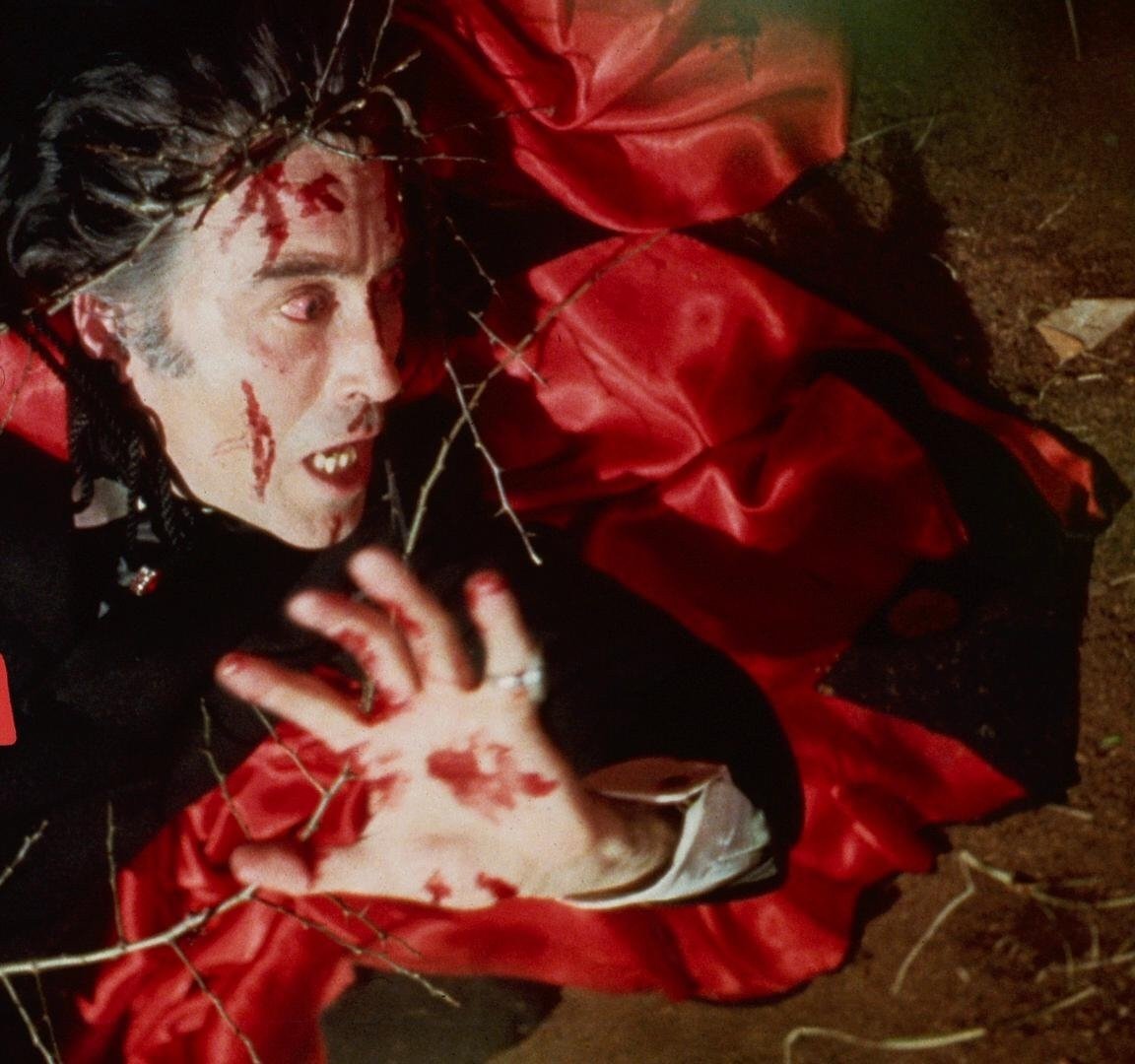
So, the ending — the famous ending, the one this film’s reputation hangs from. The Sabbath of the Undead collapses into fire and betrayal: the acolytes, who thought the plague a deterrent never to be used, baulk too late; Porter smashes the vial and takes the infection himself; Carradine and Freeborne run; and Dracula chases Van Helsing out into the grounds and straight into a hawthorn bush. Hawthorn — the wood of the crown of thorns, inimical to the undead in the old folklore — catches him, holds him, and an elderly professor finishes the King of Vampires with a fence post. Cue the jokes; they have been running for fifty years, and some of them are funny. But Harper will defend the bones of it. A Dracula who — on Van Helsing’s reading — wants to die should not fall to a silver bullet or a grand gesture. He should be brought down by an old man’s improvisation and a thorn bush in the dark — by the ordinary, holy, unglamorous world he was trying to leave. It plays as bathos because the film around it is too threadbare to sell it, not because the idea is wrong. And then Van Helsing picks the Count’s ring out of the ashes, the ring that opened the saga in 1958, and the circle — the devil’s and Hammer’s both — closes.
Trivia
- Lee killed the title. The film shot as Dracula Is Dead… and Well and Living in London — a play on the Jacques Brel revue — until Christopher Lee detonated at the announcement press conference, calling it “fatuous, pointless, absurd” and himself an actor “doing it under protest.” The title was changed before release. France kept the joke: there it played as Dracula vit toujours à Londres, “Dracula Is Still Living in London.”
- Fifteen years to the day. Shooting wrapped on January 3, 1973 — exactly fifteen years after Hammer’s first Dracula (1958) finished shooting, per film historian Jonathan Rigby. The saga’s first and last Lee productions are bookended by the same calendar date.
- The empty photograph is the plot in one image. Dracula casts no photographic image, so the dead agent’s fifth frame — a doorway with nobody in it — is a portrait of the Count. It is also how Van Helsing knows London’s least-photographed developer and the King of Vampires are the same man.
- The tower stands on the grave. Denham’s headquarters rise on the site of St Bartolph’s churchyard — the ruined church where Dracula died at the end of Dracula A.D. 1972. The Count built his empire directly over his own grave, which tells you everything about the film’s idea of him.
- First silver bullet. Van Helsing’s shot at Denham appears to be the first time a silver bullet was ever fired at a vampire on screen. Hammer’s only previous silver bullet had been cast from a melted cross and used on a werewolf, in The Curse of the Werewolf (1961). It does not save him here — the bullet fails, and the hawthorn does the work.
- America shelved it for five years. Warner Bros., which had commissioned the film, declined to release it in the United States at all. It finally surfaced there in 1978 through a small independent, Dynamite Entertainment, in a cut-down version retitled Count Dracula and His Vampire Bride — singular, and a lie: there is no bride in it. Jessica is the intended consort, and she is never turned.
- The bargain-bin afterlife. The shoestring American release meant the film spent decades turning up on cheap public-domain-style DVDs and multi-film sets — the murky route by which much of its audience found it. The first authorised American Blu-ray was the Warner Archive Collection release of 2018.
- The censors trimmed the rites. The BBFC passed the film with an X certificate for British cinemas only after ordering cuts — shortening the opening sacrifice sequence, two stakings and an electrocution. The version British audiences saw in 1974 was not quite the film Hammer delivered.
- Two Richards, one trap. Colonel Mathews, the Secret Service chief, is played by Richard Vernon; John Porter, the minister, is played by Richard Mathews. Two actors, two near-identical names, one film — listings have been fusing them into a single person ever since. Check the spelling before you credit either.
- The last dance. This is the third and final film to set Lee’s Dracula against Cushing’s Van Helsing (after 1958 and 1972), and the last Hammer film the two men made together. Cushing played a Van Helsing once more, in The Legend of the 7 Golden Vampires (1974); Lee’s Count stayed in the ground.
Where to Watch
As of November 9, 2026, in the US: The Satanic Rites of Dracula streams by subscription on Amazon Prime Video and Screambox, and free with ads on Tubi. You can rent or buy it on Amazon Video, Apple TV Store and Fandango At Home. Collectors: the Warner Archive Blu-ray is the edition to own — decades of bargain-bin discs did this film no favours. Streaming availability can change.
The Verdict
So no, fiends, The Satanic Rites of Dracula is not a good film, exactly. But it is a final one in a way few series ever manage — the monster tired of the game, the hunter tired of the chase, and the studio that made them both quietly closing the door behind them. Watch it with its predecessor, forgive the thorn bush, and stay for the boardroom. That scene is the obituary Hammer’s Dracula deserved.
Rating: 2.5 ravens out of 5.
The weekly roundup
One letter a week, from the crypt.
- New reviews, with the ravens
- New wiki entries and news
- Cool stuff worth your night
Weekly. No spam, unsubscribe in one click.