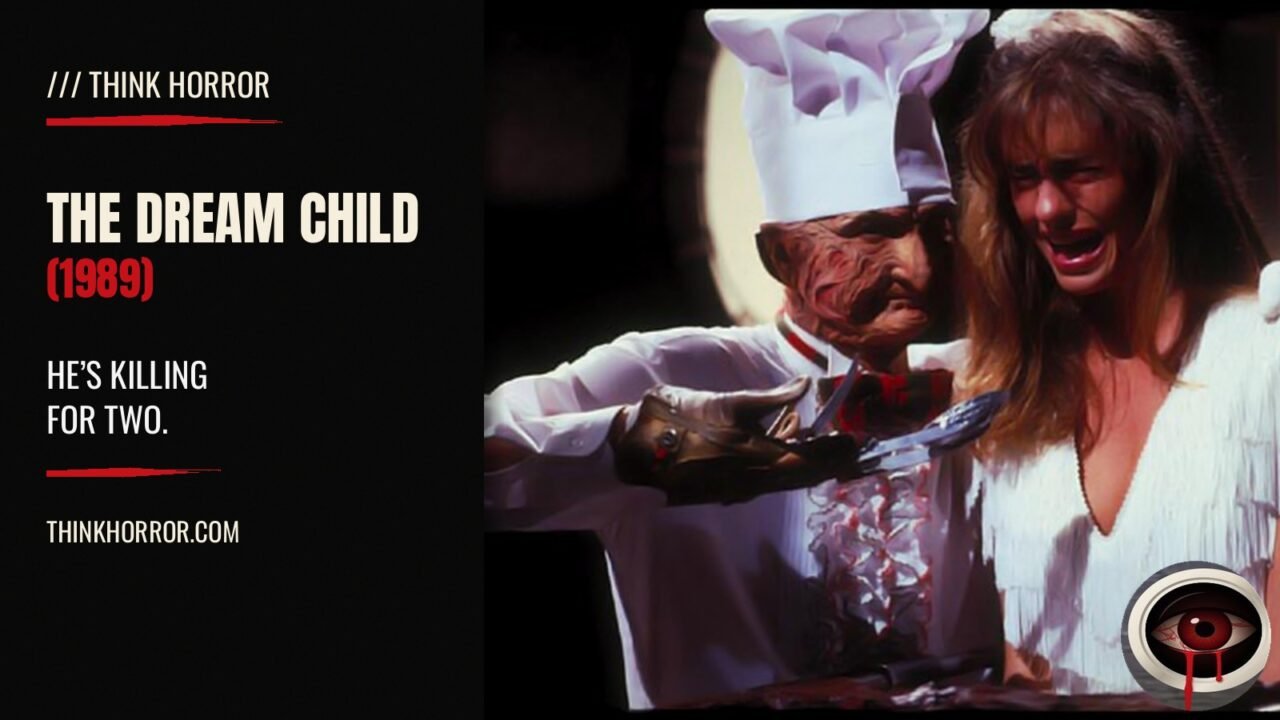
The name tag on your habit is not your name. It reads AMANDA, in a hand you do not recognize, pinned to a nun’s white you do not remember putting on — and the ward around you is not a ward so much as a held breath: a tower full of the criminally insane, a hundred of them, watching you the way weather watches a coastline. You know this place. You have never been here. The girl whose eyes you are borrowing survived Freddy Krueger a year ago by learning to pull dreamers out of the dark, and now the dark has found somewhere softer to stand — because you are not the only one dreaming in this body, fiend. There is a second sleeper aboard you now, small as a secret, dreaming his unborn dreams on a schedule no alarm clock governs. And something with a burned face and a patient smile has just moved into his room.
A Nightmare on Elm Street 5: The Dream Child (1989) is the sequel in which Freddy returns through the dreams of Alice Johnson’s unborn son.
A year after Alice Johnson beat Freddy in a ruined church and walked out of The Dream Master with her life and her boyfriend Dan beside her, the conveyor belt of Elm Street delivered its fastest sequel: Part 4 opened in August 1988, and The Dream Child opened in August 1989, shot while its script was still being rewritten, for a budget its own producer put at eight million dollars (the databases and Robert Englund’s memoir both say six). It took $22,168,359 — a steep fall from Dream Master’s forty-nine million, though still enough to make it the highest-grossing slasher of its year. The MPAA first rated it X. Its own director would later call the finished film an embarrassment he cannot watch. And yet. Inside the rush and the censorship and the convoluted mythology sits the series’ most Gothic entry, its most sincere heroine, and a handful of dream sequences as inventive as anything Elm Street ever produced. Harper has a soft spot for this bruised little picture, and Harper intends to defend the soft spot honestly — wobble and all.
The premise is the darkest the series ever dared. Alice is pregnant. A fetus dreams — in the womb, on nobody’s schedule — and Freddy, destroyed a year ago, has found in Jacob’s sleeping mind a door that stands open while Alice is wide awake. Worse, he is feeding the boy: soul after soul of Alice’s murdered friends, injected into the child to remake him as Freddy’s own. To stop it, Alice must fight on two fronts — protect a son who has become the enemy’s nursery, and free the one spirit who might fight Freddy on his own ground: his mother, Amanda Krueger, the nun whose unrecovered remains lie hidden somewhere in the asylum tower where her son was conceived in horror. It is a lot of mythology for one sequel to carry. Sometimes it carries it beautifully. Sometimes it carries it the way a man carries a piano downstairs. Both are in this review.

Quick Specs
- Director: Stephen Hopkins
- Screenplay: Leslie Bohem
- Starring: Lisa Wilcox (Alice Johnson), Robert Englund (Freddy Krueger), Danny Hassel (Dan Jordan), Kelly Jo Minter (Yvonne Miller), Erika Anderson (Greta Gibson), Joe Seely (Mark Gray), Whit Hertford (Jacob), Beatrice Boepple (Amanda Krueger)
- Music: Jay Ferguson
- Cinematography: Peter Levy
- Editor: Chuck Weiss and Brent A. Schoenfeld
- Producers: Robert Shaye and Rupert Harvey
- Production Company: New Line Cinema, Heron Communications and Smart Egg Pictures
- Distributor: New Line Cinema
- Released: August 11, 1989
- Runtime: 89 minutes
- Rating: R
- Budget: $8 million (Shaye’s figure; The Numbers lists $6 million)
- Box Office: $22,168,359 (all domestic; no separate international figure published)
- On This Site: A Nightmare on Elm Street 5: The Dream Child in the wiki · Freddy Krueger · Robert Englund
The Review
Begin with what the film gets right, because it gets the most important thing right: Lisa Wilcox. Alice Johnson is the only heroine Elm Street ever kept — Nancy went home after one sequel’s absence; Alice headlines two films running — and Wilcox plays her second outing as a woman, not a girl: graduated, in love, pregnant, and deciding for herself, against Dan’s frightened parents and their custody threats, that this child is hers and she is keeping him. The film was picketed for that decision by people who read it as propaganda; executive producer Sara Risher insisted it was not a political movie, and on screen it does not play as one — it plays as a mother’s arithmetic, the same arithmetic that powered Freddy’s Revenge. Wilcox’s name was accidentally left off the end credits of her own film. Remember it anyway. She is the reason the picture has a heart to break.
Around her, director Stephen Hopkins — hired fast off Part 4’s success, a storyboard artist of real gifts — set out to make Freddy “less jokey and more brutal,” and the look obeys him: where Dream Master was MTV gloss, The Dream Child is blue-filtered Gothic, all asylum stone and cathedral shadow. The dream setpieces are the series’ most ambitious since Craven’s original. An M. C. Escher staircase sequence that Englund signed on for the moment Hopkins sketched it on a napkin. A comic-book world rendered in black and white, where Freddy counters a boy’s paper hero by becoming Super Freddy and reducing the artist to a cut-out to be shredded. A motorcycle that fuses with its rider. A baby Freddy, remote-controlled puppetry from David Miller — the original 1984 makeup designer, back after three films away, restoring the witch-nosed, sinister Freddy of the first picture. Variety called the film “a poorly constructed special effects showcase” and then admitted the showcase was its saving grace. Both halves of that sentence are true, and the second half is the one audiences kept.
Now the wobble, and it is considerable. The script was not finished when the cameras rolled — it was being rewritten during the shoot, actors stopped memorizing lines that changed overnight, and the production reached its ending before the script had one; the climax was devised at the last minute, with Miller recalled under a new contract to build it. You can feel all of that in the middle hour: the Amanda quest, the asylum lore, the soul-feeding mechanics arrive in armfuls of exposition, and the film keeps stopping to explain itself when it should be dreaming. And then there is the censorship. The MPAA’s first verdict was an X, and the R was bought with scissors: Dan’s transformation, Greta’s force-feeding, Mark’s paper death were all shortened — Greta’s scene, the film’s most vicious piece of social horror (a model mother, a dining table, a laughing room), most cruelly. The uncut version lived on VHS and Laserdisc while DVD and Blu-ray kept the trimmed cut for decades; only the 2025 4K collection finally put both versions on disc. Hopkins’ own verdict, a year later, is the saddest line in the franchise’s record: what started as an OK film “turned into a total embarrassment. I can’t even watch it anymore.” He is too hard on it. But he is not inventing the wounds.
So the ledger, plainly. What works: Wilcox, carrying the series’ only continuing heroine with complete sincerity; the Gothic ambition — Escher stairs, comic-book paper worlds, an asylum tower out of a Hammer film; Miller’s restored Freddy, the least jokey the character had been since 1984; and a premise with real darkness in it, Freddy smuggled into the world through a child’s dreams. What doesn’t: a script finished in public, lurching between mythology lectures; the censor’s scissors in exactly the scenes built to disturb; Freddy still quipping against his director’s stated aim; and a conveyor-belt schedule that left the whole picture — released eleven months after its predecessor — looking hurried in its connective tissue even when its setpieces gleam.
Spoiler Section
Spoilers settle here, fiends — the ending is discussed plainly.
The kills fall like dominoes off Alice’s shrinking circle. Dan first: asleep at the wheel, tormented through a talk-radio call-in, pinned by his own seat belts, then mounted on a motorcycle that grows cables and chrome and fuses into his body before he wakes an instant before the Mack truck. Then Greta, at her mother’s formal table, nodding off into a dream where Freddy force-feeds her until she chokes before a laughing audience — and falls dead at the real table, her dream-cheeks grotesquely swollen. Then Mark, the comic artist, pulled into his own black-and-white panels, fighting bravely as his drawn hero until Freddy goes Super and shreds the boy’s paper self to confetti. Yvonne, the skeptic, nearly follows — a diving platform that becomes a claw, a pool drained to a steaming tank — but Alice pulls her out, and belief finally cracks the group’s last doubter open. It is Yvonne, in the waking world, who finds Amanda Krueger’s hidden remains in the asylum tower and frees her spirit into the fight.
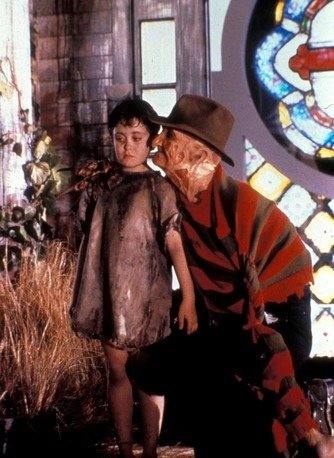
The climax is a custody battle fought inside a body. Alice draws Freddy out of herself — he has been hiding in her every time she slept — and Amanda, freed at last, urges Jacob to turn the power Freddy has been feeding him back on its maker. The child does. Jacob unmakes Freddy; the infant Freddy-form is absorbed back into Amanda, and baby Jacob is returned to Alice; Amanda seals her son away in time itself, with a warning to Alice as the door closes. Months later: a picnic, dull and sunlit and earned — Alice, her father Dennis, Yvonne, and baby Jacob Daniel Johnson. And nearby, children at a jump rope, humming a certain rhyme about never sleeping again. Elm Street always keeps a window open. But for once, fiends, the family in the foreground gets to finish its picnic first.
Trivia
- This film is a rejected sequel’s revenge. Screenwriter Leslie Bohem first pitched Freddy possessing an unborn child as the plot for Part 2 in 1985; New Line passed, partly because executive Sara Risher was pregnant and found it disturbing. Four years later the producers returned to Bohem’s pitch — with Risher herself championing the pregnancy storyline — and it became The Dream Child.
- Lisa Wilcox is billed first in the opening credits — and her name was accidentally omitted from the end credits entirely. The film’s own paperwork forgot its heroine; the audience did not.
- Whit Hertford was eleven years old when cast as Jacob, and as a minor was not permitted to deliver his scripted line to Freddy: “Fuck you, Krueger.” He won a Young Artist Award for the performance regardless.
- David Miller, who designed Freddy’s makeup for the 1984 original and disliked the more comical turn it took in his absence, returned for this film on the condition he could move Freddy back toward the original look — older, more sinister, hooked nose. Application took four hours; removal took two.
- The film placed two songs in the same Worst Original Song race at the Golden Raspberry Awards: Kool Moe Dee’s “Let’s Go” was nominated, and Bruce Dickinson’s “Bring Your Daughter… to the Slaughter” won. Dickinson’s song then became Iron Maiden’s only UK number one single when the band re-recorded it — chart-topping on January 5, 1991.
- Every writer who tried this script independently invented a comic-book sequence — John Skipp, Craig Spector and Bohem all arrived at it separately. Larry Wilson had used the same idea in a rejected Beetlejuice sequel draft and let Bohem have it rather than waste it.
- Check the storyboard credits: among the artists are Peter Ramsey and David Lowery — later the directors of Spider-Man: Into the Spider-Verse and The Green Knight. Elm Street’s dream factory employed the future before it was famous.
- The on-screen main title omits the number. The film itself is titled simply A Nightmare on Elm Street: The Dream Child; the famous “5” exists only in the marketing, trailers and merchandise.
Where to Watch
As of November 10, 2026, in the US: A Nightmare on Elm Street 5: The Dream Child streams on AMC+. Rent or buy it on Amazon Prime Video, Apple TV Store, Google Play and Fandango At Home — note that the digital edition sold is the uncut version, and Warner’s seven-film 4K collection (2025) carries both the theatrical and uncut cuts on disc. Listings rotate — check before you settle in.
The Verdict
Rating: 2.5 ravens out of 5.
Two and a half ravens — the rushed, censored, strangely soulful middle child. The Dream Child was written while it was shot, cut by the ratings board in its cruelest scenes, and disowned by its own director — and it still contains an Escher staircase, a paper boy, the series’ most Gothic photography, and Lisa Wilcox giving Alice Johnson the dignity of a complete story. It is not the sequel Elm Street deserved in 1989. It is better than the embarrassment its maker named it. Watch it uncut, fiends, the way it was shot — and spare a thought for the baby in the middle of the war, who never asked to dream for two.
The weekly roundup
One letter a week, from the crypt.
- New reviews, with the ravens
- New wiki entries and news
- Cool stuff worth your night
Weekly. No spam, unsubscribe in one click.