
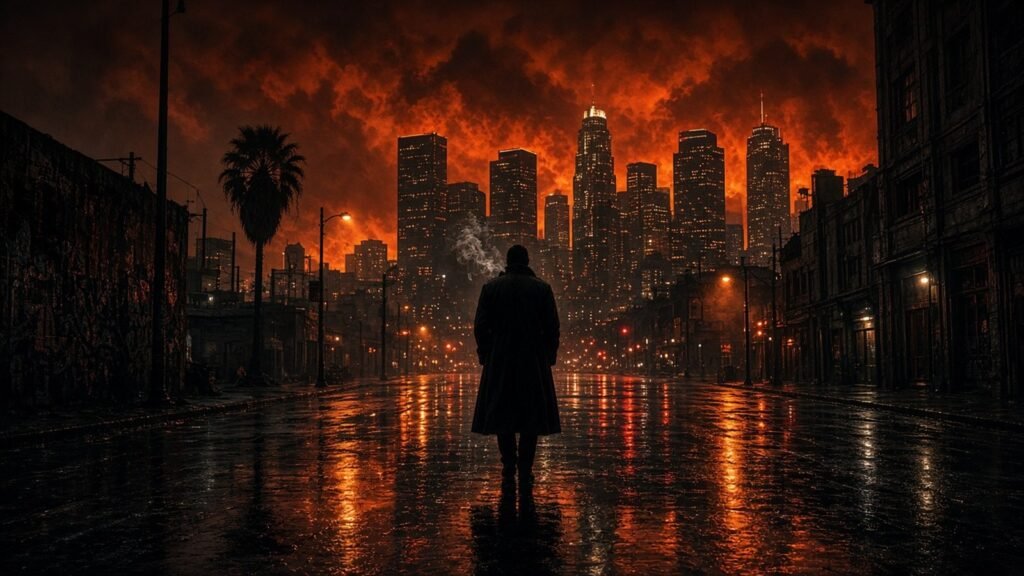
Constantine (2005) is Francis Lawrence’s supernatural horror film starring Keanu Reeves as John Constantine, the exorcist of DC’s Hellblazer comics.
John Constantine can see what the rest of us cannot: the half-angels and half-demons walking the streets of Los Angeles in human skin. He has seen them since he was a child, it drove him to try to kill himself as a teenager, and that sin has already damned him. Now he is dying of lung cancer, deporting Hell’s rule-breakers in the hope that Heaven will take notice. Constantine was Francis Lawrence’s first feature, an R-rated, theologically serious horror film wearing a DC comic as its passport, and it gave Keanu Reeves his defining horror role between The Matrix and John Wick. Reviews were mixed. The cult that grew afterwards has been strong enough to pull a sequel into development seventeen years later.
At a glance
| Director | Francis Lawrence |
| Screenplay | Kevin Brodbin and Frank Cappello |
| Story | Kevin Brodbin |
| Based on | Hellblazer by Jamie Delano and Garth Ennis (DC and Vertigo); the character was created by Alan Moore, who declined credit |
| Producers | Lauren Shuler Donner, Benjamin Melniker, Michael E. Uslan, Erwin Stoff, Lorenzo di Bonaventura, Akiva Goldsman |
| Starring | Keanu Reeves, Rachel Weisz, Shia LaBeouf, Tilda Swinton, Pruitt Taylor Vince, Djimon Hounsou, Gavin Rossdale, Peter Stormare |
| Cinematography | Philippe Rousselot |
| Editing | Wayne Wahrman |
| Music | Brian Tyler and Klaus Badelt |
| Special makeup effects | Stan Winston studio |
| Production companies | Warner Bros. Pictures, Village Roadshow Pictures, Batfilm Productions, The Donners’ Company, Weed Road Pictures, 3 Arts Entertainment |
| Distributor | Warner Bros. Pictures |
| Premiere | February 7, 2005 (Paris) |
| Release date | February 18, 2005 (United States) |
| Running time | 121 minutes |
| Rating | R |
| Budget | reported between $70 million and $100 million (commonly cited as $100 million) |
| Box office | $230,884,728 worldwide |
Plot
In Mexico, a scavenger named Manuel finds the tip of the Spear of Destiny, the spear that pierced Christ, wrapped in a Nazi flag. Possessed by it, he starts walking to Los Angeles.
In Los Angeles, the exorcist John Constantine casts a demon out of a young girl and watches it try to claw its way through her into the world. That should be impossible. Under the treaty between Heaven and Hell, angels and demons may influence Earth only through half-breeds and never cross over in person.
Constantine is dying of terminal lung cancer. As a teenager, tormented by the sight of half-angels and half-demons in their true forms, he killed himself; he was clinically dead and revived, and because suicide is a mortal sin he knows his soul belongs to Hell the moment he dies. He petitions the half-breed archangel Gabriel for more life in exchange for his work. Gabriel refuses: good deeds done for selfish reasons buy nothing.
LAPD detective Angela Dodson refuses to believe that her devout twin, Isabel, held in a psychiatric hospital, killed herself and damned her soul. On the security footage, Isabel whispers “Constantine” before she jumps. He turns the case down until demons attack Angela in the street. Then, with a ritual involving a cat and a bathtub of water, the film’s near-death machinery, he looks into Hell and confirms that Isabel is there.
Constantine’s ally Father Hennessy finds a symbol burned into Isabel’s wrist at the morgue and is murdered by the half-breed demon Balthazar, having first carved the symbol into his own palm so that Constantine would find it. Another ally, Beeman, decodes it before Balthazar kills him too. The symbol belongs to Mammon, Lucifer’s son, and a chapter of Hell’s Bible foretells Mammon crossing over to rule the Earth. He needs a powerful psychic as his vessel and divine assistance to be born. Isabel, a psychic who never buried her gift, killed herself to deny him her body.
Angela confesses that she had the same gift and repressed it. Constantine drowns her briefly to reawaken it, she locates Balthazar, and Constantine beats the truth out of him: the blood of Christ on the spear tip is the divine assistance, and Angela is Mammon’s chosen host. An unseen force vaporises Balthazar and takes her.
With the reluctant help of Papa Midnite, whose club is neutral ground, Constantine tracks Angela to the psychiatric hospital. He and his apprentice and driver, Chas Kramer, fight through the possessed with blessed weaponry and appear to drive Mammon out of her.
The ending
The unseen force is Gabriel. Embittered by God’s forgiveness of unworthy humanity, Gabriel means to loose Mammon and Hell on Earth so that the survivors will become worthy. Gabriel kills Chas with a gesture and prepares to stab Angela with the spear tip to birth Mammon.
Outmatched, Constantine slits his wrists, knowing that Lucifer will come in person for the one soul he wants most. Time stops. Lucifer, played by Peter Stormare in a stained white suit, dripping tar, hears the terms: stop Mammon, and Gabriel’s treason is exposed. Lucifer drags Mammon back to Hell and burns away Gabriel’s wings, leaving Gabriel mortal. Owing Constantine a favour, he offers any price, and Constantine asks not for his own life but for Isabel’s soul to be released to Heaven.
Lucifer grants it, then tries to drag Constantine below and finds that the selfless act has redeemed him. Constantine begins to ascend, and on the way up he gives Lucifer the middle finger. Furious at being cheated, Lucifer restores him to life and tears the cancer out of him, betting that he will damn himself again in time. Unlike the comics, Constantine does not trick the Devil here; Lucifer acts openly, on a wager.
Constantine lands one punch on the now-mortal Gabriel and leaves the spear tip with Angela to hide. In a post-credits scene, visiting Chas’s grave, he sees Chas risen as an angel, who smiles and flies away.
Cast
- Keanu Reeves as John Constantine
- Rachel Weisz as Angela Dodson and her twin sister, Isabel Dodson, and as Mammon when Angela is possessed
- Shia LaBeouf as Chas Kramer
- Tilda Swinton as Gabriel
- Pruitt Taylor Vince as Father Hennessy
- Djimon Hounsou as Papa Midnite
- Gavin Rossdale as Balthazar
- Peter Stormare as Lucifer
- Max Baker as Beeman
- Francis Guinan as Father Garret
- José Zúñiga as Detective Weiss
- Jesse Ramirez as Manuel
- Michelle Monaghan as Ellie, a half-breed demon whose role was cut to two brief shots and one line
The comics and the changes
John Constantine was created by Alan Moore and introduced in The Saga of the Swamp Thing #37 in June 1985, drawn to resemble Sting. His own series, Hellblazer, followed in 1988 from DC, later under the Vertigo label, built chiefly by Jamie Delano and then Garth Ennis. Ennis’s “Dangerous Habits” arc, issues #41 to #46, supplies the film’s lung-cancer spine, and the Original Sins material supplies Papa Midnite.
The film is credited as based on Hellblazer by Delano and Ennis. Moore, disappointed by the adaptations of From Hell and The League of Extraordinary Gentlemen, refused to be credited or associated with it and asked that his royalties be distributed among the character’s other creators.
The film’s Constantine is deliberately not the comics’ man. The comics’ Constantine is a blond, working-class Liverpool magus in a trench coat, damned by a botched summoning in Newcastle. The film moves him to Los Angeles, gives him Reeves’ own dark hair and Canadian accent, and invents the half-breed sight and the suicide damnation. It also softens the cancer resolution: in the film Lucifer chooses to save him as a bet on his future damnation, rather than being tricked as in Ennis’s arc. What survives is the silhouette: the rumpled suit, the trench coat and the chain-smoking.
The title has its own knot. The film was developed as Hellblazer and retitled Constantine to avoid confusion with Hellraiser, and that confusion had roots: the comic itself was nearly titled Hellraiser before Clive Barker’s 1987 film took the name, a year before the comic debuted.
Production
Producer Lauren Shuler Donner began developing the property in 1997. Paul Hunter was attached to direct in 1999. Tarsem Singh replaced him in 2001, with Nicolas Cage set to star and a shoot hoped for in 2002, and Singh’s exit produced lawsuits between him and Warner Bros. Francis Lawrence, a director of commercials and music videos, replaced him for his feature debut, and Keanu Reeves became attached in 2002.
Lawrence designed Hell as a parallel, blasted version of the geography around the characters, “the same place, in eternal nuclear blast,” in his words. Developed with the visual-effects supervisor and the production designer from 1940s nuclear-test footage, it is a wind-scoured double of Los Angeles where nothing ever finishes being destroyed, and Lawrence has described it as the concept that organised the whole production. Stan Winston’s studio supplied the special makeup effects.
The film was intended as a PG-13 and received an R, which Lawrence attributed to its religious content. Michelle Monaghan’s half-breed Ellie was filmed extensively and then cut to two brief shots and a single line; Lawrence said the relationship was removed to make Constantine lonelier.
Release and box office
Constantine premiered in Paris on February 7, 2005, and opened wide in the United States on February 18, 2005, through Warner Bros., after a move from an original release date of September 17, 2004.
It opened with $29,769,098 from 3,006 theatres, second for the weekend behind the second weekend of Hitch, and its original run ended on June 16, 2005. It grossed $75,976,178 in North America and $154,908,550 elsewhere, for $230,884,728 worldwide. Box-office trackers split on the international total: a second tracker’s territory sum comes to $221,593,554, about $9.3 million lower, while both agree exactly on North America’s $75,976,178. Against a reported cost of $70 million to $100 million, the film was a respectable performer rather than a breakout, and neither a flop nor a blockbuster.
A 20th-anniversary 4K UHD Blu-ray followed on February 18, 2025.
Reception and afterlife
Reviews were mixed. On Rotten Tomatoes, 46 percent of 227 critics gave it a positive review, with an average rating of 5.5 out of 10, and the consensus reads: “Despite solid production values and an intriguing premise, Constantine lacks the focus of another spiritual shoot-em-up, The Matrix.”
The reassessment came slowly. Over two decades the film gathered a cult following, and the elements retrospectives single out are Stan Winston’s makeup effects, Tilda Swinton’s Gabriel and Peter Stormare’s single-scene Lucifer, one of the screen’s great Devil cameos. Released months before Batman Begins and three years before the Marvel Cinematic Universe began, it is now cited as the test case for what comic-book filmmaking could risk before the shared universes arrived.
The sequel is the cult’s proof. In September 2022 Deadline reported that Reeves would return with Lawrence directing and Akiva Goldsman writing and producing, under DC’s Elseworlds banner outside the main DC continuity. The 2023 strikes slowed it. In early 2025 Reeves said he and Lawrence had pitched a story to DC Studios and been approved to write the script, promising that “John Constantine’s going to be tortured even more.” In October 2025 he said, “Another draft of the script came in. We’re gonna take it to the studio and hopefully they like it too.” As of October 2026 it remains in development at the script stage, with no release date.
Trivia
- Chas’s surname in the film is Kramer. In the comics he is Chas Chandler.
- Two of the film’s most memorable songs are not on the soundtrack album: A Perfect Circle’s “Passive,” heard in Midnite’s bar, and the Dave Brubeck Quartet’s “Take Five,” on Constantine’s record player.
- Constantine’s kit is a sacrament box with a body count: blessed brass knuckles inscribed with crosses, a cross-shaped shotgun, gold bullets, holy-water ampoules, dragon’s breath and a screeching beetle in a matchbox.
- The score album by Brian Tyler and Klaus Badelt was released on February 15, 2005, three days before the film.