
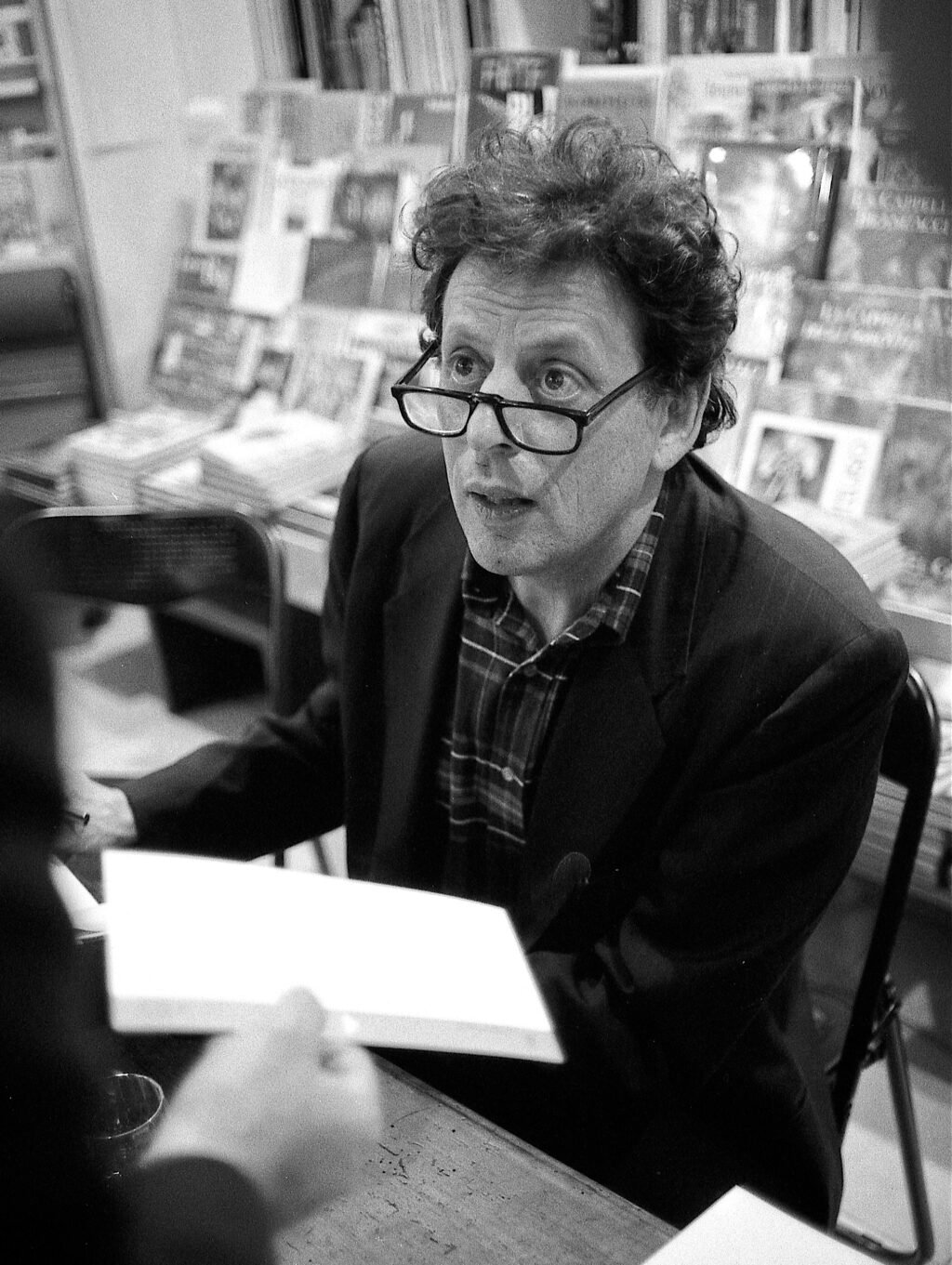
Philip Glass is the American composer whose repetitive-structure scores — above all Candyman’s organ-and-chorus liturgy — rewired horror film music.
He is the composer horror fans know best for a sound that refuses to behave like a horror score: no stingers, no stabbing strings, just pipe organ, wordless chorus and a music-box lullaby turning a Chicago housing project into a cathedral of dread. That refusal was the method of his whole career. Glass never accepted the word the world pinned on him — the style was dubbed “minimalism” by others; he preferred to call his work “music with repetitive structures,” and the distinction matters, because the operas, symphonies and film scores that followed the label’s early years left it far behind. He built the infrastructure to survive the industry’s indifference — his own ensemble, his own publisher, his own labels — and he drove a New York taxi past the premiere of the opera that made him famous. At 89, he is still composing. This is the record, credit by credit, because with Glass the credits are where the misunderstandings live.
Quick Specs
- Born: 31 January 1937, Baltimore, Maryland
- Education: University of Chicago — mathematics and philosophy; the Juilliard School
- Known for: Candyman (1992), the Dracula re-score (1999), Koyaanisqatsi (1982), Einstein on the Beach (1976)
- Honours: Three Academy Award nominations for Best Original Score (Kundun, The Hours, Notes on a Scandal); BAFTA winner, The Hours; Golden Globe winner with Burkhard Dallwitz, The Truman Show
The Record Store
Glass was born in Baltimore to Benjamin Glass, who owned a record store and repaired radios, and Ida Glass, a librarian. The store was the education: his father brought home the records that had sold badly, to work out why they had not appealed — and the flops happened to be Beethoven quartets, Schubert sonatas, Shostakovich symphonies, Bartók and Hindemith. The boy was raised on the offbeat modern repertory before the standard classics. He began violin at six and flute at eight, studying flute at the Peabody Conservatory’s preparatory programme, entered the University of Chicago at fifteen to study mathematics and philosophy, and graduated in 1956, at nineteen. In New York he studied composition at the Juilliard School under William Bergsma and Vincent Persichetti — reference sources conflict on a graduation year, so this page prints none — studied analysis with Darius Milhaud at Aspen in 1960, and spent 1961 to 1963 composing for ensembles drawn from the Pittsburgh public schools on a Ford Foundation grant.
Paris changed the music. He studied for two years with the legendary pedagogue Nadia Boulanger, and earned money transcribing Ravi Shankar’s Indian music into Western notation for the film Chappaqua. The transcription kept breaking: Glass placed Western bar lines, the bar lines created false accents, and Shankar’s tabla player, Alla Rakha, kept correcting him — “all the notes are equal.” Glass erased the bar lines and saw the music as a steady stream of rhythmic pulses grouped in cycles. That additive, cyclical conception of rhythm — small cells added and subtracted inside large cycles — became the foundation of everything after. In 1966 he travelled to northern India, encountered Tibetan refugees, and absorbed the Hindu and Buddhist philosophy that would run through the work for decades.
The Cab Years
He returned to New York in 1967 and renounced his earlier compositions — some eighty pieces — to start again in the new language. Unable to get existing groups to play it, he formed his own: the Philip Glass Ensemble, founded in 1968, seven musicians on keyboards and woodwinds, amplified and fed through a mixer, with conductor and keyboardist Michael Riesman becoming its music director — the same Riesman who would conduct across Glass’s film scores. The summation of the first period, Music in Twelve Parts (1971–74), closed the severe early style. To fund it all, Glass worked as a plumber, a furniture mover and a taxi driver. He drove a cab from 1973 to 1978 — driving until one or two in the morning, writing music from about one to six, taking the children to school, sleeping until three — and did not compose full-time until 1978, at 41.
The breakthrough had already happened, and it had still left him in the cab. Einstein on the Beach (1976), his collaboration with director and designer Robert Wilson, is a roughly five-hour opera with no conventional plot and no intermission — audiences free to come and go — its text built from numbers, solfège syllables and spoken texts, organised in scenes and five intermezzos Wilson called knee plays. It premiered at the Avignon Festival in 1976 and toured Europe; then Glass and Wilson rented the Metropolitan Opera House themselves for two sold-out performances that November. Note the credit shape, because the record is often printed backwards: the Met did not commission or produce Einstein — the creators hired the hall. The sold-out houses still lost money, the production left them in debt, and Glass went back to driving the taxi. Einstein began the portrait-opera trilogy completed by Satyagraha (1980, on Gandhi) and Akhnaten (1983, on the Egyptian pharaoh). He also built the business to match: his music is published by Dunvagen Music Publishers, formed in 1977; he had earlier co-founded the Chatham Square label to get his own records pressed; and in 2002 he co-founded Orange Mountain Music, dedicated to his recording legacy.
Reggio, Schrader, Morris
Koyaanisqatsi (1982) is Godfrey Reggio’s film — a dialogue-free study of landscapes, cities and industry, its title a Hopi word for life out of balance — made with Glass, not merely scored by him. The two worked interactively over about three years: Glass wrote music to a cut, Reggio completely reassembled the images, and they recut and recomposed section by section until, in Glass’s account, the image and the music began to function organically together; the cinematographer was listening to the music while filming. It was Glass’s first major feature score, and it began the Qatsi trilogy, continued in Powaqqatsi (1988) and Naqoyqatsi (2002). The same year’s album Glassworks carried the sound beyond the loft audience.
For Paul Schrader’s Mishima: A Life in Four Chapters (1985), Glass wrote a mosaic score for a mosaic film: string-quartet music, performed by the Kronos Quartet, for the biographical strand; string orchestra and percussion for Mishima’s last day; fuller orchestral writing for the stylised dramatisations of the novels. Schrader’s brief was a score that would unite the film’s disparate elements and propel it forward. The quartet music afterwards became Glass’s String Quartet No. 3, “Mishima,” and Glass, Schrader and costume designer Eiko Ishioka shared the Best Artistic Contribution award at Cannes in 1985. Then came the documentary partnership: Errol Morris’s The Thin Blue Line (1988), the investigation of the Randall Adams murder case. Morris — himself a Juilliard-trained cellist — took the sheet music home to study and play at the piano, had very specific music in mind for each character, and put the score through rewrite after rewrite. “He will wait you out until he gets what he wants,” Glass said of him. The partnership continued through A Brief History of Time (1991) and The Fog of War (2003).
Candyman
Bernard Rose asked him in 1990. What sold Glass on Candyman (1992) was Rose’s earlier Paperhouse and Clive Barker’s story “The Forbidden” — a tale, as it was presented to him, of contemporary myth and psychological horror. Glass wrote what the production’s liner record calls a “gothic” score, for a fixed palette of piano, pipe organ and chorus — no traditional orchestra at all — conducted by Michael Riesman and produced by Glass with Kurt Munkacsi. Its main theme, “Music Box,” is a lullaby-like chime figure, soothing and unnerving at once. “Helen’s Theme,” for Virginia Madsen’s graduate student Helen Lyle, is a warmer solo-piano variation on the same melody — so Helen and Tony Todd’s Candyman share one melodic basis, enacting their link through time. The massed wordless choir over pipe organ in “Cabrini Green” gives Candyman a sacred, near-godlike presence, and the closing cue, “It Was Always You, Helen,” reprises the themes as the score’s tonal coda.
Then the film was taken away from its director. The producers and Barker became dissatisfied with Rose’s work — in the liner record’s account, probably because he was not creating enough overt gore — and relieved him of the job of finishing the film. The final version was a disappointment to Glass: he felt he had been manipulated, that what was presented to him as a low-budget independent project with creative integrity became a low-budget Hollywood slasher flick. The score went unreleased at the time — ambivalence about the film, disappointment with the experience, and too little music for a whole disc. The first album was The Music of Candyman in 2001, on Glass’s own Orange Mountain Music, joining the 1992 score with the sequel material; the first vinyl release followed in 2014. Glass is quoted in the film’s record with the later, wryer verdict: “It has become a classic, so I still make money from that score, get checks every year.”
The sequel ledger needs care, because it runs the opposite way to the usual assumption — film by film. Candyman: Farewell to the Flesh (1995), directed by Bill Condon, is credited “Music by Philip Glass”: Glass agreed to let the studio use his original score, producer Don Christensen remixed and edited the original cues into new ones, and Glass contributed four new cues to supplement them — a built-from-plus-new score, not a wholly new one and not mere reuse. Candyman 3: Day of the Dead (1999) contains no Glass music at all: composer Adam Gorgoni intended to use themes from the previous films, was not given permission to use any of Glass’s music, and wrote an entirely new score. And Candyman (2021), directed by Nia DaCosta, is scored by Robert Aiki Aubrey Lowe — who deliberately re-imagined Glass’s “Music Box” as an homage, Lowe’s own account of what he was doing. The theme’s presence across thirty years of the franchise is real; Glass’s authorship of each chapter is a different, checkable thing.
Dracula, and the Oscar Years
His second horror landmark is a re-voicing of the first one. Universal commissioned Glass to write a new original score for Tod Browning’s Dracula (1931) — the Bela Lugosi film, directed by Tod Browning, which had originally carried almost no music — for its Classic Monsters re-release on 31 August 1999. Glass scored it for string quartet, performed by the Kronos Quartet, joining on piano himself in live film performances. His stated reason is the whole method in one decision: “The film is considered a classic. I felt the score needed to evoke the feeling of the world of the 19th century — for that reason I decided a string quartet would be the most evocative and effective. I wanted to stay away from the obvious effects associated with horror films.”
The major-studio years brought the honours — and the honours need the same credit discipline as the sequels. The ledger, exactly: three Academy Award nominations for Best Original Score, and no wins — Kundun (1997), Martin Scorsese’s film of the young Dalai Lama, its cyclical score coloured by the Tibetan engagement that began with those refugees in 1966; The Hours (2002), Stephen Daldry’s film, where a piano-led score — Michael Riesman at the piano, the Lyric Quartet, orchestra conducted by Nick Ingman — is the single musical approach binding three intercut time periods, and which won Glass the BAFTA for Best Film Music; and Notes on a Scandal (2006), Richard Eyre’s film, one of his darkest scores, built relentlessly to enforce the story as seen through Barbara Covett’s eyes, which was Eyre’s stated brief. Separately, and never merged into the Oscar ledger: The Truman Show (1998) is principally Burkhard Dallwitz’s score — Glass contributed original tracks and pre-existing music drawn from Powaqqatsi, Anima Mundi and Mishima, and appears briefly on screen at the piano — and its Golden Globe for Best Original Score was won jointly by Dallwitz and Glass. His official biography currently counts more than thirty operas, fourteen symphonies, thirteen concertos and nine string quartets alongside the film work — a count dated to that biography, in a career still adding to it.
Why He Matters
Glass’s film method was a refusal from the start: where a Bernard Herrmann crowds the viewer with emotional instruction — foreboding, fear, joy — Glass kept his distance, making the music structural rather than decorative. That distance is exactly what makes Candyman frightening: a beautiful, sacred score that declines to tell the audience when to jump, treating its monster as a god and its heroine as the figure in a tragic myth. Between the Dracula re-score — a prestige composer re-voicing the founding Universal horror film while explicitly refusing horror’s obvious effects — and Candyman’s liturgy, Glass proved horror could carry the full weight of concert-hall music without losing its dread. Beyond horror, Koyaanisqatsi made image and music equal partners, The Thin Blue Line brought the composed auteur score into documentary, and the repetitive-structures language he insisted on naming himself became one of the most influential musical languages of the last fifty years — built by a man who formed his own ensemble because no one else would play his work, and who went back to the taxi after selling out the Met.
Keep it locked on Think Horror — and say his name five times, fiends.